What does an acquisition analyst do?
An acquisition analyst specializes in performing research and analysis to determine the feasibility and advantages of a company acquisition or merger. Their responsibilities revolve around coordinating with different departments to gather necessary data, assess risks and potential legal roadblocks, and analyze the impact of a business merger on the quality of services and client satisfaction. Moreover, an acquisition analyst may perform clerical tasks such as processing documentation, producing progress reports, managing schedules, distributing information materials, and maintaining extensive records.
Acquisition analyst responsibilities
Here are examples of responsibilities from real acquisition analyst resumes:
- Update and manage agencies contract portfolio on SharePoint, providing greater visibility and transparency of contracts award.
- Assist customer in developing PWS to repair/resolve issues on custom build Bradley transmission test stand.
- Administer and maintain a secure SharePoint site for all source selection documentation.
- Develop, collect, disseminate and coordinate potential new business opportunities informational across the PEO.
- Develop and present key acquisition and logistics project documentation and information, including progress reports and dependencies.
- Prepare materials for equity offering and financial advisory presentations, confidential selling memorandums, and internal presentations.
- Ensure timely resolution of action items, analyze logistics requirements, and develop logistics initiatives for anticipate program development.
- Submit written transaction memorandums and analysis to corporate asset management committee for approval to purchase new land in Maryland.
- Perform all aspects of analysis including data acquisition and manipulation, programming, data visualization, and presentation of results.
- Participate in the full development life cycle from developing business intelligence requirements to QA and production deployment.
Acquisition analyst skills and personality traits
We calculated that 7% of Acquisition Analysts are proficient in DOD, Program Management, and PowerPoint. They’re also known for soft skills such as Computer skills, Detail oriented, and Math skills.
We break down the percentage of Acquisition Analysts that have these skills listed on their resume here:
- DOD, 7%
Analyzed and evaluated acquisition requirements utilizing a thorough understanding of all aspects of the DoD acquisition process.
- Program Management, 7%
Served in a staff capacity providing program management officials with evaluative material needed to plan and monitor execution of the program.
- PowerPoint, 6%
Produced QER briefs for high level officials on the Washington Navy Yard using Microsoft PowerPoint and Excel.
- Acquisition Process, 5%
Applied knowledge of the defense acquisition/procurement process to support customers in the analysis and improvement of acquisition process policy and procedures.
- Market Research, 5%
Developed and presented Professional Development briefings on - Market Research, Materiel Release, and Documentation Management.
- Real Estate, 4%
Performed property appraisals, investment analysis, negotiation and acquisition support for office and industrial commercial real estate private equity investment.
Common skills that an acquisition analyst uses to do their job include "dod," "program management," and "powerpoint." You can find details on the most important acquisition analyst responsibilities below.
Computer skills. The most essential soft skill for an acquisition analyst to carry out their responsibilities is computer skills. This skill is important for the role because "financial analysts must be adept at using software to analyze financial data and trends, create portfolios, and make forecasts." Additionally, an acquisition analyst resume shows how their duties depend on computer skills: "managed the asset database ensuring that all end-of-lease computers were properly prepared for release to the receiving vendor. "
Detail oriented. Another soft skill that's essential for fulfilling acquisition analyst duties is detail oriented. The role rewards competence in this skill because "financial analysts must pay attention when reviewing a possible investment, as even small issues may have large implications for its health." According to an acquisition analyst resume, here's how acquisition analysts can utilize detail oriented in their job responsibilities: "draft procurement initiation documentation (request memoranda, statement of work/detailed specs/statement of objectives, justifications, market research checklists). "
Math skills. Another skill that relates to the job responsibilities of acquisition analysts is math skills. This skill is critical to many everyday acquisition analyst duties, as "financial analysts use mathematics to estimate the value of financial securities." This example from a resume shows how this skill is used: "performed qualitative, quantitative, and financial analysis of contract delivery and task orders. "
Analytical skills. acquisition analyst responsibilities often require "analytical skills." The duties that rely on this skill are shown by the fact that "financial analysts must evaluate a range of information in finding profitable investments." This resume example shows what acquisition analysts do with analytical skills on a typical day: "conducted market research and competitive analysis, heavy online research. "
Communication skills. Another crucial skill for an acquisition analyst to carry out their responsibilities is "communication skills." A big part of what acquisition analysts relies on this skill, since "financial analysts must be able to clearly explain their recommendations to clients." How this skill relates to acquisition analyst duties can be seen in an example from an acquisition analyst resume snippet: "developed and maintained business case, program charter, program management plan, communications plan and lifecycle sustainment plan. "
The three companies that hire the most acquisition analysts are:
- CACI International16 acquisition analysts jobs
- Pediatric Partners, now a member of the Sevita family14 acquisition analysts jobs
- American Homes 4 Rent14 acquisition analysts jobs
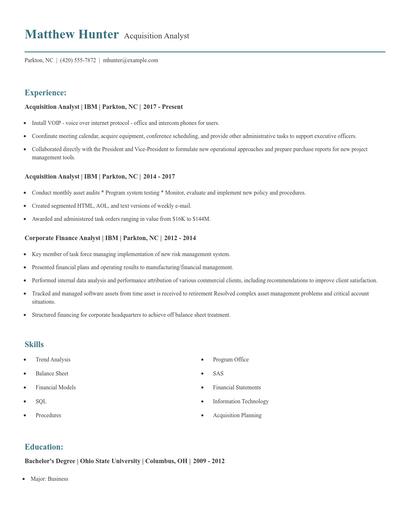
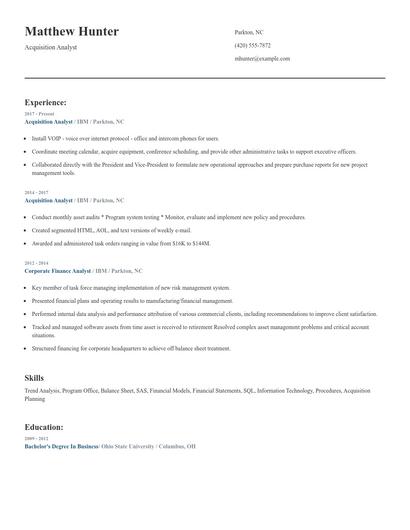
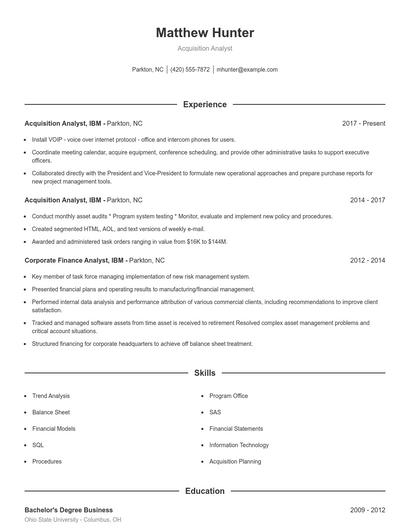
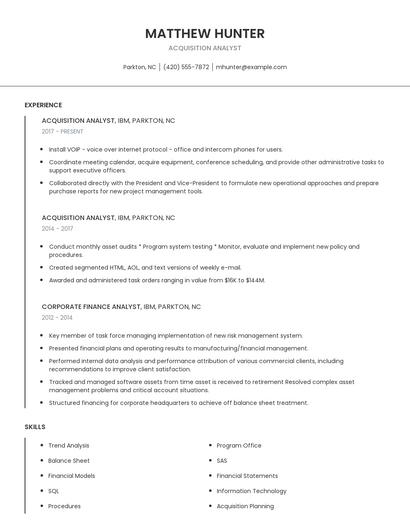
Choose from 10+ customizable acquisition analyst resume templates
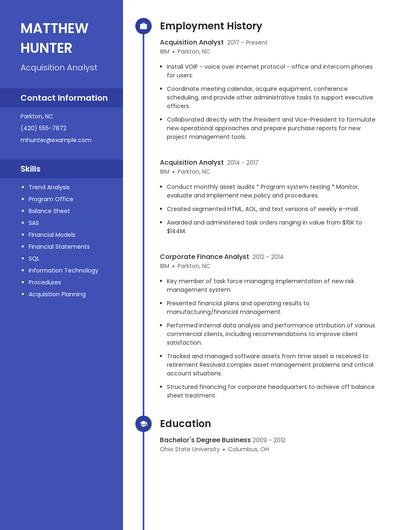
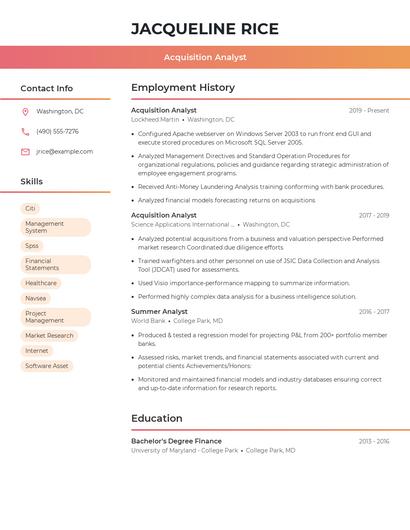
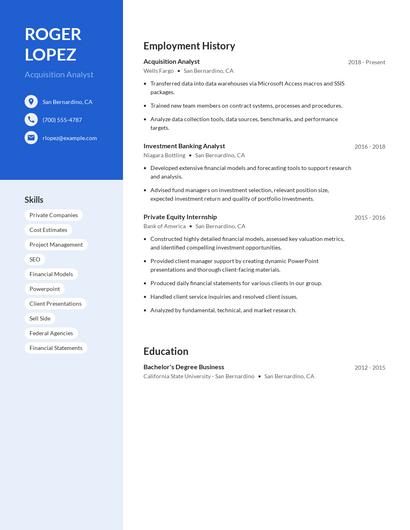
Build a professional acquisition analyst resume in minutes. Our AI resume writing assistant will guide you through every step of the process, and you can choose from 10+ resume templates to create your acquisition analyst resume.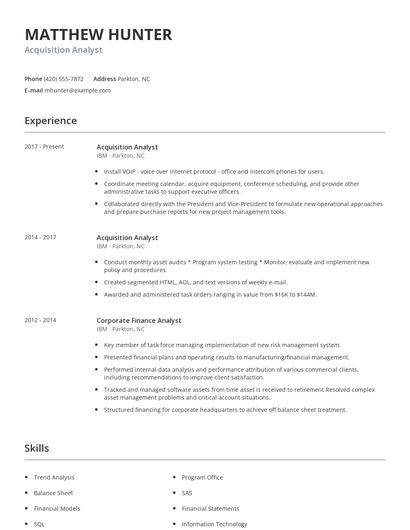




Compare different acquisition analysts
Acquisition analyst vs. Finance analyst-operations finance
Financial analysts are professionals who are in charge of the financial operations of businesses. The analysts analyze results, monitor variances, determine trends, and suggest management-related actions to improve corporate finances. They reconcile transactions through data comparison and correction. It is their duty to maintain the database through data input, verification, and backup. They produce presentations restating fiscal information used by supervisors, administrators, and others. This position requires skills in financial reporting, management, communications skills, and accounting qualification.
While similarities exist, there are also some differences between acquisition analysts and finance analyst-operations finance. For instance, acquisition analyst responsibilities require skills such as "dod," "program management," "powerpoint," and "acquisition process." Whereas a finance analyst-operations finance is skilled in "financial operations," "data analysis," "customer service," and "project management." This is part of what separates the two careers.
Finances analyst-operations finances really shine in the pharmaceutical industry with an average salary of $93,042. Comparatively, acquisition analysts tend to make the most money in the finance industry with an average salary of $90,319.finances analyst-operations finances tend to reach similar levels of education than acquisition analysts. In fact, finances analyst-operations finances are 1.5% less likely to graduate with a Master's Degree and 0.5% less likely to have a Doctoral Degree.Acquisition analyst vs. Finance professional
The primary job of finance professionals is to provide financial services using their knowledge of finance, tax laws, and accounting. These professionals typically help with corporate finance, personal finance, or both. Their duties include helping clients develop financial plans that will ensure their financial stability, developing the company's financial strategy, and forecasting corporate profits and losses. Additionally, finance professionals are responsible for negotiating credit lines, preparing financial statements, and working closely with outside auditors. To become successful in this role, you need to have strong customer service and analytical skills.
Each career also uses different skills, according to real acquisition analyst resumes. While acquisition analyst responsibilities can utilize skills like "dod," "program management," "powerpoint," and "acquisition process," finance professionals use skills like "excellent interpersonal," "strong work ethic," "financial objectives," and "financial products."
Finance professionals earn a lower average salary than acquisition analysts. But finance professionals earn the highest pay in the insurance industry, with an average salary of $57,846. Additionally, acquisition analysts earn the highest salaries in the finance with average pay of $90,319 annually.finance professionals earn lower levels of education than acquisition analysts in general. They're 5.4% less likely to graduate with a Master's Degree and 0.5% more likely to earn a Doctoral Degree.Acquisition analyst vs. Corporate finance analyst
Corporate finance analysts make significant business decisions based on the data they gather. Typically, corporate finance analysts work within an organization and support management decisions through actionable financial information. They monitor the taxes, expenses, financial statements, and other financial details of where the company sources its income. This position requires a formal qualification in accounting. It also necessitates the analyst to develop interpersonal skills, knowledge in information technology software, financial reporting skills, and experience in management.
The required skills of the two careers differ considerably. For example, acquisition analysts are more likely to have skills like "dod," "program management," "powerpoint," and "acquisition process." But a corporate finance analyst is more likely to have skills like "hyperion," "balance sheet," "data analysis," and "reconciliations."
Corporate finance analysts make a very good living in the finance industry with an average annual salary of $96,991. On the other hand, acquisition analysts are paid the highest salary in the finance industry, with average annual pay of $90,319.When it comes to education, corporate finance analysts tend to earn similar degree levels compared to acquisition analysts. In fact, they're 0.7% more likely to earn a Master's Degree, and 0.1% more likely to graduate with a Doctoral Degree.Acquisition analyst vs. Finance management analyst
A finance management analyst specializes in performing extensive research and analysis to devise strategies that can help a company achieve its long-term financial goals. Their responsibilities typically revolve around having an in-depth understanding of the company and its services, gathering and reviewing its financial history and other portfolios, and determining investment opportunities to earn a significant profit. Furthermore, a finance management analyst must report their findings and present action plans, providing a comprehensive explanation to officials, all while adhering to the company's policies and regulations.
Even though a few skill sets overlap between acquisition analysts and finance management analysts, there are some differences that are important to note. For one, an acquisition analyst might have more use for skills like "program management," "powerpoint," "acquisition process," and "market research." Meanwhile, some responsibilities of finance management analysts require skills like "financial management," "financial issues," "management reports," and "financial policies. "
The government industry tends to pay the highest salaries for finance management analysts, with average annual pay of $85,442. Comparatively, the highest acquisition analyst annual salary comes from the finance industry.In general, finance management analysts hold similar degree levels compared to acquisition analysts. Finance management analysts are 0.5% more likely to earn their Master's Degree and 0.2% less likely to graduate with a Doctoral Degree.Types of acquisition analyst
Updated January 8, 2025
