Explore jobs
Find specific jobs
Explore careers
Explore professions
Best companies
Explore companies
Job outlook for adjunct business instructors in the United States
Adjunct business instructor job growth summary. After extensive research, interviews, and analysis, Zippia's data science team found that:
The projected adjunct business instructor job growth rate is 12% from 2018-2028.
About 159,400 new jobs for adjunct business instructors are projected over the next decade.
Adjunct business instructor salaries have increased 14% for adjunct business instructors in the last 5 years.
There are over 20,622 adjunct business instructors currently employed in the United States.
There are 84,182 active adjunct business instructor job openings in the US.
The average adjunct business instructor salary is $53,224.
Are adjunct business instructor jobs in demand?
Adjunct business instructor job and salary trends over time
Adjunct business instructor jobs over time
Adjunct business instructor job growth rate over time
| Year | # of jobs | % of population |
|---|---|---|
| 2021 | 20,622 | 0.01% |
| 2020 | 20,666 | 0.01% |
| 2019 | 21,731 | 0.01% |
| 2018 | 21,811 | 0.01% |
| 2017 | 21,839 | 0.01% |
Average adjunct business instructor salary over time
Adjunct business instructor salary by year
| Year | Avg. salary | Hourly rate | % Change |
|---|---|---|---|
| 2026 | $53,224 | $25.59 | +0.9% |
| 2025 | $52,734 | $25.35 | +3.9% |
| 2024 | $50,775 | $24.41 | +4.6% |
| 2023 | $48,561 | $23.35 | +3.6% |
| 2022 | $46,862 | $22.53 | +2.8% |
Adjunct business instructor jobs by state
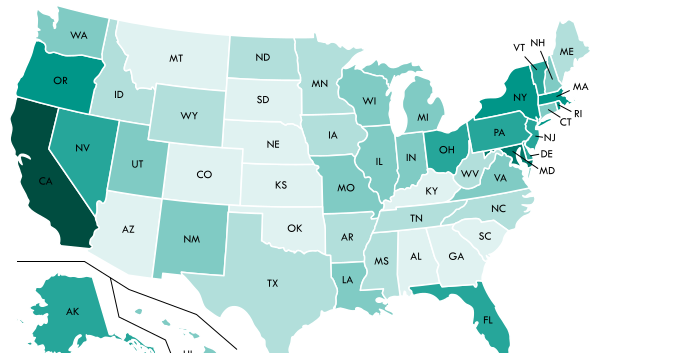
Most common states for adjunct business instructors
| Rank | State | Population | # of jobs | Employment/ 1000ppl |
|---|---|---|---|---|
| 1 | Alaska | 739,795 | 258 | 35% |
| 2 | Montana | 1,050,493 | 319 | 30% |
| 3 | Minnesota | 5,576,606 | 1,289 | 23% |
| 4 | Iowa | 3,145,711 | 685 | 22% |
| 5 | Nebraska | 1,920,076 | 419 | 22% |
| 6 | South Dakota | 869,666 | 189 | 22% |
| 7 | District of Columbia | 693,972 | 135 | 19% |
| 8 | South Carolina | 5,024,369 | 921 | 18% |
| 9 | Indiana | 6,666,818 | 1,154 | 17% |
| 10 | Kentucky | 4,454,189 | 777 | 17% |
| 11 | Kansas | 2,913,123 | 505 | 17% |
| 12 | Ohio | 11,658,609 | 1,867 | 16% |
| 13 | Missouri | 6,113,532 | 981 | 16% |
| 14 | Wisconsin | 5,795,483 | 905 | 16% |
| 15 | New Mexico | 2,088,070 | 326 | 16% |
| 16 | Tennessee | 6,715,984 | 978 | 15% |
| 17 | Nevada | 2,998,039 | 456 | 15% |
| 18 | Michigan | 9,962,311 | 1,383 | 14% |
| 19 | Arkansas | 3,004,279 | 407 | 14% |
| 20 | West Virginia | 1,815,857 | 242 | 13% |
Most common cities for adjunct business instructors
| Rank | City | # of jobs | Employment/ 1000ppl | Avg. salary |
|---|---|---|---|---|
| 1 | Skokie | 2 | 3% | $51,866 |
| 2 | San Pablo | 1 | 3% | $94,137 |
| 3 | Fairfield | 1 | 2% | $54,006 |
| 4 | Lombard | 1 | 2% | $51,497 |
| 5 | Port Arthur | 1 | 2% | $48,386 |
| 6 | Worcester | 1 | 1% | $66,693 |
| 7 | Boston | 2 | 0% | $66,869 |
| 8 | Chicago | 1 | 0% | $51,828 |
| 9 | Glendale | 1 | 0% | $42,145 |
| 10 | Lincoln | 1 | 0% | $42,394 |
| 11 | Saint Paul | 1 | 0% | $49,184 |
Adjunct Business Instructor job outlook: Expert opinions
Our panel of adjunct business instructor experts
Tiffin University
College of the Marshall Islands

Grambling State University

College of Charleston

Shaw University

University of Nebraska-Lincoln

The University of Tennessee Knoxville
Merrimack College
Orange Coast College
Dr. Stephanie Opfer
Associate Professor of English, Assistant Dean of the School of Creative and Media ArtsTiffin University
Visual And Performing Arts
What general advice would you give to an Adjunct Business Instructor?
Dr. Stephanie Opfer: Because of the state of higher education in our country today, teaching in higher education can be a difficult field to break into. However, most colleges and universities still hire adjunct instructors (part-time instructors). Students shouldn't be afraid to teach as an adjunct for a while to get some experience and decide if teaching is for them.
What will help Adjunct Business Instructors increase their earning potential?
Dr. Stephanie Opfer: Unfortunately, teaching as an adjunct does not pay well. Students should keep their full-time jobs and teach part-time until they find a full-time job at a college or university. That part-time teaching provides them valuable experience and connections that make them more competitive candidates for full-time positions because they'd also be competing with candidates who have PhDs. So adjunct work is more of a long-term investment rather than an immediate return. Also, even full-time teaching jobs don't pay particularly well, so they'll really need to love teaching if they want to do it full-time. If they don't like teaching as an adjunct, they won't like doing it full-time.
What general advice would you give to an Adjunct Business Instructor?
Alexander Velasquez: My general advice to any graduate beginning their career in their field is to continue to learn and be a student of your craft. Be open to learning new things because you never know how they will improve your skills and qualifications. For example, I am currently learning video editing. I never thought I would bother to learn video editing, but it makes me a more versatile instructor being able to give students the option of doing video projects, combining and editing them, and having a digital record of what students have learned in the classroom. And given the rise of online learning, it's important nowadays to be an effective instructor both in the traditional in-person format and within the digital landscape.
What Adjunct Business Instructor skills would you recommend for someone trying to advance their career?
Alexander Velasquez: I think that in the next three to five years the most important skills to have—and I mean this—will be critical thinking and imagination. This may sound a bit outlandish, and maybe even a bit naive, but hear me out: Artificial intelligence is making strides to the point where papers are writing themselves with simple instructions, videos are generating themselves with simple instructions, and software is beginning to write itself; and all this has been happening within the last few years. We may begin to see that in the next three to five years, once coveted programming jobs could become automated. Now, what I'm *not* saying is don't go to school for computer programming; but what I *am* saying is that the nature of work and employment *is* changing. For example, if you and and AI are making a video, and both of you have the same script, same voiceover, and so on, the only thing separating your final product from the AI's is the way you *think and imagine*, the perspective that you have as someone who can think critically about the information and lay it out in a visually appealing manner. AI can't do that—at least not yet—because it simply spits out the information it's given. But critical thought, metalevel thinking about information, is what will be one of the most important assets to have in the coming three to five years.
What will help Adjunct Business Instructors increase their earning potential?
Alexander Velasquez: I think everyone should look into their career fields and find out what it is that makes you more valuable in that field. Are there any certifications that you can get? What is it that you need to know or learn that companies will find valuable? Much can be learned online, so pick up as many of those skills as you can, and make sure they're on your resume or CV. I believe all those things could maximize salary potential, especially when starting out.
What Adjunct Business Instructor skills would you recommend for someone trying to advance their career?
Dr. Cheyrl Ensley: Training to be essential is critical. Increasing skills in using technology are necessary. Keeping students engaged and actively learning through technology is a crucial tool that will be extremely important to a teacher, whether teaching in person or virtually. Additionally, the gap year should be used to identify an area of interest for work. Once the site is specified, the graduate should build professional relationships and learn the site's culture.
What experience really stands out on Adjunct Business Instructor resumes?
Dr. Phyllis G. Jestice: The experience that most stands out on resumés, to my mind, is definitely internships or anything where the applicant has had to show initiative and exercise independent thought.
What type of skills will young Adjunct Business Instructors need?
TaVshea Smith: As a professor of education, I have noticed that there are a variety of skills that young graduates will need to enter the workforce. Young graduates should collaborate with others by building collaborative relationships that represent diverse cultures, lifestyles, races, genders, religions, and viewpoints. It is essential for young graduates, who enter the teaching profession, to be able to work in a team structure and know-how to manage conflict. The pandemic has shown us that technology is critical in education. As teachers, young graduates should know existing digital technologies and demonstrate significant adaptability to new technologies to integrate into their design of lessons and curriculum content. Young graduates must have a strong work ethic, demonstrate personal accountability, and establish effective work habits.
Are there any particularly good places in the United States for Adjunct Business Instructors to find work opportunities?
TaVshea Smith: As an educator, graduates should be able to find many work opportunities to teach. The pandemic has highlighted the need for educators to share their immense talent with students and key stakeholders.
What Adjunct Business Instructor skills would you recommend for someone trying to advance their career?
Suzanne Kemp Ph.D.: They need to stay engaged in some level of working with people with disabilities. If they do something that isn't relevant to the field, they won't be as marketable as a new graduate.
Dr. Misty Anderson Ph.D
Department Head, English, Affiliate Professor of Theatre and Religious Studies, President, Tennessee University Faculty SenatesThe University of Tennessee Knoxville
College of Arts and Sciences
Are there any particularly good places in the United States for Adjunct Business Instructors to find work opportunities?
Dr. Misty Anderson Ph.D: And as long as Tennessee continues to expand broadband access, those jobs can be anywhere. We're incredibly excited when we hear about young people returning home or moving into small towns where they can run businesses and work remotely.
Are there any particularly good places in the United States for Adjunct Business Instructors to find work opportunities?
Russell Olwell Ph.D.: In the field I work the most in, education, the labor market has been volatile, with positions being held until the last minute due to budget pressures then proceeding quickly. Job seekers who kept their eyes open, had identified places they wanted to work, and had their materials ready to go were rewarded.
Rodney Foster
Instructor - Aviation Maintenance Technology Instructor - Airframe & Powerplant TechnologyOrange Coast College
Engineering
What general advice would you give to an Adjunct Business Instructor?
Rodney Foster: Orange Coast College (OCC) teaches Aircraft Maintenance Technology (AMT) and Avionics. Although the Government has dampened air travel by putting up restrictions to prevent a Covid-19 spread, there is still a certified mechanic/skilled labor shortage. I believe all our students will have permanent jobs within a six-month search. OCC AMT is listed as an essential workforce by the state of California and is back in classes full-time, Face-to-face labs, and online lectures. Our next semester registration maximum filled in two days and still has over 35 additional students per class on the waiting list.