Explore jobs
Find specific jobs
Explore careers
Explore professions
Best companies
Explore companies
Job outlook for adjunct clinical instructors in the United States
Adjunct clinical instructor job growth summary. After extensive research, interviews, and analysis, Zippia's data science team found that:
The projected adjunct clinical instructor job growth rate is 12% from 2018-2028.
About 159,400 new jobs for adjunct clinical instructors are projected over the next decade.
Adjunct clinical instructor salaries have increased 9% for adjunct clinical instructors in the last 5 years.
There are over 49,716 adjunct clinical instructors currently employed in the United States.
There are 88,235 active adjunct clinical instructor job openings in the US.
The average adjunct clinical instructor salary is $67,696.
Are adjunct clinical instructor jobs in demand?
Adjunct clinical instructor job and salary trends over time
Adjunct clinical instructor jobs over time
Adjunct clinical instructor job growth rate over time
| Year | # of jobs | % of population |
|---|---|---|
| 2021 | 49,716 | 0.01% |
| 2020 | 44,632 | 0.01% |
| 2019 | 43,594 | 0.01% |
| 2018 | 40,694 | 0.01% |
| 2017 | 40,600 | 0.01% |
Average adjunct clinical instructor salary over time
Adjunct clinical instructor salary by year
| Year | Avg. salary | Hourly rate | % Change |
|---|---|---|---|
| 2026 | $67,696 | $32.55 | +1.2% |
| 2025 | $66,916 | $32.17 | +1.5% |
| 2024 | $65,920 | $31.69 | +3.1% |
| 2023 | $63,920 | $30.73 | +3.1% |
| 2022 | $62,009 | $29.81 | +2.4% |
Adjunct clinical instructor jobs by state
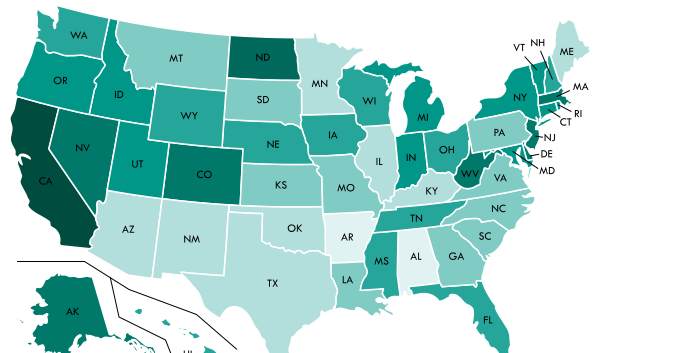
Most common states for adjunct clinical instructors
| Rank | State | Population | # of jobs | Employment/ 1000ppl |
|---|---|---|---|---|
| 1 | District of Columbia | 693,972 | 223 | 32% |
| 2 | Colorado | 5,607,154 | 1,040 | 19% |
| 3 | Montana | 1,050,493 | 204 | 19% |
| 4 | Virginia | 8,470,020 | 1,552 | 18% |
| 5 | Rhode Island | 1,059,639 | 196 | 18% |
| 6 | Maryland | 6,052,177 | 1,009 | 17% |
| 7 | Oregon | 4,142,776 | 719 | 17% |
| 8 | Maine | 1,335,907 | 222 | 17% |
| 9 | North Dakota | 755,393 | 129 | 17% |
| 10 | California | 39,536,653 | 5,747 | 15% |
| 11 | North Carolina | 10,273,419 | 1,544 | 15% |
| 12 | New Jersey | 9,005,644 | 1,336 | 15% |
| 13 | Indiana | 6,666,818 | 1,006 | 15% |
| 14 | Minnesota | 5,576,606 | 826 | 15% |
| 15 | Delaware | 961,939 | 145 | 15% |
| 16 | South Dakota | 869,666 | 131 | 15% |
| 17 | Iowa | 3,145,711 | 431 | 14% |
| 18 | Alaska | 739,795 | 106 | 14% |
| 19 | Vermont | 623,657 | 89 | 14% |
| 20 | Washington | 7,405,743 | 979 | 13% |
Most common cities for adjunct clinical instructors
| Rank | City | # of jobs | Employment/ 1000ppl | Avg. salary |
|---|---|---|---|---|
| 1 | North Andover | 1 | 4% | $78,788 |
| 2 | Council Bluffs | 1 | 2% | $66,945 |
| 3 | Decatur | 1 | 1% | $53,854 |
| 4 | Redding | 1 | 1% | $106,179 |
| 5 | Baltimore | 1 | 0% | $74,466 |
| 6 | Dallas | 1 | 0% | $57,526 |
| 7 | Houston | 1 | 0% | $59,776 |
| 8 | New York | 1 | 0% | $75,492 |
| 9 | Yonkers | 1 | 0% | $74,870 |
Adjunct Clinical Instructor job outlook: Expert opinions
Our panel of adjunct clinical instructor experts
Tiffin University

Skidmore College

Shaw University

University of Nebraska-Lincoln

The University of Tennessee Knoxville
The University of North Carolina Greensboro
Dr. Stephanie Opfer
Associate Professor of English, Assistant Dean of the School of Creative and Media ArtsTiffin University
Visual And Performing Arts
What general advice would you give to an Adjunct Clinical Instructor?
Dr. Stephanie Opfer: Because of the state of higher education in our country today, teaching in higher education can be a difficult field to break into. However, most colleges and universities still hire adjunct instructors (part-time instructors). Students shouldn't be afraid to teach as an adjunct for a while to get some experience and decide if teaching is for them.
What will help Adjunct Clinical Instructors increase their earning potential?
Dr. Stephanie Opfer: Unfortunately, teaching as an adjunct does not pay well. Students should keep their full-time jobs and teach part-time until they find a full-time job at a college or university. That part-time teaching provides them valuable experience and connections that make them more competitive candidates for full-time positions because they'd also be competing with candidates who have PhDs. So adjunct work is more of a long-term investment rather than an immediate return. Also, even full-time teaching jobs don't pay particularly well, so they'll really need to love teaching if they want to do it full-time. If they don't like teaching as an adjunct, they won't like doing it full-time.
What experience really stands out on Adjunct Clinical Instructor resumes?
Tillman W. Nechtman Ph.D.: In my home department, we've tried to stress that students need to ask themselves how they plan to tell their own story - how they want to present themselves - when they leave the college and head out on the job market. That's a personal question, one only the student can answer, and the answer shapes the things that a particular student will want to put on a resume. For instance, if you wanted to go to graduate school, we'd all suggest that you take the Thesis in History and put in the full-year work on a single research project.
That way, in your cover letter (and never underestimate the value of the cover letter as a tool for guiding potential employers through your CV and your other materials), you can narrate the work you did there. If you think your goal is to work in a museum setting, you should consider taking our class in Public History. That is a course that does a lot of directed research too, and it can span a year as well. But, it's a course that partners students with local public history institutions so that students get first-hand experience mobilizing historical research within a museum or institution of that sort. The key is for students to think about the story; they will tell potential employers. What are the things you did - that unique combination of courses and experiences - that make you stand out against the broader pool of applicants? How will you write that story in a cover letter so strong that nobody reading it will miss that you are the one candidate for the position? Be bold here. Make it clear. You stand out from the pack. Yes, perhaps other have taken a more traditional path to a specific job, but if that employer or graduate program wants somebody who can think outside the box or who brings in a different set of skills that just might shake things up in a positive way, well, make sure they know you're their candidate.
What type of skills will young Adjunct Clinical Instructors need?
TaVshea Smith: As a professor of education, I have noticed that there are a variety of skills that young graduates will need to enter the workforce. Young graduates should collaborate with others by building collaborative relationships that represent diverse cultures, lifestyles, races, genders, religions, and viewpoints. It is essential for young graduates, who enter the teaching profession, to be able to work in a team structure and know-how to manage conflict. The pandemic has shown us that technology is critical in education. As teachers, young graduates should know existing digital technologies and demonstrate significant adaptability to new technologies to integrate into their design of lessons and curriculum content. Young graduates must have a strong work ethic, demonstrate personal accountability, and establish effective work habits.
What experience really stands out on Adjunct Clinical Instructor resumes?
Suzanne Kemp Ph.D.: Any work or volunteer experiences that they have had with students with disabilities. All of the graduates will have the same school experiences, and if they don't have anything else, they don't stand out from their peers. Additionally, they have to know that principals and professional school talk, so they have to do a great job in their in-school experiences, so their names are remembered and shared.
Dr. Misty Anderson Ph.D
Department Head, English, Affiliate Professor of Theatre and Religious Studies, President, Tennessee University Faculty SenatesThe University of Tennessee Knoxville
College of Arts and Sciences
Are there any particularly good places in the United States for Adjunct Clinical Instructors to find work opportunities?
Dr. Misty Anderson Ph.D: And as long as Tennessee continues to expand broadband access, those jobs can be anywhere. We're incredibly excited when we hear about young people returning home or moving into small towns where they can run businesses and work remotely.
April Dawkins Ph.D.
Assistant ProfessorThe University of North Carolina Greensboro
Library & Information Science Department
What experience really stands out on Adjunct Clinical Instructor resumes?
April Dawkins Ph.D.: Across the United States, most school librarians are required to have a graduate degree in either education or library and information science with licensure as a school librarian (school library media coordinator). The most likely experience to benefit them in their job search is a previous experience as a classroom teacher. Teaching is one of the significant roles that school librarians play in schools, through direct and indirect instruction with students, and professional development for classroom teachers.