
Automatically apply for jobs with Zippia
Upload your resume to get started.
Adult protective caseworker skills for your resume and career
15 adult protective caseworker skills for your resume and career
2. Protective Services
Protective services are services offered to vulnerable individuals or legal representatives to protect them against potential abuse, violence, or negligence. Protective services are offered to ensure that an individual's safety stays intact and they don't fall victim to crime or exploitation. Such services include, social casework, stated appointed witness protection, home care, legal assistance, day-care etc.
- Oriented new caseworker to Adult Protective Services policies and procedures including field visits and investigations.
- Provide information and educate agency staff, community providers about elder abuse and protective services.
4. Crisis Intervention
- Conducted intake assessments, crisis intervention, and advocacy to mentally and /or physically impaired, abused, and/or neglected clients.
- Work regular shifts as On-Call Caseworker, taking calls and making home visits as indicated for crisis intervention.
5. APS
- Position required learning state laws, APS policy, and keeping up with changing database system (SHIELD).
- Reviewed reports, care plans and budgets for quality assurance for the APS and Veterans Independence Programs.
6. Mental Health
Mental health is the state of wellbeing in which an individual can cope with the regular stresses and tensions of life, and can work productively without having any emotional or psychological breakdown. Mental health is essential for a person of any age and helps them make the right decisions in their life.
- Completed intakes on persons seeking mental health services; referred to appropriate agency for treatment.
- Worked with health care and mental health clinics in order to provide appropriate care.
Choose from 10+ customizable adult protective caseworker resume templates
Build a professional adult protective caseworker resume in minutes. Our AI resume writing assistant will guide you through every step of the process, and you can choose from 10+ resume templates to create your adult protective caseworker resume.7. Community Resources
Community resources are a set of resources that are used in the day to day life of people which improves their lifestyle in some way. People, sites or houses, and population assistance can come under the services offered by community resources.
- Connect individuals with appropriate community resources.
- Coordinate referrals based on client's needs to community resources.
8. Child Abuse
When a child who is under 18 is mistreated by an adult, it is considered child abuse. There are many forms of intentional harm and mistreatment for example physical abuse, sexual abuse, emotional abuse, medical abuse, and neglect in providing adequate basic life necessities.
- Designed/facilitated/presented community education and training on Child Abuse and Neglect.
- Testify in court on the issues of child abuse, neglect, dependency, case plan compliance and permanency.
9. Adult Protective
- Investigate Adult Protective Services referrals and implement services to alleviate barriers.
- Conduct and supervise adult protective services investigations.
10. Financial Assistance
Financial assistance refers to governmental assistance one may receive for a variety of reasons. This help is typically in the form of money, whether a loan, scholarship, grant, or reduced taxes provided to an individual or organization. One of the more common forms of financial assistance is student loans, which offer many prospective students a chance for higher education.
- Determine clients' eligibility for financial assistance.
- Determine clients' eligibility for financial assistance.
11. Foster Care
- Monitored and supervised children in foster care as well as those receiving services at home.
- Filed petitions in Family Court and when necessary placed children in foster care.
12. Vulnerable Adults
- Performed investigations, protective services assessments and interventions pertaining to reports of abuse, exploitation and neglect of vulnerable adults.
- Complete investigations within 72-hours of reports of abuse, neglect, and/or exploitation regarding incapacitated and vulnerable adults.
13. Term Care
- Organized and planned long term care services, life skills training, and substance abuse treatment for client/family.
- Conducted investigations in residences, personal care homes, long-term care facilities and nursing homes.
14. Mental Illness
- Maintained general knowledge of mental illness.
15. Court Hearings
- Testified at court hearings to present investigative evidence.
- Testified in court hearings to mandate parents to obtain counseling and court-ordered services.
5 Adult Protective Caseworker resume examples
Build a professional adult protective caseworker resume in minutes. Browse through our resume examples to identify the best way to word your resume. Then choose from 5+ resume templates to create your adult protective caseworker resume.

What skills help Adult Protective Caseworkers find jobs?
Tell us what job you are looking for, we’ll show you what skills employers want.
What skills stand out on adult protective caseworker resumes?
Lillian Wichinsky Ph.D.
Associate Dean, University of Nevada - Reno
-clinical experience (therapeutic skills)
-ability to work with individuals, families, and groups from different ethnicities and backgrounds.
-case management
-resource management
-advocacy
-documentation
What soft skills should all adult protective caseworkers possess?
Lillian Wichinsky Ph.D.
Associate Dean, University of Nevada - Reno
-Teamwork. ...
-Communication Skills
-Problem-Solving Skills
-Ethics
-Flexibility/Adaptability
-Leadership skills
What adult protective caseworker skills would you recommend for someone trying to advance their career?
Alan Burkard Ph.D.
Professor, Chair
What hard/technical skills are most important for adult protective caseworkers?
Sam Terrazas Ph.D.
Professor and Academic Chair Department of Social Work, The University of Texas Permian Basin
BSW's practice in a range of organizations providing various types of services; however, in general practice in the realm of case management that requires that ability to demonstrate cultural responsiveness, develop an alliance with clients, apply NASW and a state's ethics and professional standards of practice, conduct assessments, and to develop plans to meet a client's goals.
MSW's practice in many areas such as administration, clinical, public policy and advocacy, child welfare, public safety, and health care. Each of these practice areas requires specific technical skills; however, in general, MSW's are trained to assess individuals, families, groups, and communities. To that end, MSW's must understand the cultural context and how socio/economic local, state, federal policies impact social welfare problems such as poverty, intimate partner violence, and mental illness. MSW's must possess strong engagement skills/therapeutic alliance-building, diagnostic/evaluation skills, ethical application of interventions and therapeutic approaches, and advocacy skills.
List of adult protective caseworker skills to add to your resume
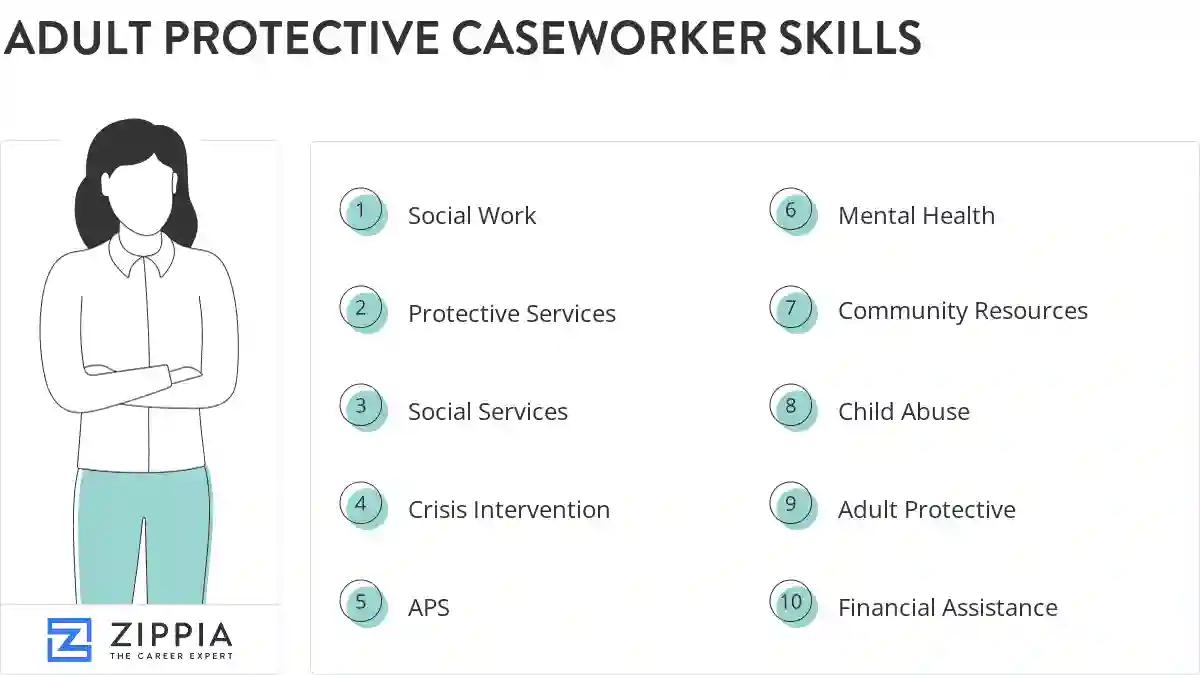
The most important skills for an adult protective caseworker resume and required skills for an adult protective caseworker to have include:
- Social Work
- Protective Services
- Social Services
- Crisis Intervention
- APS
- Mental Health
- Community Resources
- Child Abuse
- Adult Protective
- Financial Assistance
- Foster Care
- Vulnerable Adults
- Term Care
- Mental Illness
- Court Hearings
- Law Enforcement Agencies
- Adult Medicaid
- Adult Services
- at-Risk Adults
- Risk Assessments
- Community Agencies
- Crisis Management
- Direct Services
- State Regulations
- Community Education
- Community Services
- Family Court
- Court Proceedings
Updated January 8, 2025

1. Social Work