What does an assembling fabricator do?

Assembling fabricator responsibilities
Here are examples of responsibilities from real assembling fabricator resumes:
- Used power air tools, blow torches, grinders, saws, help welders.
- Cut, bend, and weld bars at the job site, using metal shears, torches, or welding equipment.
- Maintain CNC machines in a high volume production environment.
- Have to use protractors to reach the desired angle.
- Experience include using MIG and stick welding on mild steel and manganese.
- Design fixtures and mig weld them together to keep the desired shape.
- Utilize proper PPE equipment, operate overhead cranes, pallet jack and forklift.
- Fabricate and weld aluminum and stainless parts from blueprints to meet engineering specs.
- Fabricate aluminum doors for use in retail, office, and commercial venues.
- Position and clamp work pieces together and properly assemble them in jigs and fixtures.
- Assemble pieces of sheet metal into HVAC duct, using different techniques and methods.
- Cut, bend and weld steel pieces using metal shears, torches and welding equipment.
- Create assembly jigs per design blueprints create by truss designers to construct the trusses to exact design.
- Can use a measuring tape, protractor micrometer.
- Programme and maintain various machine base systems using AutoCad and other equipment base software.
Assembling fabricator skills and personality traits
We calculated that 18% of Assembling Fabricators are proficient in Hand Tools, Basic Math, and Blueprint Specifications. They’re also known for soft skills such as Math skills, Color vision, and Technical skills.
We break down the percentage of Assembling Fabricators that have these skills listed on their resume here:
- Hand Tools, 18%
Followed complex instructions and blueprints to build final product using all forms of hand tools and even some heavy machinery.
- Basic Math, 6%
Caculated rebar count and measured loads with basic math operrations.
- Blueprint Specifications, 5%
Assembled machines per blueprint specification for military contracts for aerospace defense industry.
- Math, 5%
Utilize math skills to make calculations related to machining, fabrication and/or assembly operations.
- Grinders, 5%
Operate machinery: lathes, grinders, saws, sand blast, polishers, and thread Machines etc.
- Quality Standards, 4%
Fabricate panel truck rear door assemblies using wire feed welder, maintaining quality standards by utilizing assembly drawings
"hand tools," "basic math," and "blueprint specifications" are among the most common skills that assembling fabricators use at work. You can find even more assembling fabricator responsibilities below, including:
Color vision. Another soft skill that's essential for fulfilling assembling fabricator duties is color vision. The role rewards competence in this skill because "assemblers and fabricators who make electrical and electronic products must distinguish different colors, because the wires they often work with are color coded." According to an assembling fabricator resume, here's how assembling fabricators can utilize color vision in their job responsibilities: "follow safety rules meet production line standards efficiently run production line make decisions and trouble shoot without supervision"
Technical skills. Another skill that relates to the job responsibilities of assembling fabricators is technical skills. This skill is critical to many everyday assembling fabricator duties, as "assemblers and fabricators must understand technical manuals, blueprints, and schematics for manufacturing a range of products and machines." This example from a resume shows how this skill is used: "fabricated and assembled steel joist and girders in accordance with technical drawings and designs. "
Dexterity. assembling fabricator responsibilities often require "dexterity." The duties that rely on this skill are shown by the fact that "assemblers and fabricators should have a steady hand and good hand–eye coordination, as they must grasp, manipulate, and assemble parts and components that are often very small." This resume example shows what assembling fabricators do with dexterity on a typical day: "operate a boom truck, crane and standard pallet forklifts to assemble and install parts. "
Mechanical skills. Another common skill required for assembling fabricator responsibilities is "mechanical skills." This skill comes up in the duties of assembling fabricators all the time, as "assemblers and fabricators must have a working knowledge of basic machinery to use programmable motion-control devices, computers, and robots on the factory floor." An excerpt from a real assembling fabricator resume shows how this skill is central to what an assembling fabricator does: "promoted to position with additional responsibilities skills used mechanical , hand tools, power tools , communication skills, leadership skills"
Physical strength. Lastly, "physical strength" is an important element of what an assembling fabricator does. Assembling fabricator responsibilities require this skill because "assemblers and fabricators must be able to lift heavy components or pieces of machinery." This resume example highlights how assembling fabricator duties rely on this skill: "prefer to work on set schedule.skills usedphysical strength and machine operation. "
The three companies that hire the most assembling fabricators are:
- Master Halco3 assembling fabricators jobs
- Donaldson2 assembling fabricators jobs
- Kratos Defense & Security Solutions2 assembling fabricators jobs
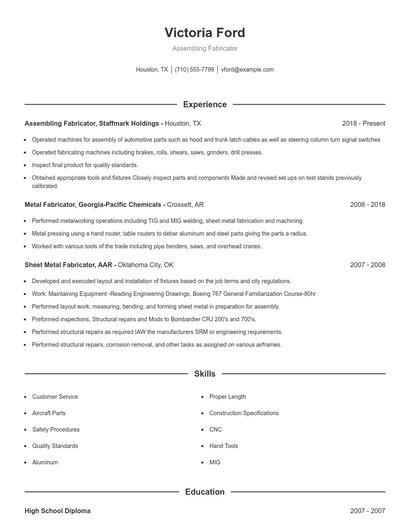
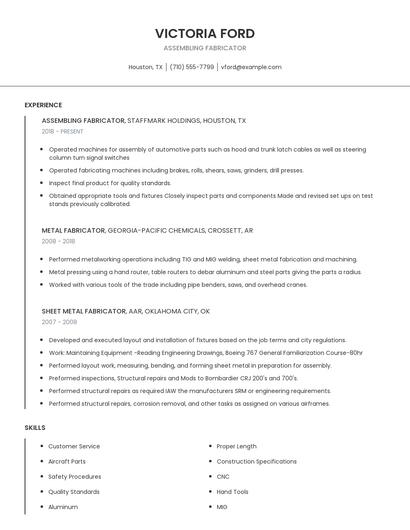
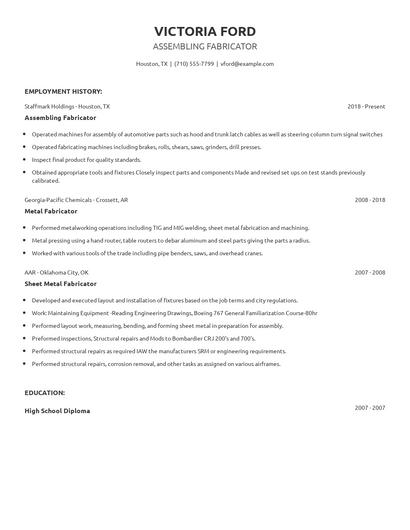
Choose from 10+ customizable assembling fabricator resume templates
Build a professional assembling fabricator resume in minutes. Our AI resume writing assistant will guide you through every step of the process, and you can choose from 10+ resume templates to create your assembling fabricator resume.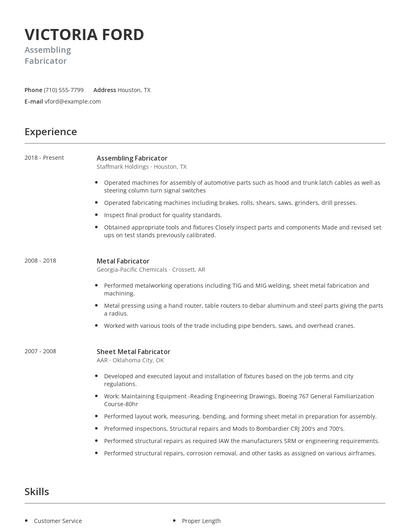
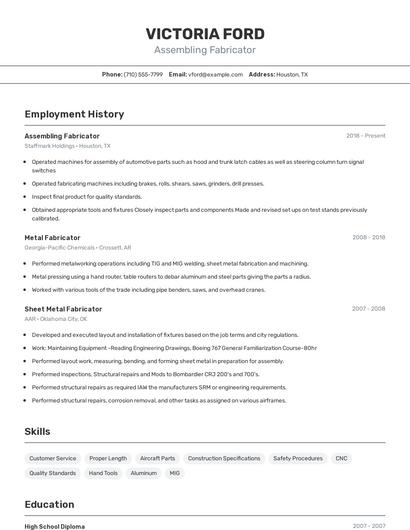


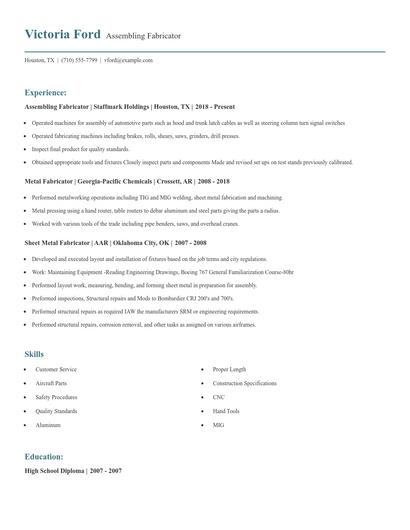
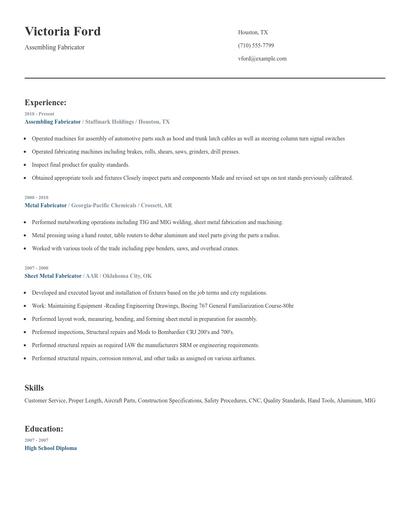
Compare different assembling fabricators
Assembling fabricator vs. Product builder
While similarities exist, there are also some differences between assembling fabricators and product builder. For instance, assembling fabricator responsibilities require skills such as "blueprint specifications," "math," "grinders," and "cranes." Whereas a product builder is skilled in "medical devices," "medical products," "catheter," and "lean manufacturing." This is part of what separates the two careers.
Product builders really shine in the health care industry with an average salary of $33,660. Comparatively, assembling fabricators tend to make the most money in the construction industry with an average salary of $37,514.On average, product builders reach similar levels of education than assembling fabricators. Product builders are 2.5% more likely to earn a Master's Degree and 0.1% more likely to graduate with a Doctoral Degree.Assembling fabricator vs. Sign maker
Each career also uses different skills, according to real assembling fabricator resumes. While assembling fabricator responsibilities can utilize skills like "hand tools," "basic math," "blueprint specifications," and "math," sign makers use skills like "graphic design," "vinyl graphics," "vehicle graphics," and "custom signage."
In general, sign makers achieve similar levels of education than assembling fabricators. They're 1.3% more likely to obtain a Master's Degree while being 0.1% less likely to earn a Doctoral Degree.Assembling fabricator vs. Box maker
There are many key differences between these two careers, including some of the skills required to perform responsibilities within each role. For example, an assembling fabricator is likely to be skilled in "hand tools," "basic math," "blueprint specifications," and "math," while a typical box maker is skilled in "pallet jack," "label boxes," "production lines," and "rf."
When it comes to education, box makers tend to earn similar degree levels compared to assembling fabricators. In fact, they're 0.7% less likely to earn a Master's Degree, and 0.1% less likely to graduate with a Doctoral Degree.Assembling fabricator vs. Liner
Types of assembling fabricator
Updated January 8, 2025
