What does an assistant education director do?
Primarily, an assistant education director is a person who assists directors in educational programs' planning, development, application, maintenance, and assessment. Assistant education directors train general education staff, parents, classified staff, and education staff. They determine the instructional strategies and techniques for improving special education student achievement in education classes. Their job asks them to monitor the compliance of the educational programs with government regulations. Supervising and evaluating the performance of classified and certified education staff are also part of their duties and responsibilities.
Assistant education director responsibilities
Here are examples of responsibilities from real assistant education director resumes:
- Coordinate several courses which involve development of the departmental syllabus and managing development of the departmental final.
- Monitor budget for program, provide technical support for computer and business equipment issues and assist patients inquiring about medical issues.
- Prepare monthly examinations for the EFL teachers
- Recruit, hire, and train EFL instructional staff.
- Coordinate several courses which involve development of the departmental syllabus and managing development of the departmental final.
Assistant education director skills and personality traits
We calculated that 14% of Assistant Education Directors are proficient in Professional Development, Oversight, and Education Programs. They’re also known for soft skills such as Computer skills, Organizational skills, and Problem-solving skills.
We break down the percentage of Assistant Education Directors that have these skills listed on their resume here:
- Professional Development, 14%
Instructed Professional Development, Anatomy/Physiology, Medical Law, Microsoft Office Suite.
- Oversight, 9%
Supervised student staff and exercised administrative oversight of a student-run cultural center.
- Education Programs, 9%
Secured state funding for alternative education programs, and ensured compliance with funding and reporting requirements.
- Curriculum Development, 9%
Managed curriculum development and administration for Religious and Hebrew school of over 500 students.
- Program Development, 8%
Assist with budget, grant writing, and program development.
- Social Work, 5%
Field Supervisor to graduate social work student interns teaching professional ethics and the most effective ways of addressing clients' needs.
Most assistant education directors use their skills in "professional development," "oversight," and "education programs" to do their jobs. You can find more detail on essential assistant education director responsibilities here:
Computer skills. The most essential soft skill for an assistant education director to carry out their responsibilities is computer skills. This skill is important for the role because "postsecondary education administrators need to be comfortable working with computers so they can use software to manage student and school records." Additionally, an assistant education director resume shows how their duties depend on computer skills: "created computer programs and documentation for tracking of funds and progress for both va and doe recipients. "
Organizational skills. Another soft skill that's essential for fulfilling assistant education director duties is organizational skills. The role rewards competence in this skill because "administrators need to be organized so they can manage records, prioritize tasks, and coordinate activities with their staff." According to an assistant education director resume, here's how assistant education directors can utilize organizational skills in their job responsibilities: "guided student retention, attendance, and completion outcomes to meet organizational objectives. "
Problem-solving skills. assistant education directors are also known for problem-solving skills, which are critical to their duties. You can see how this skill relates to assistant education director responsibilities, because "administrators need to react calmly when a difficult situation arises and develop creative solutions." An assistant education director resume example shows how problem-solving skills is used in the workplace: "coordinate professional development for all staff to improve instruction, communication, classroom management, and conflict resolution. "
Interpersonal skills. For certain assistant education director responsibilities to be completed, the job requires competence in "interpersonal skills." The day-to-day duties of an assistant education director rely on this skill, as "postsecondary education administrators need to build good relationships with colleagues, students, and parents." For example, this snippet was taken directly from a resume about how this skill applies to what assistant education directors do: "dedicated team player with excellent interpersonal communications skills. "
The three companies that hire the most assistant education directors are:
- ADAPT Community Network5 assistant education directors jobs
- Columbia University in the City of New York4 assistant education directors jobs
- GBMC Healthcare2 assistant education directors jobs
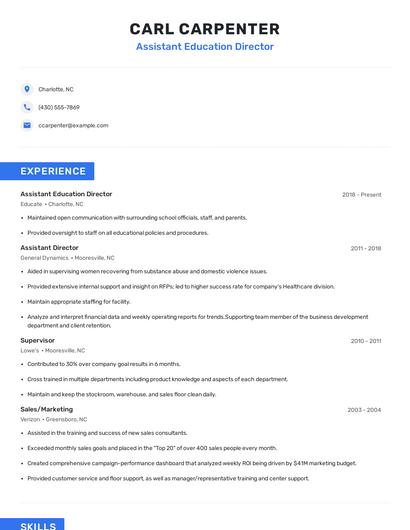
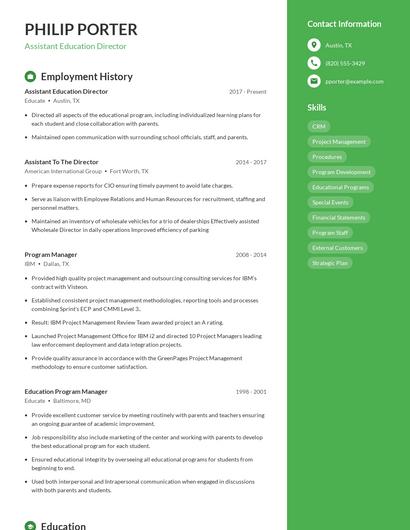
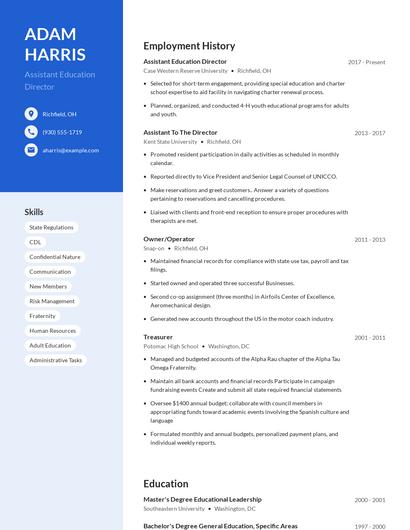
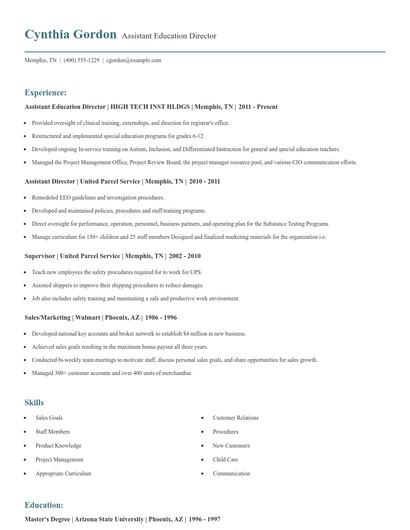
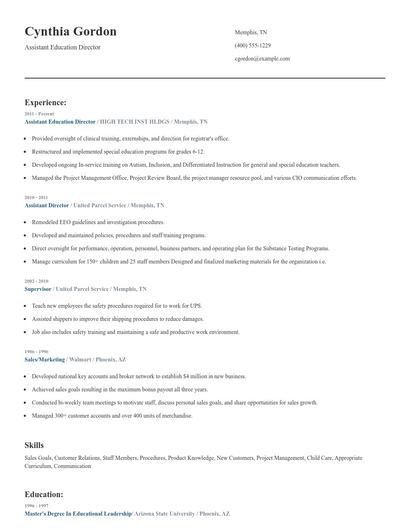
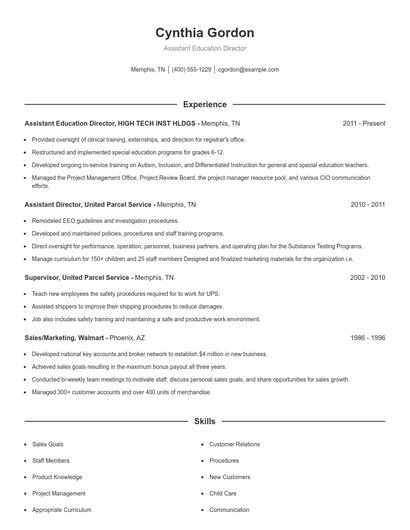
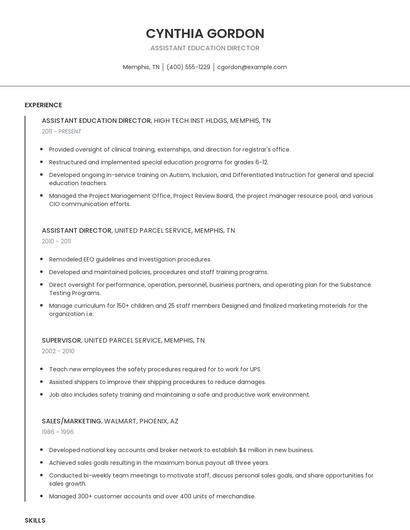
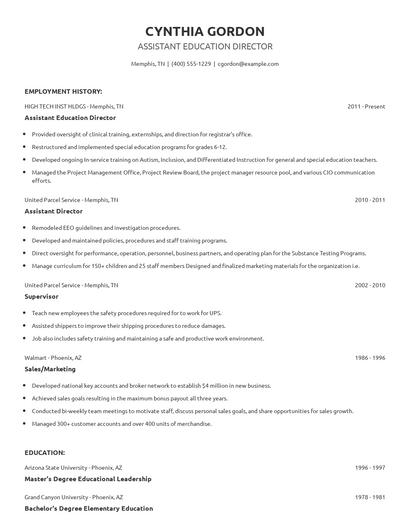
Choose from 10+ customizable assistant education director resume templates
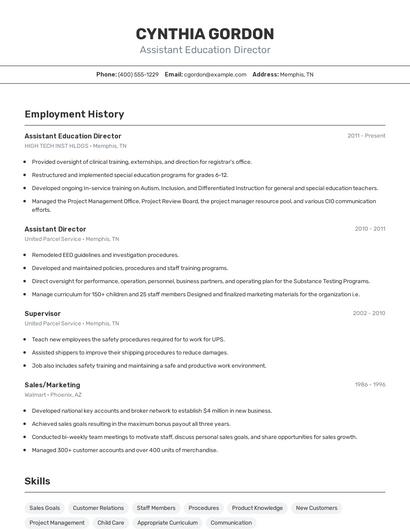
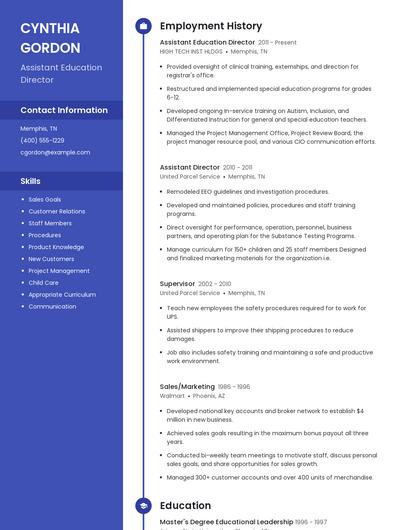
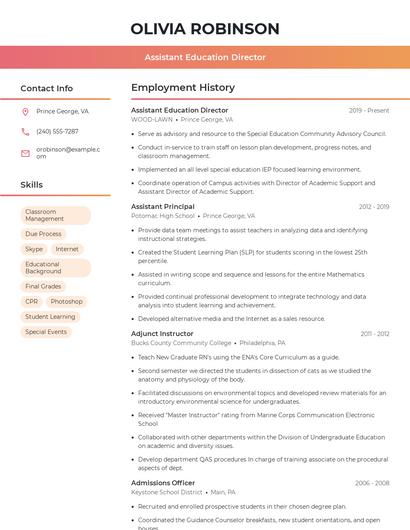
Build a professional assistant education director resume in minutes. Our AI resume writing assistant will guide you through every step of the process, and you can choose from 10+ resume templates to create your assistant education director resume.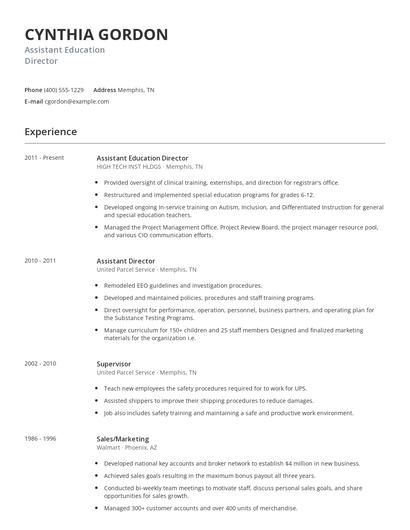
Compare different assistant education directors
Assistant education director vs. Committee chairperson
A committee chairperson or chair is a presiding officer in an organization who is responsible for leading committee meetings and establishing agendas for the committee members to tackle. Committee chairpersons must provide strong leadership to the organization while reminding committee members about their purpose, mission, and strategic direction. In terms of confidentiality, committee chairpersons must keep business meetings confidential and they must be willing to address committee members who fail to protect confidentiality. They must also report the committee's findings to the organization's board of directors.
These skill sets are where the common ground ends though. The responsibilities of an assistant education director are more likely to require skills like "oversight," "education programs," "curriculum development," and "program development." On the other hand, a job as a committee chairperson requires skills like "committee chair," "financial statements," "community outreach," and "alumni." As you can see, what employees do in each career varies considerably.
Committee chairpeople tend to reach lower levels of education than assistant education directors. In fact, committee chairpeople are 8.9% less likely to graduate with a Master's Degree and 1.7% more likely to have a Doctoral Degree.Assistant education director vs. Dean
A dean is responsible for overseeing the educational operations of the assigned department, enforcing school policies, and monitoring the students' progress by coordinating with the teachers and setting up procedures to improve teaching methods. Deans administer educational training and programs for the students, as well as extra-curricular activities to develop the students' social behavior, maximize their potentials, and increase their self-confidence. They also handle the department's budget, accurately allocating resources and funds to different activities and educational materials.
In addition to the difference in salary, there are some other key differences worth noting. For example, assistant education director responsibilities are more likely to require skills like "professional development," "program development," "social work," and "training programs." Meanwhile, a dean has duties that require skills in areas such as "scholarship," "human resources," "strategic plan," and "student learning." These differences highlight just how different the day-to-day in each role looks.
Deans may earn a higher salary than assistant education directors, but deans earn the most pay in the education industry with an average salary of $78,533. On the other hand, assistant education directors receive higher pay in the professional industry, where they earn an average salary of $53,097.In general, deans achieve lower levels of education than assistant education directors. They're 7.8% less likely to obtain a Master's Degree while being 1.7% more likely to earn a Doctoral Degree.Assistant education director vs. Vice chairperson
A chairperson is responsible for managing the overall business team, ensuring everyone's compliance with the company's strategies and processes to reach the highest business goals and objectives. A chairperson's duties also include monitoring the staff's performance, analyzing the committee's performance and decisions, providing reports and updates during meetings, improving the current policies and procedures as necessary, and facilitating committee's programs and special events. A chairperson must have excellent leadership and communication skills to lead the team towards its organizational success.
There are many key differences between these two careers, including some of the skills required to perform responsibilities within each role. For example, an assistant education director is likely to be skilled in "education programs," "curriculum development," "program development," and "social work," while a typical vice chairperson is skilled in "vice chair," "financial statements," "community outreach," and "public safety."
Most vice chairpeople achieve a lower degree level compared to assistant education directors. For example, they're 6.9% less likely to graduate with a Master's Degree, and 5.1% less likely to earn a Doctoral Degree.Assistant education director vs. Chairperson
Types of assistant education director
Updated January 8, 2025
