Explore jobs
Find specific jobs
Explore careers
Explore professions
Best companies
Explore companies
Job outlook for associate professors of biology in the United States
Are associate professor of biology jobs in demand?
Associate professor of biology job and salary trends over time
Associate professor of biology jobs over time
Associate professor of biology job growth rate over time
| Year | # of jobs | % of population |
|---|---|---|
| 2021 | 2,598 | 0.00% |
| 2020 | 2,806 | 0.00% |
| 2019 | 2,892 | 0.00% |
| 2018 | 2,821 | 0.00% |
| 2017 | 2,719 | 0.00% |
Average associate professor of biology salary over time
Associate professor of biology salary by year
| Year | Avg. salary | Hourly rate | % Change |
|---|---|---|---|
| 2025 | $67,436 | $32.42 | +2.8% |
| 2024 | $65,624 | $31.55 | +0.9% |
| 2023 | $65,033 | $31.27 | +5.5% |
| 2022 | $61,638 | $29.63 | +2.1% |
| 2021 | $60,385 | $29.03 | +1.8% |
Associate professor of biology jobs by state
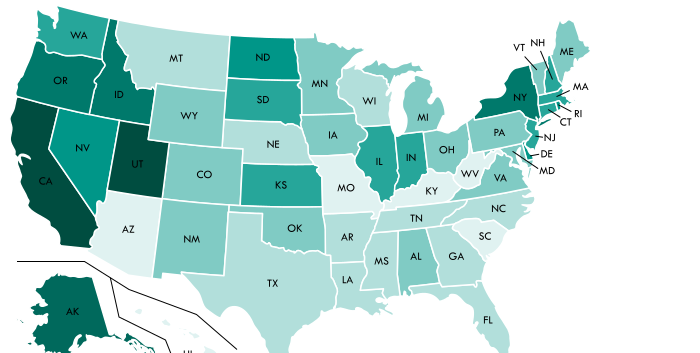
Most common states for associate professors of biology
| Rank | State | Population | # of jobs | Employment/ 1000ppl |
|---|---|---|---|---|
| 1 | District of Columbia | 693,972 | 84 | 12% |
| 2 | Vermont | 623,657 | 54 | 9% |
| 3 | Colorado | 5,607,154 | 309 | 6% |
| 4 | Oregon | 4,142,776 | 229 | 6% |
| 5 | West Virginia | 1,815,857 | 112 | 6% |
| 6 | South Dakota | 869,666 | 50 | 6% |
| 7 | Alaska | 739,795 | 42 | 6% |
| 8 | Virginia | 8,470,020 | 443 | 5% |
| 9 | Nebraska | 1,920,076 | 93 | 5% |
| 10 | New York | 19,849,399 | 838 | 4% |
| 11 | Pennsylvania | 12,805,537 | 483 | 4% |
| 12 | Kentucky | 4,454,189 | 183 | 4% |
| 13 | Utah | 3,101,833 | 138 | 4% |
| 14 | Mississippi | 2,984,100 | 122 | 4% |
| 15 | Rhode Island | 1,059,639 | 38 | 4% |
| 16 | New Jersey | 9,005,644 | 279 | 3% |
| 17 | Massachusetts | 6,859,819 | 214 | 3% |
| 18 | Alabama | 4,874,747 | 157 | 3% |
| 19 | Minnesota | 5,576,606 | 152 | 3% |
| 20 | Iowa | 3,145,711 | 106 | 3% |
Most common cities for associate professors of biology
| Rank | City | # of jobs | Employment/ 1000ppl | Avg. salary |
|---|---|---|---|---|
| 1 | Lexington | 1 | 3% | $68,984 |
| 2 | Bloomington | 1 | 1% | $69,913 |
| 3 | Fort Collins | 1 | 1% | $66,964 |
| 4 | Gainesville | 1 | 1% | $60,586 |
| 5 | Lawrence | 1 | 1% | $68,871 |
| 6 | Washington | 2 | 0% | $75,404 |
| 7 | Chicago | 1 | 0% | $70,691 |
| 8 | Columbus | 1 | 0% | $65,843 |
Associate Professor Of Biology job outlook: Expert opinions
Our panel of associate professor of biology experts
Kean University
University of Maine
Skidmore College
Ashford University
University of Kentucky College of Medicine

Meredith College
What will help Associate Professors Of Biology increase their earning potential?
Alex Holte PhD: When you are starting out at any career, it is important to negotiate your salary. Many candidates feel that they have to accept their first offer, but in reality, at many jobs, there is some room for negotiation. Be mindful however, to not request a salary that is much higher than what is being offered as they may feel like a compromise would not be possible and move on to the next candidate.
What will help Associate Professors Of Biology increase their earning potential?
Mia Fiore Ph.D.: Maximize your salary potential by teaching at a state school- if you do you can join the PSLF program and after ten years, your student loans will be forgiven.
Dr. Elizabeth Neiman
Director of Women's, Gender, and Sexuality Studies ProgramUniversity of Maine
Ethnic, Cultural Minority, Gender, And Group Studies
What will help Associate Professors Of Biology increase their earning potential?
Dr. Elizabeth Neiman: Rather than answer your questions, I'll give you some background information: Since becoming Director of the Women's, Gender and Sexuality Studies program at UMaine in fall 2022, I have been doing a great deal of outreach to faculty in other departments across the university.
Aurelie Matheron
Assistant Professor of FrenchSkidmore College
Romance Languages, Literatures, And Linguistics
What Associate Professor Of Biology skills would you recommend for someone trying to advance their career?
Aurelie Matheron: Leadership: you will be in positions of leading a program/department. Learn from current chairs by observing their own skills during meetings and moments of decision. Collaboration: develop interpersonal and interprofessional relationships that will allow you to build collaborative projects (interdepartmental courses, for instance).
What will help Associate Professors Of Biology increase their earning potential?
Aurelie Matheron: Do some research online about how much someone earns at your stage of the career. If there is a significant gap, point out (diplomatically) that, because of your extensive experience in XYZ, you would like to get a X% increase in your salary. Be reasonable: if you want a 3% increase, ask for 5% (not 10% or more). Justify your negotiation: why should they pay me more? What experience can I show them to justify my request? If you have a higher offer from another place, you can say that “I have received another generous offer and would like to know about the possibility for matching that offer.” Salary is not the only thing you can negotiate: office space, computer/laptop, sabbaticals, course release, etc. Again, be reasonable: if you think you are entitled to XYZ requests, you also have to show why.
Fabio Lanza
ProfessorAshford University
History
What will help Associate Professors Of Biology increase their earning potential?
Fabio Lanza: Difficult to say, given how quickly things change. Digital humanities was and still is fashionable and important. Public history (museum, exhibitions, outreach). And teaching.
Kristen Platt Ph.D.
Assistant ProfessorUniversity of Kentucky College of Medicine
Department of Neuroscience
What skills stand out on Associate Professor Of Biology resumes?
Kristen Platt Ph.D.: I think several skills stand out when looking at an applicant's resume. One is experience with human donor cadaver dissection. It seems that it's becoming rarer, in general, for anatomy instructors to have both background and interest in gross anatomy.
The second skill that stands out on a resume is a breadth of technological expertise. Instructors need to be comfortable with various teaching technologies, from learning management systems to publisher websites/resources and the vast array of apps and other prevalent media in anatomy education. Now, of course, no one can know how to use every piece of technology, but having a breadth of experience across various platforms helps the instructor adapt to and adopt new media.
Third and finally, it really stands out when a candidate has training in and commitment to diversity & inclusion initiatives. This is so important that it can't be overstated. We could all do well with seeking every opportunity to increase our competence in this area.
What skills will help Associate Professors Of Biology earn the most?
Kristen Platt Ph.D.: The skills that will set a candidate ahead for earnings include administrative and leadership skills. Instructor earnings are fairly standardized by institution/state/region and don't vary much based on individual skills, especially entry-level positions. However, if that instructor takes on administrative responsibilities or works their way into leadership roles, earning potential is greater over time. Finally, if individuals can harness their creativity and innovation, they could find avenues to greater earnings outside of the standard promotion ladder (for example, contracting with publishing companies or developing & marketing new teaching media).
Jason Andrus Ph.D.
Professor and Department Head of Biological SciencesMeredith College
Biology Department
What skills stand out on Associate Professor Of Biology resumes?
Jason Andrus Ph.D.: Whenever I have been on a hiring committee, teaching experience is usually the criterion that makes candidates stand out on resumes. This experience does not need to be teaching a full course load for many semesters - even guest lecturing helps. ( I should qualify that I am only considering positions at schools with a primary focus on undergraduate education.) But the more teaching experience a candidate has, the more likely the search committee will consider that candidate as a viable option.
Moreover, the more varied the courses that a candidate has taught, the more flexibility that candidate could bring to our organization. As a smaller department with a lot of courses to offer, being able to have faculty to teach multiple courses provides us with opportunities to make our curriculum not just meet the needs of our students but also offers flexibility to work with our faculty to help meet their professional goals as well.
One thing that can HURT your resume is emphasizing the wrong things. It is important to know the school where you are applying to and what their teaching/research load is. At a primary teaching institution, highlighting your vast research and funding record can actually work against you. Ultimately, we want to provide faculty with challenging and rewarding work; and while your stellar publication and funding record is fantastic, at a teaching institution, the opportunities to engage in research are more limited than at a research institution, and the search committee might conclude that the position would not be of interest to you or even a good fit! Each school that you apply to will have different expectations, so know the school culture and expectations when you apply. You can learn a lot about this by reading the school's mission statement, faculty pages, and (if available) the faculty handbook - especially the section on the faculty role model.