What does a building inspector do?

A building inspector is responsible for inspecting the safety and security of the building location, including its structural quality and construction documents. Building inspectors coordinate with landowners or institutions to verify code regulations compliance and submit work orders and permits. They also provide expense forecasting for development, identifying cost-reduction techniques by recommending trusted suppliers and third-party vendors on construction materials with the highest quality. A building inspector must have excellent communication and analytical skills, especially on negotiating contracts and processing occupation permits.
Building inspector responsibilities
Here are examples of responsibilities from real building inspector resumes:
- Lead site excavations, form structuring, and supervise concrete pours.
- Manage high volume case assignments to a final disposition of abatement, civil summons, criminal arrests or referral.
- Work from ladders, hanging scaffolding, boats, and from the bucket of snooper and bucket trucks.
- Assist in roofing and carpentry.
- Administer FEMA floodplain and mitigation efforts.
- Work orders for HVAC and architectural contractors.
- Conduct and record all OSHA compliance training for town employees.
- Inspect commercial and residential structures to ensure HVAC systems meet compliance.
- Assist other tradesmen by building weather-proof scaffolding up to 300' tall.
- Issue permits for construction, change of occupancy, demolition and occupancy.
- Patrol designate areas of the city, respond to and investigate complaints.
- Determine through inspection the ISO classification for a rating given for developing insurance premium.
- Review roofing plans in the field to ensure accuracy in product approval selection and fire ratings.
- Diagram all properties with Marshall/Swift/Boech, XactValue, and ISO methods and systems in company software.
- Write and update departmental safety policies and OSHA require written safety programs and provide training to department employees.
Building inspector skills and personality traits
We calculated that 14% of Building Inspectors are proficient in Plumbing, Customer Service, and Building Construction. They’re also known for soft skills such as Communication skills, Craft experience, and Detail oriented.
We break down the percentage of Building Inspectors that have these skills listed on their resume here:
- Plumbing, 14%
Disseminated technical information to building, plumbing and sign inspectors.
- Customer Service, 9%
Respond to customers need and provides appropriate assistance and information, utilizing professional customer service skills.
- Building Construction, 9%
Test materials for suitability in building construction.
- Ladders, 8%
Work from ladders, hanging scaffolding, boats, and from the bucket of snooper and bucket trucks.
- Construction Sites, 5%
Reviewed construction documents, visited construction sites and attended construction meetings.
- Code Violations, 5%
Investigate complaints regarding unauthorized or unsafe building use or construction, issue stop work orders on illegal construction, code violations.
Common skills that a building inspector uses to do their job include "plumbing," "customer service," and "building construction." You can find details on the most important building inspector responsibilities below.
Communication skills. To carry out their duties, the most important skill for a building inspector to have is communication skills. Their role and responsibilities require that "inspectors must be able to explain problems they discover and to write a report that clearly describes their findings." Building inspectors often use communication skills in their day-to-day job, as shown by this real resume: "certified plumbing inspector oversaw several, large commercial projects great rapport with the public excellent oral and written communication skills"
Detail oriented. building inspectors are also known for detail oriented, which are critical to their duties. You can see how this skill relates to building inspector responsibilities, because "inspectors thoroughly examine many different construction activities." A building inspector resume example shows how detail oriented is used in the workplace: "reviewed blueprints and building codes and specifications to determine work details and procedures. "
Mechanical knowledge. A big part of what building inspectors do relies on "mechanical knowledge." You can see how essential it is to building inspector responsibilities because "inspectors use a variety of testing equipment to check complex systems and must therefore understand how the systems operate." Here's an example of how this skill is used from a resume that represents typical building inspector tasks: "exhibited deep knowledge of state building codes for framing, flooring and foundations. "
The three companies that hire the most building inspectors are:
- Universal Engineering Sciences45 building inspectors jobs
- SAFEbuilt42 building inspectors jobs
- Bureau Veritas23 building inspectors jobs
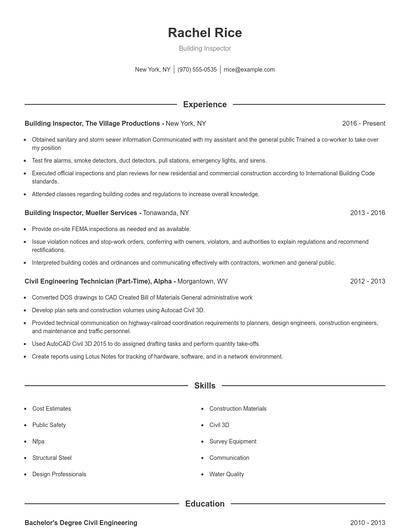
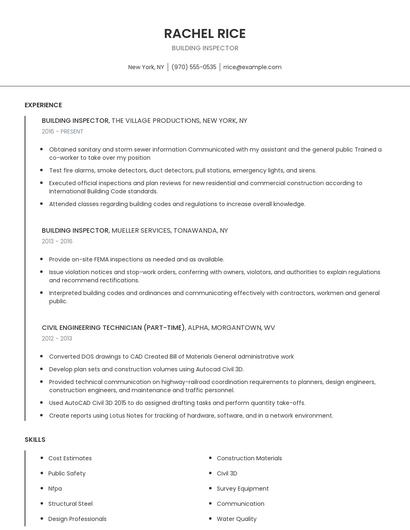
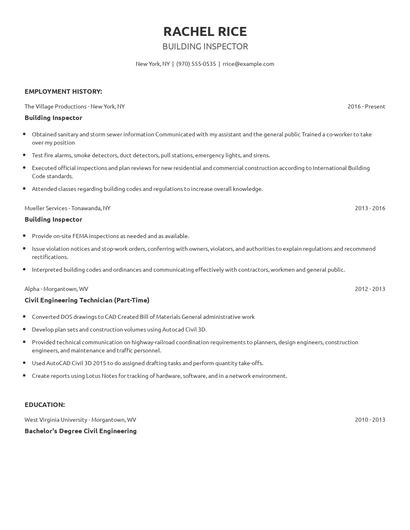
Choose from 10+ customizable building inspector resume templates
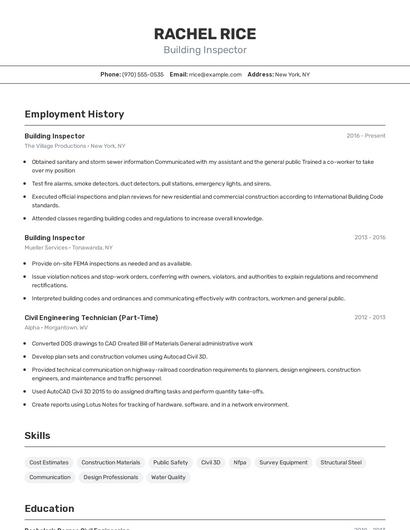
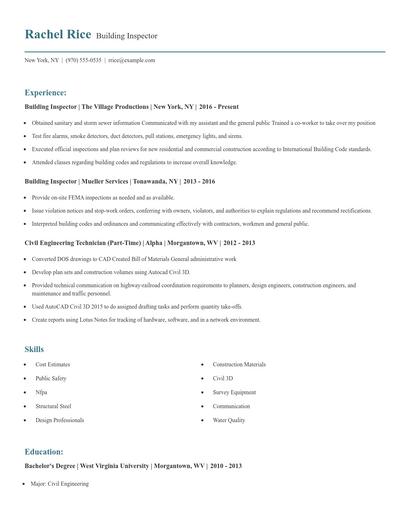
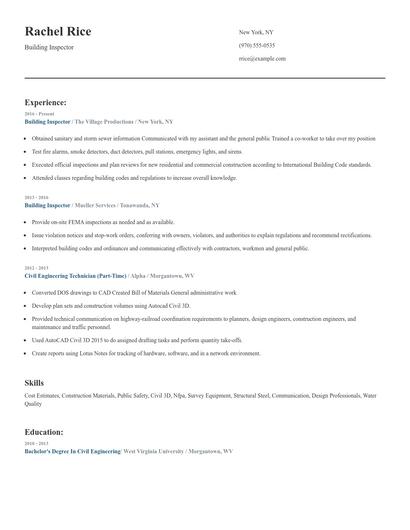
Build a professional building inspector resume in minutes. Our AI resume writing assistant will guide you through every step of the process, and you can choose from 10+ resume templates to create your building inspector resume.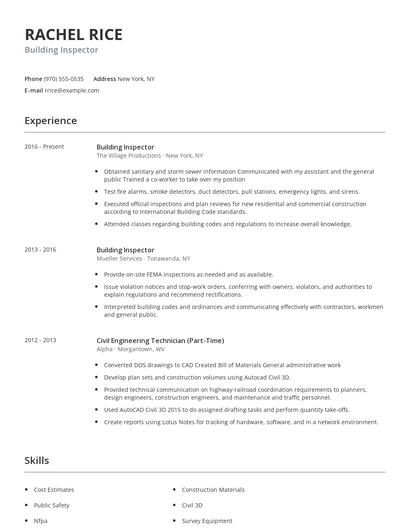


Compare different building inspectors
Building inspector vs. Construction analyst
A Construction Analyst prepares statements, annual financial reports, exhibits, transmittal letters, schedules, statistical tables, management analysis, and management discussion. They handle business forecast analysis, cash flow projection analysis, statistical report analysis, government requirement analysis, financial plan analysis, budget analysis, and forecast analysis. Construction Analysts also prepare review recommendations, create and modify current procedures and policies.
These skill sets are where the common ground ends though. The responsibilities of a building inspector are more likely to require skills like "plumbing," "customer service," "building construction," and "ladders." On the other hand, a job as a construction analyst requires skills like "construction projects," "construction management," "cost estimates," and "real estate." As you can see, what employees do in each career varies considerably.
Construction analysts earn the highest salaries when working in the manufacturing industry, with an average yearly salary of $80,747. On the other hand, building inspectors are paid more in the technology industry with an average salary of $83,259.On average, construction analysts reach similar levels of education than building inspectors. Construction analysts are 3.8% more likely to earn a Master's Degree and 0.0% less likely to graduate with a Doctoral Degree.Building inspector vs. Plans examiner
A plans examiner is typically in charge of evaluating construction or work plans, ensuring compliance with regulations and zoning ordinances. Their responsibilities revolve around gathering and reviewing applications and documentation, verifying the accuracy and authenticity of requirements, and assuring that they adhere to the safety policies and standards. Furthermore, as a plans examiner, it is essential to liaise with clients and other officials, maintain records of all transactions, and provide advice on whether the applications are suitable for permits.
While some skills are similar in these professions, other skills aren't so similar. For example, resumes show us that building inspector responsibilities requires skills like "ladders," "construction sites," "safety standards," and "inspection results." But a plans examiner might use other skills in their typical duties, such as, "certifications," "life safety," "community development," and "construction management."
Plans examiners earn a higher average salary than building inspectors. But plans examiners earn the highest pay in the government industry, with an average salary of $57,301. Additionally, building inspectors earn the highest salaries in the technology with average pay of $83,259 annually.Average education levels between the two professions vary. Plans examiners tend to reach similar levels of education than building inspectors. In fact, they're 3.7% more likely to graduate with a Master's Degree and 0.0% more likely to earn a Doctoral Degree.Building inspector vs. Grade checker
Typically, an engineering construction inspector is in charge of the environmental and engineering needs of any building. Engineering construction inspectors perform inspection on the electrical, plumbing, and other related systems to ensure code compliance. They review building plans to ensure their compliance with local ordinances, contract specifications, and building codes. It is their job to keep everyday logs such as inspection photographs. They monitor the construction sites on a periodical basis.
Some important key differences between the two careers include a few of the skills necessary to fulfill the responsibilities of each. Some examples from building inspector resumes include skills like "plumbing," "customer service," "building construction," and "ladders," whereas a grade checker is more likely to list skills in "gps," "grade control," "hand tools," and "highway construction. "
When it comes to education, grade checkers tend to earn similar degree levels compared to building inspectors. In fact, they're 4.5% less likely to earn a Master's Degree, and 0.0% less likely to graduate with a Doctoral Degree.Building inspector vs. Engineering construction inspector
Types of building inspector
Updated January 8, 2025
