Explore jobs
Find specific jobs
Explore careers
Explore professions
Best companies
Explore companies
What is a cable splicer and how to become one
For individuals who have a knack for electronics, and who don't necessarily want a nine-to-five desk job might consider a career as a cable splicer. A cable splicer typically works for a utility company or a telecommunications company to install, splice, test, and repair the high-voltage cables and wires in the field. In this day and age, cell phones, televisions, networks, and computers are all powered by electricity, and almost all are connected to the internet in some way. As a result, cable splicers provide a valuable service to keep our society up and running.
A cable splicer spends most of the time out in the field, either repairing cables on top of utility poles, inside buildings, or underground, and is responsible for installing, maintaining, and repairing power lines and cables. Cable splicers must be properly trained to handle live electrical wires and equipment and follow company safety protocols. This is especially critical when handling live electrical wires and cables that have been knocked down due to weather, or fixing broken connections, and neutralizing live wires.
Some cable splicers may have a background in electrical engineering, or may have experience working as an electrician; however, most companies will train staff in how to safely handle cable and electrical wires. Working as a cable splicer requires attention to detail, and good computer and record-keeping skills. Depending on the industry, cable splicers can make between $30,000 to over $60,000 per year, and job growth is predicted to decrease slightly by 3% by 2029.
Avg. Salary $46,998
Avg. Salary $59,228
Growth rate 6%
Growth rate 0.3%
American Indian and Alaska Native 0.86%
Asian 3.98%
Black or African American 9.23%
Hispanic or Latino 20.08%
Unknown 6.18%
White 59.68%
Genderfemale 5.06%
male 94.94%
Age - 45American Indian and Alaska Native 3.00%
Asian 7.00%
Black or African American 14.00%
Hispanic or Latino 19.00%
White 57.00%
Genderfemale 47.00%
male 53.00%
Age - 45Stress level is high
7.1 - high
Complexity level is challenging
7 - challenging
Work life balance is poor
6.4 - fair
Cable splicer career paths
Key steps to become a cable splicer
Explore cable splicer education requirements
Start to develop specific cable splicer skills
Skills Percentages Hand Tools 29.24% CDL 27.42% Bucket Truck 5.03% DOT 4.41% Ladders 4.27% Complete relevant cable splicer training and internships
Accountants spend an average of 1-3 months on post-employment, on-the-job training. New cable splicers learn the skills and techniques required for their job and employer during this time. The chart below shows how long it takes to gain competency as a cable splicer based on U.S. Bureau of Labor Statistics data and data from real cable splicer resumes.Research cable splicer duties and responsibilities
- Install UTP, STP, and T1 cabling.
- Dig and shore up cable pits, work in manholes, wire main frames and sub frames for cable throws.
- Follow safety procedures according to OSHA and BellSouth practices.
- Pull cable and dig for under grind missile bores.
Prepare your cable splicer resume
When your background is strong enough, you can start writing your cable splicer resume.
You can use Zippia's AI resume builder to make the resume writing process easier while also making sure that you include key information that hiring managers expect to see on a cable splicer resume. You'll find resume tips and examples of skills, responsibilities, and summaries, all provided by Zippi, your career sidekick.
Choose from 10+ customizable cable splicer resume templates
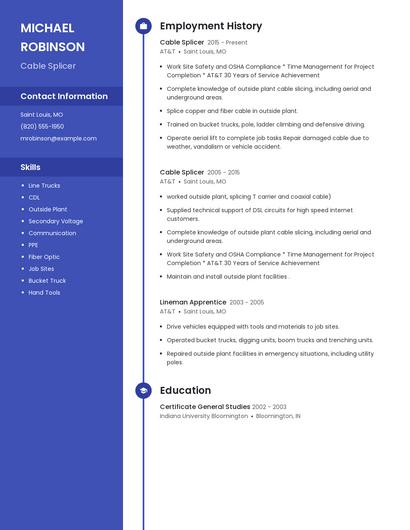
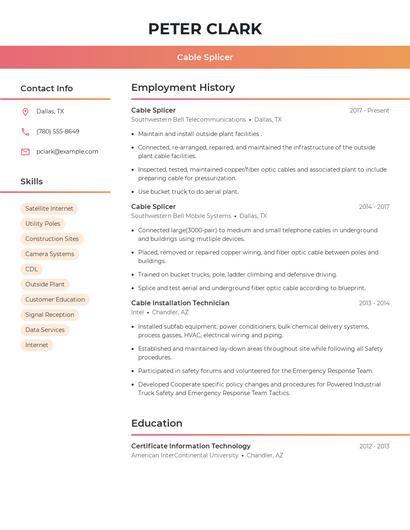
Build a professional cable splicer resume in minutes. Browse through our resume examples to identify the best way to word your resume. Then choose from 10+ resume templates to create your cable splicer resume.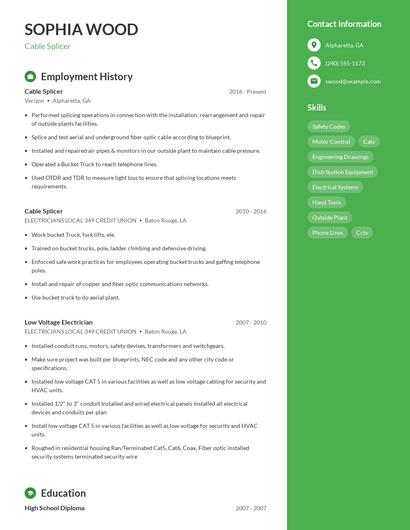


Apply for cable splicer jobs
Now it's time to start searching for a cable splicer job. Consider the tips below for a successful job search:
- Browse job boards for relevant postings
- Consult your professional network
- Reach out to companies you're interested in working for directly
- Watch out for job scams
How did you land your first cable splicer job

Are you a cable splicer?
Share your story for a free salary report.
Average cable splicer salary
The average cable splicer salary in the United States is $46,998 per year or $23 per hour. Cable splicer salaries range between $30,000 and $72,000 per year.
What am I worth?

How do cable splicers rate their job?
Cable splicer reviews

Troubleshooting fixing and installing fiber optic cable and systems
Adverse weather conditions.
Splicing makes me happy and what I love most is when I know a link or site is up after I would have done everything perfect
Working whole day and not achieving the goal
Updated January 8, 2025
