What does a cafeteria manager do?
Cafeteria manager responsibilities
Here are examples of responsibilities from real cafeteria manager resumes:
- Manage three main cafeterias and multiple internal plant cafeteria sites.
- Manage cafeteria as well as ordering groceries and other supplies and making sure all paper work is done.
- Manage festival concessions, including product selection, vendor management and volunteer training.
- Train staff as it relates to food preparation procedures and safety regulations and POS system.
- Order supplies and groceries from approve vendors.
- Monitor students' allergies and arrange for substitution if necessary.
- Supervise monthly USDA inspection of kitchen, equipment, and cafeteria areas.
- Operate large volume cooking equipment such as steamers ovens and meat slicer.
- Account for student and teachers meal accounts and work the POS computer systems.
- Keep an update allergies file for all participants and action plan from the school nurse.
- Follow safety and sanitation practices daily and complete monthly training with staff per HACCP training modules.
- Adhere to HACCP guidelines to ensure efficient, safe and sanitary food production, preparation and presentation.
- Maintain kitchen/cafeteria areas cleanliness for health inspections.
- Receive numerous certificates in cafeteria manager training and USDA training.
- Support management in all operational needs including payroll and vendor coordination.
Cafeteria manager skills and personality traits
We calculated that 18% of Cafeteria Managers are proficient in Kitchen Equipment, Food Safety, and Bank Deposits. They’re also known for soft skills such as Business skills, Communication skills, and Customer-service skills.
We break down the percentage of Cafeteria Managers that have these skills listed on their resume here:
- Kitchen Equipment, 18%
Instruct kitchen personnel in the safe, proper, and efficient use of all kitchen equipment.
- Food Safety, 15%
Prepared food in accordance with food safety standards and individual dietary restrictions.
- Bank Deposits, 9%
Maintain written daily records on food production, bank deposits, safety, sanitation, HAACP, receiving and procurement.
- Payroll, 8%
Supported management in all operational needs including payroll and vendor coordination.
- ServSafe, 6%
Maintained safe food handling knowledge and ServSafe Certification.
- Plan Menus, 5%
Use Microsoft Excel and Word to plan menus, make table toppers, sign-up sheets, etc.
Most cafeteria managers use their skills in "kitchen equipment," "food safety," and "bank deposits" to do their jobs. You can find more detail on essential cafeteria manager responsibilities here:
Business skills. One of the key soft skills for a cafeteria manager to have is business skills. You can see how this relates to what cafeteria managers do because "food service managers must understand all aspects of the restaurant business, including how to budget for supplies, comply with regulations, and manage workers." Additionally, a cafeteria manager resume shows how cafeteria managers use business skills: "decreased customer complaints by becoming active with guest and employees supervised day-to-day business operations assisted in quality control of goods and services"
Communication skills. Another soft skill that's essential for fulfilling cafeteria manager duties is communication skills. The role rewards competence in this skill because "food service managers must give clear orders to staff and be able to convey information effectively to employees and customers." According to a cafeteria manager resume, here's how cafeteria managers can utilize communication skills in their job responsibilities: "manage food service department communications, relationship with school administration, staff training and development. "
Customer-service skills. Another skill that relates to the job responsibilities of cafeteria managers is customer-service skills. This skill is critical to many everyday cafeteria manager duties, as "food service managers must be courteous and attentive when dealing with patrons." This example from a resume shows how this skill is used: "recommended corrective action to address customer complaints. "
Leadership skills. A commonly-found skill in cafeteria manager job descriptions, "leadership skills" is essential to what cafeteria managers do. Cafeteria manager responsibilities rely on this skill because "managers must establish good relationships with staff to maintain a productive work environment." You can also see how cafeteria manager duties rely on leadership skills in this resume example: "graduate of aramark's accelerate to leadership program; class of 120 out of 2000 candidates. "
Organizational skills. Lastly, "organizational skills" is an important element of what a cafeteria manager does. Cafeteria manager responsibilities require this skill because "managers have many different responsibilities, including scheduling and overseeing staff, budgeting, and maintaining financial records." This resume example highlights how cafeteria manager duties rely on this skill: "developed leadership qualities and organizational skills in order to lead the staff in the correct. "
The three companies that hire the most cafeteria managers are:
- SLA Management37 cafeteria managers jobs
- Boston Public Schools10 cafeteria managers jobs
- Aramark4 cafeteria managers jobs
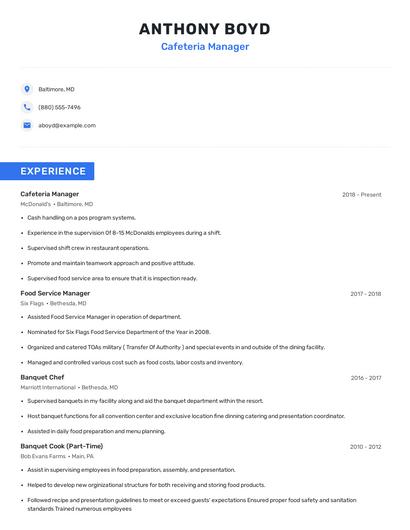
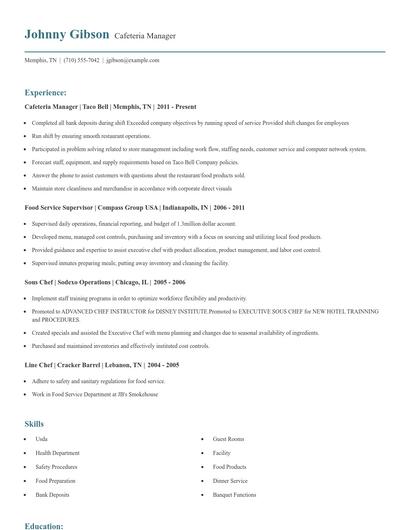
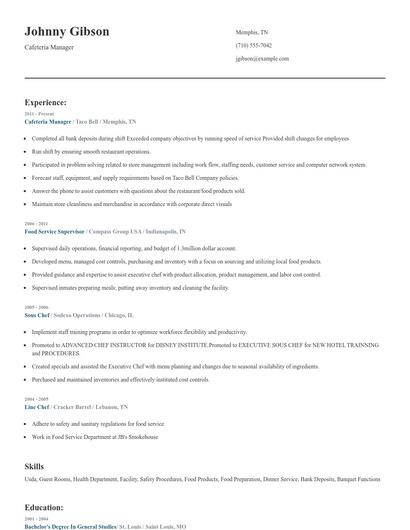
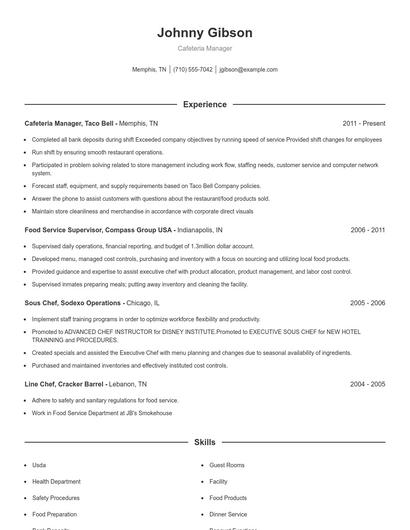
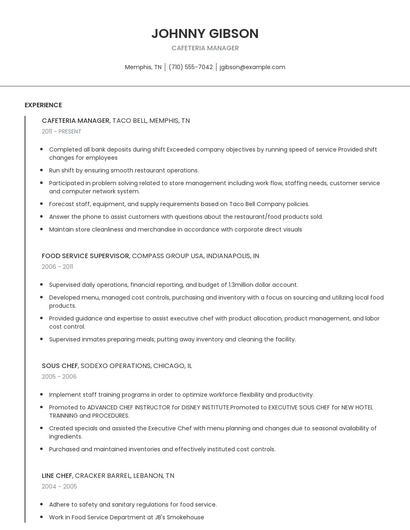
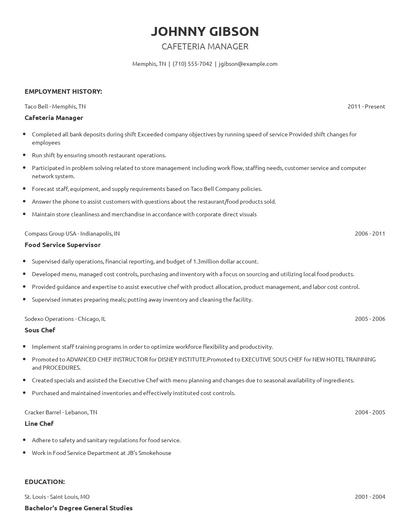
Choose from 10+ customizable cafeteria manager resume templates
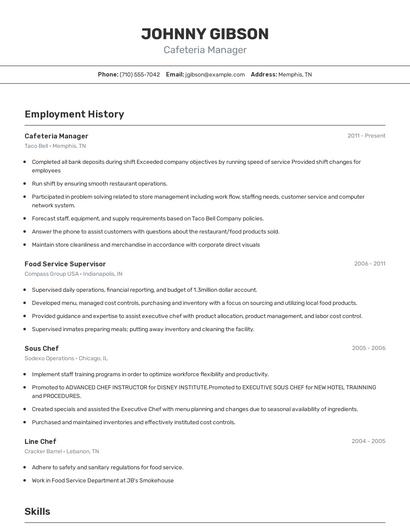
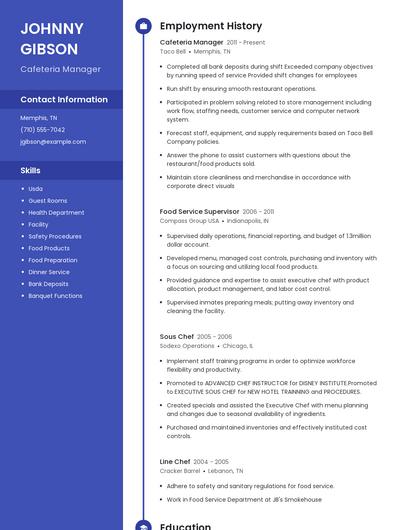
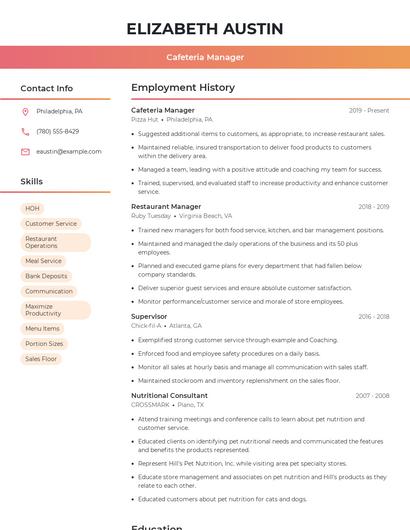
Build a professional cafeteria manager resume in minutes. Our AI resume writing assistant will guide you through every step of the process, and you can choose from 10+ resume templates to create your cafeteria manager resume.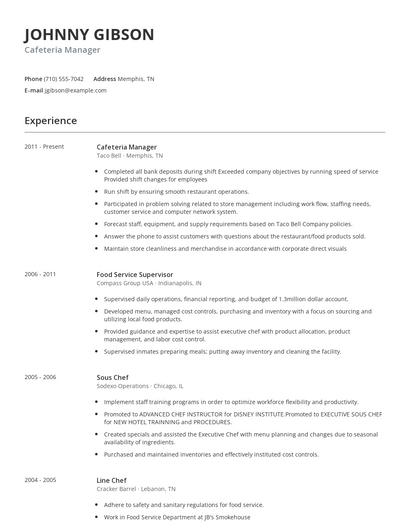


Compare different cafeteria managers
Cafeteria manager vs. Food service director
A food service director is responsible for managing the foodservice operations, achieving the customers' highest satisfaction by supervising the kitchen personnel, monitoring the food distribution, and responding to the guests' inquiries and concerns. Foodservice directors manage the food inventories, ensuring the adequacy of all the ingredients and materials, and keeping the storage safe and clean all the time by enforcing strict sanitary and hygienic procedures. A food service director must be updated with the current food industry trends to update the menu regularly and meet the guests' demands.
There are some key differences in the responsibilities of each position. For example, cafeteria manager responsibilities require skills like "bank deposits," "payroll," "plan menus," and "order food." Meanwhile a typical food service director has skills in areas such as "customer service," "culinary," "good judgment," and "cleanliness." This difference in skills reveals the differences in what each career does.
Food service directors tend to make the most money working in the health care industry, where they earn an average salary of $59,629. In contrast, cafeteria managers make the biggest average salary, $32,241, in the hospitality industry.The education levels that food service directors earn slightly differ from cafeteria managers. In particular, food service directors are 3.3% more likely to graduate with a Master's Degree than a cafeteria manager. Additionally, they're 0.0% less likely to earn a Doctoral Degree.Cafeteria manager vs. Restaurant/bar manager
A shift lead manager is an employee who is responsible for supervising the daily activities of a store, particularly in creating schedules and assigning them to staff members. Shift lead managers are required to monitor the team's performance and manage the requests of employees. They must open registers and close them by the end of the day and prepare cash to be deposited. Shift lead managers are also required to handle customer issues and report them to the management during the shift.
While some skills are similar in these professions, other skills aren't so similar. For example, resumes show us that cafeteria manager responsibilities requires skills like "kitchen equipment," "food safety," "servsafe," and "plan menus." But a restaurant/bar manager might use other skills in their typical duties, such as, "food handling," "customer service," "wine," and "guest satisfaction."
Restaurant/bar managers earn a higher average salary than cafeteria managers. But restaurant/bar managers earn the highest pay in the media industry, with an average salary of $52,593. Additionally, cafeteria managers earn the highest salaries in the hospitality with average pay of $32,241 annually.restaurant/bar managers earn similar levels of education than cafeteria managers in general. They're 1.2% more likely to graduate with a Master's Degree and 0.0% more likely to earn a Doctoral Degree.Cafeteria manager vs. Shift lead manager
A food manager oversees the operations at various dining establishments, ensuring efficient food services and client satisfaction. Their responsibilities typically include managing the staff, setting schedules and guidelines, establishing objectives and budgets, liaising with vendors and suppliers, delegating tasks, and developing strategies to optimize overall operations. There are also instances where they may assist customers, arrange reservations, process payments, prepare and organize documents, hire and train new members of the workforce, and resolve issues and concerns. Moreover, as a food manager, they must lead and encourage the staff to reach goals, all while implementing the company's policies and regulations.
The required skills of the two careers differ considerably. For example, cafeteria managers are more likely to have skills like "kitchen equipment," "payroll," "plan menus," and "food service operations." But a shift lead manager is more likely to have skills like "math," "management," "cleanliness," and "leadership."
Shift lead managers typically earn similar educational levels compared to cafeteria managers. Specifically, they're 0.0% more likely to graduate with a Master's Degree, and 0.2% more likely to earn a Doctoral Degree.Cafeteria manager vs. Food manager
Types of cafeteria manager
Updated January 8, 2025
