What does a calibration technician do?
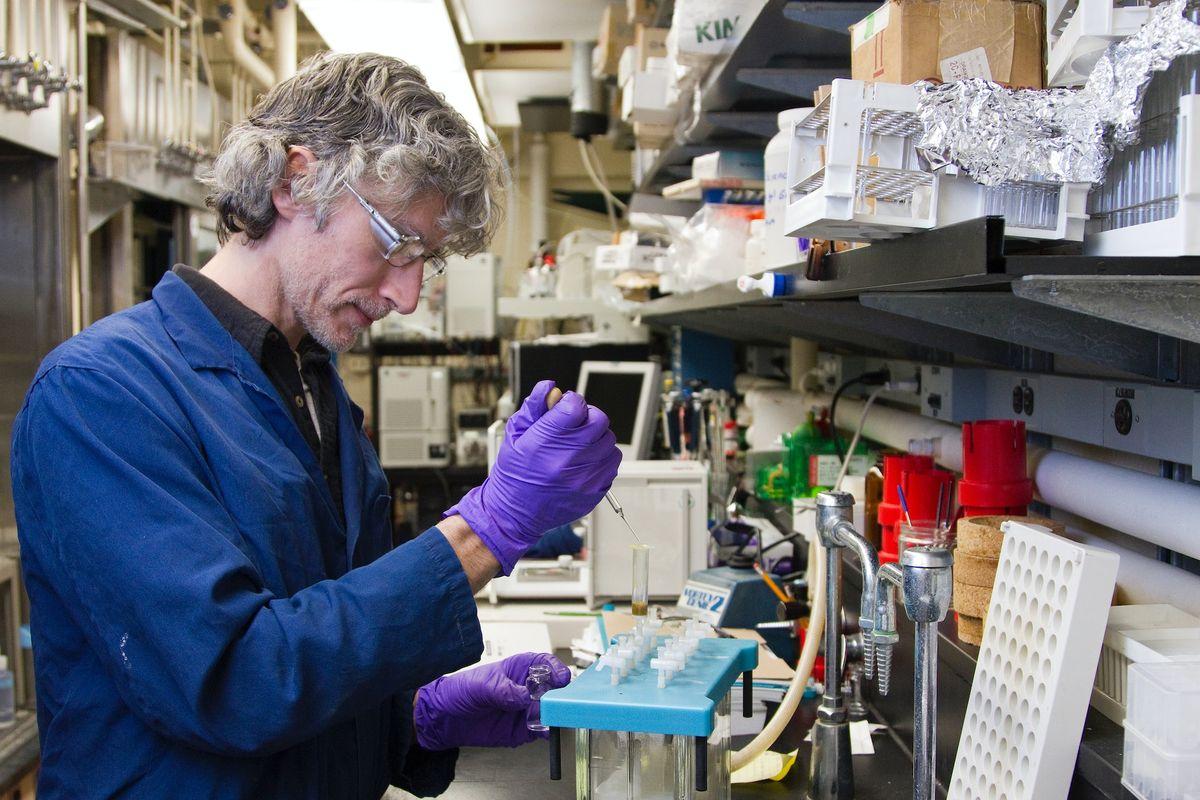
The calibration technician's primary role in manufacturing industries is to make sure that measurements taken with the use of equipment are accurate. They are responsible for the regular monitoring and maintenance of equipment and instruments to ensure that their readings and output match the desired results. Their duties include testing, maintenance, routine inspection, as well as the repair of instruments and manufacturing equipment. Important skills required for the job include keen attention to detail, analytical skills, and coordination for conducting tests with various equipment.
Calibration technician responsibilities
Here are examples of responsibilities from real calibration technician resumes:
- Comply with good laboratory practices FDA, QSR, ISO, safety and environmental regulations.
- Calibrate and repair general-purpose and RF test, measurement, & diagnostic equipment (TMDE) and microwave passive standards.
- Calibrate basic mechanical and electrical measurement instruments, such as calipers, micrometers and voltage-current-resistance meters.
- Perform calibration and maintenance of measuring equipment including micrometers, calipers and drop indicators among others.
- Maintain standards in accordance with cGMP, USP, JP and ISO.
- Install MCC's, VFD's, motors, and Allen Bradley PLC's.
- Analyze HVAC circuits to support mechanical repairs.
- Limit knowledge of reading micrometers and calibrating gage blocks.
- Utilize optical comparators to determine the quality for thread molding.
- Provide assistance to maintain current ISO standards and A2LA accreditation.
- Trouble-shoot problematic loops during commissioning start-up from field to DCS control room
- Perform calibrations and preventative maintenance of HPLC systems and other equipment.
- Review and approve all reports and certificates for TMDE calibrate, service, or repair by approve vendors.
- Develop and implement procedures for identification, turn-in, and control of TMDE requiring calibration and repair support.
- Used test measuring equipment require to perform RF, voltage/amp and computer addressing.
Calibration technician skills and personality traits
We calculated that 10% of Calibration Technicians are proficient in Metrology, Customer Service, and Calibration Procedures. They’re also known for soft skills such as Math skills, Writing skills, and Mechanical skills.
We break down the percentage of Calibration Technicians that have these skills listed on their resume here:
- Metrology, 10%
Performed calibration and repair of aviation precision measurement equipment and automatic test equipment in accordance with U.S. Navy metrology procedures.
- Customer Service, 10%
Conducted qualification and performance tested; generated test reports; and supported customer services.
- Calibration Procedures, 6%
Submitted and granted approval for 5 various calibration procedure improvements/corrections minimize possible error due to different interpretation and learning styles.
- Troubleshoot, 6%
Calibrate, maintain, repair, and troubleshoot instrumentation for laboratory and manufacturing to ensure conformance with established Standard Operating Procedures.
- Hand Tools, 4%
Operated and calibrated micro measurement and mechanical hand tools to comply with test requirements and to perform data acquisition and analysis.
- Equipment Calibration, 4%
Prepared calibration reports/certificates and maintained equipment calibration data/history logs in the company data base.
Common skills that a calibration technician uses to do their job include "metrology," "customer service," and "calibration procedures." You can find details on the most important calibration technician responsibilities below.
Math skills. The most essential soft skill for a calibration technician to carry out their responsibilities is math skills. This skill is important for the role because "electrical and electronic engineering technologists and technicians use mathematics for analysis, design, and troubleshooting tasks." Additionally, a calibration technician resume shows how their duties depend on math skills: "applied math, physics and statistical methods toward certification of instrumentation accuracy. "
Writing skills. Another essential skill to perform calibration technician duties is writing skills. Calibration technicians responsibilities require that "electrical and electronic engineering technologists and technicians write reports about onsite construction, design problems, or testing results." Calibration technicians also use writing skills in their role according to a real resume snippet: "authored investigation reports and assisted metrology engineers in writing investigation reports. "
Mechanical skills. Another skill that relates to the job responsibilities of calibration technicians is mechanical skills. This skill is critical to many everyday calibration technician duties, as "electronic engineering technologists and technicians must use hand tools and soldering irons on small circuitry and electronic parts to build components by hand." This example from a resume shows how this skill is used: "supervised 20 personnel and managed a metrology lab; oversaw calibration of mechanical and electromechanical equipment. )"
Detail oriented. Another crucial skill for a calibration technician to carry out their responsibilities is "detail oriented." A big part of what calibration technicians relies on this skill, since "electrical engineering technologists and technicians must pay attention to detail when assembling, troubleshooting, and repairing electronic and electrical mechanical systems." How this skill relates to calibration technician duties can be seen in an example from a calibration technician resume snippet: "produced detailed calibration of laboratory instrumentation with documentation in accordance with iso 9001 and other metrology regulations. "
The three companies that hire the most calibration technicians are:
- Transcat119 calibration technicians jobs
- Reno, NV44 calibration technicians jobs
- SIMCO Electronics32 calibration technicians jobs
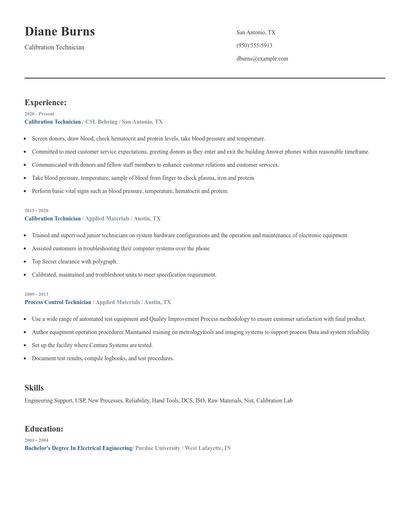
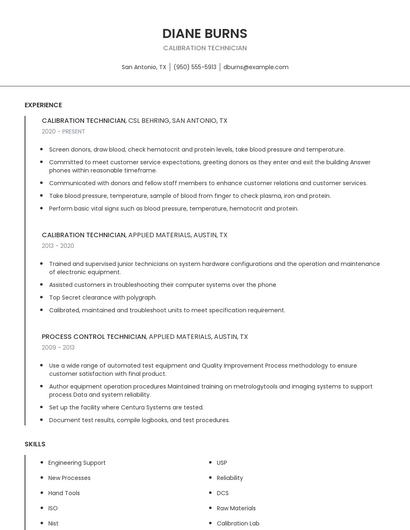
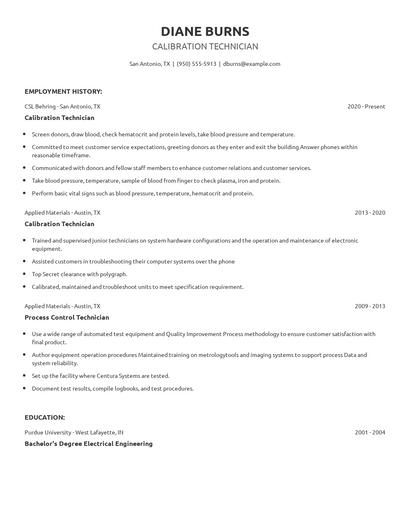
Choose from 10+ customizable calibration technician resume templates
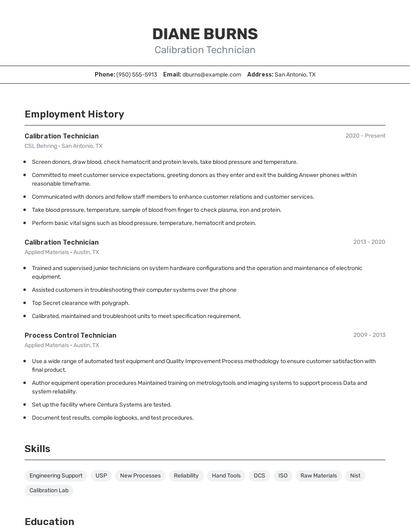
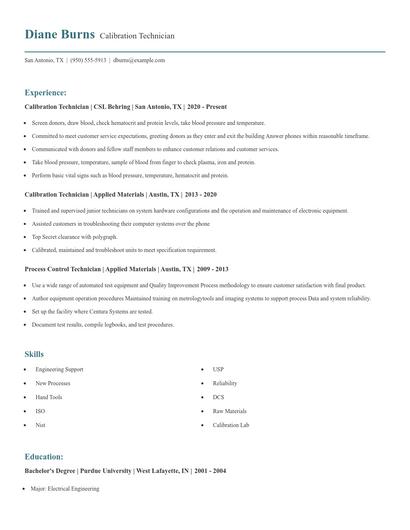
Build a professional calibration technician resume in minutes. Our AI resume writing assistant will guide you through every step of the process, and you can choose from 10+ resume templates to create your calibration technician resume.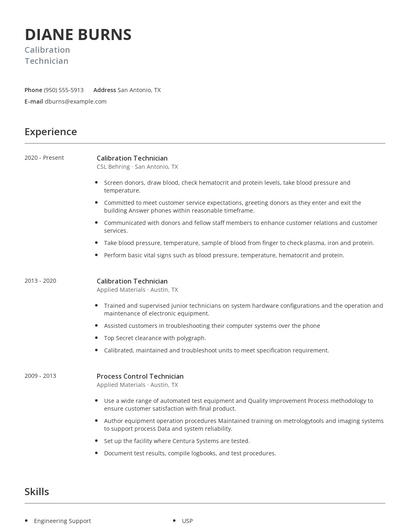



Compare different calibration technicians
Calibration technician vs. Engineering associate
An engineering associate is an individual whose job duties include analysis of project plans, development of product designs, and maintenance of equipment. The engineering fields where an engineering associate can find a job include civil, mechanical, and environmental. The requirements to qualify for the position include obtaining a bachelor's degree in engineering, familiarity with a specific industry, prior work experience related to the field, and possessing strong technical skills.
These skill sets are where the common ground ends though. The responsibilities of a calibration technician are more likely to require skills like "metrology," "customer service," "calibration procedures," and "hand tools." On the other hand, a job as an engineering associate requires skills like "python," "java," "cad," and "c++." As you can see, what employees do in each career varies considerably.
Engineering associates tend to make the most money working in the energy industry, where they earn an average salary of $88,950. In contrast, calibration technicians make the biggest average salary, $77,957, in the pharmaceutical industry.engineering associates tend to reach higher levels of education than calibration technicians. In fact, engineering associates are 7.0% more likely to graduate with a Master's Degree and 0.5% more likely to have a Doctoral Degree.Calibration technician vs. Technical testing engineer
A technical testing engineer is responsible for inspecting and reporting the quality of products across the production cycle. You will thoroughly check procedures, materials, and electrical and mechanical systems to produce high-quality products for customers. Your main job is to test various components and features of the product to identify and resolve technical issues. Other duties include organizing and conducting training for junior team members, creating test environments, and identifying the root cause of technical issues.
Each career also uses different skills, according to real calibration technician resumes. While calibration technician responsibilities can utilize skills like "metrology," "customer service," "calibration procedures," and "troubleshoot," technical testing engineers use skills like "test results," "schematics," "test data," and "test fixtures."
On average, technical testing engineers earn a higher salary than calibration technicians. Some industries support higher salaries in each profession. Interestingly enough, technical testing engineers earn the most pay in the automotive industry with an average salary of $93,229. Whereas calibration technicians have higher pay in the pharmaceutical industry, with an average salary of $77,957.technical testing engineers earn similar levels of education than calibration technicians in general. They're 1.3% more likely to graduate with a Master's Degree and 0.5% less likely to earn a Doctoral Degree.Calibration technician vs. Instrument and controls technician
An instrument and controls technician is responsible for checking and inspecting the condition of production equipment and machinery, ensuring its stability to support business functions and manufacturing processes. Instrument and control technicians study schematics and blueprints of system components to assemble parts and analyze its features for measurement. They also resolve system failures and write resolution reports to prevent the reoccurrence of downtime that may pose risks to the production, avoiding operational delays and potential hazards within the premises.
The required skills of the two careers differ considerably. For example, calibration technicians are more likely to have skills like "metrology," "customer service," "calibration procedures," and "troubleshoot." But a instrument and controls technician is more likely to have skills like "control systems," "electrical equipment," "process control," and "preventative maintenance."
Instrument and controls technicians earn the best pay in the energy industry, where they command an average salary of $71,218. Calibration technicians earn the highest pay from the pharmaceutical industry, with an average salary of $77,957.When it comes to education, instrument and controls technicians tend to earn similar degree levels compared to calibration technicians. In fact, they're 1.7% more likely to earn a Master's Degree, and 0.2% more likely to graduate with a Doctoral Degree.Calibration technician vs. Electronics engineering technician
Electronics Engineering Technician helps engineers design and advance electronic devices and components, install electrical equipment, and maintain electronic systems. They usually work in product evaluation and testing. They use diagnostic and measuring devices to test, adjust, and repair equipment. They ensure customer satisfaction by minimizing downtime, correcting and troubleshooting errors. Further duties include training new technicians in troubleshooting various equipment or product, giving management performance recommendations, testing the system by setting up equipment under simulated conditions, and documenting the troubleshooting process.
Even though a few skill sets overlap between calibration technicians and electronics engineering technicians, there are some differences that are important to note. For one, a calibration technician might have more use for skills like "metrology," "customer service," "calibration procedures," and "equipment calibration." Meanwhile, some responsibilities of electronics engineering technicians require skills like "rf," "lab equipment," "pcb," and "analog. "
Electronics engineering technicians enjoy the best pay in the technology industry, with an average salary of $86,980. For comparison, calibration technicians earn the highest salary in the pharmaceutical industry.In general, electronics engineering technicians hold similar degree levels compared to calibration technicians. Electronics engineering technicians are 0.4% more likely to earn their Master's Degree and 0.1% less likely to graduate with a Doctoral Degree.Types of calibration technician
Updated January 8, 2025
