Explore jobs
Find specific jobs
Explore careers
Explore professions
Best companies
Explore companies
Job outlook for channel sales representatives in the United States
Channel sales representative job growth summary. After extensive research, interviews, and analysis, Zippia's data science team found that:
The projected channel sales representative job growth rate is 4% from 2018-2028.
About 63,300 new jobs for channel sales representatives are projected over the next decade.
Channel sales representative salaries have increased 9% for channel sales representatives in the last 5 years.
There are over 23,178 channel sales representatives currently employed in the United States.
There are 215,005 active channel sales representative job openings in the US.
The average channel sales representative salary is $66,190.
Are channel sales representative jobs in demand?
Channel sales representative job and salary trends over time
Channel sales representative jobs over time
Channel sales representative job growth rate over time
| Year | # of jobs | % of population |
|---|---|---|
| 2021 | 23,178 | 0.01% |
| 2020 | 23,853 | 0.01% |
| 2019 | 25,082 | 0.01% |
| 2018 | 25,187 | 0.01% |
| 2017 | 25,956 | 0.01% |
Average channel sales representative salary over time
Channel sales representative salary by year
| Year | Avg. salary | Hourly rate | % Change |
|---|---|---|---|
| 2026 | $66,190 | $31.82 | +3.6% |
| 2025 | $63,908 | $30.73 | +2.4% |
| 2024 | $62,394 | $30.00 | +2.7% |
| 2023 | $60,752 | $29.21 | --0.3% |
| 2022 | $60,933 | $29.29 | +2.5% |
Channel sales representative jobs by state
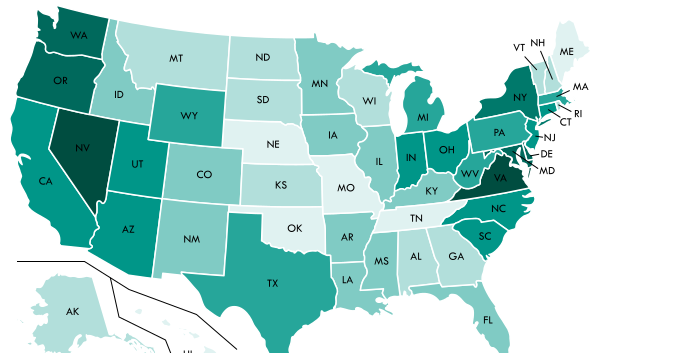
Most common states for channel sales representatives
| Rank | State | Population | # of jobs | Employment/ 1000ppl |
|---|---|---|---|---|
| 1 | District of Columbia | 693,972 | 354 | 51% |
| 2 | Vermont | 623,657 | 228 | 37% |
| 3 | Rhode Island | 1,059,639 | 372 | 35% |
| 4 | Massachusetts | 6,859,819 | 2,294 | 33% |
| 5 | Oregon | 4,142,776 | 1,281 | 31% |
| 6 | Utah | 3,101,833 | 948 | 31% |
| 7 | Pennsylvania | 12,805,537 | 3,809 | 30% |
| 8 | Montana | 1,050,493 | 314 | 30% |
| 9 | New Jersey | 9,005,644 | 2,576 | 29% |
| 10 | Delaware | 961,939 | 278 | 29% |
| 11 | Ohio | 11,658,609 | 3,018 | 26% |
| 12 | Wisconsin | 5,795,483 | 1,479 | 26% |
| 13 | Nebraska | 1,920,076 | 504 | 26% |
| 14 | New Hampshire | 1,342,795 | 352 | 26% |
| 15 | Virginia | 8,470,020 | 2,126 | 25% |
| 16 | Arizona | 7,016,270 | 1,748 | 25% |
| 17 | Colorado | 5,607,154 | 1,411 | 25% |
| 18 | Minnesota | 5,576,606 | 1,380 | 25% |
| 19 | Connecticut | 3,588,184 | 894 | 25% |
| 20 | Iowa | 3,145,711 | 778 | 25% |
Most common cities for channel sales representatives
| Rank | City | # of jobs | Employment/ 1000ppl | Avg. salary |
|---|---|---|---|---|
| 1 | Englewood | 1 | 3% | $58,319 |
| 2 | Reading | 1 | 1% | $63,507 |
| 3 | San Mateo | 1 | 1% | $75,104 |
| 4 | Charlotte | 3 | 0% | $62,724 |
| 5 | Boston | 1 | 0% | $59,815 |
| 6 | Chicago | 1 | 0% | $58,180 |
| 7 | Indianapolis | 1 | 0% | $65,351 |
| 8 | San Antonio | 1 | 0% | $65,228 |
Channel Sales Representative job outlook: Expert opinions
Our panel of channel sales representative experts
University of Maryland - College Park
Southern Illinois University Edwardsville
University of Maryland - College Park
North Dakota State University
University of Akron

Denison University

The University of Findlay

Fordham University Gabelli School of Business
University of Nebraska at Omaha
Illinois Wesleyan University

Kent State University
Virginia Polytechnic Institute and State University
University of Dallas

Central Connecticut State University
University of Wisconsin - Green Bay
What Channel Sales Representative skills would you recommend for someone trying to advance their career?
Dr. Kathleen Kelly: Maximizing your salary potential requires research, flexibility, and being your best advocate.
E. Duff Wrobbel Ph.D.
ChairSouthern Illinois University Edwardsville
Communication And Media Studies
What Channel Sales Representative skills would you recommend for someone trying to advance their career?
E. Duff Wrobbel Ph.D.: All things social media are important, and so writing skills still matter.
What will help Channel Sales Representatives increase their earning potential?
E. Duff Wrobbel Ph.D.: With this major, probably the best salaries are from sales jobs, which many people shy away from because they think only of hustling used cars, but sales can be very good work.
What general advice would you give to a Channel Sales Representative?
Hank Boyd: Demonstrated proficiency in sales represents a feather in your cap. For many
CEOs, they started their illustrious career in sales. Nowadays, it is a common
launchpad for scores of successful business executives in consumer package goods.
Why is this so? Savvy companies know that it is paramount that new hires
quickly learn who the real target consumers are. Spending time on the front lines will
enhance your later contributions to the firm. For example, after obtaining my MBA from
Berkeley, I had the good fortune to land a sales position at Merck. I served as a Hospital
Representative specializing in broad spectrum antibiotics. My territory consisted of
Stanford University Medical Center, Palo Alto VA Medical Center, and the Santa Clara
Valley Medical Center.
After 18 months of working diligently in territory, I was offered a promotion to
work inside at Merck's headquarters in Rahway, New Jersey. Once I truly knew the
needs and concerns of my clients - general surgeons, urologists, gastroenterologists,
urologists, and infectious disease specialists - Merck was confident I could craft
relevant literature pieces and design compelling ad campaigns to reach target
physicians.
Mastery of general sales is a highly coveted asset. Once you conquer a given
product domain, the artform of sales is entirely transferrable. Case in point, it is not
unusual for you to begin in pharmaceuticals and then effortlessly segue into medical
equipment sales after a couple of years.
Eric Gjerdevig
Lecturer in Marketing, Director for the Center for Professional Selling and Sales TechnologyNorth Dakota State University
Marketing
What general advice would you give to a Channel Sales Representative?
Eric Gjerdevig: First, remember that what you get out of your first job is so much more than compensation. A great manager mentoring you is priceless: it will pay you back dividends for the rest of your career. That said, in sales our compensation is typically tied to our performance. That means we need to put yourself out there, pay attention to the actions of the most successful salesperson in the company, learn everything you can, and manage your time well.
What Channel Sales Representative skills would you recommend for someone trying to advance their career?
Eric Gjerdevig: I might be a contrarian with this answer. I think as technology advances very quickly with AI it's our human-to-human skills that will become rarer and more valuable over the coming years. It might sound silly but things such as asking questions, listening, storytelling, and being empathetic can function like superpowers and I think they will even more in the coming years.
What will help Channel Sales Representatives increase their earning potential?
Eric Gjerdevig: Learning doesn't stop when you graduate. How jobs are done will continue to evolve more quickly with advancing technology. To excel you need to continue to learn, develop new skills, and be adaptive.
Director Dave Payne M.S.
Associate Professor of Practice / SalesUniversity of Akron
Specialized Sales, Merchandising And Marketing Operations
What general advice would you give to a Channel Sales Representative?
Director Dave Payne M.S.: Planning, practice, and skills are the keys to a successful career launch. Practice and coaching feedback will build competence, which builds confidence and sales performance success.
What will help Channel Sales Representatives increase their earning potential?
Ashley Strausser: Graduates need to do their research, know their worth and negotiate their job offer. It amazes me how many students accept the salary offered to them without considering negotiation. Graduates should do their due diligence using sites such as Glassdoor and Salary.com to compare their salary offer to similar roles in the same region. If you are going to negotiate, you must be able to make a strong case as to why you are deserving of more money. This cannot be based on what you feel you deserve, but rather the skills you possess, relevant experiences you've had and the tangible results you've achieved that will enable you to be successful in the role. Evaluate the job description to determine if you possess some, or perhaps many, of the desired qualifications beyond the minimum qualifications listed. If so, use those as part of your negotiation. If not, consider how you might be able to develop those desired qualifications to make you a stronger candidate.
Competitive candidates should have a strong, well-rounded skill set. Being able to articulate your skills and experiences (academic, co-curricular, internships, research, study abroad, etc.) both on your resume and in an interview is critical. Know the skills necessary to be effective in the roles you seek. If you are lacking skills essential to your desired roles or industries, consider completing online courses or certifications through LinkedIn Learning or Coursera. Take advantage of skill-building resources and programs available through your university. Finally, research and prepare well for your interviews. This includes conducting mock interviews with staff in your career center to practice and gain valuable feedback on ways to improve your interviewing skills.
Are there any particularly good places in the United States for Channel Sales Representatives to find work opportunities?
Christopher Sippel Ed.D.: A silver lining to the pandemic may be that the location of an individual in many industries no longer dictates which company or organization someone can work for. When travel restrictions begin to ease, successful candidates will be willing to go wherever they are asked to go. In these challenging times, organizations will need people that are open to working where they are needed.
What experience really stands out on Channel Sales Representative resumes?
Anthony DeFrancesco: Knowledge and experience with sales technology tools and effectively navigating Omnichannel hybrid sales environments. Social selling and analytical skills are also highly important. Product and industry knowledge for the targeted verticals also stands out. Experience with specific industry vertical prospecting tools can be a major differentiator. Finally, important to complement the aforementioned ATS keywords are leadership and team collaboration.
Will there be an enduring impact of the coronavirus pandemic on Channel Sales Representatives?
Anthony DeFrancesco: Yes, there will. Many businesses are changing their headquarters, operational infrastructure and buying communications protocols. Effective vertical prospecting, networking and selling skills will still be as important as ever as sales engagements will continue to become more complex. According to McKinsey sales engagements of course have moved mostly to digital and remote which is a trend that started before the pandemic. A McKinsey survey of B2B companies finds that, "Almost 90 percent of sales have moved to a videoconferencing(VC)/phone/web sales model, and while some skepticism remains, more than half believe this is equally or more effective than sales models used before COVID-19." (The B2B digital inflection point: How sales have changed during COVID-19) April 30, 2020 McKinsey Article)
What experience really stands out on Channel Sales Representative resumes?
Anthony DeFrancesco: Knowledge and experience with sales technology tools and effectively navigating Omnichannel hybrid sales environments. Social selling and analytical skills are also highly important. Product and industry knowledge for the targeted verticals also stands out. Experience with specific industry vertical prospecting tools can be a major differentiator. Finally, important to complement the aforementioned ATS keywords are leadership and team collaboration.
What Channel Sales Representative skills would you recommend for someone trying to advance their career?
Laura Sansoni: I think taking a year between high school and college or between a bachelor's and master's degree can be incredibly beneficial if the individual approaches this time with intentional purpose. If they want to gain work experience and/or save up money for school, seeking a position with ties to a career that interests them is going to help them narrow down their academic path once they begin their higher education.
If they want to use this time to travel, they should consider documenting their experiences to reflect on their personal growth and any new skills they gain such as learning a new language. If they simply wish to take a break from their studies, take the year to explore their personal interests and hobbies by trying new things and meeting with people doing work that interests them. Lifelong, fulfilling careers stem from your passions and interests. Discovering both early will help guide them in educational pursuits as well as fulfilling work throughout their life.
What are the biggest trends we'll see in the Channel Sales Representative job market given the pandemic?
Fred Hoyt Ph.D.: The biggest trends I believe in the job market will be the search for employees who have mastered (or at least adapted to) the demands of online everything: sales, fulfillment, working at a distance with minimum supervision in groups with minimal supervision, positive mental attitude, and an ability to self-motivate.
John Rose
Associate Lecturer, Internship Coordinator and MSA CoordinatorKent State University
Department of Accounting
What are the biggest trends we'll see in the Channel Sales Representative job market given the pandemic?
John Rose: For accounting students, the job market is good. There was a dip at the beginning of the pandemic, but CPA firms are still hiring. The number of interns for the winter season is comparable to the previous year.
Jonathan Byers
Assistant DirectorVirginia Polytechnic Institute and State University
Career and Professional Development
What skills stand out on Channel Sales Representative resumes?
Jonathan Byers:
- Professional skills related to career development competencies such as strong oral & written communication, teamwork & collaboration, leadership, problem-solving ability & creativity, and professional integrity, but we recommend that applicants do not just list these skills. They should provide evidence of how they have used them in their work experience, volunteer experience, academic experience, etc.
-The ability to use technology effectively to solve problems or improve collaboration; this could relate to social media management, computer hardware or software skills, proficiency with general programs like Microsoft Office Suite (also being able to demonstrate the use of these skills in various experiences).
-With diversity, equity, and inclusion becoming more important in 2020, the ability to appreciate different points of view, accept and appreciate different cultural backgrounds & types of identities, and increased awareness of one's own cultural biases and assumptions can also be important to market on a resume.
Are there any particularly good places in the United States for Channel Sales Representatives to find work opportunities?
Jonathan Byers: Like most Liberal Arts graduates, people with History degrees will most likely develop a number of the professional skills mentioned above that can be applicable in many different industry areas. In today's job market, college graduates are not bound to one type of job opportunity. History majors from Virginia Tech have found employment in Higher Education, Law, Politics, Public Policy, Business, Marketing, Information Technology, Information Management, International Affairs, Local & State Government, and the Federal Government. They have found opportunities in many different locations across the United Students. A person who finds a job depends on how much they are willing to network with other professionals and be strategic and intentional with their job search strategies.
Dr. Tammy Leonard
Chair & Associate Professor, Co-Director Community Assistance ResearchUniversity of Dallas
Economics Department
What experience really stands out on Channel Sales Representative resumes?
Dr. Tammy Leonard: I always tell my students that the experience that stands out is the one they own. It's been tough for students to get the same "traditional" internship experience during the pandemic. However, there are still plenty of opportunities to contribute to those willing to own those responsibilities. At UD, my Community Assistance Research (CARE) group leads an academic-community partnership with local nonprofits. We have had students creating internships out of volunteer opportunities with these organizations serving the many households adversely affected by the pandemic. Even if it's a tiny part of a project or an unpaid role, students who take ownership of something ultimately exemplify leadership, responsibility, and impact. When students go off for internships, I often encourage them to check in a month or so into the engagement, and we talk about what they can own and what they are going to do with it.
Will there be an enduring impact of the coronavirus pandemic on Channel Sales Representatives?
Dr. Tammy Leonard: "Some students have flourished in the online learning environment, and others have not. I fear employers may interpret these differences as indicators of something more than they are. Indeed, some students are more capable of managing their time than others, which is one factor that employers care about. Still, students also really learn in many different ways -and the sudden change in learning formats affected some learners more than others.
Also, Covid impacted the external situation of some students much more than others. The pandemic could further amplify disparities between different types of learners and students from diverse socio-economic backgrounds. One way to remedy this is for employers to be very forthright in asking students how they adjusted to the changing learning environment. It's unlikely the learning environment will ever go 100% back to what it used to be, so this change (and asking about this change) is here for the next several years. Employers need to be aware of the vast heterogeneity in pandemic impacts; those differences are large and likely will endure for some time.
Employers that care about equal opportunity and diversity need to be even more aware that the landscape has changed and disparities are potentially more extensive than ever before. For example, I have one student who has moved from a solid A student to an A/B student during the pandemic. That same student is managing more than one job and relying on an old computer. Another student has moved from an A/B student to more of an A student. That student is still good, but they benefit from the fact that many exams are an open book because of the online format, and there are fewer social distractions. Employers need to seek out this information when making comparisons-now more than ever."
What Channel Sales Representative skills would you recommend for someone trying to advance their career?
Kaustav Misra Ph.D.: This pandemic taught us many things and one important thing that we have an efficiency gap.
The way of doing business will be much more technology orientated. Hence graduates should be ready to unskill and upskill their credentials. This time it is necessary to forget the old way of doing business and learn new skills to get a job or stay in a current job. Soft skills have become much more important than before, but a different soft skill set would be essential to interact with future market participants. Thus, a gap year should be utilized to unskill-upskill and enhance relevant credentials by getting into short-long term programs, training, and workshops would be highly recommended.
Dr. Vallari Chandna
Chair and Associate ProfessorUniversity of Wisconsin - Green Bay
Marketing and Management Department
What type of skills will young Channel Sales Representatives need?
Dr. Vallari Chandna: Critically, for all graduates, expertise or interests, in sustainability will be important. The reason behind this is the shift in looking at sustainability holistically and not just as something one-person does. This would also give an edge to those with degrees, specifically in sustainability. Graduates with degrees related to sustainability will often be asked to oversee or manage these across-the-board sustainability endeavors. Also, soft skills are highly desired. The ability to be better at time management, work in teams, and have a strong work ethic, will be more desirable. These are all interconnected with remote work as well. Employees who "thrived" in the pandemic were those able to manage their work-life balance, work remotely in teams, all the while performing well. The skills are thus "transferable" to both modalities of work in this way.