
Automatically apply for jobs with Zippia
Upload your resume to get started.
Chemical operations specialist skills for your resume and career
15 chemical operations specialist skills for your resume and career
1. Chemical Operations
- Lead teams during military decontamination operational training and preparedness for military chemical operations involving battlefield response and vehicle/personnel decontamination.
- Provide training advice to military personnel regarding the proper use and maintenance procedures for chemical equipment and chemical operations.
2. Decontamination Equipment
- Operated and maintained identification/detection and decontamination equipment.
- Conducted maintenance on CBRN detection, protection, and decontamination equipment and executed arms security and transportation missions involving hazardous materials.
3. Training Advice
- Provided training advice/supervision regarding proper use/maintenance for CBRN equipment/operation.
- Articulated training advice and supervision regarding CBRN equipment and operations.
4. CBRN
- Planned and orchestrated annual CBRN training in collaboration with Training NCO/Officers, including devising training plans, analyzing program effectiveness.
- Ensured successful delivery of CBRN equipment to required locations; facilitated service maintenance of all inventory; resolved equipment issues.
5. AIT
After a soldier completes Basic Combat Training, and they are ready for the next step an Advanced Individual Training (AIT) teaches them the skills to perform their Army job. This could be at any one of many diverse AIT schools. Soldiers receive hands-on training and field instructions that make them an expert in the specific career field of their choosing. Discipline and work ethic is also deeply instilled to assist them with any career path they choose.
- Advanced Individual Training (AIT) - Preparation for emergencies and natural disasters.
- Completed both basic training and AIT at Ft. Leonard Wood, MO.
6. Maintenance Procedures
A maintenance procedure refers to a thorough list of steps that details the way a maintenance task needs to be performed. It also acts as a documented standard that should be maintained when performing the task or job.
- Provided training, advice, and supervision regarding proper use/maintenance procedures for chemical equipment/ operations in company and higher level organizations.
- Performed technical reviews on operations and maintenance procedures.
Choose from 10+ customizable chemical operations specialist resume templates
Build a professional chemical operations specialist resume in minutes. Our AI resume writing assistant will guide you through every step of the process, and you can choose from 10+ resume templates to create your chemical operations specialist resume.7. Safety Procedures
Safety procedures are a set of standardized procedures, that ensures minimal to no risk to people, resources, and the work environment. A company follows the step-by-step safety procedures as it they not only keep the customers and the employees safe, but also help in avoiding legal claims.
- Performed data entry pertaining to soldier training, equipment issuance and safety procedures.
- Applied safety procedures and policies as outlined in Federal and State Regulations.
8. Hazardous Materials
Any substance or good that is harmful to human health as well as the environment are called hazardous materials. Such materials must be handled carefully to avoid any mishaps. Harmful gases. chemicals, strong medicines or drugs, radioactive elements required for radiation purposes, a human blood sample that carries germs, all of these are considered hazardous materials.
- Responded to hazardous materials at the operations level in addition to radiation monitoring.
- Maintained all certifications, technical and hazardous materials, to ensure mission effectiveness.
9. Hazmat
Hazmat is a combination of the words ‘hazardous' and ‘material'. The meaning of this word is found in the integration of the aforementioned words -- which is dangerous or toxic material.
- Trained side by side with fire fighter team and HAZMAT team, became familiar with breathing apparatus and chemical detection systems.
- Performed sight security operations, and responded operations at the HAZMAT Tech level.
10. Response Operations
- Trained military and civilian personnel on emergency response operations.
- Train military personnel on chemical response operations.
11. Combat
Combat is a violent conflict between two parties. Combat can be held by using weapons or unarmed. The fighting between the armed forces of different countries can also be called combat and the main purpose of the combat is to eliminate and stop your opponent from achieving their goal.
- Implemented a Standard Operating Procedure using existing doctrine and regulations to ensure troop combat readiness.
- Conducted decontamination operations on personnel and equipment in combat training environment.
12. US Army
The United States Army is the branch of the United States Armed Forces that employs land services. It is one of the eight U.S. uniformed services and its five core competencies are land combat, combined arms operations special operations, sustain the area for the joint force, to integrate national, multinational, and joint power on land. The Army's includes combined arms maneuver and wide-area security, armoured and mechanised operations, and airborne assault operations.
- Served on a STRYKER Nuclear Biological Chemical Reconnaissance Platoon for the US Army.
- Served with honor in the US Army both stateside and overseas.
13. Hoists
- Loaded or unloaded materials into containers or onto trucks, using hoists or forklifts.
14. Hazardous Waste
- Performed technical analysis of engineering proposals for detoxification and destruction of hazardous waste and new techniques associated with this process.
- Supervised emergency hazardous material response teams and cleanup of hazardous waste spills.
15. Professional Development
Professional development means to have the essential training certification or education with the purpose of earning and having a successful career. Every job requires a different set of skills. However, new skills may be needed in the future. Professional development, in this regard, helps people to develop and polish the skills and become efficient workers.
- Managed and supervised company personnel records, evaluation reports, and first line supervisor professional development reports.
- Trained subordinate leaders in professional development, biological identification, detection principles and procedures required for qualification.
5 Chemical Operations Specialist resume examples
Build a professional chemical operations specialist resume in minutes. Browse through our resume examples to identify the best way to word your resume. Then choose from 5+ resume templates to create your chemical operations specialist resume.

What skills help Chemical Operations Specialists find jobs?
Tell us what job you are looking for, we’ll show you what skills employers want.
What technical skills for a chemical operations specialist stand out to employers?
Lisa Unico Ph.D.
Professor, Edinboro University
List of chemical operations specialist skills to add to your resume
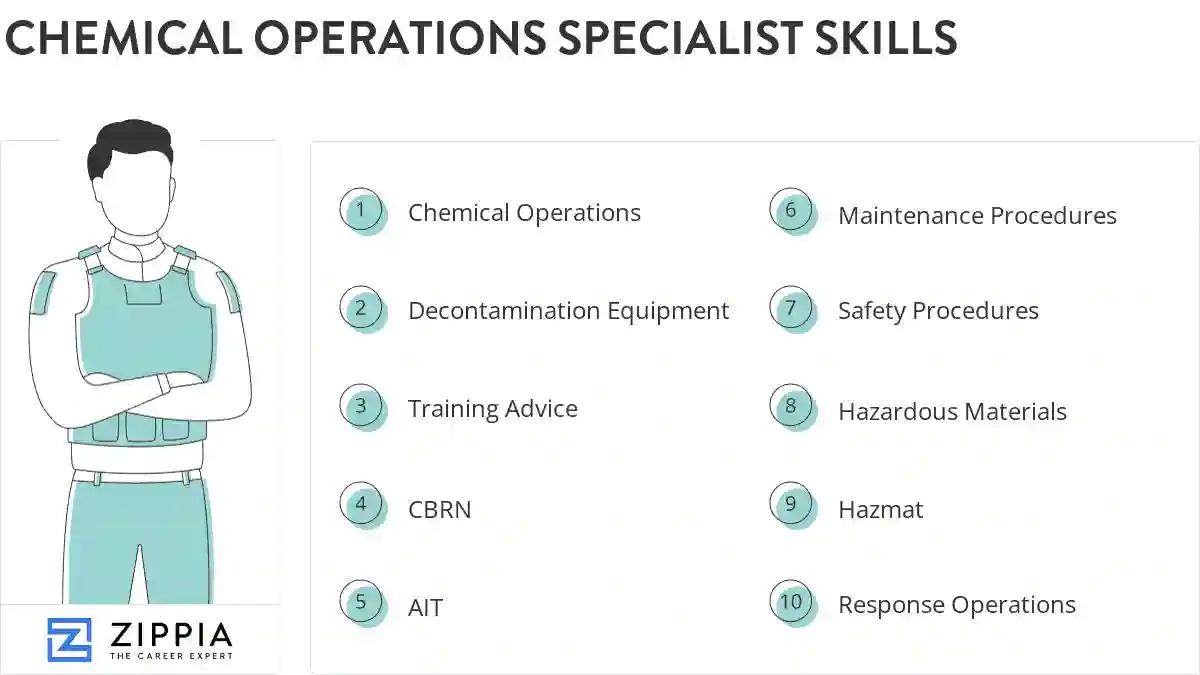
The most important skills for a chemical operations specialist resume and required skills for a chemical operations specialist to have include:
- Chemical Operations
- Decontamination Equipment
- Training Advice
- CBRN
- AIT
- Maintenance Procedures
- Safety Procedures
- Hazardous Materials
- Hazmat
- Response Operations
- Combat
- US Army
- Hoists
- Hazardous Waste
- Professional Development
- Equipment Maintenance
- PowerPoint
- Decontamination Procedures
- Protective Gear
- Training Programs
- WMD
- Ribbon
- Terrorism
- Defense Support
- Advanced Individual Training
- Military Equipment
- Chemical Training
- Defense System
- Mass Destruction
- Medal
- Chemical Warfare
- Led Training
- Decontamination Operations
Updated January 8, 2025
