
Automatically apply for jobs with Zippia
Upload your resume to get started.
Chemistry technologist skills for your resume and career
15 chemistry technologist skills for your resume and career
1. Lab Equipment
- Cleaned lab equipment, recycled products and basic lab maintenance.
- Maintained lab equipment and prepared it for use in labs.
2. Chromatography
Chromatography uses a strip of filter paper to separate the various components of a mixture. The filter paper is introduced to a solvent, which then encourages the separation of each mixture. Because different components of the mixture travel at different speeds once introduced to the solvent, a clear separation of components is visible on the filter paper.
- Prepared and analyzed numerous chemical solvents using Mass Spectrometers, Infrared Spectrometers and Gas Chromatography systems while maintaining good laboratory practices.
- Studied adsorption of petroleum hydrocarbons by hydrophobic resins with column chromatography.
3. Analytical Chemistry
- Perform analytical chemistry testing using IC and HPLC instrumentation.
- Performed various analyses in an analytical chemistry laboratory.
4. HPLC
- Conducted GC analysis of petroleum hydrocarbons and HPLC analysis of pesticides.
- Performed analysis of plant fluids utilizing AA, ICP, HPLC, GC, gamma spectroscopy, and liquid scintillation.
5. Sample Preparation
Sample preparation stands for the processes through which a sample is extracted from a bigger amount and prepared for analysis. The objective of sample preparation is to better analytical results without compromising the actual material's integrity.
- Write and develop standard operating procedures for sample preparation and instrumentation.
- Perform mechanical and chemical sample preparations for ICP-AES analysis.
6. Laboratory Procedures
- Identified and analyzed materials in specific laboratory procedures to verify accuracy and efficiency in standard operating procedures.
- Reviewed, audited, and maintained laboratory procedures and process documents.
Choose from 10+ customizable chemistry technologist resume templates
Build a professional chemistry technologist resume in minutes. Our AI resume writing assistant will guide you through every step of the process, and you can choose from 10+ resume templates to create your chemistry technologist resume.7. GMP
GMP stands for Good Manufacturing Practice. It is a system that ensures that all products like food, beverages, and medicinal drugs that are produced comply with the quality standards. It helps in minimizing the risks and hazards that cannot be eliminated after the testing of final products.
- Performed daily chemical production work following ISO and GMP guidelines; additionally created and monitored the production schedule.
- Follow GMP (Good Manufacturing Procedures)
8. Lims
A LIMS - Laboratory Information Management System is a software solution to improve laboratory productivity and efficiency with modern support of laboratory operations to address the challenges of data and sample management, automation, and regulation of laboratories from around the world and thus maintaining workflows and standardized testing and reporting procedures.
- Reported all data and test results through the Laboratory Information Management System (LIMS).
- Record laboratory data in Laboratory Information Management System (LIMS) for trending reports.
9. UV/Vis
- Supported manufacturing operation and Stability using HPLC and UV/VIS.
- Analyze formulation concentration using UV/VIS Spectroscopy.
10. Wet Chemistry
- Performed responsibilities of Wet Chemistry Technician I. Calibrated pipettes and scales.
- Performed various Classical Wet Chemistry water analyses on environmental samples.
11. GLP
GLP stands for "good laboratory practice." This refers to the integrity and quality measures that non-clinical laboratories have in place to ensure accurate research and market testing. GLP is most often used in pharmaceutical companies where new drugs must be tested before being approved for sale, but the practice can also be used in food packaging and preparation test centers.
- Worked in a regulated GLP lab setting.
- Applied aseptic techniques for daily workload/ follow GLP Provide guidance and training for Chemistry Laboratory Technicians.
12. Titration
- Determine Acidity by manual Titration.
- Perform the following tests: pH-Electode procedure, Alkalinity by manual Titration, Total Dissolved Solids and Total Suspended Solids.
13. Method Development
- Participated in test method development for incoming raw materials for the use on diagnostic products.
- Focused on handling time sensitive samples, method development, and result reporting.
14. Liquid Chromatography
- Conducted High Performance Liquid Chromatography (HPLC) sample analysis, dissolution chemistry and impurity profiling.
- Performed analysis using high performance liquid chromatography and ultraviolet spectroscopy to analyze in-process and finished products.
15. Test Results
- Analyzed, interpreted test results, and determined acceptability.
- Evaluated and interpreted test results before release of final results.
5 Chemistry Technologist resume examples
Build a professional chemistry technologist resume in minutes. Browse through our resume examples to identify the best way to word your resume. Then choose from 5+ resume templates to create your chemistry technologist resume.

What skills help Chemistry Technologists find jobs?
Tell us what job you are looking for, we’ll show you what skills employers want.
What skills stand out on chemistry technologist resumes?
Patrick Drohan Ph.D.
Associate Professor of Pedology, Pennsylvania State University
What soft skills should all chemistry technologists possess?
Dunwei Wang Ph.D.
Margaret A & Thomas A Vanderslice Chair in Chemistry, Professor of Chemistry, Chairperson of Chemistry Department, Boston College
What hard/technical skills are most important for chemistry technologists?
Dunwei Wang Ph.D.
Margaret A & Thomas A Vanderslice Chair in Chemistry, Professor of Chemistry, Chairperson of Chemistry Department, Boston College
What chemistry technologist skills would you recommend for someone trying to advance their career?
Peter Rosado
Associate Professor of Chemistry, Georgia College and State University
What type of skills will young chemistry technologists need?
Dr. Brian Augustine Ph.D.
Professor of Chemistry and Chair, High Point University
What technical skills for a chemistry technologist stand out to employers?
Dr. Matthieu Rouffet Ph.D.
Associate Professor of Chemistry, Chair, Point Loma Nazarene University
List of chemistry technologist skills to add to your resume
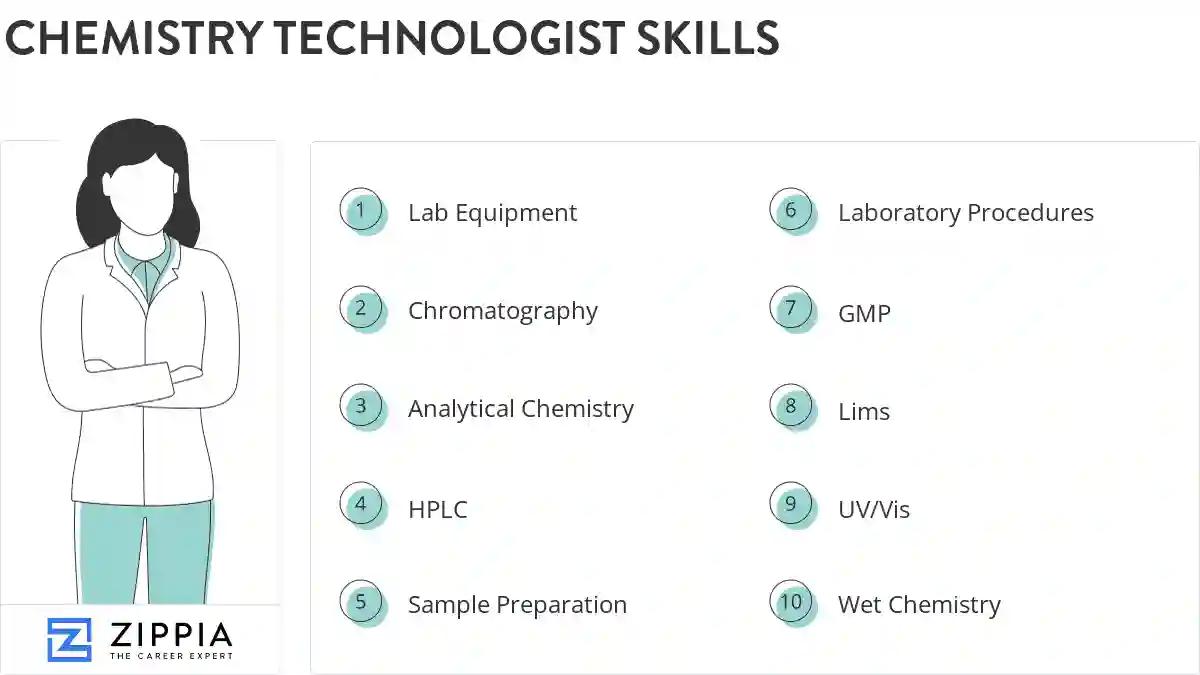
The most important skills for a chemistry technologist resume and required skills for a chemistry technologist to have include:
- Lab Equipment
- Chromatography
- Analytical Chemistry
- HPLC
- Sample Preparation
- Laboratory Procedures
- GMP
- Lims
- UV/Vis
- Wet Chemistry
- GLP
- Titration
- Method Development
- Liquid Chromatography
- Test Results
- Chemical Analysis
- AA
- FDA
- ISO
- Data Analysis
- FTIR
- Chemistry Lab
- Analytical Equipment
- IR
- Gas Chromatography
- R
- Data Entry
- PH Meter
- Chemical Solutions
- USP
- Analytical Instruments
- TOC
- GC
- Ms
- Food Products
- Chemical Inventory
- Water Samples
- Instrument Maintenance
- Laboratory Instruments
- Analyze Samples
- Plant Systems
- Microbiology
- ASTM
- Water Chemistry
- Absorption
- Instrumental Analysis
- XRF
- Hazardous Chemicals
Updated January 8, 2025
