Explore jobs
Find specific jobs
Explore careers
Explore professions
Best companies
Explore companies
Job outlook for child and family therapists in the United States
Child and family therapist job growth summary. After extensive research, interviews, and analysis, Zippia's data science team found that:
The projected child and family therapist job growth rate is 14% from 2018-2028.
About 9,100 new jobs for child and family therapists are projected over the next decade.
Child and family therapist salaries have increased 4% for child and family therapists in the last 5 years.
There are over 99,910 child and family therapists currently employed in the United States.
There are 120,152 active child and family therapist job openings in the US.
The average child and family therapist salary is $55,339.
Are child and family therapist jobs in demand?
Child and family therapist job and salary trends over time
Child and family therapist jobs over time
Child and family therapist job growth rate over time
| Year | # of jobs | % of population |
|---|---|---|
| 2021 | 99,910 | 0.03% |
| 2020 | 100,540 | 0.03% |
| 2019 | 104,281 | 0.03% |
| 2018 | 98,837 | 0.03% |
| 2017 | 95,650 | 0.03% |
Average child and family therapist salary over time
Child and family therapist salary by year
| Year | Avg. salary | Hourly rate | % Change |
|---|---|---|---|
| 2026 | $55,339 | $26.61 | +3.5% |
| 2025 | $53,474 | $25.71 | --1.0% |
| 2024 | $53,992 | $25.96 | +2.7% |
| 2023 | $52,590 | $25.28 | --0.8% |
| 2022 | $53,000 | $25.48 | +1.2% |
Child and family therapist jobs by state
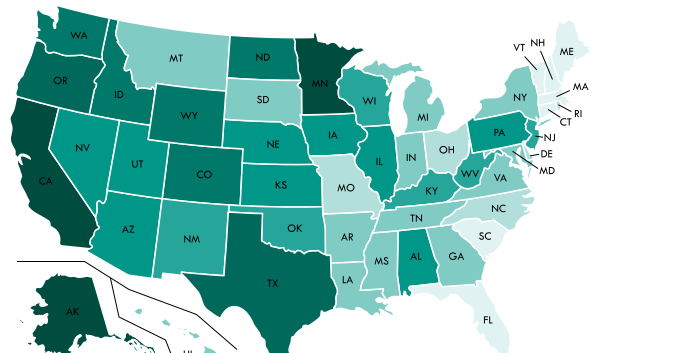
Most common states for child and family therapists
| Rank | State | Population | # of jobs | Employment/ 1000ppl |
|---|---|---|---|---|
| 1 | Maine | 1,335,907 | 520 | 39% |
| 2 | Massachusetts | 6,859,819 | 2,601 | 38% |
| 3 | North Dakota | 755,393 | 280 | 37% |
| 4 | Nebraska | 1,920,076 | 611 | 32% |
| 5 | Montana | 1,050,493 | 336 | 32% |
| 6 | Maryland | 6,052,177 | 1,614 | 27% |
| 7 | District of Columbia | 693,972 | 186 | 27% |
| 8 | Indiana | 6,666,818 | 1,706 | 26% |
| 9 | Delaware | 961,939 | 248 | 26% |
| 10 | Pennsylvania | 12,805,537 | 3,147 | 25% |
| 11 | Washington | 7,405,743 | 1,873 | 25% |
| 12 | Colorado | 5,607,154 | 1,408 | 25% |
| 13 | Iowa | 3,145,711 | 787 | 25% |
| 14 | Alaska | 739,795 | 183 | 25% |
| 15 | Kansas | 2,913,123 | 690 | 24% |
| 16 | Georgia | 10,429,379 | 2,380 | 23% |
| 17 | Minnesota | 5,576,606 | 1,287 | 23% |
| 18 | Oregon | 4,142,776 | 973 | 23% |
| 19 | New Jersey | 9,005,644 | 1,965 | 22% |
| 20 | Missouri | 6,113,532 | 1,349 | 22% |
Most common cities for child and family therapists
| Rank | City | # of jobs | Employment/ 1000ppl | Avg. salary |
|---|---|---|---|---|
| 1 | Dedham | 1 | 4% | $31,273 |
| 2 | Bremerton | 1 | 2% | $54,558 |
| 3 | Castle Rock | 1 | 2% | $53,511 |
| 4 | Brockton | 1 | 1% | $31,333 |
| 5 | Fall River | 1 | 1% | $31,758 |
| 6 | Lynn | 1 | 1% | $31,005 |
| 7 | New Bedford | 1 | 1% | $31,772 |
| 8 | Philadelphia | 1 | 0% | $48,442 |
Child And Family Therapist job outlook: Expert opinions
Our panel of child and family therapist experts
Western Illinois University
Northeastern Illinois University
Florida Institute of Technology
Loyola University New Orleans
SUNY College at Oswego
Ohio State University
Texas Southern University
St. John Fisher College

Penn State College of Medicine

University of Alabama in Huntsville
Boston College

Monmouth University

Augustana University
Tiffin University

Springfield College
Montclair State University

Montclair State University
Lindsey Nichols
Associate ProfessorWhat will help Child And Family Therapists increase their earning potential?
Lindsey Nichols: Usually people interested in counseling are not thinking about money, but with rising costs, home prices, daycare etc. making sure you are diligent about knowing counseling rates it the area you want to live and work is the first thing. The U.S. Bureau of Labor Statistics is a great tool to give you a foundation and making connections with fellow counselors in your area. Starting your career, if you are preparing to be a Licensed Professional Counselor (LPC) in your state (specialties like school counseling don't require additional training upon graduation, but you have to confirm you have met requirements from the state Department of Education.) you will have to do additional training and supervision. Once you become an LPC, opportunities open up like choices to go into private practice etc., it is a long process, but for most, it goes by quickly!
What general advice would you give to a Child And Family Therapist?
Dr. Vanessa Alleyne: It will be important to network and utilize professional organizations of which you are a member, such as the ACA (American Counseling Association), or the ASGW (Association for Specialists in Group Work), for example. Meet people, attend training for advanced skills in key areas, and present there when possible. Whether locally or nationally, these are valuable connections to make when starting out, and will also enhance your knowledge base as you begin and grow. Another valuable connection to be made can be found through your alma mater. Find professional affinity groups from your undergraduate program, and certainly maintain or build ties with your graduate program alumni. Finally, many people turn to social media such as Linkedin, which is fine, but can also be a bit overwhelming. Be deliberate in your choices about who to connect with, and don't get fomo! It's ok not to connect with everyone that pops up in your feed. Stay with one social media site at a time until you feel it's working the way you'd like, and then go on to another.
Dr. Tiffany Bainter PhD LCPC NCC
Associate ProfessorWestern Illinois University
Clinical, Counseling And Applied Psychology
What general advice would you give to a Child And Family Therapist?
Dr. Tiffany Bainter PhD LCPC NCC: Starting a career in counseling is a fulfilling journey but comes with its own set of challenges. My advice to graduates stepping into this field would be to prioritize self-care. It's crucial to maintain a healthy balance between your professional and personal life, especially when dealing with emotionally taxing situations. Seek supervision and mentorship regularly; having guidance from experienced professionals can provide invaluable insights and support as you navigate your counseling career. Additionally, stay open to continuous learning. The field of counseling is dynamic, with new research and techniques emerging constantly. Pursue opportunities for further education, attend workshops, and stay updated with the latest developments in the field. Cultivate empathy and cultural competence to better understand and connect with clients from diverse backgrounds. Building strong therapeutic relationships based on trust and empathy is at the core of effective counseling practice. Lastly, remember to advocate for mental health awareness and the importance of access to quality mental health services. Being a counselor goes beyond individual sessions; it involves being an advocate for your clients' well-being within the larger societal context.
What Child And Family Therapist skills would you recommend for someone trying to advance their career?
Dr. Tiffany Bainter PhD LCPC NCC: Education and Credentials: Obtain relevant certifications and advanced degrees in counseling or related fields. Specializations or additional training in areas such as trauma therapy, substance abuse counseling, or marriage and family therapy can increase your market value. Gain Experience: Seek opportunities to gain practical experience through internships, volunteer work, or entry-level positions. Building a strong track record of successful counseling outcomes and client satisfaction can lead to higher-paying roles. Specialize: Consider specializing in a niche area within counseling, such as working with specific populations (e.g., children, veterans, LGBTQ+ individuals) or focusing on particular issues (e.g., trauma, addiction, grief counseling). Specialization often commands higher salaries due to the specialized expertise required. Stay Current: Stay updated with industry trends, research, and best practices in counseling. Attend conferences, workshops, and continuing education programs to enhance your knowledge and skills, making you more valuable to employers. Negotiate Skillfully: When negotiating salary with potential employers, research industry standards and average salaries for your role and location. Highlight your qualifications, experience, and unique skills during negotiations. Be confident, but also realistic and flexible in your salary expectations. Explore Different Settings: Consider working in different settings such as private practice, community mental health centers, schools, hospitals, or corporate counseling programs. Each setting may offer different salary structures and opportunities for advancement. Build a Reputation: Develop a strong professional reputation by delivering quality counseling services, building positive relationships with clients and colleagues, and receiving positive feedback and referrals. A good reputation can lead to increased demand for your services and potentially higher fees. Network and Market Yourself: Network with other professionals in the counseling field, join professional organizations, and promote your services effectively. Building a strong professional network and marketing yourself can lead to new opportunities, higher-paying clients, and consulting or speaking engagements. Consider Additional Income Streams: Explore opportunities for additional income streams such as offering workshops, writing articles or books, providing supervision or consulting services, or teaching courses related to counseling.
What will help Child And Family Therapists increase their earning potential?
Dr. Tiffany Bainter PhD LCPC NCC: In the evolving field of counseling, several skills are likely to become even more important e in the coming years. Firstly, digital literacy and proficiency in utilizing technology for counseling services will become increasingly important. As more counseling sessions move online or incorporate digital tools, counselors will need to adapt and leverage these technologies effectively while maintaining client confidentiality and ethical standards. Secondly, a deep understanding of trauma-informed care and techniques will be crucial. With growing awareness about trauma's impact on mental health, counselors must be equipped to provide trauma-informed interventions and create safe therapeutic spaces for clients who have experienced trauma. Cultural competence and diversity awareness will continue to be essential skills for counselors. As our societies become more diverse, counselors must be able to work effectively with clients from various cultural backgrounds, respecting their beliefs, values, and identities. Additionally, skills related to teletherapy and remote counseling will likely become more prevalent. Counselors will need to excel in building therapeutic rapport and conducting effective counseling sessions through virtual platforms, ensuring continuity of care for clients regardless of geographical constraints. Lastly, skills in advocacy and collaboration within interdisciplinary teams will be increasingly valuable. Counselors may need to advocate for policy changes, mental health resources, and equitable access to services. Collaborating with other healthcare professionals, social workers, and community organizations will enhance holistic care for clients.
What general advice would you give to a Child And Family Therapist?
Dr. Pamela Fullerton: All the skills we need to do well in this field are important since we are dealing with people's lives and livelihoods. I believe anyone entering this field needs to recognize the significance and seriousness of our work. In the next 3-5 years, the ever-changing landscape of the population will require us to be continuously working on the competencies and ethical codes mandated through our identities as professional counselors. There is a wonderful counseling model by Ratts and Pederson (2014) called the Counselor-Advocate-Scholar model. I teach this to all my students and during my professional development workshops. This model highlights the three main areas in which we need to be constantly working on and growing in: (1) counseling work, skills, and competencies; (2) advocacy work, skills, and competencies; and (3) research to learn about best practices, recent scholarly innovations to the field, and adding more research to our field. This model can be used in the future as it adapts to whatever changes in the field and population may be occurring/prevalent in the future.
What Child And Family Therapist skills would you recommend for someone trying to advance their career?
Dr. Pamela Fullerton: Find a site with great supervision and a diverse range of clients. New clinicians really need to lean into competent and compassionate supervisory experiences that will help them not only increase their counseling competencies but also support in their growth around professional counseling identity, personal development, and multicultural and social justice advocacy. Additionally, working with a diverse range of clients at the beginning of a career will also support in increasing competencies in all the various areas of our field from skills and interventions to diagnosing and treatment planning.
What general advice would you give to a Child And Family Therapist?
Mariana Juras Ph.D.: Be attuned to your values, passion, skills, and abilities, and also to what market values.
What Child And Family Therapist skills would you recommend for someone trying to advance their career?
Mariana Juras Ph.D.: I believe multiple language and cultural knowledges and experiences are great assets to have, and also to integrate human specific and technology integration with the mental health field, by also considering ethics, culture, and humane relevancy. Neuropsychology is also a developing field and integration with mental health treatment is increasing.
What will help Child And Family Therapists increase their earning potential?
Mariana Juras Ph.D.: In the mental health field I believe it is the interaction between humans and technology, particular to the advance of AI. Also to embrace diversity and cultural difference and how to collaboratively work with them.
Kevin Foose
Professor of PracticeLoyola University New Orleans
Rehabilitation And Therapeutic Professions
What Child And Family Therapist skills would you recommend for someone trying to advance their career?
Kevin Foose: As our graduates enter the field of counseling and psychotherapy, the guidance that I provide is generally threefold. First I suggest that they develop a niche practice which they are passionate about. I encourage them to specialize rather than 'generalize' their practice. Towards that end I advise that they find a clinical supervisor and mentor with whom they share a theoretical and philosophical foundation. I encourage them to surround themselves with talented, experienced and inspiring professionals. And to follow their curiosity and cultivate the capacity to become highly competent clinically and theoretically with a specific population and modality of treatment (such as working with couples & relationships, adolescence, social justice & advocacy, play therapy etc).
What Child And Family Therapist skills would you recommend for someone trying to advance their career?
Jodi Mullen PhD LMHC RPT-S: The bulk of the work a mental health counselor does is clinical, meaning you meet with clients and provide counseling. There is also record keeping, preparation, and administrative responsibilities. New and seasoned counselors alike spend some time in supervision and consultation with other counselors. Supervision is a time to discuss cases with a more experienced professional where there are opportunities for growth professionally and personally. Consultation involves either meeting with others connected to your clients, like parents of children clients, or with professionals in mental health and other fields that can help the counselor sort out a challenge. In that case it may be an attorney or a trauma specialist.
What will help Child And Family Therapists increase their earning potential?
Jodi Mullen PhD LMHC RPT-S: There are so many opportunities for mental health counselors entering the field. The need for our services is at an all time high. Recently, there has been a great deal of focus on self-care for professional counselors to ward off compassion fatigue. There is much more being offered for counselor self-care than when I entered the field three decades ago.
What Child And Family Therapist skills would you recommend for someone trying to advance their career?
Donna Sheperis PhD, LPC, NCC, CCMHC, ACS, BC-TMH: There are so many different employment positions that a mental health counselor could take that a day could be incredibly different depending on their area of specialty. A private practitioner could have a full day of hour long individual sessions. A hospital based counselor might spend time running groups or doing crisis stabilization. A home-based counselor might travel from site to site providing family therapy or assessing living situations for child placement. Someone working in a substance use rehabilitation facility might find themselves Providing individual, group, and family therapy all within the span of several hours. In other words, a mental health counselor is going to be very flexible and able to provide a number of different services depending on the type of work that interests them and that they find themselves seeking specialty training and credentialing in.
What Child And Family Therapist skills would you recommend for someone trying to advance their career?
Samantha Bates PhD, LISW-S: One of the best things about being a mental health practitioner is supporting someone during a time of immense need. The human spirit is beautiful to witness, and the role of a mental health provider is to use the vulnerability and time spent together to empower someone to see their strengths, utilize new skills, and decide what the future holds for them. I think the best day of my professional career was when a young woman told me that had I not been in her life at the time she might not be here today. Knowing you were a support for someone, and the time you spent together made an impact, is incredibly rewarding and fulfilling. One thing that is challenging in the mental health profession is the lack of coordinated services and supports. Access and equity continue to challenge the profession and are issues we must address to tackle the mental health crisis.
Nancy Shepherd PhD., CFCS
Assistant ProfessorTexas Southern University
Human Development, Family Studies, And Related Services
What Child And Family Therapist skills would you recommend for someone trying to advance their career?
Nancy Shepherd PhD., CFCS: In general, employers stress the need for individuals that are good communicators, both verbally and in writing. Specifically in the field, the positions are varied in skill requirements. Good listening and empathy skills are important when dealing with families and young children. Business owners and workers will benefit from soft skills such as critical thinking, problem solving, teamwork, work ethic, professional attitude, and organization.
John Kiweewa Ph.D.
Associate ProfessorSt. John Fisher College
Wegmans School of Nursing
What soft skills should all Child And Family Therapists possess?
John Kiweewa Ph.D.: Receptivity to Feedback: Openness to consistently accept feedback in a respectful way is a vital quality, especially for new graduates. Such openness is important not only to feedback from supervisors but from colleagues and clients. Agreeing to or feeling bound to act on the feedback received is not as important as communicating appreciation for the effort of others in giving feedback. In this case, display of behaviors such as anger, annoyance, frustration, defensiveness, excessive/exaggerated self-criticism, or withdrawal gets in the way of learning and/or being a member of a team.
Appropriate Self-Disclosure: The ability for mental health practitioners to 'use' themselves for the benefit of their clients is one of the cornerstones of effective counseling. Such a quality is most evident when one only shares information about themselves that fits the nature and purpose of the interaction with a particular client. When personal information is revealed, it is tasteful, relevant, and is not upsetting, distracting, or confusing to others. Prospective employers are keenly aware of the ways self-serving or self-aggrandizing disclosure of personal information can negatively impact the ability to provide meaningful services to clients.
Reliability and Follow Through: Mental health professionals work in a helping profession that requires the professional to be consistently dependable, reliable, and able to follow through with tasks and assignments in a timely and thorough manner. This includes meeting deadlines, being punctual to sessions with clients and for agency meetings, being prepared, and having a reputation as one who can be counted on to do their part when functioning as a team or project member.
Flexibility and Adaptability: This quality is most evident when a mental health counseling professional consistently demonstrates a willingness to change or compromise in the face of new information, circumstances, and contexts. Situations such as the COVID-19 pandemic, for instance, require mental health practitioners to have an openness to solutions that match the needs of their service recipients and organizations.
Sense of Humor: There is little to cheer about in the professional life of mental health professionals. We spend the majority of our working time listening to the most painful and vulnerable aspects of people's lives. This quality is most evident when a mental health counselor assumes an orientation to life that acknowledges to self and others the value of looking at the "lighter side" of life to maintain a balance; when they find enjoyment in laughing with others and recognize laughter as a way of reducing tension and as an important aspect of social discourse.
Confidence Balanced with Humility: Confidence in one's abilities (self-efficacy) is a general challenge for beginning mental health counselors. Some may appear over-confident as a way to compensate for lack of experience in the field and to project an image of competence. It is, therefore, important that new graduate is able to act with self-assurance by consistently expressing themselves in a clear, deliberate, and unassuming manner. It is not helpful to "put on airs" or flaunt knowledge or skills in order to bring attention to oneself. What is important is to convey appreciation for the privilege to partake in other people's life journeys and struggles.
Martha Peaslee Levine M.D.
Medical Director of the PHP and IOP, Director of the Office of Professional Mental HealthPenn State College of Medicine
Adolescent Medicine, Psychiatry
What soft skills should all Child And Family Therapists possess?
Martha Peaslee Levine M.D.: Good communication skills are important. Working as a therapist involves interacting with someone. It will be important to demonstrate being able to listen effectively and being able to communicate clearly. Active listening is important in therapy and in an interview. Be engaged; listen to the interviewer so that you are clearly providing the information that they need. For example, I often ask interviewees to tell me about a case that they found rewarding or challenging. From this, I want to know how someone thinks through a clinical situation. I want to hear how they describe their client (anonymously, of course) and how they put together the important parts of the story. If it was challenging and they now recognize ways to handle it differently, that lets me know that they have thought about this. It also shows that they are willing to reflect on difficult situations and learn from them. If someone cannot relate a story or discuss a client with me, that makes me wonder about their skills as a therapist and their interest in their patients. These clinical interactions can come from your work in school, shadowing someone in training, or internships. It is recognizing and describing the important elements of the case. Another important skill is good written communication. Check your resumes for spelling mistakes. Reread any emails to make certain they are clear. Send thank-you notes. Keep things professional--use the interviewer's professional title when you write. Be on time and have a question or two to ask about the position or place of employment. Examples can be, what are they looking for in a counselor? What have they found the most rewarding working in this office? Find your own go-to question, but interviewers what to know that you are interested.
Dr. Nathan Tenhundfeld Ph.D.
Assistant Professor of Human FactorsUniversity of Alabama in Huntsville
Psychology Department
What skills stand out on Child And Family Therapist resumes?
Dr. Nathan Tenhundfeld Ph.D.: Strong analytical skills are a must. This includes both logic and reasoning skills, but also data analysis skills. For many jobs, the ability to collect and scientifically evaluate data will be vital, if not an absolute necessity. Similarly, a strong understanding of experimental methods can put a candidate in a great position to be able to help a company evaluate existing programs and chart a path forward for new ones. Finally, I would say that a strong ability to write is critical. Those graduates who are able to effectively and persuasively communicate in writing are setting themselves up for success at any company and allowing the company to leverage them for increasingly important tasks.
What soft skills should all Child And Family Therapists possess?
Dr. Nathan Tenhundfeld Ph.D.: Students need to be able to read individual and group dynamics in order to act appropriately in any given situation. This includes not only the interactions with one's bosses but also peers and subordinates. Similarly, being comfortable with networking can help any company, but networking skills shine through in interviews.
What hard/technical skills are most important for Child And Family Therapists?
Dr. Nathan Tenhundfeld Ph.D.: Technical skills like the ability to perform statistical analyses are critically important for most Psychology-related jobs. This allows a candidate to collect and analyze data but also to interpret and understand other existing data. A strong statistical background can also help set a candidate apart from their peers in the application process. This includes understanding when and how to use various parametric and nonparametric statistics to be able to answer questions regardless of the data one is working with.
What skills will help Child And Family Therapists earn the most?
Dr. Nathan Tenhundfeld Ph.D.: An understanding of a programming language, like Python or Javascript, can be a huge advantage in the job market. It will allow candidates to handle not only large datasets but also do rapid prototyping (in cases of UX work, for example) or even simply design a way in which to collect data for a customer. A student who knows how to code and who can apply those skills in their chosen career field is likely to differentiate themself over the competition.
Treniece Lewis Harris Ph.D.
Associate Professor of the Practice, Program Director, Master's Program in Mental Health CounselingBoston College
Department of Counseling, Developmental, and Educational Psychology
What skills stand out on Child And Family Therapist resumes?
Treniece Lewis Harris Ph.D.: The skills that likely stand out the most on psychologists' resumes include empathy, critical thinking, knowledge of mental health and illness determinants, psychological assessment, evidence-based psychotherapy skills, and research design and implementation.
What soft skills should all Child And Family Therapists possess?
Treniece Lewis Harris Ph.D.: -compassion
-active listening
-perspective-taking
-open-mindedness and respect for differences
-humility
-curiosity and critical observation
-problem recognition and analytical thinking
-creativity and flexibility
-presentation skills
What skills stand out on Child And Family Therapist resumes?
Alan Cavaiola Ph.D.: Skills that stand out on a resume: What mental health counselors need to emphasize on their resume/CV would be any additional training, certificates, and conferences to help make their resume stand out. For example, some of our students take workshops and training to become certified Disaster Response Crisis Counselors in New Jersey. Others take workshops or trainings in DBT, or they'll take EMDR training or telehealth training. These are definitely the skills employers would see as important and would help put the applicant's resume at the top of the pile. Also, students in our graduate program can specialize in addiction counseling which then helps to make them eligible for both the LPC (Licensed Professional Counselor) and the LCADC (Licensed Clinical Alcohol & Drug Counselor). Having both licenses will increase job possibilities exponentially.
Dr. Benjamin Jeppsen
Associate ProfessorAugustana University
Psychology Department
What soft skills should all Child And Family Therapists possess?
Dr. Benjamin Jeppsen: Cultural awareness, knowledge, and skills are important, including openness to work with people with varying religious views. The ability to easily connect with others and put people at ease in your presence is valuable in working with clients and collaborating with a treatment team. As more and more agencies interact with the medical field, spiritual leaders, and other holistic approaches to health, counselors need to see their role in an interdisciplinary approach to healing and work effectively with other departments. With teletherapy/virtual therapy, just the simple difficulty of creating eye contact when one's camera is not directly aligned with their viewscreen can complicate important connections in the therapeutic relationship. Learning to effectively connect through screens is essential.
What skills will help Child And Family Therapists earn the most?
Dr. Benjamin Jeppsen: It depends on the population they want to work with and the clinical setting they are comfortable in. But one thing that I wish I had learned more about was how to run a health service business. Though this won't be an eye-catcher on your resume when applying for counselor positions, if you want to work at a private practice (even if you won't be the owner), an understanding of basic business principles--especially how to work with insurance companies--will help you earn more money. I worked in private practice for a little over a year. I was very frustrated about differing reimbursement processes from one insurance company to the next. Sometimes it was 6 months before I was paid for sessions I completed with clients due to difficult insurance policies. Suppose you're not comfortable contacting your clients directly to collect co-insurance, copayments, etc. In that case, private practice may not be for you. I ended up doing quite a bit of unintended pro-bono work because the insurance company refused payment (due to unmet deductibles, or the client had used all of their "approved" sessions) because I was uncomfortable going to collections with clients who couldn't pay and were unaware of their insurance limits before starting. So in terms of earning potential, learn about how third-party payer systems work, and develop a good prior authorization protocol with documentation of exactly what services you can provide that will get you paid. Then, if your business is healthy enough, hire someone else to do the job of collecting payments, working with insurance companies, and contacting clients who owe to avoid those ruptures and complications in the therapeutic relationship.
Jonathan Appel Ph.D.
Professor of Psychology, Counseling & Criminal JusticeTiffin University
Department of Behavioral and Social Sciences
What certifications/licenses/courses can have the biggest impact for Child And Family Therapists?
Jonathan Appel Ph.D.: Clinical practice license/certifications are often critical for marketability and employment. At Tiffin University we provide a training track for Psychology students to get a Chemical Dependency License to practice with an undergraduate degree. There is a nationwide shortage for licensed addiction specialists. The demand for licensed counselors in this area has increased greater than the supply.
These students are very often among the first of our graduates to get hired. Opportunities are only increasing as the The American Rescue Plan Act will provide $4 billion for substance use disorder and mental health services.
We also provide close advising and assist students to attend graduate school to obtain additional clinical licenses in the fields of psychology, counseling and social work.
Will there be an enduring impact of the coronavirus pandemic on Child And Family Therapists?
Jonathan Appel Ph.D.: The pandemic has exacerbated mental health issues and needs all across the world. People need social interaction for well-being. The pandemic has contributed to increases in mental health and addictive disorders. Knowledge, training, treatment for psychological well-being has become even more critical as a personal and professional required skill across all fields.
Being able to understand and adapt to the limits of distance work will also be a lasting impact.
What will help Child And Family Therapists increase their earning potential?
Jonathan Appel Ph.D.: Mixing unusual majors and minors-to stand out in the crowd often can help student marketability. For example I recently have been working with a psychology student to establish a business minor. This can prepare the student work in human resource management as well as the human service field.
Obtaining an advanced graduate degree often helps.
Are there any particularly good places in the United States for Child And Family Therapists to find work opportunities?
Elizabeth Morgan Ph.D.: One potential outcome of the pandemic is that place may matter less as jobs are created and sustained with remote work environments. For example, it might be possible to participate in education endeavors, community mental health, human services in general, or consulting remotely, which render geography less important.
In addition, there will likely be changes in the types of jobs available to graduates in Psychology as employers are rethinking employee productivity in the wake of the coronavirus and need human resources specialists or industrial/organizational psychologists to consult on organizational change. Individuals with training and experience in delivering services remotely may find themselves able to secure some of these new positions; recent graduates will have a leg up in that regard, since they experienced training in a remote environment.
How do you envision technology impacting Child And Family Therapists in the next 5 years?
Elizabeth Morgan Ph.D.: The forced use of technology to connect with others during the pandemic will likely encourage lasting change in education, counseling and human services, business and marketing endeavors, research, and other areas where graduates in psychology end up. This will create shifts in what the jobs look like, what training is needed, and even perhaps, the mental health and well-being of workers in general. As these technological changes are introduced, new graduates will need to learn and embrace them to keep up with the trends, as well as evaluate their effectiveness.
What experience really stands out on Child And Family Therapist resumes?
Dr. Michael Hannon Ph.D.: The kinds of experiences that really stand out on resumes are those that demonstrate their added value. School counselors, like all school personnel, are tasked with providing evidence that students are better as a result of their work with them. School counselors must show how the range of school counseling services provided (e.g., individual counseling, small group counseling, career development interventions, individual advising, etc.) help students experience success. I encourage those looking for jobs to meticulously document the processes and outcomes that inform why they implement their programs and services. That way, potential employers clearly understand the value new school counselors will add to the school community and support student wellness.
What experience really stands out on Child And Family Therapist resumes?
Dr. Nancy Chae Ph.D.: In resumes and during interviews, be sure to highlight the different ways you responded to and impacted student and school needs during your practicum and internship experiences. You could share examples of small group or classroom lessons that you developed to address identified needs for students or develop specific skill sets. Demonstrate how you have used data to inform your research-based interventions and programs, how you collected and analyzed data after conducting your interventions, and how the outcome data inform your next steps in the school counseling program. Provide examples of meaningful connections you made with students, families, school staff, and community partners when facilitating school counseling programs. Highlight initiatives you led or collaborated with others to address social justice issues in the school and community. Altogether, most importantly, describe what you learned from these experiences and how you plan to apply these learning experiences in your future work as a school counselor and advocate.