
Automatically apply for jobs with Zippia
Upload your resume to get started.
Clinical laboratory manager skills for your resume and career
15 clinical laboratory manager skills for your resume and career
1. CLIA
- Experienced in a high-throughput sequencing environment (CAP and CLIA regulations) and experience with next-generation sequencing and data analysis
- Handled quarterly CLIA requirements of facility equipment in the laboratory setting.
2. Patients
- Led and guided in developing quality improvement programs to continue delivering high quality services to physician and patients.
- Supervised patients and subordinate staff member.
3. Test Results
- Demonstrated the ability to communicate test results effectively with physicians, pathologists and nursing staff as a member of interdisciplinary team.
- Supervised multiple technicians* Prepared chemical mixture for dying* Recorded and analyzed test results* Developed dying techniques for cotton fabric in low temperatures
4. Hematology
Hematology is the name of that branch of medicine that deals with all the matters pertaining to blood. The branch also deals with the treatment of blood-related diseases, predicting the outcome of developing diseases, the prevention of all such diseases, and their treatment.
- Participated in Process Improvement teams for Hematology, Chemistry, and Registration.
- Maintained QC for all testing including chemistry, immunoassay, hematology, coagulation, whole blood glucose, and urinalysis.
5. Microbiology
- Served as a bioengineer specializing in microbiology.
- Volunteer experience in Clinical Biochemistry, Microbiology and Immunology Laboratory .
6. Customer Service
Customer service is the process of offering assistance to all the current and potential customers -- answering questions, fixing problems, and providing excellent service. The main goal of customer service is to build a strong relationship with the customers so that they keep coming back for more business.
- Handled proficiency testing, regulatory compliance and customer service.
- Manage daily operations of the clinical lab to ensure quality results with emphasis on efficiency and customer service.
Choose from 10+ customizable clinical laboratory manager resume templates
Build a professional clinical laboratory manager resume in minutes. Our AI resume writing assistant will guide you through every step of the process, and you can choose from 10+ resume templates to create your clinical laboratory manager resume.7. Laboratory Procedures
- Developed cost analysis system for laboratory procedures, budget control through price negotiation.
- Develop and maintain laboratory procedures in current online document control system (LUCIDOC).
8. Proficiency Testing
- Perform proficiency testing for assigned tests/equipment and record and maintain records of performance and outcomes according to standard operating procedures.
- Assisted with and participated in Quality Control and Proficiency Testing programs as directed by the Laboratory Manager to meet regulatory standards.
9. Immunology
Immunology is a branch of medical service that deals with studying the immune system of a person. This particular specialization focuses on the function of the immune system and how it affects the entire body. It is usually an activity where it develops a mechanism that helps prevent and susceptibility of bacteria, infection, and other viruses that can enter the body.
- Helped acquire and provided Immunology and Virology services to 30 hospitals in direct competition with area commercial reference laboratories.
- Directed daily operation of the Microbiology area which included Bacteriology, Virology, Immunology, Molecular PCR and Mycobacteriology.
10. LIS
Libraries and Information Sciences, LIS, is the scientific and professional study of how information and information media are produced, disseminated, discovered, evaluated, selected, acquired, used, organized, maintained, and managed, either in physical or digital format. LIS careers include, but are not limited to, College Librarian, Legal Librarian, School Librarian, Data Curator, Teaching Librarian, and Emerging Technology Librarian.
- Coordinated conversion to new Laboratory Information System (LIS), verifying accuracy of data transfer and ensuring minimal operational impact.
- Coordinated lab information services team effort selecting and installing of Soft Computer Consultants Laboratory Information System to replace SunQuest LIS.
11. Patient Samples
- Maintained inventory and ensures proper storage of reagents and patient samples.
- Developed an efficient and confidential electronic system of logging, monitoring and reporting analyzed patient samples.
12. Clinical Lab
A clinical lab is a healthcare facility where tests are carried out on clinical specimens to obtain information. Information is used to aid in diagnosis, treatment, and prevention.
- Supervised the clinical laboratory testing and blood transfusion services for over 1,530 combat injured personnel.
- Oversee daily operations in an ancillary clinical laboratory setting.
13. Patient Care
Patient care entails the diagnosis, recovery, and control of sickness as well as the maintenance of physical and emotional well-being through the use of healthcare providers' services. Patient care is described as services provided to patients by health practitioners or non-professionals under guidance.
- Designed and implemented a decentralized STAT Laboratory in the Critical Care unit to improve patient care by expediting laboratory results.
- Provided administration with information to support new equipment and technology which produced better patient care and increased revenue.
14. Process Improvement
- Identify and implement process improvement opportunities and labor budgeting.
- Partnered with process owners and senior management to promote Six Sigma process improvement concepts, principles, and projects.
15. Oversight
Having oversight of someone means to monitor a process or a situation. If someone has oversight of something, they are responsible for the completion of the project. Oversight is usually given to experts as they monitor their juniors or newbies as they go through a project.
- Provide oversight of multiple areas of the Molecular Lab Operations.
- Served on hospital task force committees, led laboratory quality assurance and oversight of annual capital/financial budgets and expense reduction initiatives.
5 Clinical Laboratory Manager resume examples
Build a professional clinical laboratory manager resume in minutes. Browse through our resume examples to identify the best way to word your resume. Then choose from 5+ resume templates to create your clinical laboratory manager resume.

What skills help Clinical Laboratory Managers find jobs?
Tell us what job you are looking for, we’ll show you what skills employers want.
What skills stand out on clinical laboratory manager resumes?
Dr. Luis Rogelio Cruz-Vera
Associate Professor, University of Alabama in Huntsville
What hard/technical skills are most important for clinical laboratory managers?
Dr. Luis Rogelio Cruz-Vera
Associate Professor, University of Alabama in Huntsville
List of clinical laboratory manager skills to add to your resume
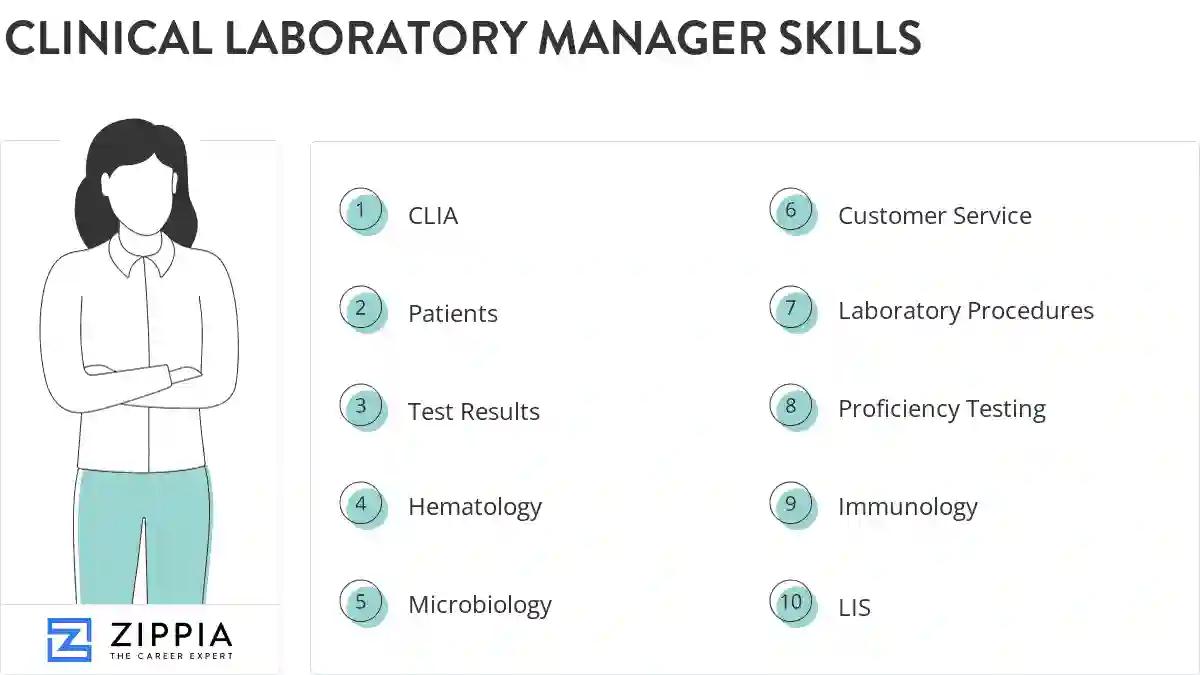
The most important skills for a clinical laboratory manager resume and required skills for a clinical laboratory manager to have include:
- CLIA
- Patients
- Test Results
- Hematology
- Microbiology
- Customer Service
- Laboratory Procedures
- Proficiency Testing
- Immunology
- LIS
- Patient Samples
- Clinical Lab
- Patient Care
- Process Improvement
- Oversight
- Sops
- CPT
- Regulatory Compliance
- Regulatory Agencies
- Laboratory Operations
- Lims
- Procedure Manuals
- Clinical Pathology
- NGS
- OSHA
- Lab Equipment
- Lab Results
- Clinical Trials
- DNA
- Specimen Handling
- Data Analysis
- Laboratory Safety
- Regulatory Standards
- FDA
- Elisa
- Direct Reports
- CMS
- Vital Signs
- PCR
- Performance Reviews
- State Regulations
- R
- Genotyping
- GLP
Updated January 8, 2025
