What does a collections, customer service do?

A collections customer service or collections agent is the person who is in charge of collecting past-due bill payments. Collections agents establish a list of individuals who failed to make their payments. They organize the list based on the severity of their delinquency. It is their task to find the location of the customers through background checks, credit bureau information, and loan documents. Those who are interested in this job should develop skills in intuition, quick thinking, problem-solving, and communication.
Collections, customer service responsibilities
Here are examples of responsibilities from real collections, customer service resumes:
- Monitor all assign accounts by reviewing the client's aging, manage all potential bad debit, DSO, aging.
- Provide excellent verbal, written, oral communication skills, attend ongoing training of collections and FDCPA regulations and guidelines.
- Provide excellent interpersonal, negotiation, and customer service skills via telephone.
- Research accounts to verify credits and debits make are accurately post against supporting documents showing timely reflect within the FDCPA guidelines.
- Prevent impending loss and increase profitability through negotiation and enforcement of schedule collection campaigns.
- Submit additional information request by insurance companies such as medical records, primary/secondary insurance explanation of benefits (EOB).
- Prepare up to date DSO reports for CFO, which are discussed in monthly meetings.
- Research all accounts utilizing Accurint, Lexis Nexis and several credit-reporting agencies if need.
Collections, customer service skills and personality traits
We calculated that 45% of Collectionss, Customer Service are proficient in Strong Customer Service, Customer Service, and Payment Arrangements. They’re also known for soft skills such as Communication skills, Empathy, and Good judgment.
We break down the percentage of Collectionss, Customer Service that have these skills listed on their resume here:
- Strong Customer Service, 45%
Used strong customer service skills to engage debtor in finalizing a secured payment plan.
- Customer Service, 12%
Provided superior customer service and work quality while demonstrating attention to detail, flexibility and innovation in resolving problems
- Payment Arrangements, 5%
Contacted customers to negotiate payment arrangements, develop solutions to resolve delinquency and prevent loss.
- Credit Card Payments, 4%
Processed debit card payments, managed 150 accounts extremely effectively.
- Delinquent Accounts, 4%
Utilized interpersonal communication skills and interviewing techniques to successfully locate individuals and collect money on delinquent accounts for major retail corporations.
- Past Due Accounts, 3%
Scheduled repossession activity on seriously past due accounts.
Most collectionss, customer service use their skills in "strong customer service," "customer service," and "payment arrangements" to do their jobs. You can find more detail on essential collections, customer service responsibilities here:
Listening skills. Lastly, "listening skills" is an important element of what a collections, customer service does. Collections, customer service responsibilities require this skill because "collectors must pay attention to what debtors say when trying to negotiate a repayment plan." This resume example highlights how collections, customer service duties rely on this skill: "communicated with clients to obtain debts or make payment arrangements. "
The three companies that hire the most collections, customer services are:
- Kwik Trip14 collectionss, customer service jobs
- Dave & Buster's12 collectionss, customer service jobs
- American Red Cross10 collectionss, customer service jobs
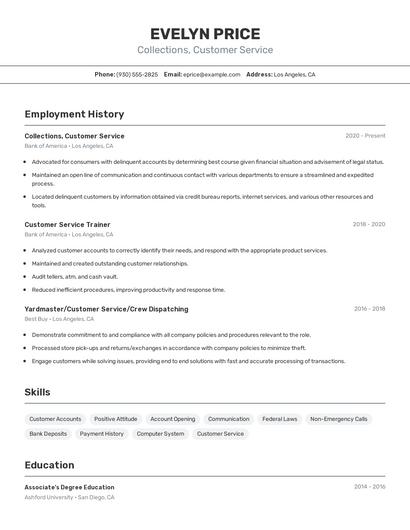
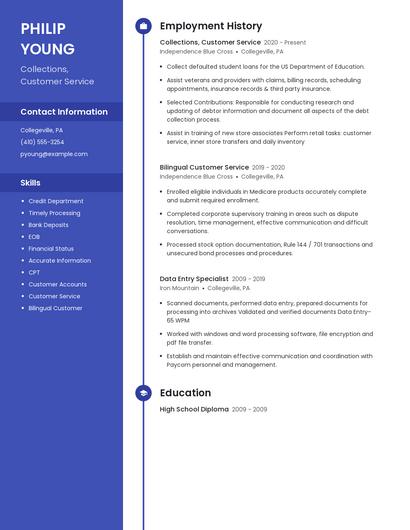
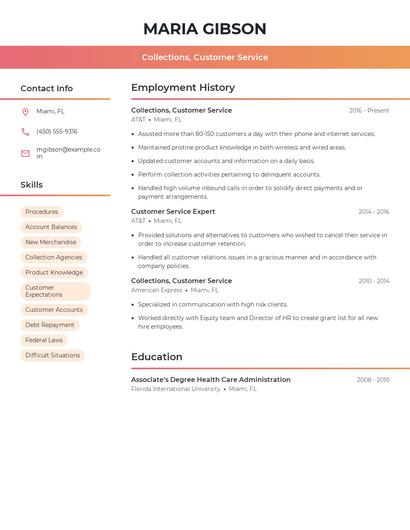
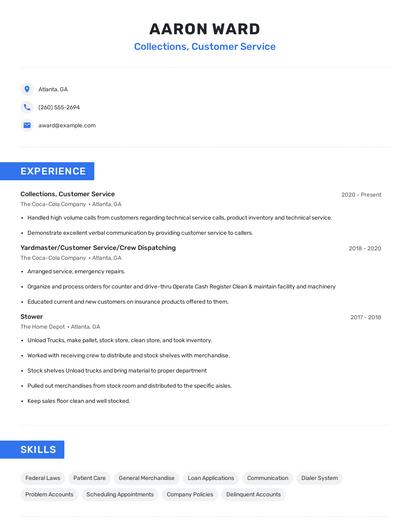
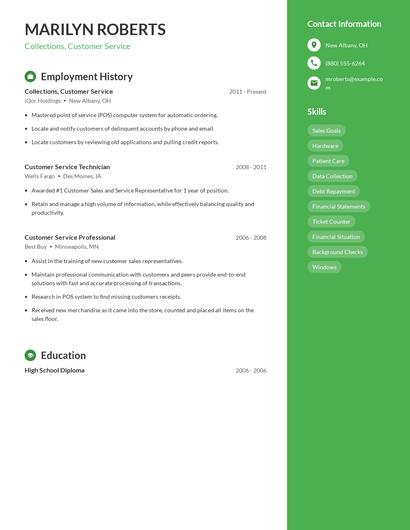
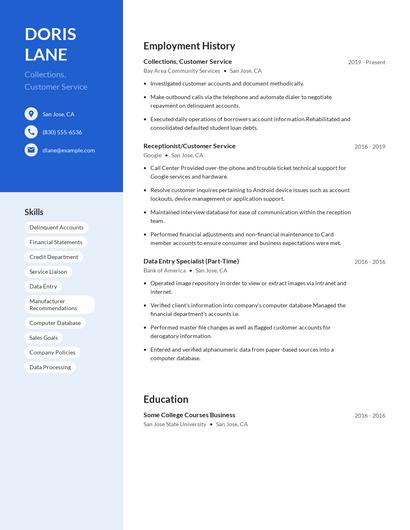
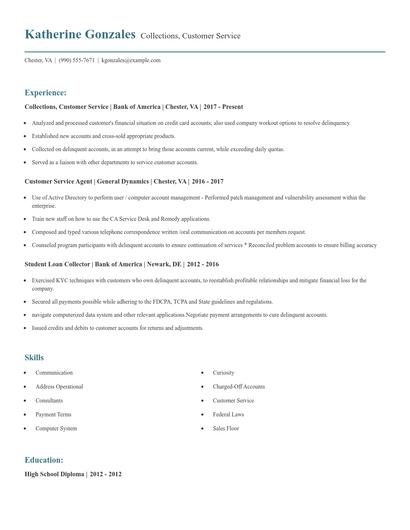
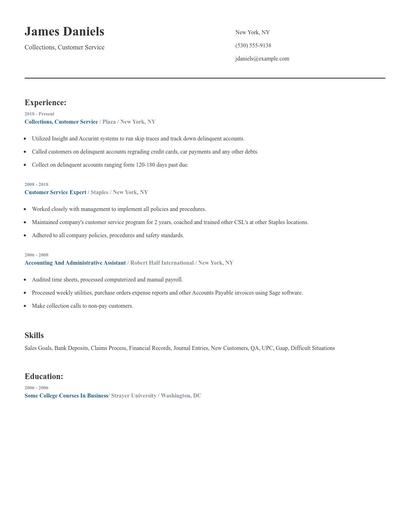
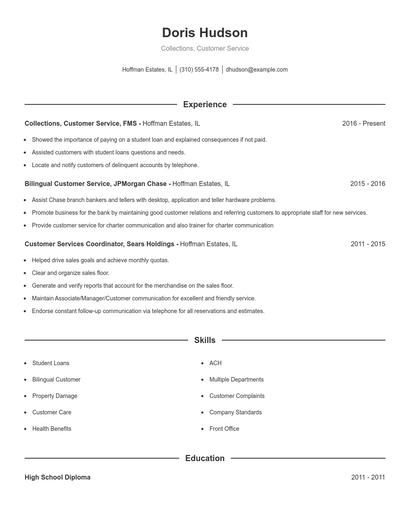
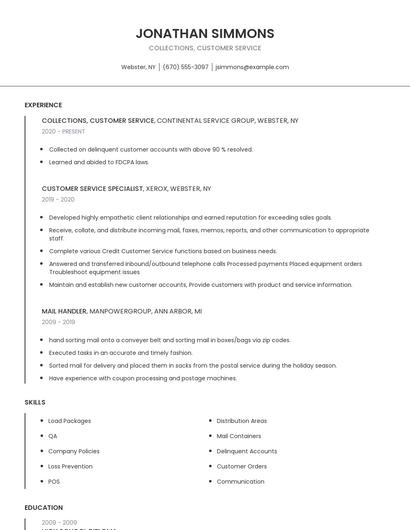
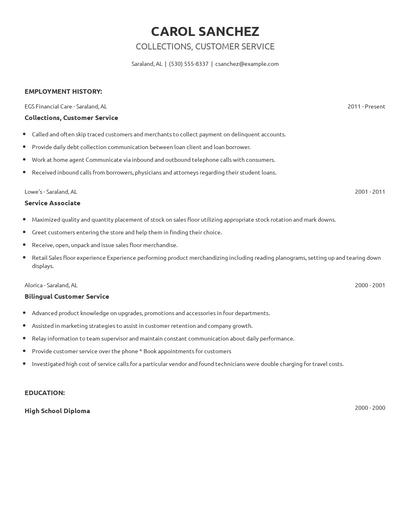
Choose from 10+ customizable collections, customer service resume templates
Build a professional collections, customer service resume in minutes. Our AI resume writing assistant will guide you through every step of the process, and you can choose from 10+ resume templates to create your collections, customer service resume.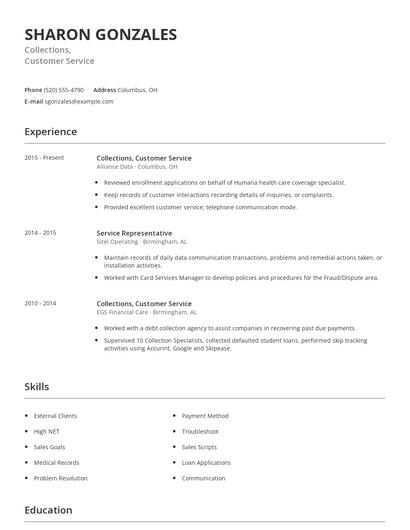
Compare different collectionss, customer service
Collections, customer service vs. Customs collector
An officer for collections/accounts receivable is in charge of a company's financial activities, ensuring that they receive payment from clients. They primarily focus on overseeing all billing and invoices, processing and verifying all receipts and rendered services, maintaining an accurate record of all transactions, producing reports and presentations, reviewing account and payment histories, and ensuring the accuracy of all processes involving the matter. Furthermore, should there be any complex issues, it is essential to reach out to a manager or a supervisor right away.
These skill sets are where the common ground ends though. The responsibilities of a collections, customer service are more likely to require skills like "strong customer service," "customer service," "collections," and "payment processing." On the other hand, a job as a customs collector requires skills like "process payments," "billing inquiries," "customer care," and "telephone calls." As you can see, what employees do in each career varies considerably.
Customs collectors really shine in the automotive industry with an average salary of $35,327. Comparatively, collectionss, customer service tend to make the most money in the automotive industry with an average salary of $36,740.On average, customs collectors reach similar levels of education than collectionss, customer service. Customs collectors are 0.5% more likely to earn a Master's Degree and 0.2% less likely to graduate with a Doctoral Degree.Collections, customer service vs. Collections/accounts receivable
Customer service representatives are the first point of contact of the customers, acting as the frontiers of the company and help in driving customer loyalty and retention by leaving a great impression and resolving all of their concerns. They accommodate customer queries by providing useful and comprehensive information about any products or services. Some would use that as an opportunity to market and promote more sales. The most challenging issues they use to handle are customer complaints and processing of refunds and returns. They also assist in basic troubleshooting or accounts and payment setup with the use of specific guidelines or step by step procedures. At most, they help and solve customer issues on their own, but sometimes they would need support from supervisors or other departments.
While some skills are similar in these professions, other skills aren't so similar. For example, resumes show us that collections, customer service responsibilities requires skills like "strong customer service," "student loans," "collections," and "outbound collection calls." But a collections/accounts receivable might use other skills in their typical duties, such as, "patients," "provides administrative support," "data entry," and "collection calls."
Collections/accounts receivables may earn a higher salary than collectionss, customer service, but collections/accounts receivables earn the most pay in the finance industry with an average salary of $39,163. On the other hand, collectionss, customer service receive higher pay in the automotive industry, where they earn an average salary of $36,740.collections/accounts receivables earn similar levels of education than collectionss, customer service in general. They're 1.8% more likely to graduate with a Master's Degree and 0.2% less likely to earn a Doctoral Degree.Collections, customer service vs. Customer service representative
An associate customer service representative is responsible for providing high customer service by assisting customers on their inquiries and concerns, as well as resolving and escalating high-level complaints to the supervisor or tenured customer service representative. Associate customer service representatives also process orders and payments from the customers, replacing defective items, and issuing refunds as needed. They must have excellent communication and organizational skills, especially on handling data processing procedures to the database for reference to customer concerns.
Some important key differences between the two careers include a few of the skills necessary to fulfill the responsibilities of each. Some examples from collections, customer service resumes include skills like "credit card payments," "past due accounts," "student loans," and "debt repayment," whereas a customer service representative is more likely to list skills in "cleanliness," "pos," "data entry," and "sales floor. "
Customer service representatives earn the highest salary when working in the insurance industry, where they receive an average salary of $34,074. Comparatively, collectionss, customer service have the highest earning potential in the automotive industry, with an average salary of $36,740.When it comes to education, customer service representatives tend to earn similar degree levels compared to collectionss, customer service. In fact, they're 0.0% more likely to earn a Master's Degree, and 0.1% more likely to graduate with a Doctoral Degree.Collections, customer service vs. Associate customer service representative
Types of collections, customer service
Updated January 8, 2025
