What does a community educator do?

Community Educators are responsible for organizing and improving access to training and education opportunities throughout a local community. Their duties include forming relationships with community groups, discovering local interests, develop service plans with education providers, and increase learning channels such as through classes, tutorials, and mentorship programs. They are responsible for sourcing project grants, managing education budgets, facilitating voluntary groups' growth, and conducting report assessment. Community Educators also carry out volunteer and staff training sessions.
Community educator responsibilities
Here are examples of responsibilities from real community educator resumes:
- Grow and manage existing relationships in assign territories with physicians, hospitals, skil nursing and rehabilitation facilities and assist livings.
- Conduct nutrition education component of diabetes education program for all classes.
- Grow and manage existing relationships in assign territories with physicians, hospitals, skil nursing and rehabilitation facilities and assist livings.
- Authorize and monitor CCAD services to ensure that the consumer receives the services as authorized and their needs are being meet.
Community educator skills and personality traits
We calculated that 11% of Community Educators are proficient in Community Outreach, Community Education, and Educational Programs. They’re also known for soft skills such as Analytical skills, Instructional skills, and Writing skills.
We break down the percentage of Community Educators that have these skills listed on their resume here:
- Community Outreach, 11%
Plan and implement targeted community outreach and education presentations that are culturally appropriate to the targeted population.
- Community Education, 7%
Developed, implemented, coordinated, assessed, and managed community health education; Instructor for community education and wellness programs.
- Educational Programs, 5%
Initiated/planned/implemented/evaluated educational programs using multiple innovative delivery models.
- Community Events, 5%
Educate the Community about Hospice through speaking engagements and participation in Community events.
- Health Education, 5%
Participated in the development, implementation, evaluation and revision of health education after-school programs for low income families.
- Mental Health, 4%
Created presentations and presented in communities throughout Minnesota educating the public and professionals on current mental health issues.
Most community educators use their skills in "community outreach," "community education," and "educational programs" to do their jobs. You can find more detail on essential community educator responsibilities here:
Analytical skills. One of the key soft skills for a community educator to have is analytical skills. You can see how this relates to what community educators do because "health education specialists collect and evaluate data to determine the needs of the people they serve." Additionally, a community educator resume shows how community educators use analytical skills: "maintain databases, mailing lists, telephone networks, and other information to facilitate the functioning of health education programs. "
Instructional skills. Many community educator duties rely on instructional skills. "health education specialists and community health workers lead programs, teach classes, and facilitate discussion with clients and families.," so a community educator will need this skill often in their role. This resume example is just one of many ways community educator responsibilities rely on instructional skills: "coach and implement didactic skill requirements applicable to instructional design/health education and training standards. "
Interpersonal skills. A big part of what community educators do relies on "interpersonal skills." You can see how essential it is to community educator responsibilities because "health education specialists and community health workers interact with many people from a variety of backgrounds." Here's an example of how this skill is used from a resume that represents typical community educator tasks: "examined and assessed factors that contribute to interpersonal violence on campus. "
Problem-solving skills. Another common skill required for community educator responsibilities is "problem-solving skills." This skill comes up in the duties of community educators all the time, as "health education specialists and community health workers must think creatively about improving the health of the community." An excerpt from a real community educator resume shows how this skill is central to what a community educator does: "established community education for curatio solutions, llc wound care and hyperbaric medicine clinics. "
The three companies that hire the most community educators are:
- Americorps12 community educators jobs
- AmeriHealth Caritas6 community educators jobs
- Billings Clinic3 community educators jobs
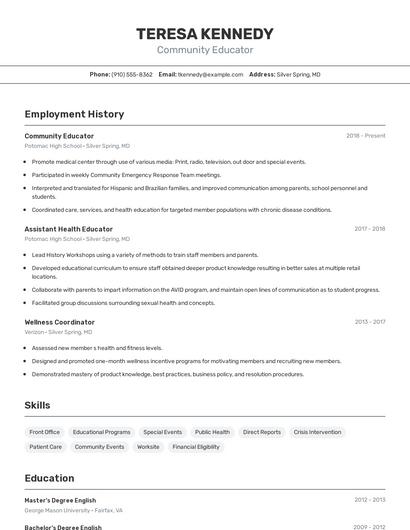
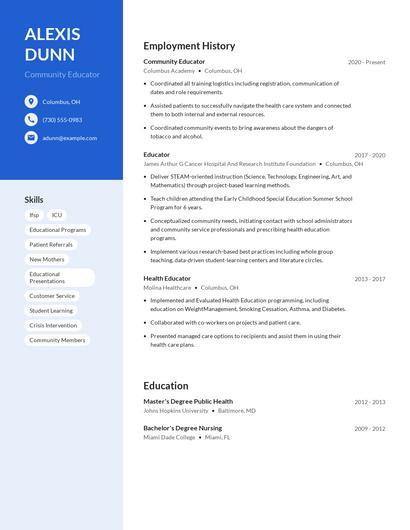
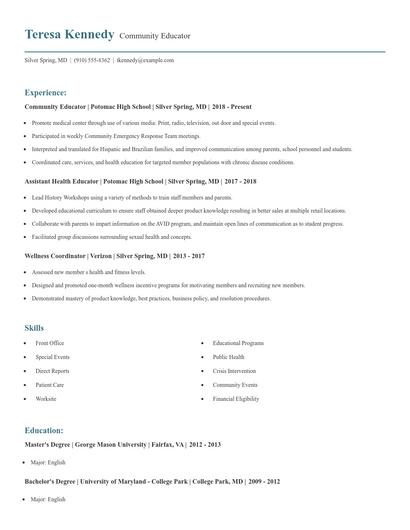
Choose from 10+ customizable community educator resume templates
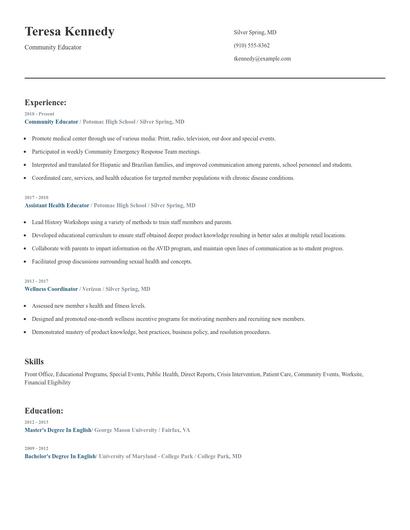
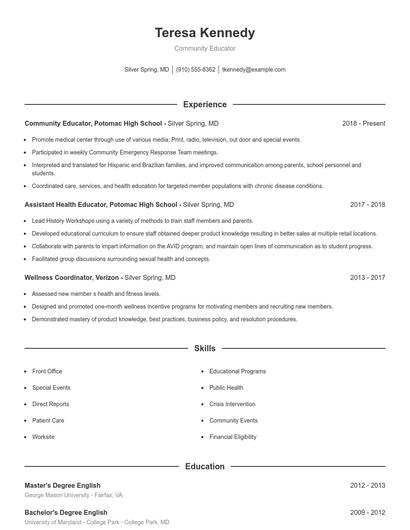
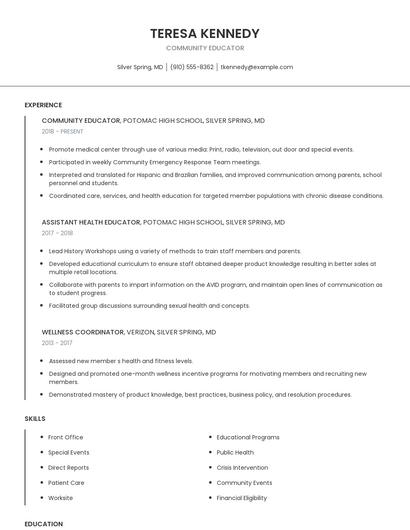
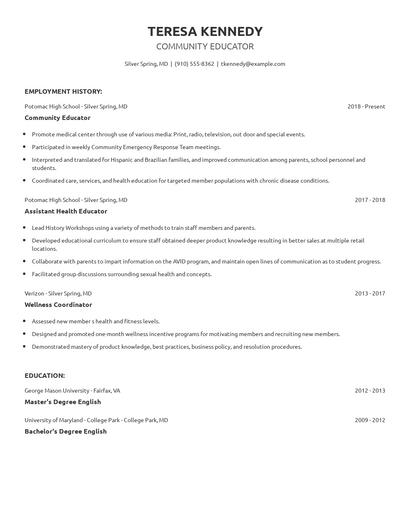
Build a professional community educator resume in minutes. Our AI resume writing assistant will guide you through every step of the process, and you can choose from 10+ resume templates to create your community educator resume.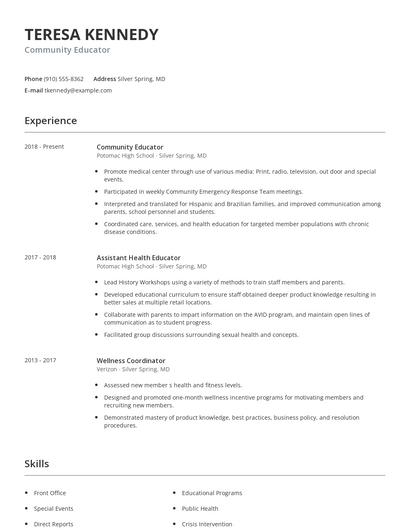


Compare different community educators
Community educator vs. Health coach
A Health Coach is an individual health educator who provides lifestyle and behavior guidance. They work with clients to help them feel their best through food and lifestyle changes.
While similarities exist, there are also some differences between community educators and health coach. For instance, community educator responsibilities require skills such as "community outreach," "community education," "educational programs," and "community events." Whereas a health coach is skilled in "customer service," "patients," "optimal health," and "excellent interpersonal." This is part of what separates the two careers.
Health coaches earn the highest salaries when working in the health care industry, with an average yearly salary of $40,713. On the other hand, community educators are paid more in the health care industry with an average salary of $65,093.health coaches tend to reach similar levels of education than community educators. In fact, health coaches are 0.1% more likely to graduate with a Master's Degree and 0.1% less likely to have a Doctoral Degree.Community educator vs. Volunteer coordinator
A volunteer coordinator is an individual who is in charge of recruiting and managing volunteers to help convey the organization's purpose to the general public. Volunteer coordinators must use marketing tools such as outreach programs and emails to attract new customers and maintain relationships with existing customers. They keep schedules and records of the volunteers' work and also conduct regular training. The minimum educational requirement of a volunteer coordinator is to obtain an Associate's degree.
Each career also uses different skills, according to real community educator resumes. While community educator responsibilities can utilize skills like "community education," "health education," "mental health," and "cpr," volunteer coordinators use skills like "patients," "work ethic," "strong work ethic," and "home health."
Volunteer coordinators earn a lower average salary than community educators. But volunteer coordinators earn the highest pay in the professional industry, with an average salary of $43,691. Additionally, community educators earn the highest salaries in the health care with average pay of $65,093 annually.volunteer coordinators earn similar levels of education than community educators in general. They're 4.6% less likely to graduate with a Master's Degree and 0.1% less likely to earn a Doctoral Degree.What technology do you think will become more important and prevalent for community educators in the next 3-5 years?
Jessica Tangen Daniels Ph.D.
Associate Provost - Innovation and Partnerships, Program Director/Professor, Ed.D. Leadership in Higher Education, Bethel University
Community educator vs. Public health advisor
A public health advisor is primarily in charge of designing and developing health programs according to the needs of a community. It is their duty to conduct research and analysis, gather and analyze community data, and monitor the practices and progress of current health programs to identify areas needing improvement, recommending solutions as necessary. They must also set objectives and guidelines in adherence to the budget and timelines, providing support to employees. Furthermore, a public health advisor may implement health programs while enforcing the agency's safety policies and regulations.
The required skills of the two careers differ considerably. For example, community educators are more likely to have skills like "community education," "educational programs," "community events," and "mental health." But a public health advisor is more likely to have skills like "patients," "nyc," "public health programs," and "disease control."
Public health advisors earn the best pay in the health care industry, where they command an average salary of $53,025. Community educators earn the highest pay from the health care industry, with an average salary of $65,093.When it comes to education, public health advisors tend to earn higher degree levels compared to community educators. In fact, they're 12.9% more likely to earn a Master's Degree, and 1.7% more likely to graduate with a Doctoral Degree.Community educator vs. Outreach coordinator
An outreach coordinator is responsible for assisting community and fundraising programs, ensuring the smooth flow of events and participants' engagement. Outreach coordinators often work with humanitarian organizations or other nonprofit institutions to promote and develop citizens' welfare. They handle press releases, create marketing materials, negotiate with third-party vendors, book venues, finalize event schedules, and recruit volunteers as needed. An outreach coordinator also plans activities, monitors expenses, and requests financial support from sponsorships and donation programs.
Types of community educator
Updated January 8, 2025
