Explore jobs
Find specific jobs
Explore careers
Explore professions
Best companies
Explore companies
Job outlook for computer information systems instructors in the United States
Are computer information systems instructor jobs in demand?
Computer information systems instructor job and salary trends over time
Computer information systems instructor jobs over time
Computer information systems instructor job growth rate over time
| Year | # of jobs | % of population |
|---|---|---|
| 2021 | 3,354 | 0.00% |
| 2020 | 2,770 | 0.00% |
| 2019 | 6,527 | 0.00% |
| 2018 | 1,161 | 0.00% |
| 2017 | 1,130 | 0.00% |
Average computer information systems instructor salary over time
Computer information systems instructor salary by year
| Year | Avg. salary | Hourly rate | % Change |
|---|---|---|---|
| 2026 | $64,422 | $30.97 | +3.4% |
| 2025 | $62,300 | $29.95 | +2.3% |
| 2024 | $60,889 | $29.27 | +1.5% |
| 2023 | $59,969 | $28.83 | +1.7% |
| 2022 | $58,990 | $28.36 | +1.6% |
Computer information systems instructor jobs by state
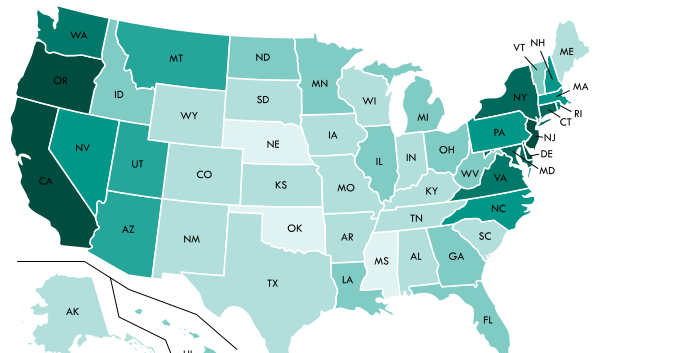
Most common states for computer information systems instructors
| Rank | State | Population | # of jobs | Employment/ 1000ppl |
|---|---|---|---|---|
| 1 | District of Columbia | 693,972 | 375 | 54% |
| 2 | North Dakota | 755,393 | 332 | 44% |
| 3 | Alaska | 739,795 | 299 | 40% |
| 4 | Vermont | 623,657 | 235 | 38% |
| 5 | New Hampshire | 1,342,795 | 502 | 37% |
| 6 | Wyoming | 579,315 | 214 | 37% |
| 7 | Delaware | 961,939 | 336 | 35% |
| 8 | Montana | 1,050,493 | 349 | 33% |
| 9 | Rhode Island | 1,059,639 | 336 | 32% |
| 10 | South Dakota | 869,666 | 277 | 32% |
| 11 | Oregon | 4,142,776 | 1,266 | 31% |
| 12 | Minnesota | 5,576,606 | 1,684 | 30% |
| 13 | Virginia | 8,470,020 | 2,454 | 29% |
| 14 | Nebraska | 1,920,076 | 560 | 29% |
| 15 | Iowa | 3,145,711 | 878 | 28% |
| 16 | New Mexico | 2,088,070 | 579 | 28% |
| 17 | Washington | 7,405,743 | 1,988 | 27% |
| 18 | North Carolina | 10,273,419 | 2,655 | 26% |
| 19 | Arizona | 7,016,270 | 1,808 | 26% |
| 20 | Massachusetts | 6,859,819 | 1,728 | 25% |
Most common cities for computer information systems instructors
| Rank | City | # of jobs | Employment/ 1000ppl | Avg. salary |
|---|---|---|---|---|
| 1 | Oakland | 1 | 0% | $97,649 |
| 2 | Riverside | 1 | 0% | $83,013 |
Computer Information Systems Instructor job outlook: Expert opinions
Our panel of computer information systems instructor experts

University of West Florida

Shaw University
Northern Seminary

Lafayette College

The University of Tennessee Knoxville
AGWA - American Grant Writers' Association, Inc.
The University of North Carolina Greensboro

Misericordia University

University of Mount Union

Youngstown State University

New York University

Seattle University

University of West Georgia

Linfield University
Dr. Thomas Gilbar Ph.D.
Chair and LecturerUniversity of West Florida
Electrical and Computer Engineering
What hard/technical skills are most important for Computer Information Systems Instructors?
Dr. Thomas Gilbar Ph.D.: There are quite a few hard/technical skills that are important for Computer Engineers. We've found a lot of managers are looking for comfort in a variety of programming languages, including C++, C#, Java, Python, etc. Also, try to have a background in a variety of operating systems (certainly windows and mac, but also having experience on Apple iOS, Android, and even Linux will give you a leg up on the competition). Having at least some experience in data/cyber security is also important these days. On the hardware side, programming and applying microcontrollers and VHDL/Verilog programming are extremely important. VLSI design is also a nice addition to skill sets, though in most cases, not a deal-breaker. Circuit and electronic design are also very important skills to supplement your microcontroller skills.
How do you envision technology impacting Computer Information Systems Instructors in the next 5 years?
TaVshea Smith: Technology will play a vital role in education in the next five years. The pandemic has changed the way educators think about teaching learners and interacting with families and colleagues. Educators will need to learn various instructional methods of engaging with learners, enhancing instructional practices, and using digital tools ethically and efficiently to create assignments, complete tasks, solve problems, and effectively teach students.
What technology do you think will become more important and prevalent for Computer Information Systems Instructors in the next 3-5 years?
Rev. Tracey Bianchi: It is likely that once the pandemic ends, doing church at home will remain an option for millions of people of faith. As the epidemic goes on, families and communities have become comfortable with the flexible, on-demand church option. It may be hard to get many of them back into the pews once it is safe to return to worship. The technology to support this reality will be necessary for the foreseeable future. Career options in production, streaming, and recording will be more prevalent in religious organizations than in the past.
What technology do you think will become more important and prevalent for Computer Information Systems Instructors in the next 3-5 years?
Karina Skvirsky: That's hard to predict! I believe Facebook will become dated, and no one under 30 will be using it in the future.
Dr. Misty Anderson Ph.D
Department Head, English, Affiliate Professor of Theatre and Religious Studies, President, Tennessee University Faculty SenatesThe University of Tennessee Knoxville
College of Arts and Sciences
How do you envision technology impacting Computer Information Systems Instructors in the next 5 years?
Dr. Misty Anderson Ph.D: No one knows precisely what the future jobs will look like, but every indication is that the best ones will involve writing and communicating at a distance. We talk about how English majors have "robot-proof" futures. That human touch, through sound, honest communication, is irreplaceable.
Will there be an enduring impact of the coronavirus pandemic on Computer Information Systems Instructors?
John Porter Ph.D.: Grant writing is a very consistent business. It does not matter if the market is up or down or which party is in office. If the economy is down and money is tight, business tends to turn towards grant funding to supplement revenue. If the economy is strong, the company has a little extra cash and is willing to explore grant funding.
When unemployment rises and it isn't easy to find employment, more people will start their own business. If that business is a non-profit, it could receive grant funding for their programs and activities.
Grant writing is an excellent full-time, and part-time opportunity. Many, mostly non-profit organizations, seek Certified Grant Writers to help compensate for the lack of revenue, which has occurred from the recent economic shutdown. Independent Grant Consultants have a lot of control over the number and type of clients they work with, from a few each month to as many as there is time to do.
Certified Grant Writers are in high demand to compensate for issues like the recovery from the economic shutdown, rising taxes, and other financial strains,
April Dawkins Ph.D.
Assistant ProfessorThe University of North Carolina Greensboro
Library & Information Science Department
What technology do you think will become more important and prevalent for Computer Information Systems Instructors in the next 3-5 years?
April Dawkins Ph.D.: Technology in schools is rapidly changing. Many schools have been transitioning to a one-to-one device environment in the last decade (the pandemic has put a rush on this for some districts who have been late to adopt this model). School librarians have played a significant role in the early adoption of technology and providing classroom teachers training in its practical use. In the current pandemic, school librarians have helped parents and students access technology for learning, such as online classrooms, ebooks and audiobooks, and other digital learning tools. School librarians are also powerful advocates for equity of access for all students by ensuring students have access to devices, stable broadband and the internet, and digital resources for learning and reading. While school librarians can advocate for these things, it will require a significant commitment at local, state, and national levels to ensure that ALL students truly have equity of access.
For the future, I see a growing need for school librarians to be knowledgeable about technology tools that have excellent accessibility features and promote individualized learning. We live in a world where students need to create new content and explore new ideas. Therefore, school librarians need to be well-versed in audio and video creation tools, and know the potential for augmented and virtual reality as learning tools.
David Hage
Assistant Professor, Field DirectorMisericordia University
Department of Social Work
What technology do you think will become more important and prevalent for Computer Information Systems Instructors in the next 3-5 years?
David Hage: I have seen many social service agencies behind technological trends in the past begin to catch up as they figure out how to deliver quality services in a post-COIVD world. Examples of technologies that will likely grow might include telehealth and online meeting platforms, for example.
In-home based services, offered via technology, are not the end-all-be-all solution, but they will be an essential tool to continue to provide services while practicing appropriate social distancing protocols rapidly.The National Association of Social Workers (NASW), Association of Social Work Boards (ASWB), Council on Social Work Education (CSWE), and the Clinical Social Work Association (CSWA) have wisely developed a set of standards for technology in social work practice which can help when implementing technology in the field.
Online documentation systems and electronic medical (EMR) or health record systems (EHR) will also likely increase in use as agencies need to make employee documentation more accessible from various locations. Mobile app-based supports may increase in use among social workers, and social service web-based resources and social service directories will be likely to increase in use among social service consumers, in addition to new novel technology solutions as well.
Dr. Jerome Miksell
Professor (Musicianship, Technology, Viola), Department ChairUniversity of Mount Union
Music Department
What technology do you think will become more important and prevalent for Computer Information Systems Instructors in the next 3-5 years?
Dr. Jerome Miksell: Anything that makes live sound reinforcement and home studio recording better and more affordable will always have a future. I also think the digitization of sheet music could enjoy great success if someone released a cheap tablet.
How do you envision technology impacting Computer Information Systems Instructors in the next 5 years?
Dragana Crnjak: Technology has expanded the potentials of art professions tremendously within the last decade and more, and helped creative professionals find connections between fields traditionally separated from art, such as science, engineering, medicine, etc. By exposing students to new technologies, such as 3D printing or laser cutting, for example, with open and creative objectives given, students are not only learning how to use these tools, they are directly engaged in the processes of discoveries where they become leaders and owners of the outcomes. These outcomes often trigger discoveries and new challenges, technical and conceptual, with technology providing ways to expand our understanding of humanity, our time, our cultures, the fundamental questions artists have been dealing with for centuries - what it means to be a human?
Marlene McCarty
Clinical Professor of Visual ArtsNew York University
Department of Art and Art Professions
How do you envision technology impacting Computer Information Systems Instructors in the next 5 years?
Marlene McCarty: One could argue that technical skills are a must; however, such gifts have a shelf-life and must be continually reacquired. As AI automates work, the kind of independent, creative thinking taught in the arts becomes a critical skill. Technical skills are beneficial only if a visionary mind fuels their use.
Alexander Mouton
Chair, Associate ProfessorSeattle University
Department of Art, Art History & Design
How do you envision technology impacting Computer Information Systems Instructors in the next 5 years?
Alexander Mouton: The next five years will most likely find design going ever more into screen-based media, UI/UX design, app development, etc. We hope that there will also be a new wave of more conscientious students/employees who move the needle in terms of how we relate to social media, how companies take responsibility for their products, etc.
How do you envision technology impacting Computer Information Systems Instructors in the next 5 years?
Ye Chen Ph.D.: Technology is an integral part of this field. Technology advances will no doubt bring in new exciting research opportunities and practice innovations. As people better leverage new important technology such as virtual reality, augmented reality, artificial intelligence, machine learning, innovative research, and practices will emerge in personalized and immersive e-learning. The black swan event, the COVID 19 pandemic, will further accelerate this trend by placing an urgent call for improving people's e-learning experience.
How do you envision technology impacting Computer Information Systems Instructors in the next 5 years?
Dr. Carrie Kondor: I believe that teachers will be more intentional and comfortable with technology. Technology will continue to be used to target specific learning needs. It provides opportunities for kinesthetic, auditory, and visual supports to pedagogy, while also opening up opportunities for students to demonstrate their learning in meaningful and creative ways. Perhaps another important note is that this pandemic has shown us that technology cannot take our teacher's place. Effective and responsive teachers are the key to student success.