What does a controller do?

Controllers are employees in the accounting department who manage the finances of the organization. They are involved in the budget setting activity at the start of the company's fiscal year. Controllers are responsible for ensuring that all departments work within their respective budgets. They have the power to recommend budget cuts due to any unforeseen circumstances that may happen. They also have the ability to veto or forego budget items. Controllers should have accounting skills and auditing skills. They must also be trustworthy and should work with integrity.
Controller responsibilities
Here are examples of responsibilities from real controller resumes:
- Manage NAV production, calculation of performance fees, IFRS accounts and subscription/redemption analysis.
- Lead transition of company from sole proprietor to NYSE list company subsidiary, including implementing new financial reporting system.
- Manage a team of junior staff accountants and maintaining quality control throughout the entire monthly billing, A/P & A/R processes.
- Manage treasury, open several new accounts, establish new procedures and controls, monitor daily activity.
- Produce monthly account reconciliations, post monthly journal entries and review, analyze, correct and issue monthly comparative financial statements.
- Perform accounting research and special projects as required including cash flow analysis, cost projections, reconciliations and other financial analysis.
- Generate monthly financial statements, general ledger, A/P, A/R, payroll, sales tax, extensive departmental job cost.
- Handle capital expenditures, bank/balance sheet reconciliations, accounts payable/receivable, and payroll.
- Develop and implement accounting policies to comply with GAAP requirements, SOX requirements and management reporting requirements.
- Establish SOX procedures including identifying internal controls and preparing process documentation, allowing the company to be in compliance with regulations.
- Negotiate the sale of the company to a NYSE list company.
- Prepare and ensure accuracy of payroll reports, financial statements and corporate reporting.
- Develop new internal control policies which improve existing internal control policies relate to SOX requirements.
- Utilize QuickBooks Online to generate internal financial statements and facilitate day to day accounting operations.
- Restructure offshore subsidiaries, closing certain operations and forming new companies under more favorable taxation circumstances.
Controller skills and personality traits
We calculated that 8% of Controllers are proficient in CPA, Payroll Processing, and Reconciliations. They’re also known for soft skills such as Analytical skills, Communication skills, and Detail oriented.
We break down the percentage of Controllers that have these skills listed on their resume here:
- CPA, 8%
Worked with company CPA to ensure accuracy and integrity of financial information and assisted with internal audits to ensure regulatory compliance.
- Payroll Processing, 7%
Consolidated human resource and payroll operations into one umbrella organization reducing unemployment tax costs and streamlining payroll processing and internal transfers.
- Reconciliations, 6%
Produced monthly account reconciliations, posted monthly journal entries and reviewed, analyzed, corrected and issued monthly comparative financial statements.
- Cash Management, 5%
Cash management and analysis including negotiation of payment terms discounts with suppliers and assisting Procurement department with managing supplier relationships.
- Internal Controls, 5%
Performed audits of financial statements and processes to ensure accuracy, compliance and adequate internal controls exists to safeguard hospital assets.
- GAAP, 5%
Designed and implemented financial reporting procedures, including modifications to software packages to ensure compliance with GAAP and internal audit procedures.
Common skills that a controller uses to do their job include "cpa," "payroll processing," and "reconciliations." You can find details on the most important controller responsibilities below.
Analytical skills. One of the key soft skills for a controller to have is analytical skills. You can see how this relates to what controllers do because "to assist executives in making decisions, financial managers need to evaluate data and information that affects their organization." Additionally, a controller resume shows how controllers use analytical skills: "designed, implemented and analyzed company's erp system including job cost, general ledger, payroll, and purchasing modules. "
Communication skills. Another essential skill to perform controller duties is communication skills. Controllers responsibilities require that "financial managers must be able to explain and justify complex financial transactions." Controllers also use communication skills in their role according to a real resume snippet: "work with cpa end of the year for tax return, create a flow of communication between, departments. "
Detail oriented. This is an important skill for controllers to perform their duties. For an example of how controller responsibilities depend on this skill, consider that "in preparing and analyzing reports, such as balance sheets and income statements, financial managers must be precise and attentive to their work in order to avoid errors." This excerpt from a resume also shows how vital it is to everyday roles and responsibilities of a controller: "compiled detailed fixed asset depreciation schedule for year-end tax reporting to independent cpa firm".
Math skills. For certain controller responsibilities to be completed, the job requires competence in "math skills." The day-to-day duties of a controller rely on this skill, as "financial managers need strong skills in certain branches of mathematics, including algebra." For example, this snippet was taken directly from a resume about how this skill applies to what controllers do: "developed management reports generated from the loan origination system which greatly improved transparency into loan production statistics. "
Organizational skills. Another common skill required for controller responsibilities is "organizational skills." This skill comes up in the duties of controllers all the time, as "because financial managers deal with a range of information and documents, they must have structures in place to be effective in their work." An excerpt from a real controller resume shows how this skill is central to what a controller does: "created a new access database to more efficiently manage financial activity and work more effectively with the organizational erp. "
The three companies that hire the most controllers are:
- Robert Half511 controllers jobs
- Morgan Stanley30 controllers jobs
- Randstad North America, Inc.23 controllers jobs
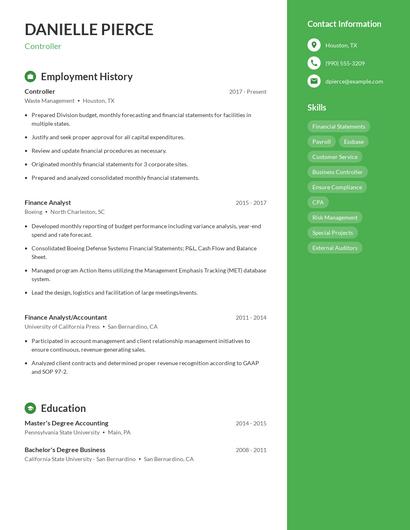
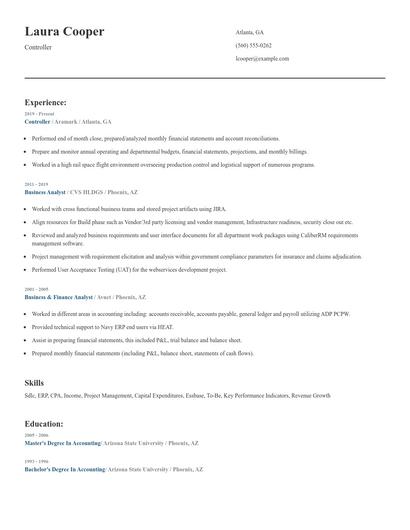
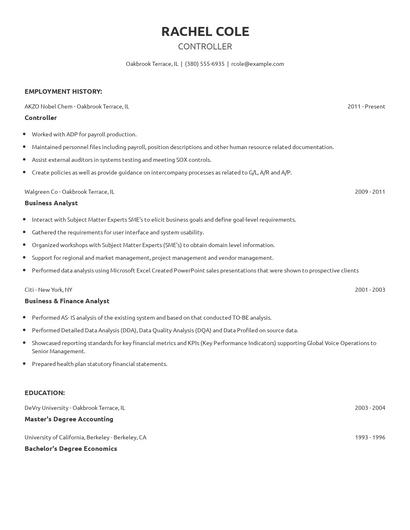
Choose from 10+ customizable controller resume templates
Build a professional controller resume in minutes. Our AI resume writing assistant will guide you through every step of the process, and you can choose from 10+ resume templates to create your controller resume.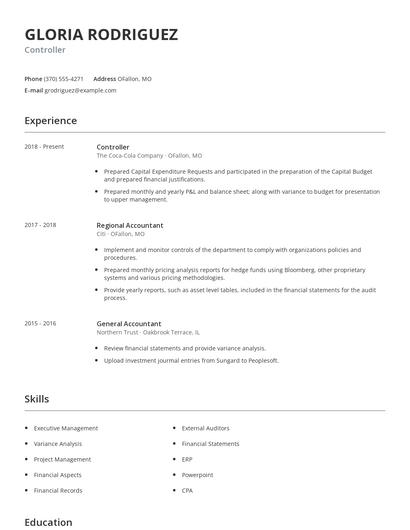






Compare different controllers
Controller vs. Business manager-finance manager
A business manager/finance manager is responsible for handling the financial transactions of an organization, analyzing financial reports, and monitor investment activities. Business managers/finance managers strategize effective techniques to boost the organization's financial performance and identify business opportunities to increase revenues. They also prepare financial statements and assist senior management in making corporate decisions by conducting data and statistical analysis by studying market trends. A business manager/finance manager must have excellent critical thinking and analytical skills, especially in calculating costs and expenses to minimize the company's loss and stabilize profits.
There are some key differences in the responsibilities of each position. For example, controller responsibilities require skills like "payroll processing," "account reconciliations," "general ledger accounts," and "balance sheet accounts." Meanwhile a typical business manager-finance manager has skills in areas such as "project management," "shared services," "process improvement," and "strong analytical." This difference in skills reveals the differences in what each career does.
Business manager-finance managers tend to make the most money working in the finance industry, where they earn an average salary of $115,910. In contrast, controllers make the biggest average salary, $105,981, in the technology industry.The education levels that business manager-finance managers earn slightly differ from controllers. In particular, business manager-finance managers are 5.3% more likely to graduate with a Master's Degree than a controller. Additionally, they're 0.4% more likely to earn a Doctoral Degree.Controller vs. Manager/finance accounting
A manager of finance accounting's role is to oversee the financial activities in a company or organization. Their responsibilities revolve around coordinating with other departments to gather financial data, analyze the revenues and expenditures, and develop written reports and presentations. A manager of finance accounting must also maintain accurate financial records, identify any errors or inconsistencies, and perform support tasks for staff when necessary. Furthermore, as a manager, it is essential to lead and encourage the team, all while implementing the company's policies and regulations.
While some skills are similar in these professions, other skills aren't so similar. For example, resumes show us that controller responsibilities requires skills like "journal entries," "oversight," "human resources," and "a/p." But a manager/finance accounting might use other skills in their typical duties, such as, "customer service," "hr," "shared services," and "treasury."
Managers/finance accounting earn a lower average salary than controllers. But managers/finance accounting earn the highest pay in the government industry, with an average salary of $92,198. Additionally, controllers earn the highest salaries in the technology with average pay of $105,981 annually.managers/finance accounting earn similar levels of education than controllers in general. They're 4.2% more likely to graduate with a Master's Degree and 0.4% more likely to earn a Doctoral Degree.What technology do you think will become more important and prevalent for controllers in the next 3-5 years?
Claudia Kocher Ph.D.
Associate Professor, Finance, University of Michigan Dearborn
Controller vs. Finance manager
A finance manager is responsible for monitoring the financial system of a company. Their tasks include handling their organization's financial status, generating cost estimates and budget goals, identifying business opportunities to increase revenues and profitability, improving financial strategies, reducing costs, analyzing account statements, processing invoice as needed, analyzing market trends, searching potential partnerships, and presenting reports. A finance manager must have excellent analytical skills and knowledge of the accounting and financial industry. They are responsible for providing the best recommendations for the organization's growth.
There are many key differences between these two careers, including some of the skills required to perform responsibilities within each role. For example, a controller is likely to be skilled in "payroll processing," "general ledger accounts," "oversight," and "balance sheet accounts," while a typical finance manager is skilled in "customer service," "hyperion," "financial models," and "strong analytical."
Finance managers make a very good living in the finance industry with an average annual salary of $118,926. On the other hand, controllers are paid the highest salary in the technology industry, with average annual pay of $105,981.finance managers typically earn similar educational levels compared to controllers. Specifically, they're 3.0% more likely to graduate with a Master's Degree, and 0.3% more likely to earn a Doctoral Degree.Controller vs. Finance leader
The duties of a finance leader depend on one's place or industry of employment. Typically, their responsibilities revolve around monitoring the sales and financial operations in a company, preparing financial reports and statements, finding new sales opportunities, identifying the market and client needs, and maintaining records of all financial transactions. There are also instances where a finance leader may set and allocate budgets, perform audits in costs and expenditures, all while implementing the company's policies and regulations.
Types of controller
Updated January 8, 2025
