
Automatically apply for jobs with Zippia
Upload your resume to get started.
Cyber security engineer skills for your resume and career

15 cyber security engineer skills for your resume and career
1. Cyber Security
- Performed with Corporate Nuclear Security in procedures writings, in support of plant operations and Cyber Security technical decisions.
- Supported FAA Cyber Security Management Center (CSMC) on performing vulnerability assessment, mitigation and reporting activities.
2. Python
Python is a widely-known programming language. It is an object-oriented and all-purpose, coding language that can be used for software development as well as web development.
- Authored several network reconnaissance/security tools in python.
- Developed python scripts for NVP stream use cases both analytic teams and SOC.
3. Linux
Linux is a Unix-like operating system. Just like Windows, Mac OS, and IOS, Linux is an operating system used by millions across the globe. Android itself is powered by the Linux operating system. Linux manages all the hardware resources that are associated with your computer. The software is famous because of the protection it grants from viruses, malware, and crashes. The Linux operating system is entirely free and is an open-source software meaning it can be altered by those equipped with the knowledge to code.
- Research and Development of a new product using my knowledge of information security, IP protocols, and Linux.
- Utilize advanced Linux utilities such as TCP dump to identify network connectivity issues for remote OCONUS IDPS systems.
4. Architecture
- Recommend technological and architectural upgrades/modifications to FAA's Information Systems Security architecture based on analysis performed in RedSeal.
- Monitored threat landscape through vulnerability and penetration testing assessments on enterprise architecture networking baselines.
5. NIST
- Retrieve results of these Verification Reports and if necessary, initiate corrective action to adhere to NIST & POAM compliance.
- Review system documentation and provide analysis results to satisfy DoD 8500 IA Controls and NIST SP 800-53.
6. Incident Response
Incident response is defined as the process by which a company or organization handles a cyber attack or a data breach. Along with dealing with the initial attack, this also deals with the possible consequences of the breach. The goal of incident response is to limit the damage caused by the attack.
- Write, edit and maintain Contingency/Incident Response, Information Security, Configuration Management, and Security Testing plans.
- Performed security monitoring, security and data/logs analysis to detect security incidents, and mounts incident response.
Choose from 10+ customizable cyber security engineer resume templates
Build a professional cyber security engineer resume in minutes. Our AI resume writing assistant will guide you through every step of the process, and you can choose from 10+ resume templates to create your cyber security engineer resume.7. DOD
Definition of Done (DoD) is a set of deliverables that are needed to devise software. These deliverables are valuable to the system and can be exemplified by writing code, coding comments, unit testing, integration testing, design documents, release notes, and so on.
- Review system audit results and prepare reports for review by the DoD Information Assurance Certification or Accreditation organization.
- Prepared and presented technical analyses, demonstrate, and present to senior-level internal and external DOD organizations.
8. RMF
RMF (the Risk Management Framework) refers to a set of criteria used by the federal government and its contractors to improve information security. To be proficient in RMF, in-depth technical experience with core technologies like Digital, Cloud, Data Protection, etc., along with knowledge of FISMA and FedRAMP regulatory compliance requirements.
- Tasked to assist in bringing USAF Space Command systems to a Risk Management Framework (RMF) compliant state.
- Managed DIACAP Risk Management Framework (RMF) process and standards for Department of Veteran Affairs.
9. Firewall
- Performed initial configuration of Panorama Box (Management unit for Palo-Alto Firewalls).
- Document inventory of current Firewall devices and malicious sources.
10. SIEM
- Plan and execute routine, scheduled maintenance and health check tasks of leveraged and dedicated SIEM Environment.
- Conducted Analysis of Alternatives on multiple SIEM products to enhance the security monitoring process.
11. Security Tools
Security tools refer to network security tools that can be both software-based or hardware-based. These tools help security teams to keep the networks of the organization secure. They keep critical infrastructure and sensitive data safe and secure from attacks.
- Experience evaluating and implementing IT security tools and applications.
- Integrate various open source security tools into monitoring solutions.
12. Network Security
- Prepare or monitor the preparation and analysis of statistics on network security, utilization and availability.
- Network security policies, application security, access control and corporate data safeguards.
13. Cloud Security
- Researched cloud security best practices for implementation of Disaster Recovery solutions.
- Offered Cloud Security Solutions and managed RSA authentication.
14. Java
Java is a widely-known programming language that was invented in 1995 and is owned by Oracle. It is a server-side language that was created to let app developers "write once, run anywhere". It is easy and simple to learn and use and is powerful, fast, and secure. This object-oriented programming language lets the code be reused that automatically lowers the development cost. Java is specially used for android apps, web and application servers, games, database connections, etc. This programming language is closely related to C++ making it easier for the users to switch between the two.
- Received Android SDK, XML, and JAVA training from Fort Gordon in order to develop applications for ARMY.
- Deployed, SAML 1.0/2.0, XML, XACML, WS-Security, SOA, ASP.Net, Java/J2EE.
15. Risk Assessments
The process of analyzing and identifying the acts or events that have the potential to negatively affect an individual, asset, or business is called risk assessment. Risk assessments are important because they form an integral part of an organization as well as occupational safety plans
- Analyze risk assessments and review Certification and Accreditation packages for systems with over 250 information assurance controls.
- Map non-compliant technical findings to the appropriate IA control and perform risk assessments to determine DIACAP severity codes for non-compliant controls.
5 Cyber Security Engineer resume examples
Build a professional cyber security engineer resume in minutes. Browse through our resume examples to identify the best way to word your resume. Then choose from 5+ resume templates to create your cyber security engineer resume.

What skills help Cyber Security Engineers find jobs?
Tell us what job you are looking for, we’ll show you what skills employers want.
What skills stand out on cyber security engineer resumes?
Louis Bobelis
Part-Time Faculty, The University of Tampa
What soft skills should all cyber security engineers possess?
Louis Bobelis
Part-Time Faculty, The University of Tampa
What hard/technical skills are most important for cyber security engineers?
Louis Bobelis
Part-Time Faculty, The University of Tampa
What cyber security engineer skills would you recommend for someone trying to advance their career?
Kermit Burley M.Ed.
Program Coordinator of Information Technology and Cybersecurity Analytics and Operations, Pennsylvania State University - Lehigh Valley
List of cyber security engineer skills to add to your resume
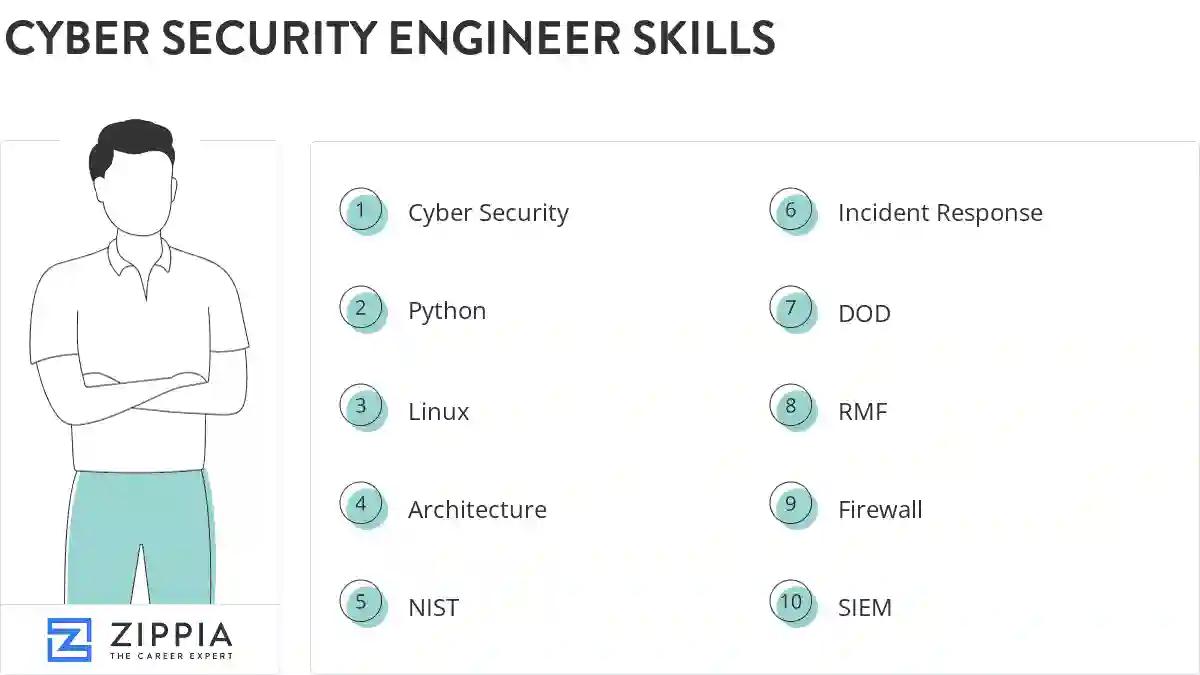
The most important skills for a cyber security engineer resume and required skills for a cyber security engineer to have include:
- Cyber Security
- Python
- Linux
- Architecture
- NIST
- Incident Response
- DOD
- RMF
- Firewall
- SIEM
- Security Tools
- Network Security
- Cloud Security
- Java
- Risk Assessments
- ACAS
- Security Policies
- Splunk
- Vulnerability Management
- Security Posture
- Encryption
- Security Solutions
- Intrusion Detection
- Data Loss Prevention
- Azure
- STIG
- Nessus
- Unix
- DLP
- Application Security
- Vulnerability Assessments
- Disa
- SQL
- Security Incidents
- National Security
- Technical Support
- FISMA
- OS
- Key Management
- ATO
- VMware
- SOC
- HBSS
- Configuration Management
- Security Products
- Wireshark
- Windows Server
- Security Assessments
Updated January 8, 2025
