Explore jobs
Find specific jobs
Explore careers
Explore professions
Best companies
Explore companies
Job outlook for data management associates in the United States
Are data management associate jobs in demand?
Data management associate job and salary trends over time
Data management associate jobs over time
Data management associate job growth rate over time
| Year | # of jobs | % of population |
|---|---|---|
| 2021 | 1,626 | 0.00% |
| 2020 | 1,742 | 0.00% |
| 2019 | 1,703 | 0.00% |
| 2018 | 1,642 | 0.00% |
| 2017 | 1,517 | 0.00% |
Average data management associate salary over time
Data management associate salary by year
| Year | Avg. salary | Hourly rate | % Change |
|---|---|---|---|
| 2026 | $119,281 | $57.35 | +1.2% |
| 2025 | $117,846 | $56.66 | +3.9% |
| 2024 | $113,477 | $54.56 | +4.4% |
| 2023 | $108,668 | $52.24 | +4.4% |
| 2022 | $104,065 | $50.03 | +0.5% |
Data management associate jobs by state
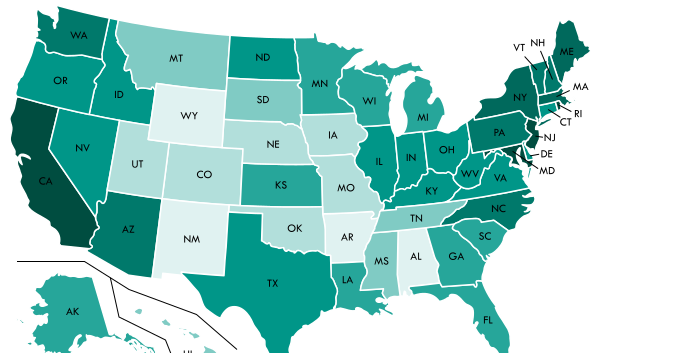
Most common states for data management associates
| Rank | State | Population | # of jobs | Employment/ 1000ppl |
|---|---|---|---|---|
| 1 | Massachusetts | 6,859,819 | 2,169 | 32% |
| 2 | North Dakota | 755,393 | 205 | 27% |
| 3 | Alaska | 739,795 | 189 | 26% |
| 4 | New Hampshire | 1,342,795 | 310 | 23% |
| 5 | South Dakota | 869,666 | 197 | 23% |
| 6 | Maryland | 6,052,177 | 1,321 | 22% |
| 7 | Minnesota | 5,576,606 | 1,222 | 22% |
| 8 | Connecticut | 3,588,184 | 792 | 22% |
| 9 | Illinois | 12,802,023 | 2,693 | 21% |
| 10 | New Jersey | 9,005,644 | 1,835 | 20% |
| 11 | Colorado | 5,607,154 | 1,142 | 20% |
| 12 | Nebraska | 1,920,076 | 386 | 20% |
| 13 | California | 39,536,653 | 7,323 | 19% |
| 14 | North Carolina | 10,273,419 | 1,959 | 19% |
| 15 | Iowa | 3,145,711 | 586 | 19% |
| 16 | New York | 19,849,399 | 3,539 | 18% |
| 17 | Pennsylvania | 12,805,537 | 2,194 | 17% |
| 18 | Arizona | 7,016,270 | 1,189 | 17% |
| 19 | Kansas | 2,913,123 | 491 | 17% |
| 20 | Delaware | 961,939 | 166 | 17% |
Most common cities for data management associates
| Rank | City | # of jobs | Employment/ 1000ppl | Avg. salary |
|---|---|---|---|---|
| 1 | Newark | 3 | 9% | $105,014 |
| 2 | Annapolis | 2 | 5% | $136,905 |
| 3 | Tampa | 11 | 3% | $88,234 |
| 4 | Lansing | 2 | 2% | $87,320 |
| 5 | Springfield | 2 | 2% | $93,527 |
| 6 | Beverly | 1 | 2% | $123,886 |
| 7 | Little Rock | 2 | 1% | $54,533 |
| 8 | Centennial | 1 | 1% | $71,996 |
| 9 | New York | 5 | 0% | $118,756 |
| 10 | Baltimore | 3 | 0% | $137,093 |
| 11 | Boston | 2 | 0% | $124,224 |
| 12 | Denver | 2 | 0% | $71,848 |
| 13 | San Diego | 2 | 0% | $121,146 |
| 14 | Washington | 2 | 0% | $112,475 |
| 15 | Atlanta | 1 | 0% | $89,568 |
| 16 | Charlotte | 1 | 0% | $105,459 |
| 17 | Chicago | 1 | 0% | $101,139 |
Data Management Associate job outlook: Expert opinions
Our panel of data management associate experts
University of Maryland - College Park
Kettering University
University of Missouri - St Louis
University of California, Irvine
Morgan State University
University of Oregon
University of Wisconsin - Green Bay
University of Indianapolis
Saint Peter's University
University of Michigan - Ann Arbor
Georgia Institute of Technology
University of Minnesota - Duluth

Stony Brook University

Washington State University

DePauw University

Binghamton University
Tim Scales
Director of Center for Entrepreneurship – Director Center for Economic Education and Senior Lecturer in Business and EconomicsWhat Data Management Associate skills would you recommend for someone trying to advance their career?
Tim Scales: To maximize salary potential when starting a career in the field, it's important to negotiate effectively, demonstrate value through performance, seek out opportunities for advancement and additional responsibilities, and continuously invest in improving skills and knowledge relevant to the industry.
What general advice would you give to a Data Management Associate?
Sean Cao: Data analytics skills, critical thinking and problem-solving skills, and communication skills will become more important and prevalent in the next few years. Acquiring these skills positions students to gain a competitive edge in the era of AI.
Dr. Osama Aljarrah
Assistant ProfessorKettering University
Manufacturing Engineering
What general advice would you give to a Data Management Associate?
Dr. Osama Aljarrah: The capacity to solve complex problems in real-time settings. What enables you to do that is the ability to analyze information systematically and make data-driven decisions using artificial intelligence, data analytics, lean manufacturing, lean six sigma, and programming skills.
What will help Data Management Associates increase their earning potential?
Ambrose Kidd III: Be patient and explore widely. It sometimes takes a while to find the first job, but that will be a new opportunity to learn and demonstrate your ability.
What Data Management Associate skills would you recommend for someone trying to advance their career?
Dr. Jessie Borelli Ph.D.: The value of technical skills keeps increasing, and I can only imagine that these skills will continue to rise in value. One edge that psychological science students bring to the table is the ability to interpret data, as well as to understand the user experience that influences human behavior in digital spaces. For example, people with training in psychological science will be needed to consult on interpersonal interactions, promoting mental health in an increasing digital world and how to address issues of equity and inclusion in digital spaces.
Dr. Jacqueline Holland EdD, CFCS
Associate ProfessorMorgan State University
Family And Consumer Sciences/Human Sciences
What will help Data Management Associates increase their earning potential?
Dr. Jacqueline Holland EdD, CFCS: In the next 3-5 years, skills such as data analysis, digital literacy, and adaptability will become more important and prevalent in the field.
Fangjun Sang
Assistant Professor of AccountingUniversity of Wisconsin - Green Bay
Accounting And Related Services
What Data Management Associate skills would you recommend for someone trying to advance their career?
Fangjun Sang: Data analytics skills. Specifically, be able to learn new software tools quickly, be able to analyze databases and find patterns or issues from data analysis.
What Data Management Associate skills would you recommend for someone trying to advance their career?
Abigail Richard Ph.D.: When starting your career, it is important to develop 'soft skills' in learning to effectively communicate and explain your expertise to those outside of your field. Practice by trying to explain your talents and expertise to friends outside of your field.
Dr. Joshua Feinberg
Associate Professor of PsychologySaint Peter's University
Social Sciences
What Data Management Associate skills would you recommend for someone trying to advance their career?
Dr. Joshua Feinberg: Make sure you emphasize the knowledge, skills, abilities, and other tools you have picked up with your psychology major and undergraduate education. Many students worry that they don't have the direct experience that some jobs/employers are looking for; it is important that students emphasize the aspects of their education that are transferable to their career interests.
Ronald Larson
Distinguished University ProfessorUniversity of Michigan - Ann Arbor
Multi/Interdisciplinary Studies
What general advice would you give to a Data Management Associate?
Ronald Larson: I view salary as the fruit of being very good at what you do, and being very good generally requires you to love what you do enough to spend not just time but concentration on it. A good salary will generally eventually follow, especially in fields in which there is high demand. (The performing arts (music, acting) are a different story: unless you are extraordinarily good or lucky, these can be great hobbies, but only few make well-paying careers in them.) Generally, I have found greater pleasure in tasks well done than in the pay received for these tasks. Some of the greatest rewards are not monetary.
What general advice would you give to a Data Management Associate?
Dylan Brewer: Students with a bachelor's degree in economics from Georgia Tech often find employment opportunities in a variety of fields, including technology, consulting, banking, and policy/nonprofit organizations. In addition, lots of students go on to pursue graduate degrees. Here are some typical jobs that economics graduates from Georgia Tech might pursue:
Tech:
Data analyst roles at tech companies like Google, Amazon, Microsoft, etc.
Business analyst or product manager roles at tech firms
Economic analyst positions at tech companies, analyzing market trends and consumer behavior
Positions in financial technology companies, leveraging economic knowledge and data skills
Consulting:
Economic consultant roles at major consulting firms like McKinsey, BCG, Deloitte, etc.
Management consulting positions, providing data-driven business strategy advice
Consulting roles focused on economic analysis, forecasting, and risk assessment
Banking/Finance:
Roles in investment banking, such as financial analyst or associate positions
Positions in commercial banking, such as credit analyst or loan officer
Opportunities in corporate finance, financial analysis, and risk management departments
Roles in asset management firms, hedge funds, and other investment companies
Policy/Nonprofit:
Economic policy analyst positions at think tanks, research organizations, or government agencies
Roles in economic development organizations, analyzing policies and initiatives
Opportunities at nonprofit organizations focused on economic issues, such as poverty alleviation or microfinance
Positions in international organizations like the World Bank or IMF, working on economic development projects
Graduate studies:
Economics PhD and masters programs focused on research
Legal (JD) programs and other social sciences PhD programs
Data science masters programs
The quantitative and analytical skills gained through an economics degree, combined with Georgia Tech's strong reputation in STEM fields, make economics graduates attractive candidates for roles that involve data analysis, forecasting, and strategic decision-making across various industries.
Ahmed Maamoun Ph.D.
Assistant Professor of Marketing & 8X Recipient of the University of Minnesota’s Certificate for “Outstanding Teaching and Dedication to Helping Students Learn”University of Minnesota - Duluth
Marketing
What will help Data Management Associates increase their earning potential?
Ahmed Maamoun Ph.D.: The news from the job market is quite startling. A recent study from McKinsey & Company
estimates that nearly half of all U.S. jobs will be automated by 2030. Artificial Intelligence,
machine learning, and robots will make routine and conventional jobs obsolete. Most of what
students are learning will be irrelevant and dated by the time they graduate. This highlights the
need for emphasizing not just the academic abilities of graduates, but their soft and professional
skills as well. Graduates (regardless of their undergraduate major) who demonstrate a capacity to
think critically, communicate clearly, learn adaptively, make ethical decisions, work well with
others, and solve complex problems will stand a better chance of surviving in that ever-changing
job market. For example, in one survey, 93% of employers reported that "a candidate's
demonstrated capacity to think critically, communicate clearly, and solve complex problems is
more important than his or her undergraduate major."
Mark Gibson
Clinical Associate ProfessorWashington State University
School of Economic Sciences
How do you envision technology impacting Data Management Associates in the next 5 years?
Mark Gibson: Technological progress increasingly favors high-skilled workers, particularly those with superior analytical and quantitative skills. Economics graduates need to stress their broad-based strengths in these areas, which enable them to adapt to changing technology.
What type of skills will young Data Management Associates need?
Mark Gibson: The skills graduates need when they enter the workforce are higher-level cognitive skills. Critical thinking and problem-solving are the most important. Being able to analyze and interpret data is a crucial part of this. Economics is designed to equip students with these skills.
Are there any particularly good places in the United States for Data Management Associates to find work opportunities?
Mark Gibson: Economics isn't meant to prepare graduates for a particular field after graduation. Rather, it imparts a set of analytical and quantitative skills, that are highly valued, in a number of fields, including finance, banking, data analytics, government policy, and law.
Are there any particularly good places in the United States for Data Management Associates to find work opportunities?
Zhixin Wu Ph.D.: (1) Insurance Companies or Actuarial Consulting Firms. Students can work as an actuary analyst or work in the field of underwriting and risk management.
(2) Banking and Investment, doing investment and accounting or work as a financial analyst or market research analyst
(3) IT companies, as a programmer or data scientist
(4) Pharmaceutical companies as a statistician
(5) K-12 Schools as a math teacher
Xingye Qiao Ph.D.
Associate ProfessorBinghamton University
Department of Mathematical Sciences
Are there any particularly good places in the United States for Data Management Associates to find work opportunities?
Xingye Qiao Ph.D.: I don't know what you mean by good places. West coast remains to be a hot spot, though there are enough opportunities everywhere, NYC, Boston, DC, to name a few.