
Automatically apply for jobs with Zippia
Upload your resume to get started.
Data modeler skills for your resume and career

15 data modeler skills for your resume and career
1. ETL
- Analyzed ETL processing to identify risk factors and made necessary recommendations to ensure data integrity in the data warehouse.
- Worked to ensure implementation meets the documented specifications for ETL processes including data translation/mapping and transformation.
2. Data Analysis
- Redefined many attributes and relationships in the reverse engineered model and cleansed unwanted table/columns as part of data analysis responsibility.
- Reviewed Entities and relationships in the engineered model and cleansed unwanted tables/ columns as part of data analysis responsibilities.
3. Data Architecture
- Maintained and enforce data architecture/administration standards, as well as standardization of column name abbreviations, domains and attributes.
- Performed an analysis of U.S. Customs Automated Commercial System's as-is architecture to establish baseline data architecture.
4. Physical Data Models
- Performed Reverse Engineering of the current application using Erwin, and developed Logical and Physical data models for Central Model consolidation.
- Developed the logical data models and physical data models that confine existing condition/potential status data fundamentals and data flows using Erwin.
5. Data Warehouse
Data warehouse, often abbreviated as either DW or DWH is a system used in computing for data analysis as well reporting. The DW is also considered to be an integral component of business intelligence as they also provide storage facilities for both real-time and historical data. ETL and ELT are the two driving forces behind a data warehouse system.
- Participated with key management resources in the strategic analysis and planning requirements for Data Warehouse/Data Mart reporting and data mining solutions.
- Designed and developed system for generating data warehouse quality test scripts driven by meta-data extracted from ER/Studio models.
6. Tableau
- Developed and delivered dynamic reporting visuals using Tableau.
- Used various reporting objects like Hierarchies, filters, calculated fields, Sets, Groups, Parameters etc., in Tableau.
Choose from 10+ customizable data modeler resume templates
Build a professional data modeler resume in minutes. Our AI resume writing assistant will guide you through every step of the process, and you can choose from 10+ resume templates to create your data modeler resume.7. Metadata
Metadata is a combination of two words, meta and data. Meta is a prefix defined as more comprehensive, and data means collection of data. Metadata is defined as the data that describes other data. It is used to summarize data about data to make the data easier to analyze.
- Developed Private Bank's Metadata Strategy that leverages shared corporate resources including use of Computer Associates Advantage Metadata Repository.
- Created SQL queries to extract Report and source/target metadata from Business Objects and Oracle Data Integrator internal repository databases.
8. SQL Server
- Created custom data repository application and database using SQL Server.
- Performed various SQL Server data administration functions.
9. Visualization
- Translate business requirements into functional design specifications and used visualization tool to get consensus from business users during development.
- Developed complex algorithms and advanced (undocumented) tableau visualization techniques that were successfully integrated into Tableau dashboard models.
10. BI
- Modified logical and physical relational and dimensional models for sales analysis BI reporting.
- Interacted with BI developers for business requirements gathering to generate the report elements.
11. Extraction
- Performed GIS data manipulation, analysis, extraction and regeneration with Access and Excel 2.
- Involved with Data Extraction, Modification, Validation, Analysis, Management and Reporting.
12. Er Studio
- Created the dimensional logical model with approximately 10 facts, 30 dimensions with 500 attributes using ER Studio.
- Performed ER Studio Repository Administrative tasks assigning Read/write access to models to different users based on their needs.
13. Java
Java is a widely-known programming language that was invented in 1995 and is owned by Oracle. It is a server-side language that was created to let app developers "write once, run anywhere". It is easy and simple to learn and use and is powerful, fast, and secure. This object-oriented programming language lets the code be reused that automatically lowers the development cost. Java is specially used for android apps, web and application servers, games, database connections, etc. This programming language is closely related to C++ making it easier for the users to switch between the two.
- Developed interface pages in Java script by facilitating the user to pass parameters into the report.
- Helped Java Developers AND Testers in understanding the Data Model.
14. Data Quality
- Proposed an approach to the consolidation of policy holder and producer information and to data quality improvement.
- Maintained the integrity of data also monitored data quality.
15. Profiling
- Analyzed functional and non-functional data elements for data profiling and mapping from source to target data environment.
- Performed data profiling, attribute analysis.
5 Data Modeler resume examples
Build a professional data modeler resume in minutes. Browse through our resume examples to identify the best way to word your resume. Then choose from 5+ resume templates to create your data modeler resume.

What skills help Data Modelers find jobs?
Tell us what job you are looking for, we’ll show you what skills employers want.
What skills stand out on data modeler resumes?
Yingfu (Frank) Li Ph.D.
Program Chair of Statistics and Associate Professor of Statistics, University of Houston - Clear Lake
What soft skills should all data modelers possess?
Michael Gallaugher Ph.D.
Assistant Professor, Elected Director of The Classification Society, Baylor University
What hard/technical skills are most important for data modelers?
Michael Gallaugher Ph.D.
Assistant Professor, Elected Director of The Classification Society, Baylor University
What data modeler skills would you recommend for someone trying to advance their career?
Edward Boone Ph.D.
Professor of Statistics, Virginia Commonwealth University
I see many students who say they want to be a medical doctor. I usually respond to them, "You want to work with sick people the rest of your life?" Some will say "yes" that they want to make a difference and help sick people. Others will say, "I hadn't thought about it."
In terms of skills...
If someone is interested in a technical career such as Statistics, Mathematics, Operations Research, Data Science, Computer Science, Engineering, I would learn a computer language. Even if you already know one computer language, discover another. All of the above careers require one to be able to learn new computer languages quickly.
The other immense skill someone should learn is interpersonal skills. Often technical people spend a large portion of their job sitting in front of a computer. However, interacting with people is the most critical skill, as you will always need to work with others.
What type of skills will young data modelers need?
Zhixin Wu Ph.D.
Associate Professor, DePauw University
List of data modeler skills to add to your resume
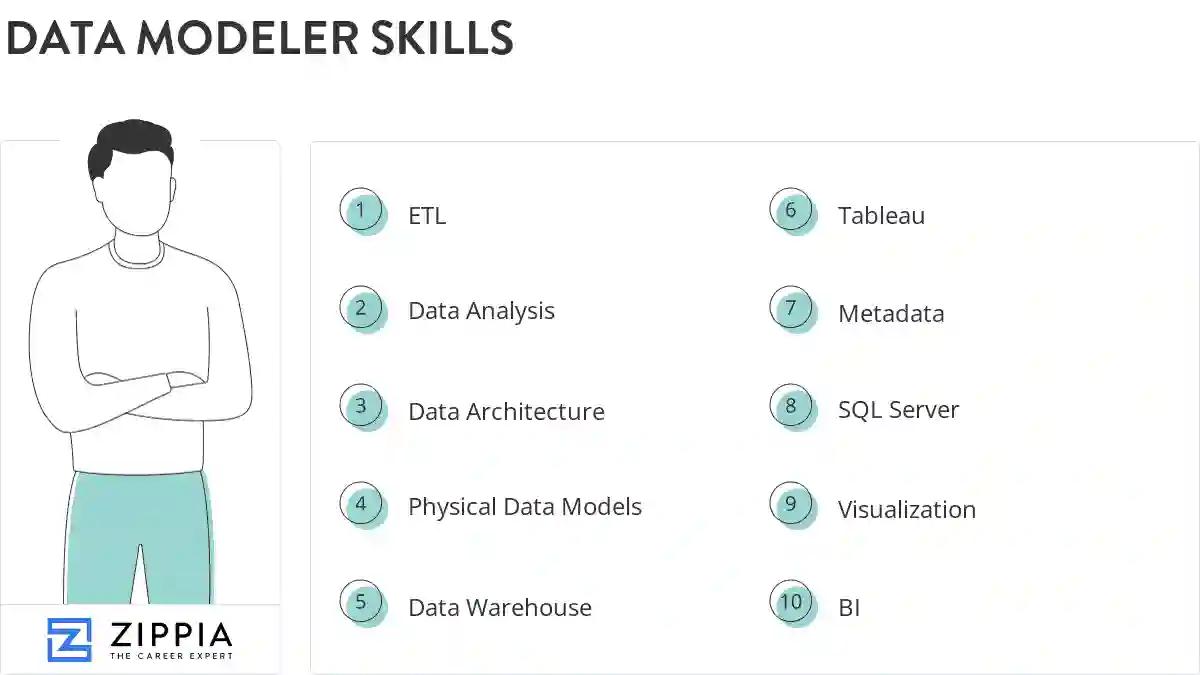
The most important skills for a data modeler resume and required skills for a data modeler to have include:
- ETL
- Data Analysis
- Data Architecture
- Physical Data Models
- Data Warehouse
- Tableau
- Metadata
- SQL Server
- Visualization
- BI
- Extraction
- Er Studio
- Java
- Data Quality
- Profiling
- Data Governance
- Data Warehousing
- SAS
- Schema
- DDL
- Snowflake
- XML
- Data Dictionary
- Data Marts
- DB2
- Oracle Sql
- Dimensional Data
- OLTP
- Regression
- Logical Data Model
- Strong Analytical
- EDW
- Data Elements
- Business Analysts
- PL/SQL
- Business Rules
- QA
- Toad
- Business Process
- Linux
- Unix
- Reverse Engineering
- SME
- Ssis
- UML
- ODS
- Sap Hana
- OLAP
Updated January 8, 2025
