What does a deaf interpreter do?
Deaf interpreter responsibilities
Here are examples of responsibilities from real deaf interpreter resumes:
- Help implement and modify behavior plans and IEP goals for the success of the students.
- Work closely with teachers & other staff to meet or exceed student IEP goals & to resolve problems.
- Provide effective communication by making important connection between patients, families and providers in clinical and hospital settings.
- Follow establish departmental guidelines and protect confidentiality of member's information (HIPPA )
Deaf interpreter skills and personality traits
We calculated that 35% of Deaf Interpreters are proficient in Registry, EIPA, and ASL. They’re also known for soft skills such as Business skills, Cultural sensitivity, and Dexterity.
We break down the percentage of Deaf Interpreters that have these skills listed on their resume here:
- Registry, 35%
Maintain professional standards as delineated in the Code of Ethics of the National Registry of Interpreters for the Deaf.
- EIPA, 15%
Certified through EIPA (Educational Interpreter Performance Assessment) Proficient in American Sign Language receptive and expressive.
- ASL, 12%
Assisted the teachers in communicating with the students via American Sign Language (ASL).
- Facilitate Communication, 11%
Facilitate communication between Deaf and Hard of Hearing and hearing consumers in various settings, other students and disability coordinator
- Mental Health, 10%
Managed marketing for Interpreters Unlimited by identifying mental health, government and other support agencies and pitching interpreter services.
- IEP, 7%
Worked closely with teachers & other staff to meet or exceed student IEP goals & to resolve problems.
Common skills that a deaf interpreter uses to do their job include "registry," "eipa," and "asl." You can find details on the most important deaf interpreter responsibilities below.
Business skills. One of the key soft skills for a deaf interpreter to have is business skills. You can see how this relates to what deaf interpreters do because "self-employed interpreters and translators must be able to manage their finances." Additionally, a deaf interpreter resume shows how deaf interpreters use business skills: "interpret in a variety of settings that include medical, mental health, education, music and business industries. "
Cultural sensitivity. Another essential skill to perform deaf interpreter duties is cultural sensitivity. Deaf interpreters responsibilities require that "interpreters and translators must be aware of expectations among the people for whom they are helping to facilitate communication." Deaf interpreters also use cultural sensitivity in their role according to a real resume snippet: "facilitated communication through use of sign language, spoken english, cultural medication, and knowledge about accessibility. "
Dexterity. Another skill that relates to the job responsibilities of deaf interpreters is dexterity. This skill is critical to many everyday deaf interpreter duties, as "sign language interpreters must be able to make quick and coordinated hand, finger, and arm movements when interpreting." This example from a resume shows how this skill is used: "perform frequent transfers and lifting, dressing, bathing, grooming and feeding for all assigned patients. "
Interpersonal skills. A big part of what deaf interpreters do relies on "interpersonal skills." You can see how essential it is to deaf interpreter responsibilities because "interpreters and translators must be able to put clients and others at ease." Here's an example of how this skill is used from a resume that represents typical deaf interpreter tasks: "helped break down language barriers, effective communication and interpersonal skillsworked well under emotionally charged conversations"
Listening skills. A commonly-found skill in deaf interpreter job descriptions, "listening skills" is essential to what deaf interpreters do. Deaf interpreter responsibilities rely on this skill because "interpreters must pay attention when interpreting for audiences to ensure that they hear and interpret correctly." You can also see how deaf interpreter duties rely on listening skills in this resume example: "communicated fluently in sign language to deaf staff & clients when needed. "
The three companies that hire the most deaf interpreters are:
- University of Rochester3 deaf interpreters jobs
- Advocates2 deaf interpreters jobs
- State Of Montana2 deaf interpreters jobs
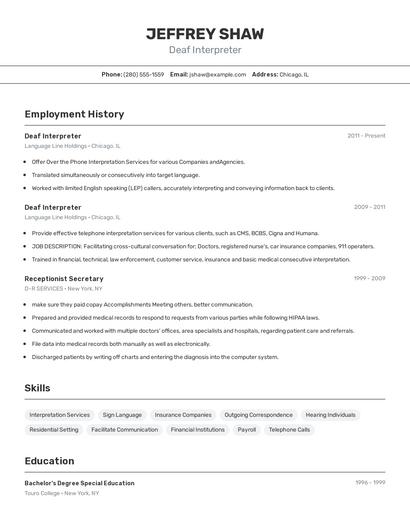
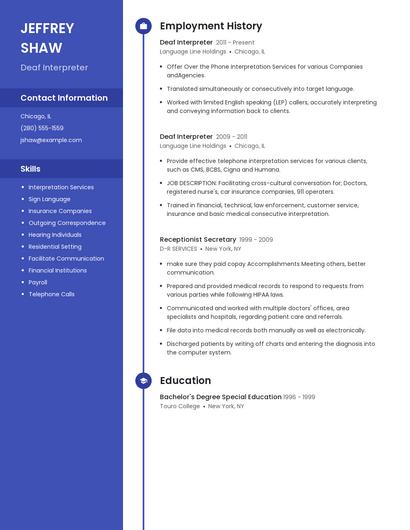
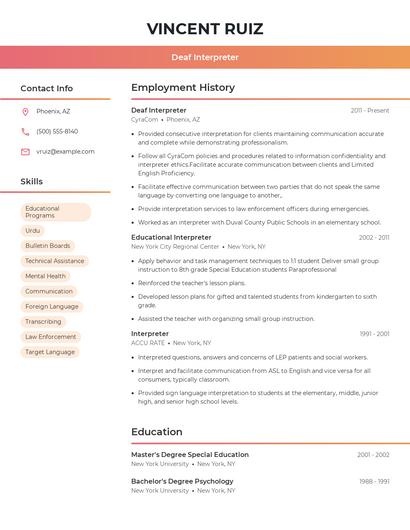
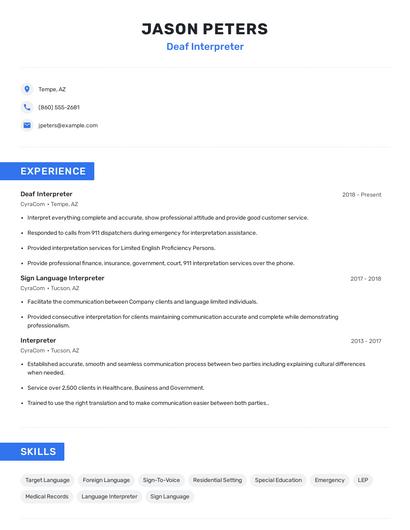
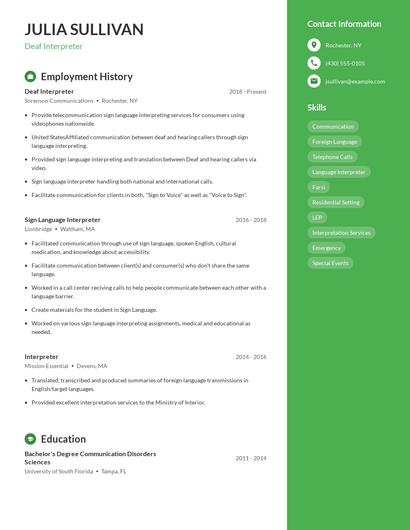
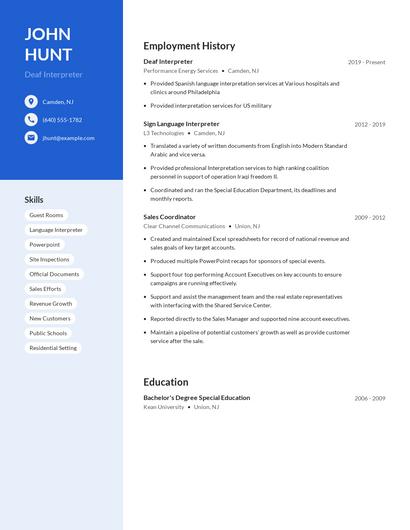
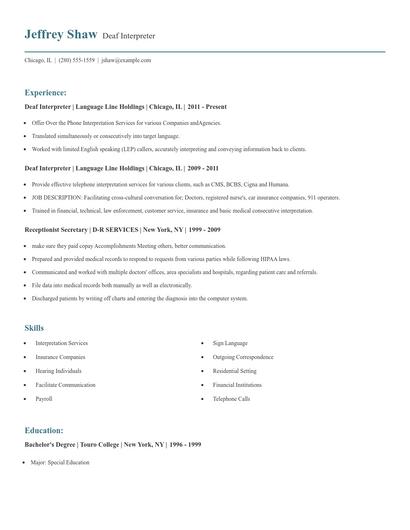
Choose from 10+ customizable deaf interpreter resume templates
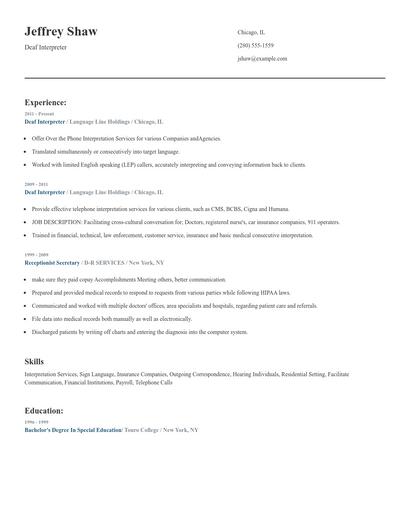
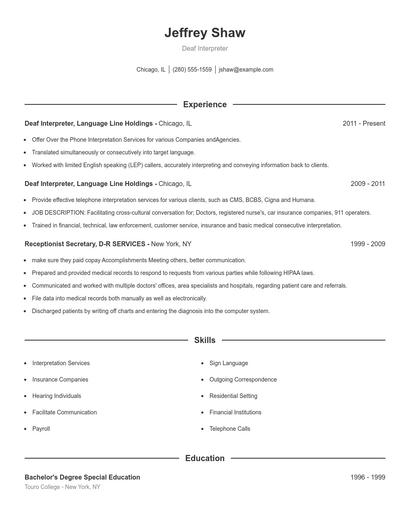
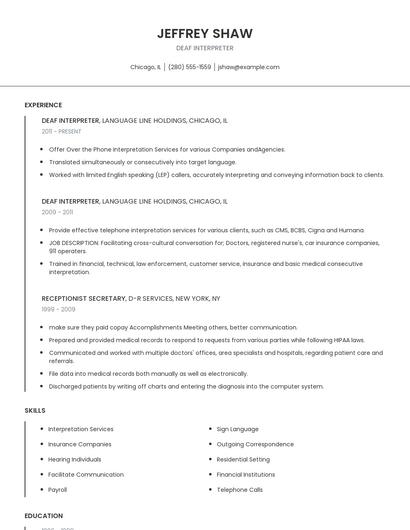
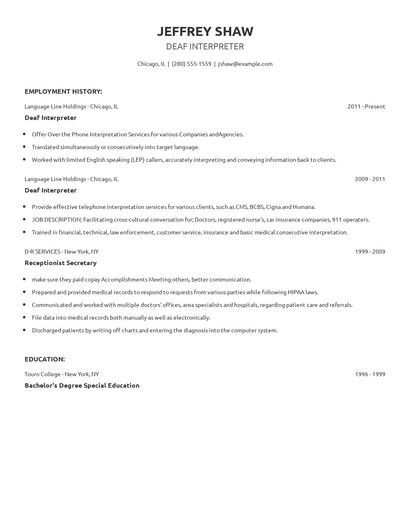
Build a professional deaf interpreter resume in minutes. Our AI resume writing assistant will guide you through every step of the process, and you can choose from 10+ resume templates to create your deaf interpreter resume.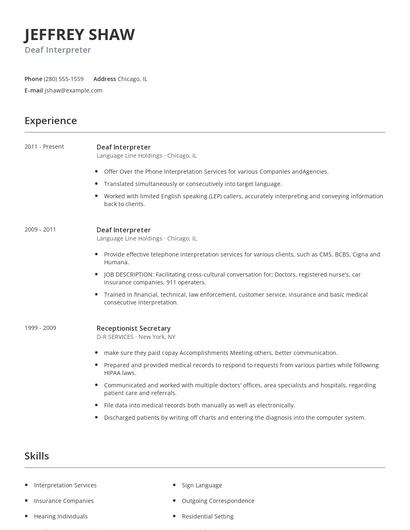
Compare different deaf interpreters
Deaf interpreter vs. Cryptologic linguist
Cryptologic linguists are lingual professionals who are responsible for using signals equipment to identify and analyze foreign communications. These linguists must assist intelligence community analysts in translating open source and sensitive materials as well as producing comprehensive reports about the daily activities of their enemies. They are required to supervise a team of other linguistic professionals to provide transcriptions and analysis from foreign communications. Cryptologic linguists must also identify the languages spoken at target geographic areas of interest.
These skill sets are where the common ground ends though. The responsibilities of a deaf interpreter are more likely to require skills like "registry," "eipa," "asl," and "facilitate communication." On the other hand, a job as a cryptologic linguist requires skills like "tip," "government agencies," "national security," and "signals intelligence." As you can see, what employees do in each career varies considerably.
On average, cryptologic linguists reach similar levels of education than deaf interpreters. Cryptologic linguists are 4.1% less likely to earn a Master's Degree and 0.8% more likely to graduate with a Doctoral Degree.Deaf interpreter vs. Freelance translator
A freelance translator is an independent contractor specializing in translating audio or written materials into a particular language. They primarily communicate with clients to identify their needs and preferences, including project specifications such as deadlines and format. Being a freelance translator means that they can work remotely at their preferred schedule, most of the time, working from home. They are not employed under a company, which is why most freelance translators prepare their own portfolios and create client bases through websites and other platforms.
While some skills are similar in these professions, other skills aren't so similar. For example, resumes show us that deaf interpreter responsibilities requires skills like "registry," "eipa," "asl," and "facilitate communication." But a freelance translator might use other skills in their typical duties, such as, "target language," "web content," "vice versa," and "user manuals."
Freelance translators earn higher levels of education than deaf interpreters in general. They're 13.2% more likely to graduate with a Master's Degree and 0.8% more likely to earn a Doctoral Degree.Deaf interpreter vs. Arabic linguist
Arabic linguists are experts who interpret and translate research or business documents that are written in the Arab language or its dialects. These linguists are required to advise peers and superiors about the Arabic language and culture while providing inputs of written reports developed from target materials utilizing the specific Arabic language. They must conduct simultaneous interpretations of conversations during diplomatic meetings and conferences. Arabic linguists must also create and manage Arabic language training for the newly hired linguists.
There are many key differences between these two careers, including some of the skills required to perform responsibilities within each role. For example, a deaf interpreter is likely to be skilled in "registry," "eipa," "asl," and "facilitate communication," while a typical arabic linguist is skilled in "transcription," "target language," "language," and "vice versa."
When it comes to education, arabic linguists tend to earn similar degree levels compared to deaf interpreters. In fact, they're 0.7% more likely to earn a Master's Degree, and 0.9% more likely to graduate with a Doctoral Degree.Deaf interpreter vs. Language translator
Language translators are linguistic professionals who are responsible for converting information from one language to another to help people read the translation based on the original source. These translators must use a computer to translate the original language into their native language. They can work for software development companies as under contract independent foreign language translators. They must utilize target language to translate and transcribe critical information and performing immediate data analysis. Language translators must also provide interpretations for meetings, conferences, and administrative hearings for any sponsored functions.
Types of deaf interpreter
Updated January 8, 2025
