
Automatically apply for jobs with Zippia
Upload your resume to get started.
Dentist/owner skills for your resume and career
15 dentist/owner skills for your resume and career
1. Patients
- Owned and operated sole Dental proprietorship with a practice size of over 7,000 patients and monthly revenue of over $70,000.
- Provided Oral Conscious Sedation care for patients as needed and was ACLS certified and Board licensed to provided such care.
2. Oral Surgery
- General practitioner with experience on restorative, prosthodontics, implants, minor oral surgery, endodontics, periodontics and oral pathology
- Range of dental services includes: oral surgery, operative dentistry, removable prosthodontics, periodontics, and endodontics.
3. Treatment Planning
- Diagnosed cases daily and executed treatment planning after communication to each patient.
- Experienced in comprehensive treatment planning & delivering.
4. Dental Implants
Dental implant in the medical world refers to the placement of an artificial tooth in the place of a missing or broken tooth. The dental implant is the metal piece that takes the root portion of the tooth and forms the foundation where the dentist will place the artificial tooth.
- Assisted in placement and restoration of Dental Implants including implant-supported bridges and over-dentures.
- Assisted in advance dental implant surgeries using multiple systems.
5. Dental Procedures
Dental procedures is a term used to refer to the medical procedures and processes which occur within or otherwise related to a patient's teeth or other connected and nearby elements. Such procedures are medical in nature and thus must be done, specifically, by medical experts and professionals who also must be in possession of the appropriate medical licenses. These procedures can include but are not limited to: dental fillings, crowns, extraction of teeth, and braces.
- Performed multiple dental procedures including mostly all dental fields, starting from diagnosis until minor oral surgical procedures.
- Performed all dental procedures with dental assistant support; maintained best practices.
6. Dentures
- Fabricated temporary / permanent dentures and night guards and provided in-office whitening.
- Observed bonding, restorations, tooth extraction, periodontal surgery, dentures, root canal, and crown placement
Choose from 10+ customizable dentist/owner resume templates
Build a professional dentist/owner resume in minutes. Our AI resume writing assistant will guide you through every step of the process, and you can choose from 10+ resume templates to create your dentist/owner resume.7. Surgical Extractions
- Perform Non-surgical and Surgical extractions, includingimpacted teeth.
- Performed routine and surgical extractions that required a surgical handpiece for sectioning of teeth and ostectomy.
8. Direct Patient Care
- Provided direct patient care, general dentistry
- Provided and manage direct patient care, including physical examinations, evaluations, assessments, diagnoses and treatment plans.
9. Dental Clinic
A dental clinic is a medical premise or compound where dentistry services and treatments are provided by a certified dentist. A dental clinic hosts general dental diagnoses, Hygenic treatments, as well as complex dental surgeries.
- Established and managed a dental clinic in the Norcross area and grew the monthly revenue up to $40,000.
- Serviced multiple states and federally-funded rural medical-dental clinics throughout California promoting oral health to the impoverished social classes.
10. Patient Education
- Initiated and implemented patient education protocols for team members on implants, cosmetic dentistry, restorative and preventative dentistry.
- Provided patient education to different schools and organization through lectures.
11. Prosthetics
- Practice general dentistry, including prosthetic and restorative dentistry.
- Carried out prosthetic procedures including fixed and removable.
12. Surgical Procedures
Surgical procedures include the list of tasks that are done while doing surgery. Usually, a surgical procedure involves an incision with instruments, performed to repair damage or heal the disease in a living body. Surgical procedures are performed by trained individuals such as surgeons, doctors, and nurses.
- Performed surgical procedures and 3rd molar extractions.
- Gained experience in presentation of complex restorative treatment plans and improved my knowledge and expertise in surgical procedures.
13. Root Canals
- Addressed emergency cases by alleviating pain and successfully completing root canals.
- Perform tooth filing, root canals and perform tooth extractions when it's necessary.
14. Treatment Options
Treatment options are the different medical treatments doctors choose from to give to a sick person or animal. Treatment options depend highly on how ill a patient is and what drugs they can't without using.
- Quoted prices, credit terms and treatment options, where always adhered.
- Communicated treatment options, costs, risks, and benefits for all different options.
15. Medicaid
- Provide Dental care for HMOs, PPOs, Medicare, and Medicaid
- Performed all duties of a General Dentist in a mostly Medicaid dental office, treating adults and children.
5 Dentist/Owner resume examples
Build a professional dentist/owner resume in minutes. Browse through our resume examples to identify the best way to word your resume. Then choose from 5+ resume templates to create your dentist/owner resume.

What skills help Dentist/Owners find jobs?
Tell us what job you are looking for, we’ll show you what skills employers want.
What skills stand out on dentist/owner resumes?
Stephen Sterlitz
Clinical Assistant Professor, University of Michigan School of Dentistry
What soft skills should all dentist/owners possess?
Oliver Keefer DDS
Assistant Clinical Professor, University of New England
What hard/technical skills are most important for dentist/owners?
Oliver Keefer DDS
Assistant Clinical Professor, University of New England
What dentist/owner skills would you recommend for someone trying to advance their career?
Dr. Katie Dinh
Assistant Dean of Curriculum and Assessment, Associate Professor of Restorative Dentistry, Lake Erie College of Osteopathic Medicine
What type of skills will young dentist/owners need?
Mario Alemagno
Dental Coach, Business Coach, Life Coach, Dental School
What technical skills for a dentist/owner stand out to employers?
Mauricio Restrepo
Dental Department Head, Florida National University
List of dentist/owner skills to add to your resume
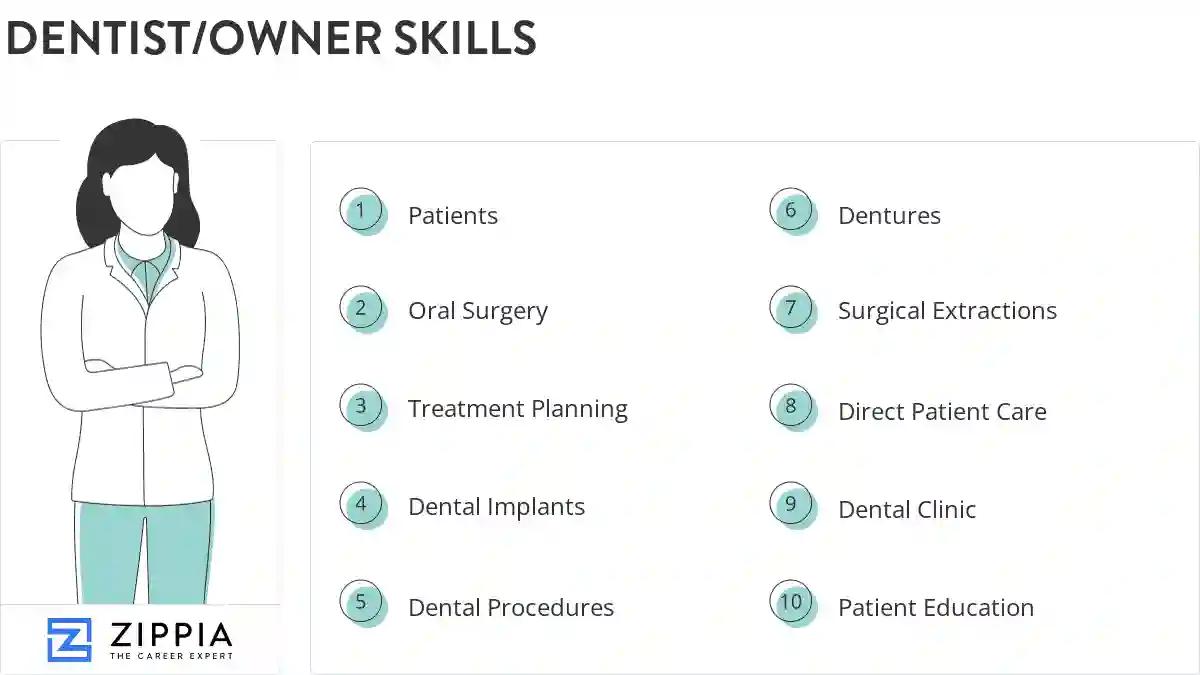
The most important skills for a dentist/owner resume and required skills for a dentist/owner to have include:
- Patients
- Oral Surgery
- Treatment Planning
- Dental Implants
- Dental Procedures
- Dentures
- Surgical Extractions
- Direct Patient Care
- Dental Clinic
- Patient Education
- Prosthetics
- Surgical Procedures
- Root Canals
- Treatment Options
- Medicaid
- Practice Management
- Dental Assistants
- PPO
- HMO
- Quality Care
Updated January 8, 2025
