What does a deployment manager do?
Deployment managers make sure that the updates released to their technical systems are working smoothly as with other IT (information technology) projects. Their primary duties include hands-on supervision during technical release processes to ensure that every possible error already has a backup solution. They also are responsible for scheduling system updates release dates and preparing the necessary reports to present to the higher management. Being a deployment manager usually requires at least a bachelor's degree and about 3 to 5 years of experience.
Deployment manager responsibilities
Here are examples of responsibilities from real deployment manager resumes:
- Manage the UDM program, plan & facilitate individual deployment operations/LOGMOD database
- Lead procurement, build, and installation of platform to terminate, aggregate, and hand off IP traffic.
- Spearhead and lead a successful initiative to create the first standard deployment policy document for BP's new global ERP.
- Manage contractor labor, billing, tracking of site surveys and providing the site matrix for desktop refresh system wide.
- Lead a team of 9 RF engineers and 8 site acquisition staff as well as 5 construction teams and multiple vendors.
- Manage overall business objectives along an ITIL performance evaluation scale.
- Develop and implement QA checklists for customer network infrastructure.
- Design silent MSI packages and software executables.
- Volunteer to take on additional duties and assist current UDM.
- Support a world-wide rollout project exchanging old PC's with new.
- Deploy new PC hardware as necessary for the support of end-user requirements.
- Install all necessary software and move data onto new servers after migration.
- Coordinate UAT testing with business sector, cross functional teams and vendors.
- Administer production systems for remote desktop management, endpoint security, and VDI.
- Design and launch pre-load training clinics, optimize training documentation prior to go-live.
Deployment manager skills and personality traits
We calculated that 19% of Deployment Managers are proficient in Post Deployment, Project Management, and Status Reports. They’re also known for soft skills such as Business skills, Leadership skills, and Organizational skills.
We break down the percentage of Deployment Managers that have these skills listed on their resume here:
- Post Deployment, 19%
Conduct post deployment follow-up with the agencies involved ensuring agency support needs are met.
- Project Management, 12%
Facilitated successful software configuration management audits by creating and distributing to senior management and project management team member all required documentation.
- Status Reports, 6%
Maintained operational metrics and provided regular status reports to senior management team in order to accomplish strategic military goals and duties.
- DOD, 5%
Coordinate activities of team members from BMC, NETCOM OED & ISEC, Microsoft, F5, and multiple DoD subcontractors.
- Java, 5%
Created Java Script to Publish Legal Collection (Microsoft Excel) Reports on Web.
- Combat, 4%
Analyzed combat capabilities of the unit and reviewed data to determine deficiencies and subsequently directed corrective actions.
Common skills that a deployment manager uses to do their job include "post deployment," "project management," and "status reports." You can find details on the most important deployment manager responsibilities below.
Business skills. One of the key soft skills for a deployment manager to have is business skills. You can see how this relates to what deployment managers do because "it managers must develop and implement strategic plans to reach the goals of their organizations." Additionally, a deployment manager resume shows how deployment managers use business skills: "worked directly with senior management of 15 business units in developing and implementing their hr strategies. "
Leadership skills. Another soft skill that's essential for fulfilling deployment manager duties is leadership skills. The role rewards competence in this skill because "it managers must lead and motivate it teams or departments so that workers are efficient and effective." According to a deployment manager resume, here's how deployment managers can utilize leadership skills in their job responsibilities: "briefed leadership regularly on deployment and contingency operations, as well as held training session for new members. "
Organizational skills. Another skill that relates to the job responsibilities of deployment managers is organizational skills. This skill is critical to many everyday deployment manager duties, as "some it managers must coordinate the work of several different it departments to make the organization run efficiently." This example from a resume shows how this skill is used: "managed air support integration for organizational level operations providing assistance to 300 personnel during combat operations in afghanistan. "
Analytical skills. A big part of what deployment managers do relies on "analytical skills." You can see how essential it is to deployment manager responsibilities because "it managers must analyze problems and consider and select the best ways to solve them." Here's an example of how this skill is used from a resume that represents typical deployment manager tasks: "lead implementation activities for baan erp and datasweep shop floor control systems. "
Communication skills. Another common skill required for deployment manager responsibilities is "communication skills." This skill comes up in the duties of deployment managers all the time, as "it managers must explain their work to top executives and give clear instructions to their subordinates." An excerpt from a real deployment manager resume shows how this skill is central to what a deployment manager does: "deployed over 1000 combat communications personnel and equipment to down-range locations. "
The three companies that hire the most deployment managers are:
- Deloitte14 deployment managers jobs
- Amazon10 deployment managers jobs
- Marsh & McLennan Companies6 deployment managers jobs
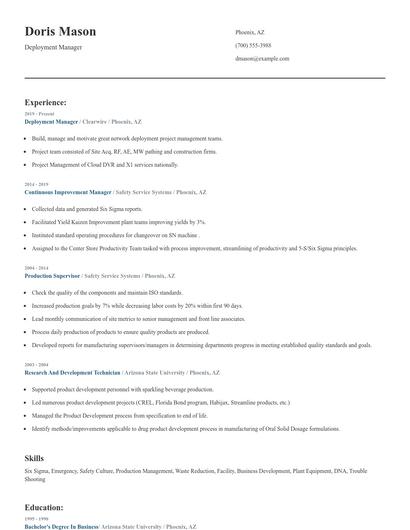
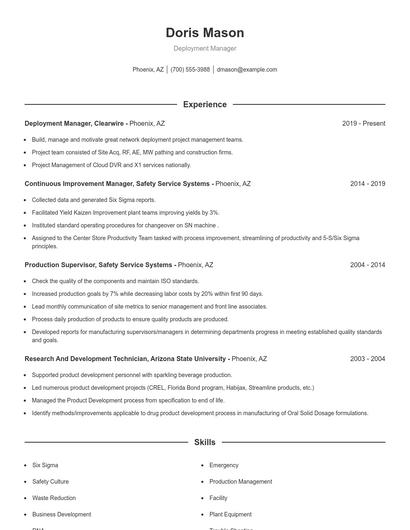
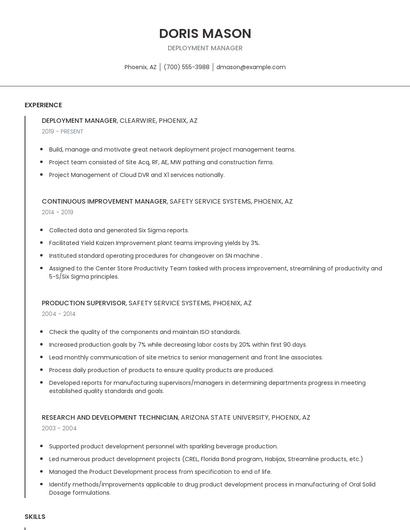
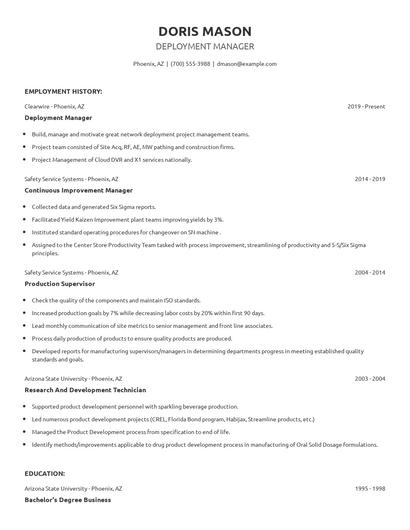
Choose from 10+ customizable deployment manager resume templates
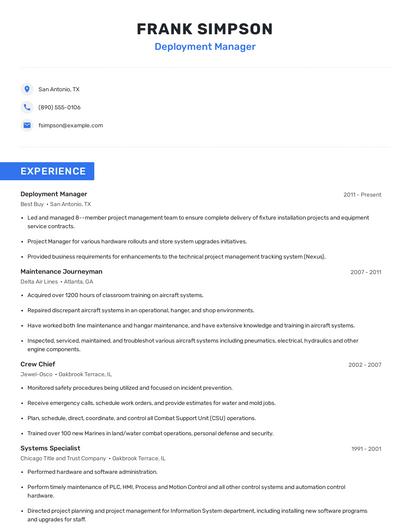
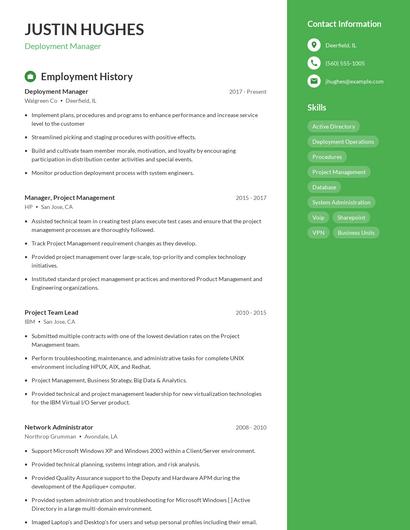
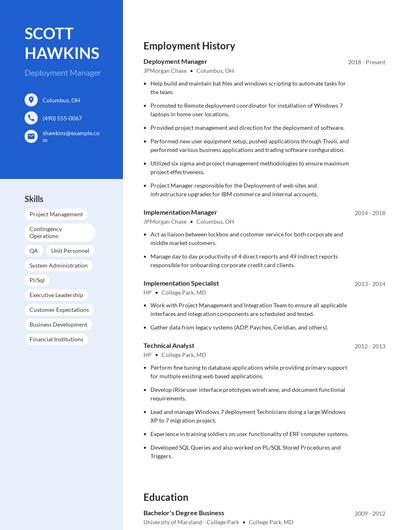
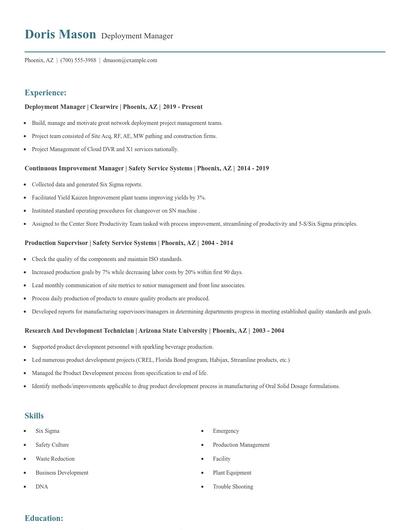
Build a professional deployment manager resume in minutes. Our AI resume writing assistant will guide you through every step of the process, and you can choose from 10+ resume templates to create your deployment manager resume.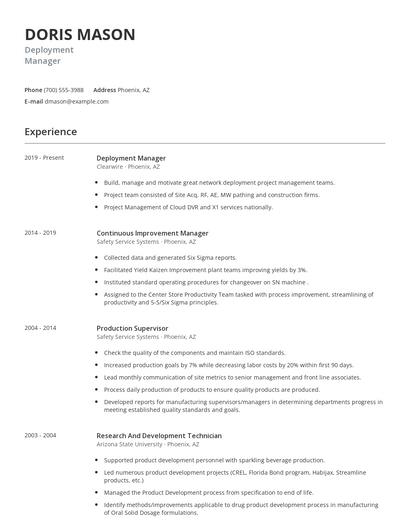
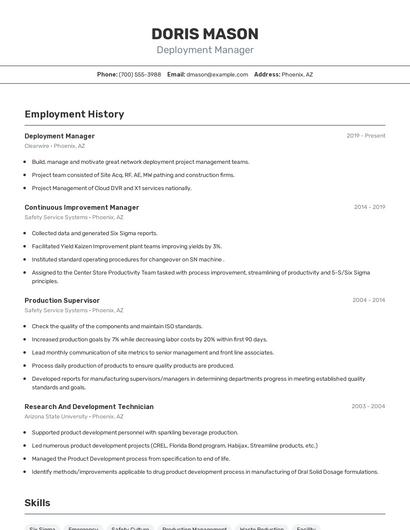
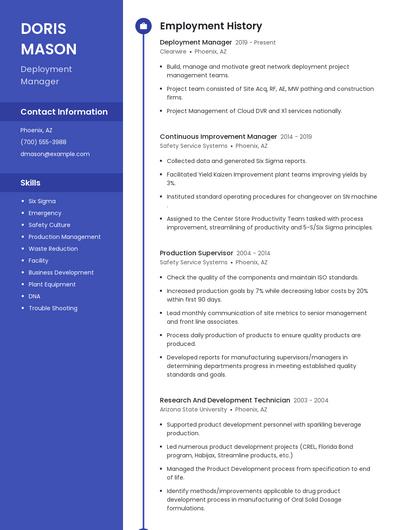
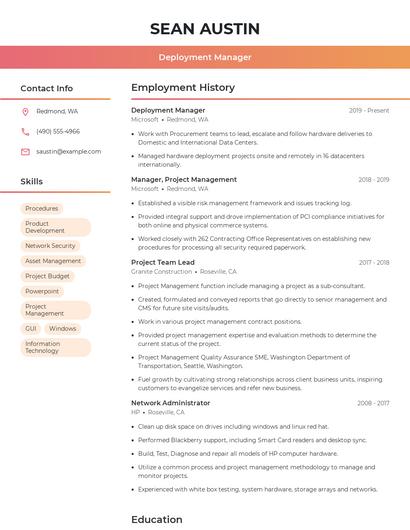
Compare different deployment managers
Deployment manager vs. Vice president of information technology
A Vice President Of Information Technology supervises an organization's technology initiatives, IT changes, and updates to all projects. They also identify and propose new information technologies and systems to improve business processes and decision-making.
There are some key differences in the responsibilities of each position. For example, deployment manager responsibilities require skills like "post deployment," "status reports," "dod," and "java." Meanwhile a typical vice president of information technology has skills in areas such as "architecture," "cloud," "customer service," and "network infrastructure." This difference in skills reveals the differences in what each career does.
Vice president of information technologies tend to make the most money working in the automotive industry, where they earn an average salary of $162,421. In contrast, deployment managers make the biggest average salary, $125,262, in the professional industry.On average, vice president of information technologies reach higher levels of education than deployment managers. Vice president of information technologies are 5.8% more likely to earn a Master's Degree and 0.6% more likely to graduate with a Doctoral Degree.Deployment manager vs. Information technology director
An information technology (IT) Director is an individual responsible for the management, strategy, and execution of an organization's IT infrastructure. He/She supervises a team of workers while working with the organization's management and external vendors and advisors. Aside from managing workers, an IT director should possess problem-solving skills and an aptitude for organizational thinking. An IT director must also identify new market opportunities and should lead an effort to improve the organization's IT process.
While some skills are similar in these professions, other skills aren't so similar. For example, resumes show us that deployment manager responsibilities requires skills like "post deployment," "status reports," "dod," and "java." But an information technology director might use other skills in their typical duties, such as, "customer service," "cloud," "network infrastructure," and "disaster recovery."
Information technology directors earn a higher average salary than deployment managers. But information technology directors earn the highest pay in the technology industry, with an average salary of $145,076. Additionally, deployment managers earn the highest salaries in the professional with average pay of $125,262 annually.Average education levels between the two professions vary. Information technology directors tend to reach similar levels of education than deployment managers. In fact, they're 2.9% more likely to graduate with a Master's Degree and 0.6% more likely to earn a Doctoral Degree.Deployment manager vs. Vice president, technology
A vice president of technology is in charge of overseeing all technological operations in a company while managing the workforce involved, ensuring efficiency and smooth workflow. Typically, it is their responsibility to establish goals and objectives, devising strategies to enforce them. They also spearhead the development of new systems and tools that boost workforce productivity, coordinate with analysts and specialists, and resolve any issues and concerns. Furthermore, as a vice president, it is essential to implement the company's policies and regulations, creating new ones as needed.
There are many key differences between these two careers, including some of the skills required to perform responsibilities within each role. For example, a deployment manager is likely to be skilled in "post deployment," "status reports," "dod," and "combat," while a typical vice president, technology is skilled in "analytics," "architecture," "portfolio," and "cloud."
Vice presidents, technology earn the highest salary when working in the technology industry, where they receive an average salary of $156,843. Comparatively, deployment managers have the highest earning potential in the professional industry, with an average salary of $125,262.When it comes to education, vice presidents, technology tend to earn higher degree levels compared to deployment managers. In fact, they're 5.9% more likely to earn a Master's Degree, and 2.3% more likely to graduate with a Doctoral Degree.Deployment manager vs. Senior information technology manager
A senior information technology manager is responsible for monitoring the efficiency and performance of the company's technology and network systems. Senior information technology managers oversee technology infrastructures and operations, ensuring the processes adhere to the company policies and regulations. They analyze the schematics and specifications of computer systems, maintaining the safety and security across all networks to prevent unauthorized access. A senior information technology manager must have extensive knowledge of the technology industry, as well as a strong command of programming languages.
Types of deployment manager
Updated January 8, 2025
