
Automatically apply for jobs with Zippia
Upload your resume to get started.
Detention worker skills for your resume and career
14 detention worker skills for your resume and career
1. Crisis Intervention
- Provide crisis intervention in a shelter care setting using behavioral management techniques.
- Position included the supervision of staff, contraband searches, crisis intervention, transportation, and report writing.
2. Perform Intake
- Perform intake duties, including pat/comprehensive searches, interviewing juveniles.
3. Incident Reports
An Incident Report, in a medical facility such as hospitals and nursing homes, is a type of paperwork filled out immediately after and in the case of an incident of some sort, with the goal of describing the incident and its consequences, as well as the measurements taken after or during the incident, as well as any other information relevant to said incident. Such an incident might be a patient acting out or a patient being injured.
- Completed incident reports and security checks as required.
- Monitor cctv, complete daily activity logs and malfunction reports, incident reports, and 252 police reports when needed.
4. Emergency Situations
- Respond to emergency situations, interact to diffuse aggressive youth.
- Responded to emergency situations according to facility procedures, such as medical, fire, security, etc.
5. CPR
Cardiopulmonary resuscitation or CPR is a medical procedure that involves chest compression to help a patient breathe. This artificial ventilation helps in keeping the brain function in place and regulates blood throughout the body. CPR is a lifesaving procedure that is used in emergencies.
- Provided health and safety interventions through the administration of medications, First Aid, CPR, Crisis and behavioral Interventions.
- Provide emergency response including crisis management, first aid, and CPR and fire response as needed.
6. Juvenile Programs
- Maintain care and custody of juveniles awaiting Court or committed to juvenile programs.
Choose from 10+ customizable detention worker resume templates
Build a professional detention worker resume in minutes. Our AI resume writing assistant will guide you through every step of the process, and you can choose from 10+ resume templates to create your detention worker resume.7. Laundry Equipment
Laundry equipment refers to all equipment that would wash clothes and other textiles. Washers, steam boiler, extractors, dryers, chest-type ironers, lint control devices, thermal fluid heater for ironer, dry cleaning equipment, linen folders, linen carts, laundry sinks, air compressors, and laundry are the equipments used to do laundry.
- Perform general housekeeping and cleaning duties, operate laundry equipment, and other related duties, as required.
8. Mental Health
Mental health is the state of wellbeing in which an individual can cope with the regular stresses and tensions of life, and can work productively without having any emotional or psychological breakdown. Mental health is essential for a person of any age and helps them make the right decisions in their life.
- Worked with a diverse group of youth with regards to race, socio-economic status, mental health capacity, and age.
- Assist in applications to medicare, medicaid, veteran benefits/skills training/group facilitator/suicide prevention, Mental Health Officer.
9. Log Book
- Administrated medication and maintained official log book.
- Maintain documentation, log book, and other documentation and reporting forms.
10. Manual Equipment
- Monitor and operate electronic and manual equipment.
- Maintain accurate records * Conduct room and personal searches * Monitor and operate electronic and manual equipment.
11. Security Checks
A security check is the processing of manually or automatically checking if a person is armed before entering a building. It's also the checking of a perimeter to see if it's secure. It goes further into the investigation on the background of an individual before the person is employed in an organization to check if there's any criminal record of the person in the past.
- Perform routine safety and security checks of youth and facility.
- Maintain ongoing security checks of youths and facilities Perform visual inspection of facilities to detect any security deficiencies.
12. Substance Abuse
- Monitor juveniles on conditional release/probation* Provide support and guidance to juveniles* Conduct Juvenile Automated Substance AbuseEvaluations (JASAE)* Urinalysis
- Participated in agency emergency services, which involved screening for domestic violence shelter and/or residential substance abuse treatment.
13. Disciplinary Actions
Disciplinary actions refer to a corrective measure taken against an employee for unsatisfactory behavior. Many work environments have a tiered system for disciplinary action, where the first warning is verbal and the second is written. Disciplinary action may be given after a weak performance review, a violation of company rules and policies, or a poor customer review.
- Initiated disciplinary actions, write disciplinary reports and monitor the application of the consequences.
14. Role Model
A role model is a person with desirable qualities who inspires other people to emulate their example.
- Serve as role model for incarcerated youth while maintain appropriate professional boundaries.
- Serve as positive role model and demonstrates professionalism with regard to healthy interactions and respectful communication with residents and team member

What skills help Detention Workers find jobs?
Tell us what job you are looking for, we’ll show you what skills employers want.
List of detention worker skills to add to your resume
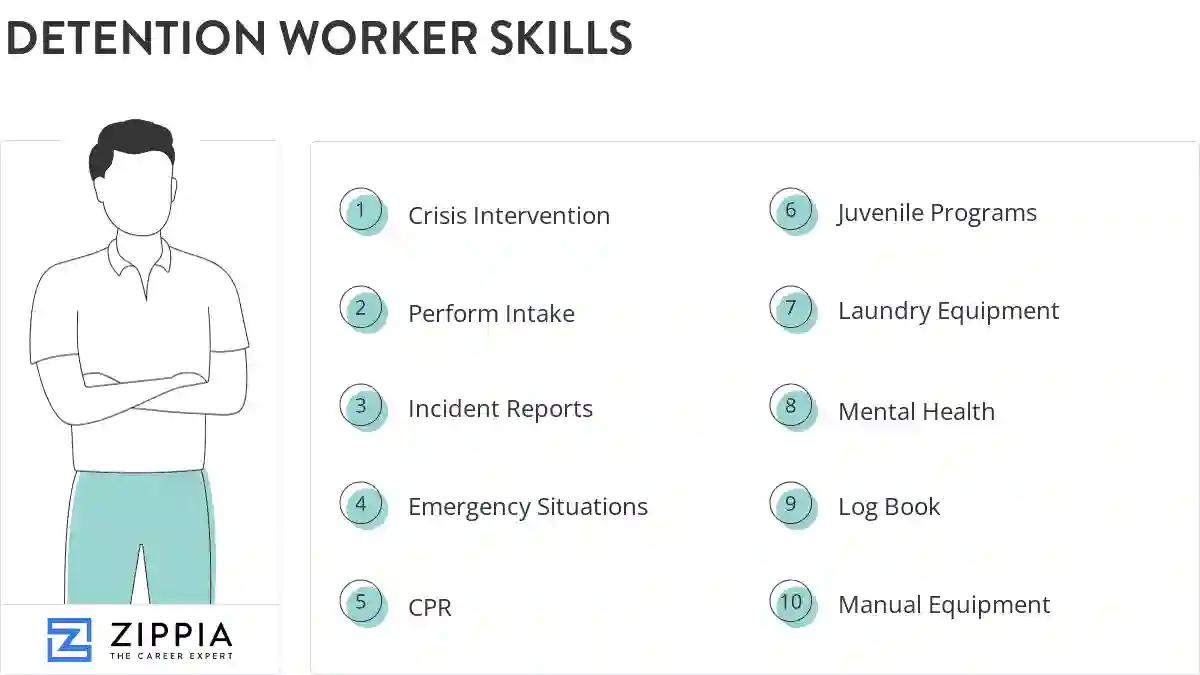
The most important skills for a detention worker resume and required skills for a detention worker to have include:
- Crisis Intervention
- Perform Intake
- Incident Reports
- Emergency Situations
- CPR
- Juvenile Programs
- Laundry Equipment
- Mental Health
- Log Book
- Manual Equipment
- Security Checks
- Substance Abuse
- Disciplinary Actions
- Role Model
Updated January 8, 2025
