What does a director, applications do?
An application director is responsible for designing and reviewing software applications to support business requirements and network solutions. Applications directors strategize efficient techniques in developing systems, assist the design teams, and conduct quality checks to the outputs to ensure its accuracy and adherence to guidelines and project procedures. They review applications request, manage and allocate budget and resources, and determine the timetable of deliverables. An application director must have excellent technical skills to support the team in resolving application discrepancy and analyzing technology standards.
Director, applications responsibilities
Here are examples of responsibilities from real director, applications resumes:
- Manage SAN and iSCSI channel storage infrastructure.
- Lead HIPAA compliance initiative for all clinical applications.
- Manage end-user systems using Hyperion OLAP tool and design modeling techniques.
- Lead a team of Java developers to improve cross-browser compliance of all web-base applications.
- Execute & manage various data security and compliance initiatives including SSAE16, and PCI.
- Manage end-to-end product development cycles including requirements definition, project plan, scrum leadership, QA and release coordination.
- Align vision and priorities across application development, infrastructure engineering, operations, and enterprise architecture to achieve long-range business goals.
- Review project requests for access control systems, intrusion detection, and CCTV products and concepts.
- Implement global disaster recovery and business continuity solutions support by strategic cloud and infrastructure backup strategy.
- Perform user assessment of PC use.
- Review and implement procedures for EDI compliance.
- Produce UI, stories, and imagery within application.
- Integrate with PeopleSoft AR to invoice charges and process payments.
- Serve as scrum master on newly establish scrum development teams.
- Design and develop client reporting API to integrate into trading platform.
Director, applications skills and personality traits
We calculated that 13% of Directors, Applications are proficient in Cloud, Project Management, and Customer Service. They’re also known for soft skills such as Analytical skills, Business skills, and Communication skills.
We break down the percentage of Directors, Applications that have these skills listed on their resume here:
- Cloud, 13%
Provided technical services including monitoring, incident, problem and release management functions for test and production cloud environments.
- Project Management, 7%
Implemented standard project management processes and led the organization change to significantly improve project execution and success.
- Customer Service, 6%
Led the development of a web-enabled customer service application increasing customer service representatives' inquiry response accuracy while reducing training time.
- Architecture, 5%
Led executive team in the development of an information technology architecture and strategic plan aligned with business strategy and operating goals.
- Infrastructure, 5%
Revitalized the support model leveraging ITIL and improved reliability and quality of service for all corporate applications and infrastructure globally.
- ERP, 4%
Implemented ERP system upgrade as well as various system modifications to improve company productivity and overall experience.
Most directors, applications use their skills in "cloud," "project management," and "customer service" to do their jobs. You can find more detail on essential director, applications responsibilities here:
Analytical skills. One of the key soft skills for a director, applications to have is analytical skills. You can see how this relates to what directors, applications do because "it managers must analyze problems and consider and select the best ways to solve them." Additionally, a director, applications resume shows how directors, applications use analytical skills: "manage 40 technical staff responsible for erp and other business applications including database, operating system, and network administration. "
Business skills. Many director, applications duties rely on business skills. "it managers must develop and implement strategic plans to reach the goals of their organizations.," so a director, applications will need this skill often in their role. This resume example is just one of many ways director, applications responsibilities rely on business skills: "designed multiple business processes and customized erp functions to meet business requirements. "
Communication skills. directors, applications are also known for communication skills, which are critical to their duties. You can see how this skill relates to director, applications responsibilities, because "it managers must explain their work to top executives and give clear instructions to their subordinates." A director, applications resume example shows how communication skills is used in the workplace: "full p&l; ownership for unified communications portfolio inclusive of application servers, business applications and voicemail solutions. "
Leadership skills. For certain director, applications responsibilities to be completed, the job requires competence in "leadership skills." The day-to-day duties of a director, applications rely on this skill, as "it managers must lead and motivate it teams or departments so that workers are efficient and effective." For example, this snippet was taken directly from a resume about how this skill applies to what directors, applications do: "provided direct leadership over the jde erp and integrated 3rd party applications implementation. "
Organizational skills. Another common skill required for director, applications responsibilities is "organizational skills." This skill comes up in the duties of directors, applications all the time, as "some it managers must coordinate the work of several different it departments to make the organization run efficiently." An excerpt from a real director, applications resume shows how this skill is central to what a director, applications does: "managed organizational change via the pmo department"
The three companies that hire the most director, applicationss are:
- Discover12 directors, applications jobs
- Applied Materials10 directors, applications jobs
- Snap9 directors, applications jobs
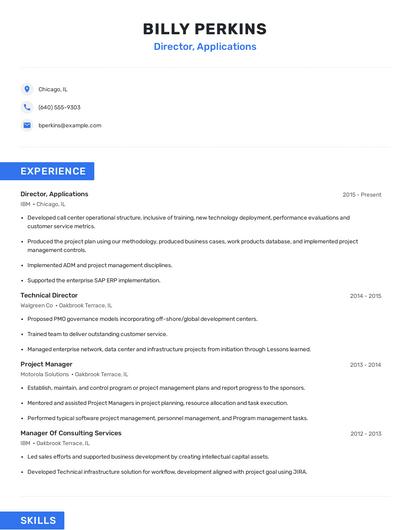
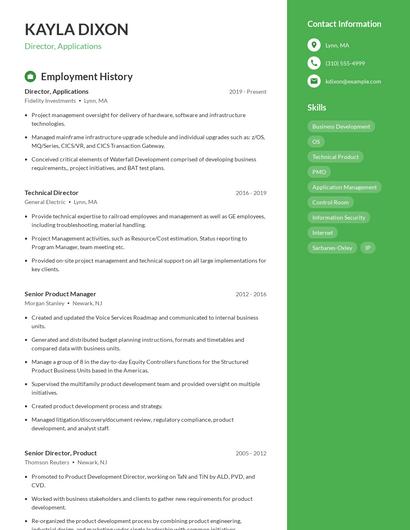
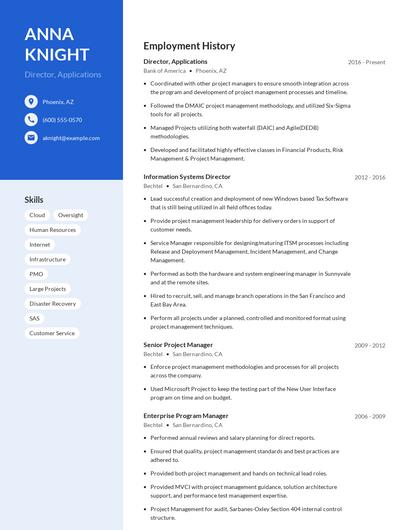
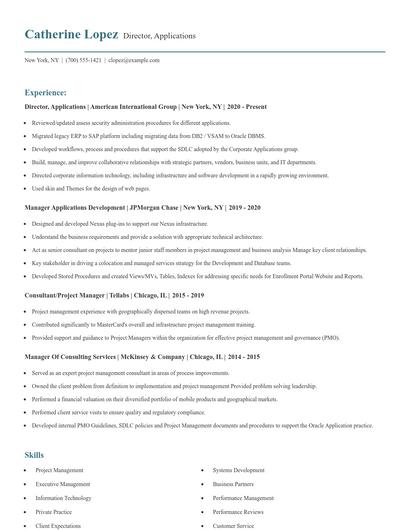
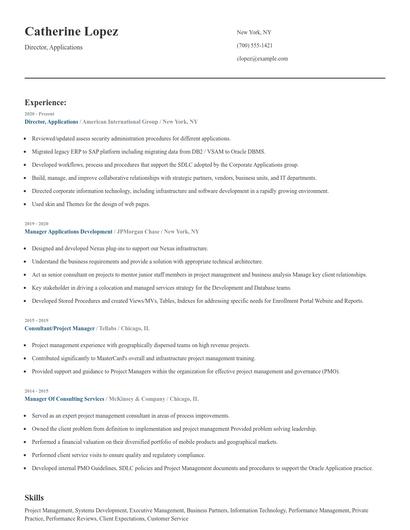
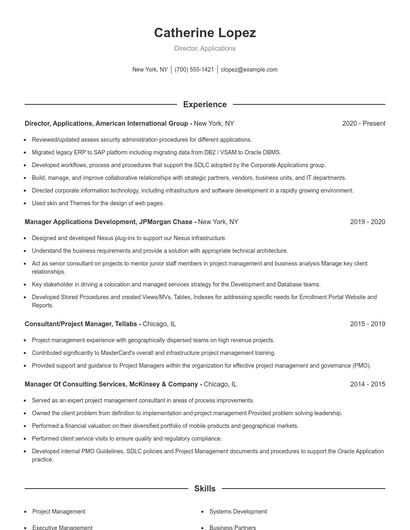
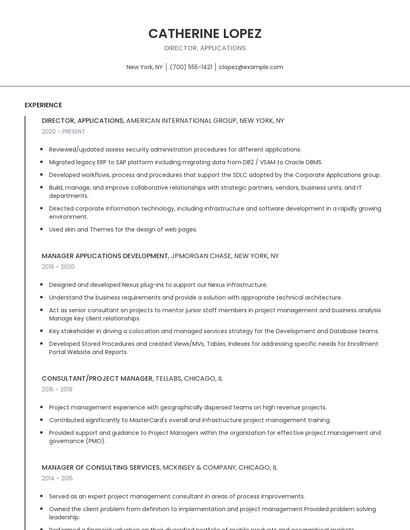
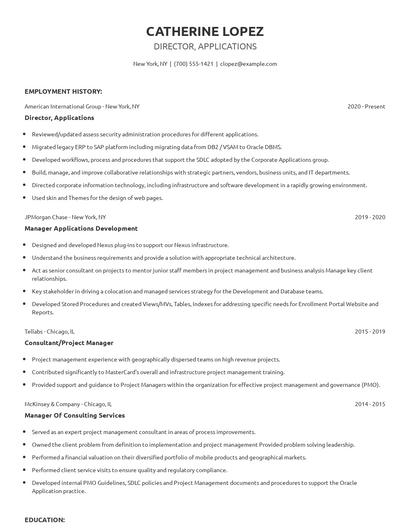
Choose from 10+ customizable director, applications resume templates
Build a professional director, applications resume in minutes. Our AI resume writing assistant will guide you through every step of the process, and you can choose from 10+ resume templates to create your director, applications resume.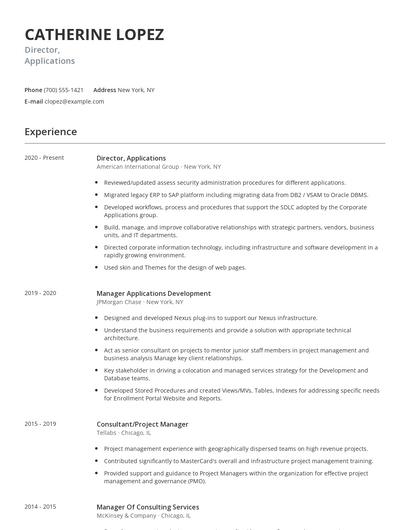
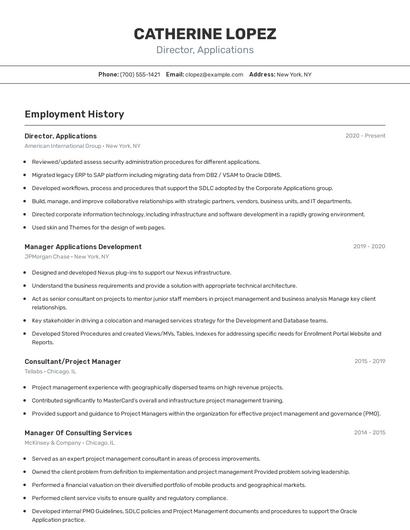
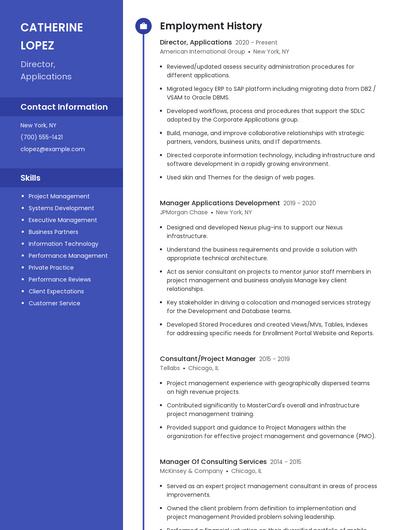
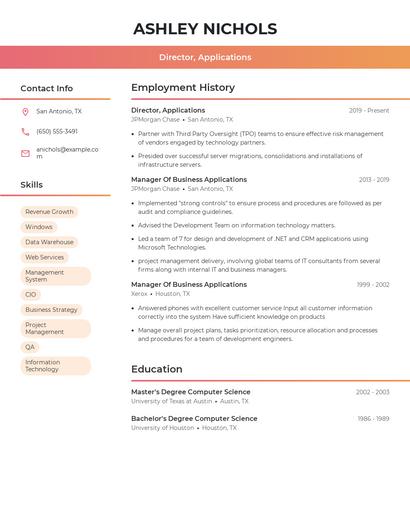
Compare different directors, applications
Director, applications vs. Information technology technical services manager
An information technology/technical services manager is responsible for supervising the operations of the information technology team, assisting the technical staff in providing efficient performance by improving technology systems and network infrastructure to support business functions. This job requires extensive knowledge of the technology industry, as well as an excellent command of programming and system processes to ensure smooth navigation and consistent transitions. An information technology/technical services manager also handles the development of new network systems according to business requirements and client specifications.
While similarities exist, there are also some differences between directors, applications and information technology technical services manager. For instance, director, applications responsibilities require skills such as "cloud," "architecture," "infrastructure," and "strategic direction." Whereas a information technology technical services manager is skilled in "service management," "itsm," "service delivery," and "level agreements." This is part of what separates the two careers.
Information technology technical services managers really shine in the finance industry with an average salary of $124,604. Comparatively, directors, applications tend to make the most money in the technology industry with an average salary of $159,499.The education levels that information technology technical services managers earn slightly differ from directors, applications. In particular, information technology technical services managers are 4.9% less likely to graduate with a Master's Degree than a director, applications. Additionally, they're 1.9% less likely to earn a Doctoral Degree.Director, applications vs. Information technology systems manager
An information technology systems manager is responsible for monitoring the efficiency and optimal performance of the organization's technology systems. Information technology systems managers ensure the safety and security of all the network systems, developing standard operating procedures to avoid unauthorized access and suspicious activities. They also identify technical opportunities to improve network infrastructures and technology solutions. An information technology systems manager must have excellent knowledge of the technology industry, as well as a strong command of programming languages and system codes to design configuration and maintain the stability of systems.
Each career also uses different skills, according to real director, applications resumes. While director, applications responsibilities can utilize skills like "cloud," "architecture," "infrastructure," and "strategic direction," information technology systems managers use skills like "network infrastructure," "san," "windows server," and "disaster recovery."
On average, information technology systems managers earn a lower salary than directors, applications. Some industries support higher salaries in each profession. Interestingly enough, information technology systems managers earn the most pay in the hospitality industry with an average salary of $139,343. Whereas directors, applications have higher pay in the technology industry, with an average salary of $159,499.In general, information technology systems managers achieve lower levels of education than directors, applications. They're 9.6% less likely to obtain a Master's Degree while being 1.9% less likely to earn a Doctoral Degree.Director, applications vs. Information technology manager
An information technology manager is responsible for supervising tasks for the company's network and information systems operations. Information technology managers require excellent knowledge of the information systems industry, a strong command of programming languages, and software and hardware application processes. An information technology manager reviews the performance of the IT department staff, ensuring that networks and systems maintain the highest quality and efficiency, and adjusting the specific system updates as needed. Information technology managers monitor the security of the system's database and identify business opportunities to utilize all business systems to improve the company's services.
There are many key differences between these two careers, including some of the skills required to perform responsibilities within each role. For example, a director, applications is likely to be skilled in "cloud," "architecture," "infrastructure," and "strategic direction," while a typical information technology manager is skilled in "database," "network infrastructure," "san," and "disaster recovery."
Most information technology managers achieve a lower degree level compared to directors, applications. For example, they're 8.4% less likely to graduate with a Master's Degree, and 2.1% less likely to earn a Doctoral Degree.Director, applications vs. Senior project manager
Senior project managers are experienced employees assigned to oversee a specific project in the organization. They manage the project from conception to execution. They are onboard the project from the ideation phase, providing valuable insights to ensure the success of the project. Senior project managers are also in charge of managing the budget, ensuring that the expected timelines are followed, adjusting strategies when needed, and guiding project team members. It is important for senior project managers to be good leaders and communicators. They should be able to balance the interests of all the stakeholders involved in the project. They should have good interpersonal skills and decision-making skills.
Types of director, applications
Updated January 8, 2025
