
Automatically apply for jobs with Zippia
Upload your resume to get started.
Director of records management skills for your resume and career
15 director of records management skills for your resume and career
1. Direct Reports
- Supervised project-related processes and direct reports.
- Managed, coached and trained 4 direct reports.
2. Management Program
A Management program is a program that educate participants with the right skills needed to manage their businesses, manage people effectively, and execute projects. Management program comes in different fields, but the most popular and generic of them all is the business management program which is followed by project management. There's also a special faculty in the university that offers a wide range of management programs for students up to postgraduate levels.
- Maintained an ongoing comprehensive Records Management Program agency-wide with limited staff and tools.
- Coordinated the University's Records Management Program.
3. HIPAA
- Submitted HIPAA student information file twice each month via Core FTP.
- Provided oversight of numerous administrative programs to include Health Insurance Portability Accountability (HIPAA).
4. Comprehensive Policies
- Developed, updated, and deployed comprehensive policies, best practices, methods and guidelines.
5. Retention Schedules
- Prepare requests for periodic disposals in accordance with approved Record Retention Schedules and applicable City legal and policy requirements.
- Reviewed and revised retention schedules for all state, county and municipal government agencies.
6. Litigation
- Mitigated litigation risk and led a team which managed inactive records clean-out at non-divesting National City retail branches.
- Handled and facilitated data relative to exploration, development, litigation, venture, acquisition, merger and divestiture activities.
Choose from 10+ customizable director of records management resume templates
Build a professional director of records management resume in minutes. Our AI resume writing assistant will guide you through every step of the process, and you can choose from 10+ resume templates to create your director of records management resume.7. Enterprise-Wide
- Provided leadership and developed strategy for enterprise-wide Records Management, program development, execution, budgets, and program operation.
- Provided oversight to the communication plan development, facilitated enterprise-wide awareness and developed Web-ex training.
8. Transcription
- Directed Health Information Management Services including discharge analysis, medical staff/CMS interactions, release of medico-legal information and medical transcription.
- Assumed responsibility for process challenged department and directly managed HIM Personnel including Transcription and Coding.
9. Business Process
A business process is a group of tasks that are performed by people working in a business to attain a worthy product and to present it to their customers. A business process can also be defined as performing several steps to achieve a certain goal set by a company. Business processes need to set purposeful goals and the outcome of that goal should be clear.
- Improved throughput 20% with no additional headcount by redesigning the business process, rebalancing workload and upgrading scanning /printing hardware.
- Program and Project Management on related business process implementations.
10. Strategic Direction
- Provided leadership and strategic direction to the Associate Registrar, Records Office Coordinator, and two student staff members.
- Guided strategic direction and managed the full records lifecycle.
11. Enterprise Content Management
- Provided input and direction for company-wide scanning operations and enterprise content management (ECM) system.
- Implemented a dynamic electronic records repository, MLR, in partnership with Enterprise Content Management Technology, IBM and business clients.
12. Hippa
HIPAA, which stands for Health Insurance Portability and Accountability Act, is a United States federal statue created, enacted, and turned to law in 1996, which whose primary purposes were to modernise the healthcare systems in the United States, secure and generally enhance the management of that personal information of patients that was in the hands of healthcare facilities, such as hospitals and insurance companies, and to enable the providing of healthcare and insurance to more people.
- Organized and performed training as needed to keep all members in compliance with HIPPA, Equal Opportunity, and EMT Tables.
- Ensured adherence to eligibility, billing, and Health Insurance Portability and Accountability Act (HIPPA) was in compliance.
13. Payroll
Payroll is the sum of all the compensation that an organization has to pay to employees at a specified time. Payroll is managed by the finance or HR department while small business owners may handle it themselves. Payroll isn't fixed as it varies every month due to sick leaves, overtime, etc.
- Supervised 6-10 personal within 4 different programs, to include coordinating schedules, payroll and training.
- Design, development and maintenance of all electronic interfaces between internal and vendor systems including payroll and Benefits.
14. Computer System
- Spearheaded transition of new computer system that upgraded viewing of patient documentation.
- Completed project management for HBOC computer system Installation.
15. Electronic Format
- Managed project of permanent records conversion from paper to electronic format for greater efficiency and State archival purposes.
- Evaluated technology and methods / procedures for management of records in electronic formats.
5 Director Of Records Management resume examples
Build a professional director of records management resume in minutes. Browse through our resume examples to identify the best way to word your resume. Then choose from 5+ resume templates to create your director of records management resume.

What skills help Directors Of Records Management find jobs?
Tell us what job you are looking for, we’ll show you what skills employers want.
What skills stand out on director of records management resumes?
Brooke Buffington
Senior Associate Director of Corporate and Employer Relations, Martha and Spencer Love School of Business, Elon University
What soft skills should all Directors of records management possess?
Candace Esken Ph.D.
Assistant Professor of Management & Leadership, Bradley University
List of director of records management skills to add to your resume
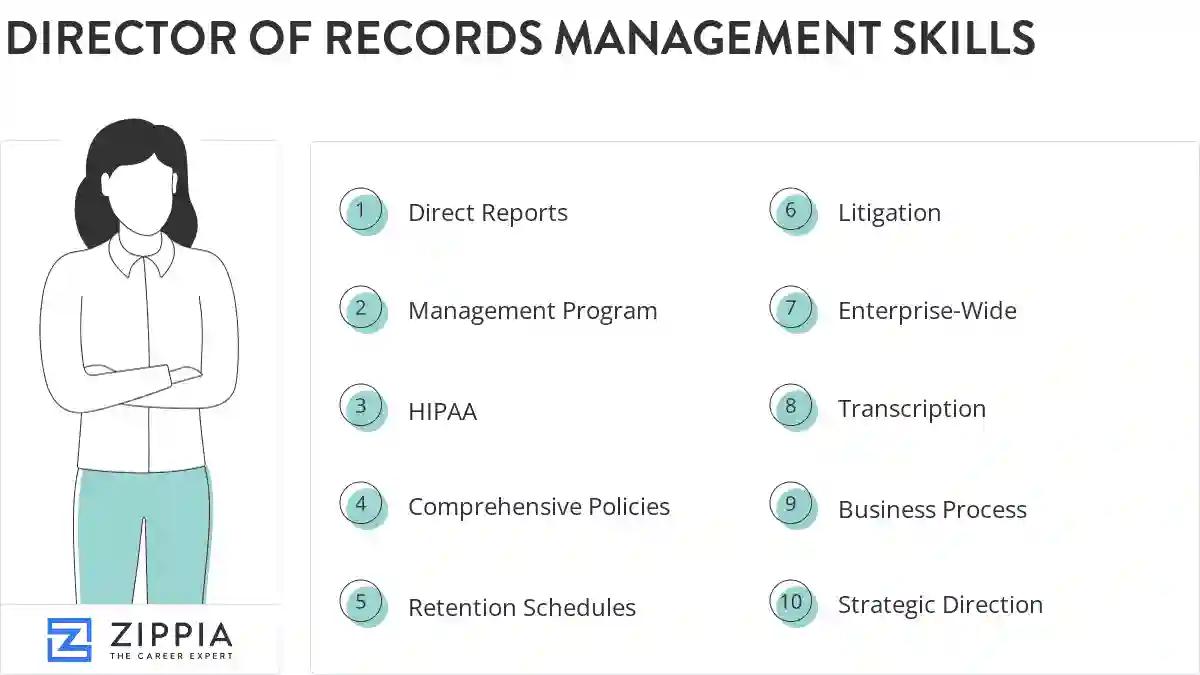
The most important skills for a director of records management resume and required skills for a director of records management to have include:
- Direct Reports
- Management Program
- HIPAA
- Comprehensive Policies
- Retention Schedules
- Litigation
- Enterprise-Wide
- Transcription
- Business Process
- Strategic Direction
- Enterprise Content Management
- Hippa
- Payroll
- Computer System
- Electronic Format
- Certifications
- CIO
Updated January 8, 2025
