What does an educational interpreter do?
An educational interpreter specializes in providing communication assistance to students with hearing problems or difficulty in understanding the language. It is their duty to develop strategies to convey lessons through various materials and efforts, interpret messages from the speaker and receiver, and monitoring the student's progress. They may also produce progress reports, coordinating with teachers and parents at all times. Furthermore, an educational interpreter must build a positive relationship with the student, helping them feel comfortable as they adjust to the classroom environment.
Educational interpreter responsibilities
Here are examples of responsibilities from real educational interpreter resumes:
- Manage marketing initiatives for all CME and CPE conferences which include e-mail deployments and content design for all marketing collateral.
- Demonstrate natural leadership and mentoring skills working with groups of ASL students.
- Interpret from ASL to English and English to ASL for students in classroom settings.
- Serve as an educational assistant and dedicate aide in the special education department as well as in a general education kindergarten classroom
- Interpret Farsi and Dari between clients and providers.
- Provide Cantonese interpreting services on a monthly basis to underprivilege women diagnose with cancer.
Educational interpreter skills and personality traits
We calculated that 28% of Educational Interpreters are proficient in EIPA, Facilitate Communication, and Math. They’re also known for soft skills such as Business skills, Cultural sensitivity, and Dexterity.
We break down the percentage of Educational Interpreters that have these skills listed on their resume here:
- EIPA, 28%
Certified through EIPA (Educational Interpreter Performance Assessment) Proficient in American Sign Language receptive and expressive.
- Facilitate Communication, 15%
Facilitate communication between students and all other school personnel.
- Math, 8%
Translate Math Standardized State Exams from English to Arabic Interpret each question during exam Ensure student's comprehension of questions and instructions
- Mathematics, 7%
Tailored instruction for small groups in balanced literacy and mathematics.
- IEP, 7%
Facilitated communication within educational settings including classroom instruction, IEP and development sessions.
- Educational Programs, 7%
Developed off-site school-based educational programming to improve visitation trends.
Common skills that an educational interpreter uses to do their job include "eipa," "facilitate communication," and "math." You can find details on the most important educational interpreter responsibilities below.
Business skills. The most essential soft skill for an educational interpreter to carry out their responsibilities is business skills. This skill is important for the role because "self-employed interpreters and translators must be able to manage their finances." Additionally, an educational interpreter resume shows how their duties depend on business skills: "interpreted for deaf and hard of hearing individuals in a variety of settings including business, medical and educational. "
Cultural sensitivity. Another soft skill that's essential for fulfilling educational interpreter duties is cultural sensitivity. The role rewards competence in this skill because "interpreters and translators must be aware of expectations among the people for whom they are helping to facilitate communication." According to an educational interpreter resume, here's how educational interpreters can utilize cultural sensitivity in their job responsibilities: "facilitate communication and provide cultural mediation for deaf students. "
Dexterity. educational interpreters are also known for dexterity, which are critical to their duties. You can see how this skill relates to educational interpreter responsibilities, because "sign language interpreters must be able to make quick and coordinated hand, finger, and arm movements when interpreting." An educational interpreter resume example shows how dexterity is used in the workplace: "developed and presented educational programs and hands-on workshops. "
Listening skills. educational interpreter responsibilities often require "listening skills." The duties that rely on this skill are shown by the fact that "interpreters must pay attention when interpreting for audiences to ensure that they hear and interpret correctly." This resume example shows what educational interpreters do with listening skills on a typical day: "school yearcommunicated to the hearing impaired student using american sign language for teacher and other students. "
The three companies that hire the most educational interpreters are:
- Montgomery County Public Schools2 educational interpreters jobs
- Grandville Public Schools2 educational interpreters jobs
- Pueblo City-County Library District1 educational interpreters jobs
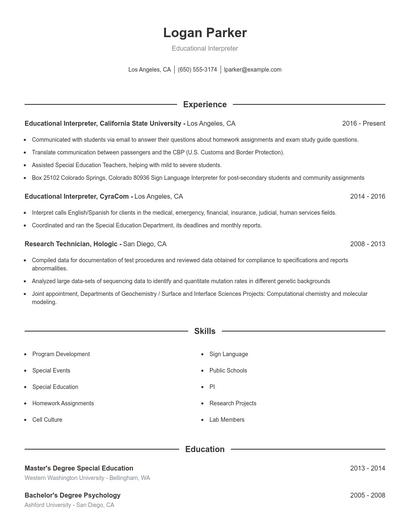
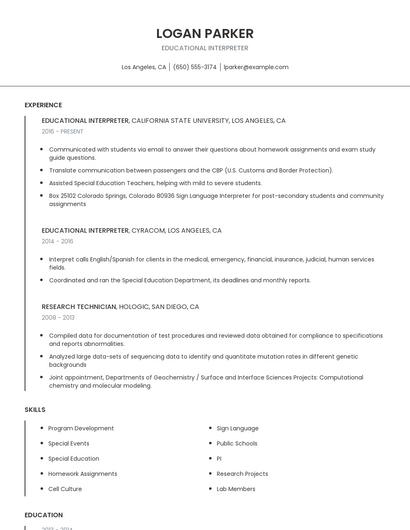
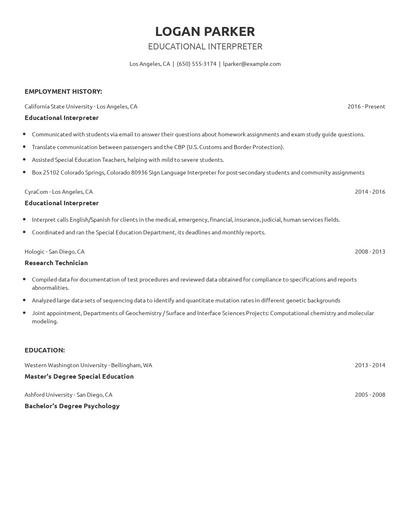
Choose from 10+ customizable educational interpreter resume templates
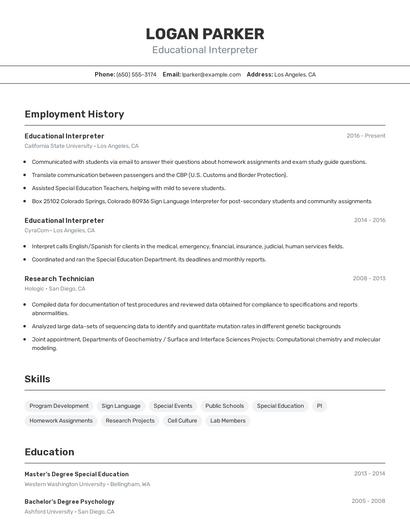
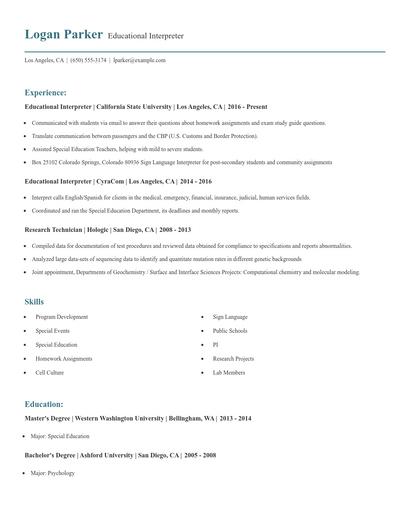
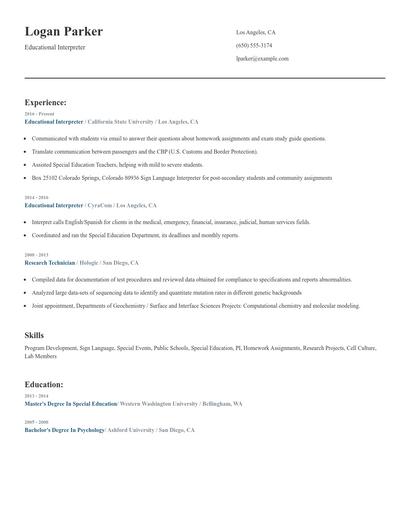
Build a professional educational interpreter resume in minutes. Our AI resume writing assistant will guide you through every step of the process, and you can choose from 10+ resume templates to create your educational interpreter resume.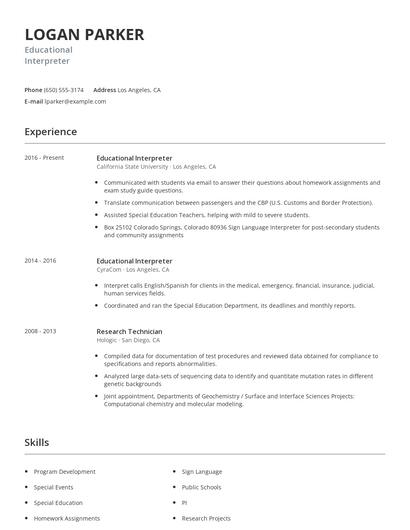


Compare different educational interpreters
Educational interpreter vs. Cryptologic linguist
Cryptologic linguists are lingual professionals who are responsible for using signals equipment to identify and analyze foreign communications. These linguists must assist intelligence community analysts in translating open source and sensitive materials as well as producing comprehensive reports about the daily activities of their enemies. They are required to supervise a team of other linguistic professionals to provide transcriptions and analysis from foreign communications. Cryptologic linguists must also identify the languages spoken at target geographic areas of interest.
While similarities exist, there are also some differences between educational interpreters and cryptologic linguist. For instance, educational interpreter responsibilities require skills such as "eipa," "facilitate communication," "math," and "mathematics." Whereas a cryptologic linguist is skilled in "tip," "government agencies," "national security," and "signals intelligence." This is part of what separates the two careers.
The education levels that cryptologic linguists earn slightly differ from educational interpreters. In particular, cryptologic linguists are 1.4% less likely to graduate with a Master's Degree than an educational interpreter. Additionally, they're 0.3% more likely to earn a Doctoral Degree.Educational interpreter vs. Arabic linguist
Arabic linguists are experts who interpret and translate research or business documents that are written in the Arab language or its dialects. These linguists are required to advise peers and superiors about the Arabic language and culture while providing inputs of written reports developed from target materials utilizing the specific Arabic language. They must conduct simultaneous interpretations of conversations during diplomatic meetings and conferences. Arabic linguists must also create and manage Arabic language training for the newly hired linguists.
In addition to the difference in salary, there are some other key differences worth noting. For example, educational interpreter responsibilities are more likely to require skills like "eipa," "facilitate communication," "math," and "mathematics." Meanwhile, an arabic linguist has duties that require skills in areas such as "english language," "transcription," "target language," and "vice versa." These differences highlight just how different the day-to-day in each role looks.
Arabic linguists earn similar levels of education than educational interpreters in general. They're 3.5% more likely to graduate with a Master's Degree and 0.3% more likely to earn a Doctoral Degree.Educational interpreter vs. Freelance translator
A freelance translator is an independent contractor specializing in translating audio or written materials into a particular language. They primarily communicate with clients to identify their needs and preferences, including project specifications such as deadlines and format. Being a freelance translator means that they can work remotely at their preferred schedule, most of the time, working from home. They are not employed under a company, which is why most freelance translators prepare their own portfolios and create client bases through websites and other platforms.
Some important key differences between the two careers include a few of the skills necessary to fulfill the responsibilities of each. Some examples from educational interpreter resumes include skills like "eipa," "facilitate communication," "math," and "mathematics," whereas a freelance translator is more likely to list skills in "target language," "web content," "vice versa," and "user manuals. "
Most freelance translators achieve a higher degree level compared to educational interpreters. For example, they're 16.0% more likely to graduate with a Master's Degree, and 2.7% more likely to earn a Doctoral Degree.Educational interpreter vs. Language translator
Language translators are linguistic professionals who are responsible for converting information from one language to another to help people read the translation based on the original source. These translators must use a computer to translate the original language into their native language. They can work for software development companies as under contract independent foreign language translators. They must utilize target language to translate and transcribe critical information and performing immediate data analysis. Language translators must also provide interpretations for meetings, conferences, and administrative hearings for any sponsored functions.
Types of educational interpreter
Updated January 8, 2025
