What does an embedded systems engineer do?

An embedded systems engineer is responsible for monitoring and creating embedded network systems and servers to support business operations. Embedded systems engineers run multiple diagnostic tests to identify technical solutions that would increase the efficiency and stability of the systems. They must have excellent technical skills for network resolution, as well as a strong command of programming languages and system codes to write scripts and generate support for data integration. An embedded systems engineer updates infrastructure to boost optimization and identify opportunities for enhancing engineering techniques.
Embedded systems engineer responsibilities
Here are examples of responsibilities from real embedded systems engineer resumes:
- Lead the firmware part of the project, which includes firmware design, development and testing.
- Used standard bus interfaces like UART, SPI, I2C, USB for interfacing sensors and other devices.
- Used various programming protocols like RS232, SPI and I2C.
- Develop ADC drivers base on I2C, SPI and UART protocol.
- Design and develop a wireless system to replace a legacy product base on linux and java.
- Utilize DSP techniques to process sensing data and build a Bluetooth wireless interface for data transmission.
- Implement the GPS receiver in MATLAB for evaluating the algorithm for the purpose of FPGA implementation.
- Design and develop embedded real-time control system software using C++ coding in VxWorks (RTOS) environment.
- Used wireless communication protocol, I2C, UART modules.
- Job involve extensive prototyping, troubleshooting, and field work.
- Work with C/C++ programming and assembly to implement DSP algorithms.
- Apply digital signal processing techniques to NIR sensor measurements using MATLAB.
- Work on Ethernet drivers and boot loaders in conjunction with VxWorks.
- Integrate power meter with embed TCP/IP stack, provide Ethernet and Wi-Fi interfaces.
- Head the implementation of an RTOS and PID control system in future products.
Embedded systems engineer skills and personality traits
We calculated that 12% of Embedded Systems Engineers are proficient in Embedded Systems, Python, and Software Development. They’re also known for soft skills such as Analytical skills, Communication skills, and Creativity.
We break down the percentage of Embedded Systems Engineers that have these skills listed on their resume here:
- Embedded Systems, 12%
Designed and implemented embedded systems software firmware.
- Python, 8%
Implemented a significant portion of the software on flagship systems using C and Python.
- Software Development, 5%
Developed software for evaluation, customer demonstration, and deployment using a software development process.
- C, 5%
Developed embedded system firmware in C and Assembly language targeted to various micro-controller technologies, utilizing real time operating system services.
- C++, 5%
Modified a parser program written in MFC using c++ Lithium ion Battery life monitor using PIC18.
- Linux, 5%
Developed and tested the interfacing programs in the VxWorks, LINUX/UNIX and PetaLinux Operating System.
Common skills that an embedded systems engineer uses to do their job include "embedded systems," "python," and "software development." You can find details on the most important embedded systems engineer responsibilities below.
Analytical skills. The most essential soft skill for an embedded systems engineer to carry out their responsibilities is analytical skills. This skill is important for the role because "developers must analyze users’ needs and then design software to meet those needs." Additionally, an embedded systems engineer resume shows how their duties depend on analytical skills: "developed various data logging and test applications to communicate with various embedded control boards. "
Communication skills. Another soft skill that's essential for fulfilling embedded systems engineer duties is communication skills. The role rewards competence in this skill because "developers must be able to give clear instructions to others working on a project." According to an embedded systems engineer resume, here's how embedded systems engineers can utilize communication skills in their job responsibilities: "developed communication software (java, c) as part of a small team in a fast-paced wireless start-up. "
Creativity. This is an important skill for embedded systems engineers to perform their duties. For an example of how embedded systems engineer responsibilities depend on this skill, consider that "developers are the creative minds behind new computer software." This excerpt from a resume also shows how vital it is to everyday roles and responsibilities of an embedded systems engineer: "reconciled the inventory with online database to make hardware procurement process accurate thus cutting wasteful spending. ".
Detail oriented. A big part of what embedded systems engineers do relies on "detail oriented." You can see how essential it is to embedded systems engineer responsibilities because "developers often work on many parts of an application or system at the same time and must therefore be able to concentrate and pay attention to detail." Here's an example of how this skill is used from a resume that represents typical embedded systems engineer tasks: "installed linux drivers, configured, and scripted for custom boards using arm architecture and bluetooth oriented designs. "
Interpersonal skills. Another crucial skill for an embedded systems engineer to carry out their responsibilities is "interpersonal skills." A big part of what embedded systems engineers relies on this skill, since "software developers must be able to work well with others who contribute to designing, developing, and programming successful software." How this skill relates to embedded systems engineer duties can be seen in an example from an embedded systems engineer resume snippet: "used interpersonal skills within drs culture to identify and raise attention to flaws in the firmware"
Problem-solving skills. Lastly, "problem-solving skills" is an important element of what an embedded systems engineer does. Embedded systems engineer responsibilities require this skill because "because developers are in charge of software from beginning to end, they must be able to solve problems that arise throughout the design process." This resume example highlights how embedded systems engineer duties rely on this skill: "investigated and resolved memory leak problems as well as an ethernet packet loss problem in the gt48310 galileo 100mb ethernet chip. "
The three companies that hire the most embedded systems engineers are:
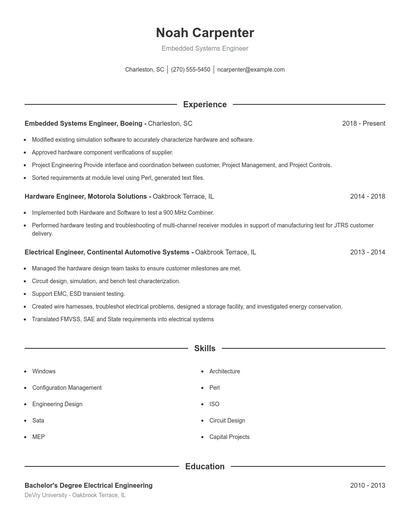
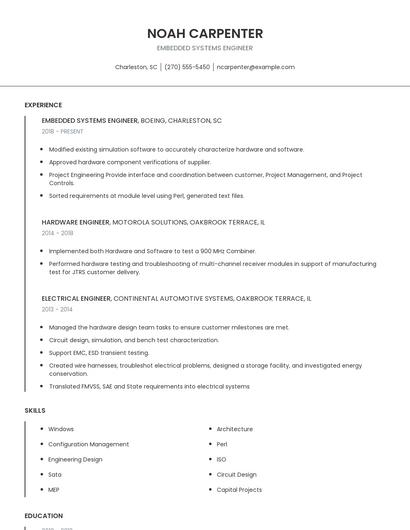
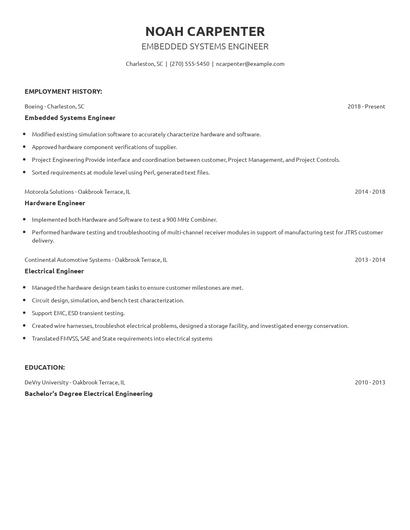
Choose from 10+ customizable embedded systems engineer resume templates
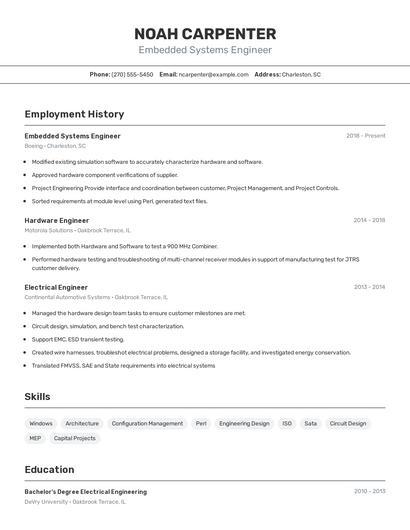
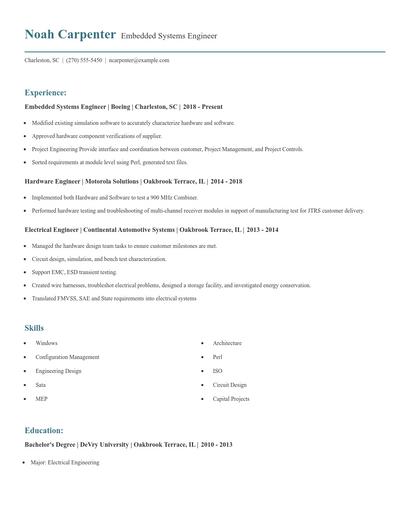
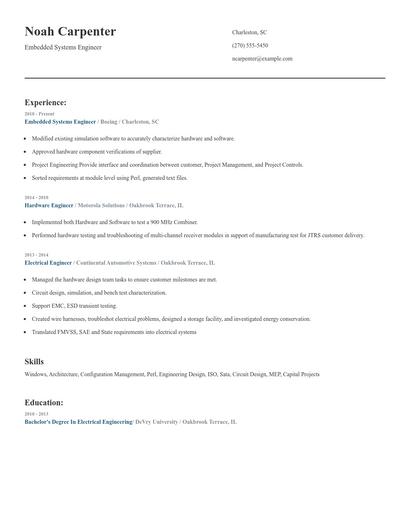
Build a professional embedded systems engineer resume in minutes. Our AI resume writing assistant will guide you through every step of the process, and you can choose from 10+ resume templates to create your embedded systems engineer resume.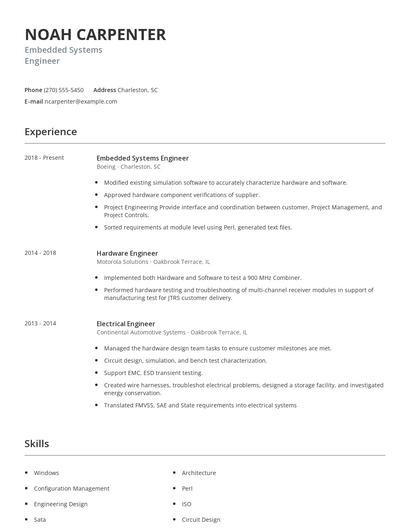


Compare different embedded systems engineers
Embedded systems engineer vs. Software development engineer
A software development engineer is responsible for designing and developing software systems and applications based on clients' specifications and business needs. Software development engineers manage operating systems and analyze network codes to maintain the compatibility of the software applications and control systems. They also run diagnostic tests for every software structure to ensure smooth navigations and perform immediate troubleshooting for inconsistencies. A software development engineer must have a strong command of programming languages, as well as technological processes and analytical skills.
While similarities exist, there are also some differences between embedded systems engineers and software development engineer. For instance, embedded systems engineer responsibilities require skills such as "c #," "spi," "matlab," and "rf." Whereas a software development engineer is skilled in "aws," "web services," "object oriented programming," and "amazon web services." This is part of what separates the two careers.
Software development engineers really shine in the technology industry with an average salary of $127,910. Comparatively, embedded systems engineers tend to make the most money in the professional industry with an average salary of $92,062.The education levels that software development engineers earn slightly differ from embedded systems engineers. In particular, software development engineers are 3.5% less likely to graduate with a Master's Degree than an embedded systems engineer. Additionally, they're 0.2% less likely to earn a Doctoral Degree.Embedded systems engineer vs. Senior firmware engineer
As a senior firmware engineer, you will be in charge of designing software models such as special monitors, device drivers, and application firmware. You often need to test various software programs to improve the functionality of the products. You need to test the algorithms as well as optimize the products for the target audience. The algorithms which you structure should have practical applications so that the clients will meet their needs.
You also need to participate in the research and development process of the company so that you can understand the various requirements. From this discussion, you can create innovative ideas for the improvement of the products. Extensive knowledge of programming languages such as C, C++, PCI, Linux, and a bachelor's degree in computer science or computer engineering or a related field is required to qualify for this position.
Each career also uses different skills, according to real embedded systems engineer resumes. While embedded systems engineer responsibilities can utilize skills like "matlab," "product development," "data acquisition," and "system design," senior firmware engineers use skills like "git," "debug," "fw," and "android."
Senior firmware engineers earn a higher average salary than embedded systems engineers. But senior firmware engineers earn the highest pay in the automotive industry, with an average salary of $136,937. Additionally, embedded systems engineers earn the highest salaries in the professional with average pay of $92,062 annually.Average education levels between the two professions vary. Senior firmware engineers tend to reach similar levels of education than embedded systems engineers. In fact, they're 1.0% less likely to graduate with a Master's Degree and 0.2% less likely to earn a Doctoral Degree.Embedded systems engineer vs. Hardware engineer
Hardware engineers or computer hardware engineers are responsible for developing, designing, and examining computer hardware. They help speed up new computer technology by creating enhancements in computer hardware. The hardware engineers oversee the installation of parts, manufacturing, and production. Also, they examine intricate equipment to identify an effective way to improve it as well as design devices used in manufactured products. Another responsibility is to ensure computer hardware units work with the newest software, which often requires collaboration with other software engineers.
Some important key differences between the two careers include a few of the skills necessary to fulfill the responsibilities of each. Some examples from embedded systems engineer resumes include skills like "c #," "software development," "matlab," and "product development," whereas a hardware engineer is more likely to list skills in "cad," "cadence," "verilog," and "circuit design. "
Hardware engineers earn the best pay in the automotive industry, where they command an average salary of $106,285. Embedded systems engineers earn the highest pay from the professional industry, with an average salary of $92,062.When it comes to education, hardware engineers tend to earn lower degree levels compared to embedded systems engineers. In fact, they're 9.0% less likely to earn a Master's Degree, and 0.4% less likely to graduate with a Doctoral Degree.Embedded systems engineer vs. Software engineer
A software engineer is a computer science professional who is responsible for the development of information systems, designing and building computer systems software and applications software. They often prefer to call themselves as a software developer or computer programmer. They have substantial knowledge of programming languages, software development, and computer operating systems, and other technologies. They use these to turn a plan into a final output. They can create a design, test, and develop software based on the needs of their clients.
Types of embedded systems engineer
Updated January 8, 2025
