
Automatically apply for jobs with Zippia
Upload your resume to get started.
Embryologist skills for your resume and career
15 embryologist skills for your resume and career
1. In-vitro
- Perform laboratory testing and procedure preparation for In-Vitro Fertilization and Artificial Insemination patients.
- Performed ovary aspirations, in-vitro maturation, embryo culture and evaluation.
2. Patient Care
Patient care entails the diagnosis, recovery, and control of sickness as well as the maintenance of physical and emotional well-being through the use of healthcare providers' services. Patient care is described as services provided to patients by health practitioners or non-professionals under guidance.
- Team embryologist assigned and responsible for doctor support on issues including patient care, stimulation choice, and chart review.
- Maintain and records pertaining to patient care.
3. Lab Equipment
- Interacted with superiors daily to manage individual projects, communicate results, and oversee general maintenance of lab equipment and conditions
- Maintained a steady supply of experimental specimen and provided critical technical support for the operational function of lab equipment.
4. EMR
- Experience working with EMR (E-IVF)
5. Insemination
- Trained on retrieval of oocytes for insemination, Embryo Transfer, assessment and micro-manipulation.
- Centrifuge for preparation of sperm for insemination.
6. FDA
The Food and Drug Administration (FDA) is a division of the US Department of Health and Human Services that regulates the production and sale of food, pharmaceutical products, medical equipment, and other consumer goods, as well as veterinary medicine. The FDA is now in charge of overseeing the manufacture of products like vaccines, allergy treatments, and beauty products.
- Maintained desirable pregnancy rates and passed Joint Commission and FDA inspections with perfect scores.
- Created and implemented a process for validating Excel macros demonstrating accurate interpretation and presentation of data used in FDA submissions.
7. Semen Analysis
- Involved in microbial analysis of semen and culture sensitivity.
- Conduct handling/thawing of semen for fertilization procedures.
8. Control Procedures
- Identified and prepared oocytes for insemenation Prepared dishes and paperwork for clinical cases Performed Quality Control procedures for various laboratory equipment
9. Equipment Maintenance
Equipment maintenance is any process that includes the use of maintenance methods and procedures to keep the organization's equipment in good and reliable working condition. This may include routine maintenance as well as corrective repairs. The practice takes place in a variety of settings, including catering establishments, industrial factories, manufacturing facilities, hotels, etc.
- Contributed to basic equipment maintenance, cleaning and calibration.
- Reviewed Quality Assessment programs, Quality Control, Proficiency Testing protocols as well as equipment maintenance records.
10. Cell Culture
- Prepared lysing buffer from cell culture water, potassium sulphate, sodium bicarbonate, and EDTA.
- Performed cell culture utilizing sterile technique and managed laboratory safety/chemical inventory/equipment.
11. Genetic Diagnosis
- Conducted embryo / blastomere biopsies for Pre-implantation Genetic Diagnosis (PGD).
12. OSHA
- Act as Chemical Hygiene Officer (CHO) and OSHA safety coordinator.
- Manipulate potentially contaminated tissues and utilize hazardous chemicals consistent with CDC & OSHA standards.
13. Tese
- Isolate sperms from PESA, TESA and TESE for IVF or cryopreservation Oocyte retrieval.
14. Sperm Preparation
- Conduct semen quality analysis, sperm preparation, and oocyte retrievals for IVF/ICSI cycles.
15. R
R is a free software environment and a language used by programmers for statistical computing. The R programming language is famously used for data analysis by data scientists.
- Maintain a statistical database utilizing R programming for scientific analyses.
- Develop and maintain modules for StatsTeachr (http://www.statsteachr.org/), an open-access repository for teaching statistics and R programming.

What skills help Embryologists find jobs?
Tell us what job you are looking for, we’ll show you what skills employers want.
What embryologist skills would you recommend for someone trying to advance their career?
Craig Magie Ph.D.
Associate Professor of Biology Quinnipiac University Department of Biological Sciences, Quinnipiac University
What type of skills will young embryologists need?
S. Laurie Sanderson Ph.D.
Professor and Chair, William & Mary
What soft skills should all embryologists possess?
Srinivas Sonne Ph.D.
Assistant Professor of Biology, Paine College
What hard/technical skills are most important for embryologists?
Srinivas Sonne Ph.D.
Assistant Professor of Biology, Paine College
List of embryologist skills to add to your resume
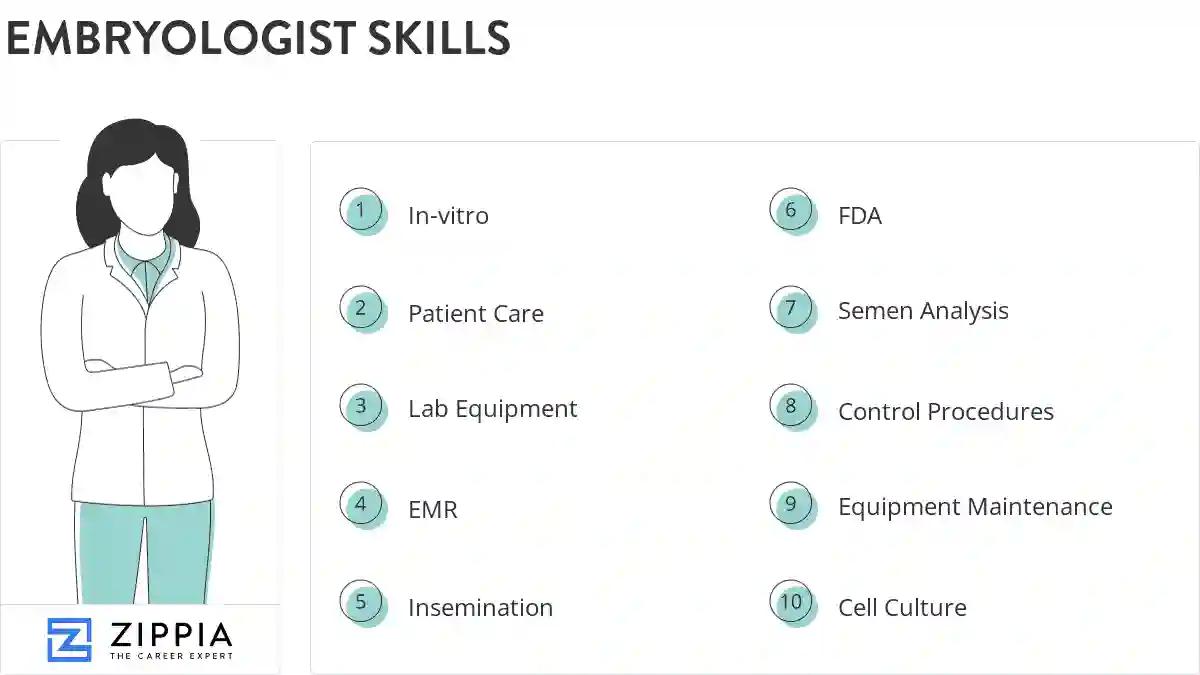
The most important skills for an embryologist resume and required skills for an embryologist to have include:
- In-vitro
- Patient Care
- Lab Equipment
- EMR
- Insemination
- FDA
- Semen Analysis
- Control Procedures
- Equipment Maintenance
- Cell Culture
- Genetic Diagnosis
- OSHA
- Tese
- Sperm Preparation
- R
- Data Entry
- Oocyte Retrieval
- Data Collection
- Lab Inventory
Updated January 8, 2025
