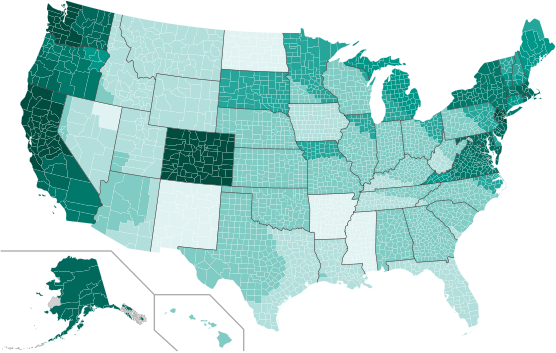
Employment programs analyst demographics and statistics in the US
On this page
Employment programs analyst demographics by:
Employment programs analyst gender statistics
62.3% of employment programs analysts are women and 37.7% of employment programs analysts are men.
- Female, 62.3%
- Male, 37.7%
Employment programs analyst gender ratio
| Gender | Percentages |
|---|---|
| Female | 62.3% |
| Male | 37.7% |
Employment programs analyst gender pay gap
Women earn 94¢ for every $1 earned by men


Male income
$61,609

Female income
$57,891
Employment programs analyst gender ratio over time
This data breaks down the percentage of men and women in employment programs analyst positions over time. Currently, 62.3% of employment programs analysts are female.
Employment programs analyst gender ratio by year
| Year | Male | Female |
|---|---|---|
| 2010 | 40.56% | 59.44% |
| 2011 | 40.26% | 59.74% |
| 2012 | 40.48% | 59.52% |
| 2013 | 40.06% | 59.94% |
| 2014 | 38.46% | 61.54% |
| 2015 | 39.85% | 60.15% |
| 2016 | 39.13% | 60.87% |
| 2017 | 38.60% | 61.40% |
| 2018 | 40.44% | 59.56% |
| 2019 | 38.80% | 61.20% |
| 2020 | 37.24% | 62.76% |
| 2021 | 37.67% | 62.33% |
Employment programs analyst related jobs gender ratio
We compared employment programs analysts with similar job titles to see how gender ratios vary. As you can see, timber buyer and chief estimator have the biggest gender ratio gaps.
| Job title | Male | Female |
|---|---|---|
| Wedding Coordinator | 9% | 91% |
| Conference Planning Manager | 9% | 91% |
| Human Resources Administrative Assistant | 9% | 91% |
| Employment Programs Analyst | 38% | 62% |
| Electronic Security Specialist | 94% | 6% |
| Chief Estimator | 95% | 5% |
| Timber Buyer | 97% | 3% |
Male
Female
100%
75%
50%
25%
0%
0%
25%
50%
75%
100%
Employment programs analyst demographics by race
The most common ethnicity among employment programs analysts is White, which makes up 68.2% of all employment programs analysts. Comparatively, 9.8% of employment programs analysts are Asian and 9.0% of employment programs analysts are Hispanic or Latino.
- White, 68.2%
- Asian, 9.8%
- Hispanic or Latino, 9.0%
- Black or African American, 8.3%
- Unknown, 4.5%
- American Indian and Alaska Native, 0.2%
Employment programs analyst race
| Employment programs analyst race | Percentages |
|---|---|
| White | 68.2% |
| Asian | 9.8% |
| Hispanic or Latino | 9.0% |
| Black or African American | 8.3% |
| Unknown | 4.5% |
| American Indian and Alaska Native | 0.2% |
Employment programs analyst race and ethnicity over time
See how employment programs analyst racial and ethnic diversity trended since 2010 according to the United States Census Bureau data.
Employment programs analyst race and ethnicity by year
| Year | White | Black or African American | Asian | Hispanic or Latino |
|---|---|---|---|---|
| 2010 | 76.97% | 8.00% | 6.50% | 6.48% |
| 2011 | 76.23% | 8.09% | 6.88% | 6.73% |
| 2012 | 75.17% | 8.47% | 7.28% | 6.93% |
| 2013 | 75.05% | 8.16% | 7.69% | 6.92% |
| 2014 | 75.36% | 8.24% | 7.76% | 6.56% |
| 2015 | 74.27% | 7.77% | 8.03% | 7.54% |
| 2016 | 74.04% | 7.70% | 8.40% | 7.42% |
| 2017 | 73.62% | 8.00% | 8.41% | 7.52% |
| 2018 | 73.72% | 7.46% | 8.69% | 7.62% |
| 2019 | 71.50% | 8.01% | 9.38% | 8.49% |
| 2020 | 69.71% | 8.01% | 8.68% | 9.11% |
| 2021 | 68.19% | 8.27% | 9.83% | 9.03% |
Employment programs analyst wage gap by race
According to our data, asian employment programs analysts have the highest average salary compared to other ethnicities. Black or african american employment programs analysts have the lowest average salary at $58,890.
| Ethnicity | Salary |
|---|---|
| Unknown | $61,480 |
| White | $62,433 |
| Black or African American | $58,890 |
| Asian | $64,953 |
| Hispanic or Latino | $60,457 |
Average employment programs analyst age
See how the average age of employment programs analysts varies based on ethnicity and gender.
Male
Female
Employment programs analyst age by race and gender
| Race | Male age | Female age |
|---|---|---|
| Unknown | 40 | 39.5 |
| White | 45 | 46 |
| Black or African American | 42 | 46 |
| Asian | 39 | 37 |
| Hispanic or Latino | 39.5 | 40 |
Employment programs analyst age breakdown
The average age of employment programs analysts is 40+ years years old, representing 59% of the employment programs analyst population.
Employment programs analyst age breakdown
| Employment Programs Analyst Years | Percentages |
|---|---|
| 40+ years | 59% |
| 30-40 years | 27% |
| 20-30 years | 13% |
Employment programs analyst educational attainment
The most common degree for employment programs analysts is bachelor's degree, with 66% of employment programs analysts earning that degree. The second and third most common degree levels are associate degree degree at 15% and associate degree degree at 12%.
- Bachelor's, 66%
- Associate, 15%
- Master's, 12%
- High School Diploma, 3%
- Other Degrees, 4%
Employment programs analysts by degree level
| Employment programs analyst degree | Percentages |
|---|---|
| Bachelor's | 66% |
| Associate | 15% |
| Master's | 12% |
| High School Diploma | 3% |
| Other Degrees | 4% |
Employment programs analyst jobs you might like
Employment programs analyst wage gap by degree level
According to the data, employment programs analysts with a Doctorate degree earn more than those without, at $72,614 annually. With a Master's degree, employment programs analysts earn a median annual income of $68,790 compared to $62,411 for employment programs analysts with an Bachelor's degree.
| Education | Salary |
|---|---|
| Master's Degree | $68,790 |
| Bachelor's Degree | $62,411 |
| Doctorate Degree | $72,614 |
Employment programs analyst employment statistics
Most employment programs analysts work for a private in the education industry.
Company size where employment programs analysts work
Below, you can see the size of companies where employment programs analysts work.
Employment programs analyst jobs by employer size
| Company size | Percentages |
|---|---|
| < 50 employees | 2% |
| 50 - 100 employees | 14% |
| 100 - 500 employees | 20% |
| 500 - 1,000 employees | 10% |
| 1,000 - 10,000 employees | 36% |
| > 10,000 employees | 18% |
Employment programs analyst jobs by company type
Employees with the employment programs analyst job title have their preferences when it comes to working for a company. For instance, most employment programs analysts prefer to work at private companies over education companies.
Employment programs analyst jobs by sector
| Company type | Percentages |
|---|---|
| Education | 28% |
| Public | 17% |
| Private | 37% |
| Government | 17% |
Employment programs analyst jobs by industry
The most common industries for employment programs analysts are education, government and professional.
Employment programs analyst industry statistics
| Industry | Percentages |
|---|---|
| Education | 24% |
| Government | 14% |
| Professional | 12% |
| Technology | 12% |
| Manufacturing | 10% |
| Finance | 6% |
| Fortune 500 | 6% |
| Health Care | 4% |
| Insurance | 4% |
| Retail | 2% |
| Transportation | 2% |
| Media | 2% |
| Hospitality | 2% |
Employment programs analyst turnover and employment statistics
Employment programs analyst unemployment rate over time
The unemployment rate for employment programs analysts between 2008 and the most recent data has varied, according to the Bureau of Labor Statistics.
Employment programs analyst unemployment rate by year
| Year | Employment programs analyst unemployment rate |
|---|---|
| 2010 | 6.86% |
| 2011 | 4.96% |
| 2012 | 5.00% |
| 2013 | 4.70% |
| 2014 | 4.15% |
| 2015 | 3.56% |
| 2016 | 3.57% |
| 2017 | 3.12% |
| 2018 | 3.13% |
| 2019 | 3.02% |
| 2020 | 4.33% |
| 2021 | 4.32% |
Average employment programs analyst tenure
The average employment programs analyst stays at their job for 1-2 years, based on the 161 employment programs analysts resumes in Zippia's database.
Employment programs analyst tenure statistics
| Number of years | Percentages |
|---|---|
| Less than 1 year | 28% |
| 1-2 years | 30% |
| 3-4 years | 18% |
| 5-7 years | 13% |
| 8-10 years | 4% |
| 11+ years | 6% |
Employment programs analyst LGBT ratio compared to similar jobs
Review the percent of employment programs analysts that are members of the LGBT community. You can see how this compares to similar jobs in the chart below.
| Job title | LGBT | Job openings |
|---|---|---|
| Building Construction Estimator | 4.41% | 41,605 |
| Logistics Support Specialist | 8.65% | 104,890 |
| Category Analyst | 10.00% | 17,182 |
| Director, Internet Services | 11.05% | 63,829 |
| Environmental Compliance Specialist | 11.64% | 31,894 |
| Employment Programs Analyst | 12.44% | - |
| Principal Gifts Officer | 19.25% | 95,423 |
Similar employment programs analyst jobs LGBT demographics
| Profession | Percentages of LGBT | Job openings |
|---|---|---|
| Building Construction Estimator | 4.41% | 41,605 |
| Logistics Support Specialist | 8.65% | 104,890 |
| Category Analyst | 10.00% | 17,182 |
| Director, Internet Services | 11.05% | 63,829 |
| Environmental Compliance Specialist | 11.64% | 31,894 |
| Principal Gifts Officer | 19.25% | 95,423 |
Foreign languages spoken by employment programs analysts
The most common foreign language among employment programs analysts is Spanish at 40.0%. The second-most popular foreign language spoken is German at 20.0% and Carrier is the third-most popular at 20.0%.
- Spanish, 40.0%
- German, 20.0%
- Carrier, 20.0%
- French, 20.0%
Employment programs analyst languages spoken
| Foreign language | Percentages |
|---|---|
| Spanish | 40.0% |
| German | 20.0% |
| Carrier | 20.0% |
| French | 20.0% |