Explore jobs
Find specific jobs
Explore careers
Explore professions
Best companies
Explore companies
Job outlook for english language assistants in the United States
English language assistant job growth summary. After extensive research, interviews, and analysis, Zippia's data science team found that:
The projected english language assistant job growth rate is 12% from 2018-2028.
About 159,400 new jobs for english language assistants are projected over the next decade.
English language assistant salaries have increased 8% for english language assistants in the last 5 years.
There are over 7,788 english language assistants currently employed in the United States.
There are 23,043 active english language assistant job openings in the US.
The average english language assistant salary is $51,167.
Are english language assistant jobs in demand?
English language assistant job and salary trends over time
English language assistant jobs over time
English language assistant job growth rate over time
| Year | # of jobs | % of population |
|---|---|---|
| 2021 | 7,788 | 0.00% |
| 2020 | 8,630 | 0.00% |
| 2019 | 9,047 | 0.00% |
| 2018 | 9,104 | 0.00% |
| 2017 | 9,208 | 0.00% |
Average english language assistant salary over time
English language assistant salary by year
| Year | Avg. salary | Hourly rate | % Change |
|---|---|---|---|
| 2026 | $51,167 | $24.60 | +0.7% |
| 2025 | $50,788 | $24.42 | +2.9% |
| 2024 | $49,379 | $23.74 | +2.6% |
| 2023 | $48,134 | $23.14 | +1.9% |
| 2022 | $47,259 | $22.72 | +2.8% |
English language assistant jobs by state
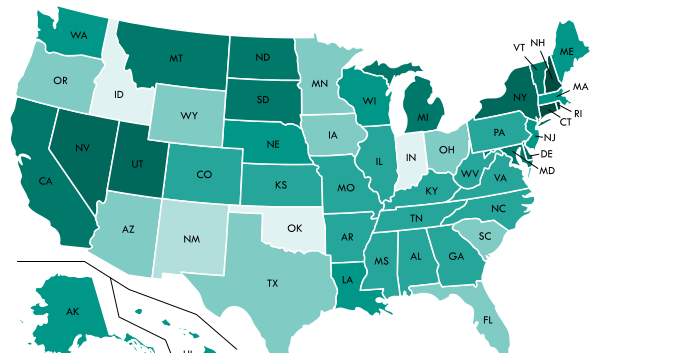
Most common states for english language assistants
| Rank | State | Population | # of jobs | Employment/ 1000ppl |
|---|---|---|---|---|
| 1 | New Hampshire | 1,342,795 | 241 | 18% |
| 2 | Vermont | 623,657 | 115 | 18% |
| 3 | West Virginia | 1,815,857 | 216 | 12% |
| 4 | Delaware | 961,939 | 93 | 10% |
| 5 | Massachusetts | 6,859,819 | 564 | 8% |
| 6 | Virginia | 8,470,020 | 513 | 6% |
| 7 | Maryland | 6,052,177 | 353 | 6% |
| 8 | Connecticut | 3,588,184 | 220 | 6% |
| 9 | Kansas | 2,913,123 | 182 | 6% |
| 10 | New Mexico | 2,088,070 | 128 | 6% |
| 11 | Nebraska | 1,920,076 | 110 | 6% |
| 12 | Montana | 1,050,493 | 61 | 6% |
| 13 | North Dakota | 755,393 | 43 | 6% |
| 14 | District of Columbia | 693,972 | 39 | 6% |
| 15 | Florida | 20,984,400 | 1,043 | 5% |
| 16 | Illinois | 12,802,023 | 616 | 5% |
| 17 | Washington | 7,405,743 | 381 | 5% |
| 18 | South Carolina | 5,024,369 | 256 | 5% |
| 19 | Rhode Island | 1,059,639 | 56 | 5% |
| 20 | South Dakota | 869,666 | 47 | 5% |
Most common cities for english language assistants
| Rank | City | # of jobs | Employment/ 1000ppl | Avg. salary |
|---|---|---|---|---|
| 1 | Sacramento | 1 | 0% | $61,623 |
English Language Assistant job outlook: Expert opinions
Our panel of english language assistant experts

Union University

Macalester College
University of Iowa

North Central College
SUNY Buffalo State

The University of Vermont

Texas Tech University
Arizona State University

Northern Arizona University

Wilson College

University of Houston - Downtown

Davidson College

University of Michigan
East Los Angeles College
Arizona State University

The University of Texas Permian Basin
Pennsylvania State University Altoona

Jackson State University

University of Louisville
The University of Texas at El Paso
What skills stand out on English Language Assistant resumes?
Julie Glosson: -Area of specialization
-Language proficiency
-Work History
-Study abroad/Immersion type of experiences
What soft skills should all English Language Assistants possess?
Julie Glosson: -Positive attitude
-Adaptability
-Ability to be a team player as well as work independently
-Willingness to grow and learn from mistakes
What hard/technical skills are most important for English Language Assistants?
Julie Glosson: -Language proficiency
-Knowledge of content
-Pedagogical Skills in Language Acquisition
-Professional Development
What skills will help English Language Assistants earn the most?
Julie Glosson: -Completed Terminal Degree (professors)
-Publications (professors)
-Other scholarly material (professors)
-Specialization in another area (either professor or K12 teacher)
-State certifications (K12 teachers)
-Other types of certifications or affiliations (either professor or K12 teacher)
Nanette Scott Goldman
Senior Lecturer in the Classical Mediterranean and Middle EastMacalester College
Department of the Classical Mediterranean and Middle East
What skills stand out on English Language Assistant resumes?
Nanette Scott Goldman: Language fluency and teaching experience.
What soft skills should all English Language Assistants possess?
Nanette Scott Goldman: With a Classical languages major, you learn to excel at clear writing, listening, memorizing, data analysis, critical thinking, promoting understanding across cultural boundaries, data organization, and presentation
Dr. Irina Kostina
Associate Professor of Instruction, The Director of Undergraduate Studies in the Russian ProgramUniversity of Iowa
Division of World Languages, Literatures and Cultures
What soft skills should all English Language Assistants possess?
Dr. Irina Kostina: Some of the soft skills are listed above. I would add to the aforementioned skills organization, communication, and teamwork.
What hard/technical skills are most important for English Language Assistants?
Dr. Irina Kostina: Certifications, computer skills, writing, language, and presentation skills.
What skills will help English Language Assistants earn the most?
Dr. Irina Kostina: Unfortunately, everything changed today. Before, degrees were very important, but today the skills are.
Social media marketing, content writing, website development, and so on... will help to earn more money and educational administration.
Brian Hoffert
Associate Professor of Religious Studies and History; Coordinator of History of Ideas; Coordinator of East Asian Studies\North Central College
Religious Studies
What soft skills should all English Language Assistants possess?
Brian Hoffert: I would say that cultural competency (being familiar with one or more East Asian cultures) is the key soft skill that employers would look for. It is a soft skill because it is difficult to "prove" this kind of competency on a resume, though the essential thing that students should consider is literally how much time they've spent in the culture in question. A degree in East Asian Studies will suggest that you have a basic understanding of Chinese, Japanese, and/or Korean cultures, but study abroad experiences demonstrate that you have actually spent time in the culture in question. At North Central, we offer short-term study abroad programs to the region (mostly focusing on China and Japan, but sometimes Taiwan, Hong Kong, and potentially Korea); these are helpful, but two weeks is not enough time to gain real competency. We, therefore, offer many long-term (one or two-semester) programs throughout the region, which will allow students to practice their "hard skills" (i.e., communicating in an East Asian language on a daily basis) but will also help them develop a deeper understanding of the culture. In addition, any kind of employment where one is in contact with one of these cultures is helpful, whether that is doing an internship in an East Asian country or working in a Japanese restaurant in Naperville.
Dr. Mark Fulk Ph.D.
Associate ProfessorSUNY Buffalo State
Department of English
What soft skills should all English Language Assistants possess?
Dr. Mark Fulk Ph.D.: English majors, while many are introverted thinkers, are good workers on group projects. They are affable and adaptable, good conversationalists who are also good listeners. They allow others to find their own voice and do their work while contributing their own insights. They are great for being engaged in culture and perpetuating the kinds of self-directed learning that is expected of English majors inside and outside the classroom.
What skills stand out on English Language Assistant resumes?
Dr. Mark Fulk Ph.D.: Their involvement in many kinds of experience through the English major, including the study of literature/culture and their experiences as writers and thinkers. Through involvement in opportunities such as writing tutoring, which is done via the department, publishing, and internships, our majors can be leaders in the work in which they are invested, helping to manage and guide others.
What soft skills should all English Language Assistants possess?
Angeline Chiu Ph.D.: Communication, communication, communication. All kinds of communication, be it clear, lucid speaking (whether one-on-one, in small groups, or in large groups), good concise writing that isn't full of jargon and excrescences, or even the seemingly simple but absolutely crucial everyday interactions with the people around you. They can make or break a work or school environment. I don't mean mere etiquette. I mean building a real sense of community and human connection as a base for all the other things the school/company/etc. is trying to do. What can we do that robots can't do? Be human beings in communication and community with other human beings.
Another note on communication: we have all seen situations in which garbled announcements or backtracking/confusing directions have caused all kinds of problems then and later. Focus, clarity, and efficiency in communication are key. And look people in the eye.
Related to this is, of course, the ability to work with others in all kinds of different settings and configurations. Collaboration and cooperation are essential, but they too rest on a foundation of clear communication.
The ultimate soft skill, though, is a little harder to quantify. I'm talking about learning how to learn. Life comes at you fast, at work or school or home, and the ultimate human skill is adapting to situations as they arise and being able to pivot, be flexible, be resilient, be creative in responding, and be able to do all that while remembering that we are working as humans with other humans, and there is much we do not know, and much we do not know as well as we ought to or think we do. Patience, grace, empathy, humility are part of the equation.
What hard/technical skills are most important for English Language Assistants?
Angeline Chiu Ph.D.: What I tell you today might not be applicable tomorrow! Tech changes so fast. The best thing I can tell you is to keep current on what's going on. Also: don't be afraid of new things. At the same time, remember that something isn't automatically better just because it's new. Perhaps the real skill I'm describing is figuring what is useful for your purpose and what isn't, and don't try to apply every single shiny new tech toy that comes along. And for goodness sake, be careful about data and security and those basics that you think everyone knows but so many people don't.
What skills stand out on English Language Assistant resumes?
Dr. Ashley Voeks: If a language instructor is applying for a teaching job, work experience, not skills, are the most important part of their resume or CV. If a language instructor is looking to branch out and find an industry job, "skills" are only relevant if and when a resume gets past an ATS (Applicant Tracking System) and into human hands. In my experience, an ATS is only likely to let an applicant's resume through if it is properly formatted and tailored to the job ad. When an ATS scans a resume, it looks for the skills and years of work experience listed in the job ad and automatically tosses it if certain skills seem off, no matter how much they "stand out." In short: the skills that make a candidate stand out are the skills that the employer wants and specifies in the job ad itself.
What soft skills should all English Language Assistants possess?
Dr. Ashley Voeks: All of them. The trouble with soft skills is that they're not really resume showstoppers. Anyone can say that they have good communication skills, a sense of creativity, critical thinking, and problem-solving skills, etc. The time for a job seeker (language instructor or otherwise) to really wow a potential employer with their soft skills is during the interview or in an anecdote in the cover letter. The bottom line: all soft skills are important, but showing a potential employer how you developed them is key.
What skills will help English Language Assistants earn the most?
Dr. Ashley Voeks: Clients and recent graduates who have negotiated "high" salaries in entry-level positions have been able to speak to their communication, collaboration, and self-management skills but have also had some technical competencies from internships or online boot camps and workshops. High-earning skills include web design, graphic design, online course content creation, project management, UX design, IT support, coding, Blockchain, social media marketing, etc. Almost all these skills can be gained through certificate-granting online courses.
Lorena Cuya Gavilano Ph.D.
Assistant Professor of Spanish and Latin American CulturesArizona State University
Languages and Cultures
What soft skills should all English Language Assistants possess?
Lorena Cuya Gavilano Ph.D.: I mentioned some soft skills in my previous answer, but translingual and transcultural competence is necessary for effective communication and work collaboration. Transcultural competence requires understanding racial, ethnic, gender, age, disability, and structural issues in the workplace. It not only helps to avoid and resolve conflicts. Transcultural competence also helps to promote compassion and empathy. Translingual and transcultural competence are the foundation of work ethics. Furthermore, from year to year and from semester to semester, any instructor faces new protocols, new strategies, new pedagogical technologies, new teams, etc. Thus, the ability to adapt is another must.
What hard/technical skills are most important for English Language Assistants?
Lorena Cuya Gavilano Ph.D.: Hard skills for languages and cultures are somehow flexible. Instructors need to know about new pedagogies, digital humanities, educational technologies, and social media literacy. But all these requirements change very fast, so instructors should evidence knowledge of all these hard skills and the ability to adapt fast to new ones. The present pandemic had demonstrated how most instructors quickly adapted to new virtual classrooms. We ought to always be ready for any change. For this and other pedagogical reasons, adaptability is one of the most needed values in language education.
Lawrence Lenhart
Associate Chair nd Associate ProfessorNorthern Arizona University
Department of English
What skills stand out on English Language Assistant resumes?
Lawrence Lenhart: Ability to help writers across the disciplines
What skills will help English Language Assistants earn the most?
Lawrence Lenhart: For someone working for themselves (e.g., tutor, freelance writer/editor, etc.): initiative, career self-management, innovative thinking / for someone working for a company (e.g., teacher, journalist, ): ability to leverage their strengths to support not just themselves, but entire departments; understanding/willingness to contribute to leadership's vision
Michael Cornelius Ph.D.
Professor of English, Program Director MAHUMWilson College
English Department
What skills stand out on English Language Assistant resumes?
Michael Cornelius Ph.D.: In the academy, we often talk about English majors teaching students vital skills in critical thinking, communication, research, and analysis. An English major can be handed a project and know how to research the necessary components, compile them together in a clear and consistent format, and present that material to a client or supervisor with confidence. And I think the skill that really unites all of these aspects of the English major is independence. In our field, we ask students to articulate the rudiments of pragmatics, identify the meaning inherent to a seventeenth-century poem, and punch back at the masterpieces of the canon. No student can tackle such a diverse learning platform without a streak of independence that teaches them that, yes, scholars have been analyzing and deconstructing Shakespeare for 500 years, but no one has quite seen the text the way you have, and that's why you need to write about it. Heck, in a national conversation about higher education that strongly suggests that any major without a specific job title in its name should not even be considered, it takes someone who is a bit of a maverick to choose a major in English. But that independent streak serves our students really well in their careers and lives beyond college.
On a resume, I look for independence in that projection completion mode: acting as editor for student media; presenting a paper at a conference; writing a theatrical work; publishing; internships; etc. Anything that shows me that the applicant can tackle a project and get it done is what I am looking for.
What skills will help English Language Assistants earn the most?
Michael Cornelius Ph.D.: Self-advocacy. I am not suggesting every English major rush to their boss and demand a big raise, but our culture continually suggests one should apologize for majoring in a liberal arts field. I don't buy it. English majors are amazing at solving problems, facilitating communication, researching ideas, developing programs-they are, in short, the total package. And they have a tremendous capacity to learn new skills and new abilities. This is why students from my college, for example, end up in a huge variety of subject fields. We need to understand the value we bring to any organization as an English major.
Adam Ellwanger Ph.D.
Professor of EnglishUniversity of Houston - Downtown
College of Humanities & Social Sciences
What skills stand out on English Language Assistant resumes?
Adam Ellwanger Ph.D.: When applying to be an instructor of English, your resume itself must be clean and totally without error. If you can't produce impeccable writing, why should your prospective employers believe that you can teach others to do so? A clean, complete, well-formatted resume reflects that you are a strong writer and editor, and these are critical skills. Of course, if you want to be an English instructor, some experience as a teacher is strongly preferred -- even if that is in informal contexts (e.g., leading training sessions at a previous place of employment or serving as a teaching assistant in graduate school).
What soft skills should all English Language Assistants possess?
Adam Ellwanger Ph.D.: It is also important that you speak well -- that you are a good conversationalist. People in education want to hire people who will be collegial co-workers and have a dynamic classroom presence.
What skills stand out on English Language Assistant resumes?
Cynthia Lewis Ph.D.: Demonstrated facility with language; the ability to tap into how the tutor learned what the tutee needs to know and to use that knowledge in tutoring; the ability to interest students in both reading and writing accomplished prose; a command of the vocabulary of English grammar and an ability to explain good grammatical practices; a grasp of the elements of composition and style.
(Some of these skills would come out in a cover letter versus a resume.)
What skills will help English Language Assistants earn the most?
Cynthia Lewis Ph.D.: I would say not so many skills as demonstrated experience and having testimonials from students, the tutor has helped successfully.
Laura Aull
Associate Professor and Writing Program DirectorUniversity of Michigan
English Language & Literature Department
What skills stand out on English Language Assistant resumes?
Laura Aull: Ability to:
- conduct research to compile information,
- ability to synthesize information, including identifying connections and implications,
- strong formal written and oral communication,
- organizational skills
- communication and project management experience, especially in educational settings or community organization settings
What soft skills should all English Language Assistants possess?
Laura Aull: - formal oral and written communication skills
- interpersonal engagement
- ability to identify what is needed and break up information well to communicate with different stakeholders (e.g., administrators, staff, students, parents, faculty, donors, etc.)
What hard/technical skills are most important for English Language Assistants?
Laura Aull: - navigating institutional and academic databases
- identifying and summarizing best practices and research
- website oversight, visualization, and management
What skills will help English Language Assistants earn the most?
Laura Aull: The best is a combination of the above skills, including strong writing skills and strong digital communication and oversight skills.
Diane Renée Mannone
Associate Professor of EnglishEast Los Angeles College
English Department
What skills stand out on English Language Assistant resumes?
Diane Renée Mannone: The ability to teach close reading and critical thinking are vital, especially when helping students develop their unique voices, as well as the ability to construct engaging courses adaptable to all learning styles. Teaching argument is also key.
What soft skills should all English Language Assistants possess?
Diane Renée Mannone: Working well with colleagues: collaborating, being a team player, involved in the department and campus, etc.
What hard/technical skills are most important for English Language Assistants?
Diane Renée Mannone: Technical literacy and the ability to teach in myriad environments with diverse students.
What skills will help English Language Assistants earn the most?
Diane Renée Mannone: All of the above.
What certifications/licenses/courses can have the biggest impact for English Language Assistants?
Jessica Early Ph.D.: Teachers who receive their reading endorsement as well as training in the teaching of writing through local sites of the National Writing Project, like the Central Arizona Writing Project at ASU put themselves at an advantage. Also, courses that prepare teachers in culturally sustaining teaching practices and digital literacies will help them meet the needs of diverse student populations and ever-evolving communication tools.
Rebecca Babcock
William and Ordelle Watts ProfessorThe University of Texas Permian Basin
Department of Literature and Language
What's a good job out of college for English Language Assistants?
Rebecca Babcock: All people seeking to enter a career should plan on doing an internship in that business. I believe an internship is the best way to get started in any career. If an internship is not available consider an apprenticeship, volunteering, or job shadowing. Get yourself in there and show how valuable you are.
What English Language Assistant skills would you recommend for someone trying to advance their career?
Roselyn Costantino Ph.D.: Most important advice: Take initiative and be productive.
Find practical ways to use skills even if unpaid. Volunteer work is good. Use language skills. Technology skills. Exploit technology skills around the area of interest. If you want to be a teacher find out what software they are using today; what research skills are they utilize. Make sure you log your activities during the gap year especially those that relate to the area in which you want to work. If you want to go into finance, and you're working at a lawn service, understand and learn the business model and the accounting. If you're working at Starbucks (or in any commercial environment), get a chance to do inventories, learn about the ordering process and sources and suppliers for those orders; and how people are scheduled for work. All of that is relevant experience for business.
The CFO and recruiter for Keystone Staffing Solutions emphasized having evidence in your resume of of being productive during the gap time, no matter if it's one, two or three years. Evidence of being productive is what recruiters want to see on your resume: He stresses: "What did you do to expand your knowledge and skills not only in your selected area but beyond. BEING PRODUCTIVE for yourself proves to be an indicator of how productive you will be for me."
Still on gap year. How to go about it? Use teachers, friends, family, anyone in the field or related to it to provide guidance, insight, suggestions. This can lead to projects or experience that will help in learning and growth.
What technical skills for an English Language Assistant stand out to employers?
Leticia Pérez Alonso Ph.D.: In the past some employers appeared to be attracted to candidates who were familiar with online or distant education. Given the changing face of the academia, especially over the last year, I believe that skills to work remotely will be especially taken into consideration when hiring instructors of English language, education and literature. As I see it, an ability to develop online courses through platforms such as Canvas, Moodle or Blackboard stand out to employers of the educational sector. Along these lines, experience with video communications technologies such as Zoom will be a plus when deciding to hire an online or distance English teacher.
Additionally, specializations in English literature appear to have dropped, yet positions in rhetoric and composition are still in demand. Therefore, those English majors interested in literature might want to diversify their curriculum and receive training in areas such as technical and professional writing. They might also be interested in expanding their knowledge in second language acquisition or pedagogy to teach English to foreign speakers.
What's a day at work look like for an English Language Assistant?
Karen Chandler Ph.D.: I don't assume that there will be one paradigm, but I suppose many recent graduates' work will include more remote work than before the pandemic. Their academic work in virtual classrooms, while different, may help prepare them to do individual tasks and collaborative work remotely.
What will help English Language Assistants increase their earning potential?
Karen Chandler Ph.D.: Interest in graduate programs seems to indicate that more students are considering returning to university to pursue higher degrees. For those in the workplace outside higher ed, an environment, whether actual or virtual, that fosters recent graduates' development would be important. This would involve clear communication and trust.
Dr. Isabel Baca Ph.D.
Professor of English in Rhetoric and Writing StudiesThe University of Texas at El Paso
English Department
What certifications/licenses/courses can have the biggest impact for English Language Assistants?
Dr. Isabel Baca Ph.D.: The courses that will have the biggest impact on job prospects are technology and communication courses. Using different hardware, software, and technological platforms effectively and efficiently to communicate will be crucial in the workplace. Knowing how to use different social media is a must. Courses that allow students to learn and practice problem-solving and critical thinking will make them stronger job candidates. I also believe that having strong writing, speaking, and interpersonal communication skills will still be important in the workplace. Writing, of course, now entails composing multimodal texts/digital texts. Teamwork, knowing how to work with others, will still be important too.
What will help English Language Assistants increase their earning potential?
Dr. Isabel Baca Ph.D.: Knowing how to use technology effectively and efficiently will help people in my field increase their earning potential. As stated above, knowing how to communicate well through different means will be very important. Composing print and digital texts, being strong in problem-solving and critical thinking, knowing how to work well with others, and using technology to convey messages effectively and efficiently will contribute to their earning potential. More knowledge on user experience will contribute as well.
Will there be an enduring impact of the coronavirus pandemic on English Language Assistants?
Dr. Isabel Baca Ph.D.: I believe the enduring impact of the pandemic on graduates will be on their use of technology. We have become accustomed to meeting online now. We conduct meetings, interviews, and conferences online, and this format may not go away anytime soon. The face-to-face interactions may not be the "normal" setting anymore.