
Automatically apply for jobs with Zippia
Upload your resume to get started.
Field reviewer skills for your resume and career
15 field reviewer skills for your resume and career
1. HIPAA
- Upload Patient Medical Charts-Travel to facilities to retrieve charts-Follow HIPAA requirements to ensure patient information is confidential and safe.
- Shredded photocopied documents for HIPAA as required for confidentiality, at end of day.
2. Relevant Components
- Followed by scanning relevant components or converting electronic components to PDF format.
- Scanned relevant components of the medical record to support reviews performed.
3. HEDIS
- Participated in National Quality Assurance Program (HEDIS) and Medicare Risk assessment, abstracted information from medical records as directed.
- Retrieve and review specific requested documents from medical records for HEDIS or PIA Project/Study audits at specified Provider facilities or offices.
4. CMS
A Content Management System or CMS is computer software that works as a framework where content can be assembled and managed by using a database. CMS is an important asset in web development. This platform enables users to create, edit, collaborate on, publish and store digital content. It helps users to manage their content and modify it from a single system.
- Worked as needed to review patient charts for Payment Integrity Audits and the federal mandated CMS audits.
- Received a certificate through CMS to do CMS-HCC Medicare risk adjustment review.
5. Clinical Facilities
- Communicate effectively and professionally with care provider offices, clinics, hospitals, and other clinical facilities.
- Identify and retrieve requested information from medical records located in various clinical facilities.
6. Medical Facilities
Health facilities are places where healthcare services are provided. For example, clinics, hospitals, care centers, outpatient centers, psychiatric care centers etc. are all health facilites.
- Recognized for outstanding effort in facilitating communication with care provider offices, clinics, hospitals, and other medical facilities.
- Review medical charts at various medical facilities using company provided equipment.
Choose from 10+ customizable field reviewer resume templates
Build a professional field reviewer resume in minutes. Our AI resume writing assistant will guide you through every step of the process, and you can choose from 10+ resume templates to create your field reviewer resume.7. Data Collection
Data collection means to analyze and collect all the necessary information. It helps in carrying out research and in storing important and necessary information. The most important goal of data collection is to gather the information that is rich and accurate for statistical analysis.
- Provided medical staff with review and audit process for data collection
- Conducted data collection and analysis by utilizing software applications and identifyingstreamlining opportunities to ensue accuracy.
8. Hippa
HIPAA, which stands for Health Insurance Portability and Accountability Act, is a United States federal statue created, enacted, and turned to law in 1996, which whose primary purposes were to modernise the healthcare systems in the United States, secure and generally enhance the management of that personal information of patients that was in the hands of healthcare facilities, such as hospitals and insurance companies, and to enable the providing of healthcare and insurance to more people.
- Conduct medical record reviews abiding by HIPPA and other related confidentiality requirements by scanning relevant medical records to support record audits.
- Scanned and electronically uploaded to the auditing company's site all information gathered under proper HIPPA guidelines
9. Quality Assessments
- Maintain communication lines with Outcomes advocate.Successfully complete required training, testing and quality assessments.
10. Medicaid
- Review and collect identified chart audit materials from various medical practices/facilities as required for IPAs for Medicare and Medicaid.
- Provide validation of services provided and submitted to MD Medicaid Re-imbursement programs.
11. EHR
Electronic Health Records, or simply EHR, contains all the information about a patient whether they are new or old. It includes the record of diagnosis, medication, progress note, medical history, radiology, and laboratory results. A health facility or hospital has this kind of document to track a patient's record electronically.
- Assisted with system testing for transition to a new EHR system.
- Trained superuser in Avatar EHR.
12. HCC
- Review medical charts for Medicare Supplemental Insurances to verify and confirm diagnosis according to HCC categories.
- Enter collected data information into specific computer programs and assign codes as needed for HCC guidelines.
13. Patient Charts
- Review patient charts, collected data for Medicare/Medicaid related patients, uploaded data.
- Reviewed and transmitted patient charts from offices, clinics, and hospitals for insurance purposes
14. Onsite
- Schedule, coordinate, and conduct onsite medical record reviews.
- Serve as liaison and mediator between onsite medical personnel and Inovalon.
15. Health Insurance
- Travel to doctor's offices and hospitals to collect confidential information for health insurance research.
- Provide data for health insurance companies such as Emblem Health and Health First.
5 Field Reviewer resume examples
Build a professional field reviewer resume in minutes. Browse through our resume examples to identify the best way to word your resume. Then choose from 5+ resume templates to create your field reviewer resume.

What skills help Field Reviewers find jobs?
Tell us what job you are looking for, we’ll show you what skills employers want.
List of field reviewer skills to add to your resume
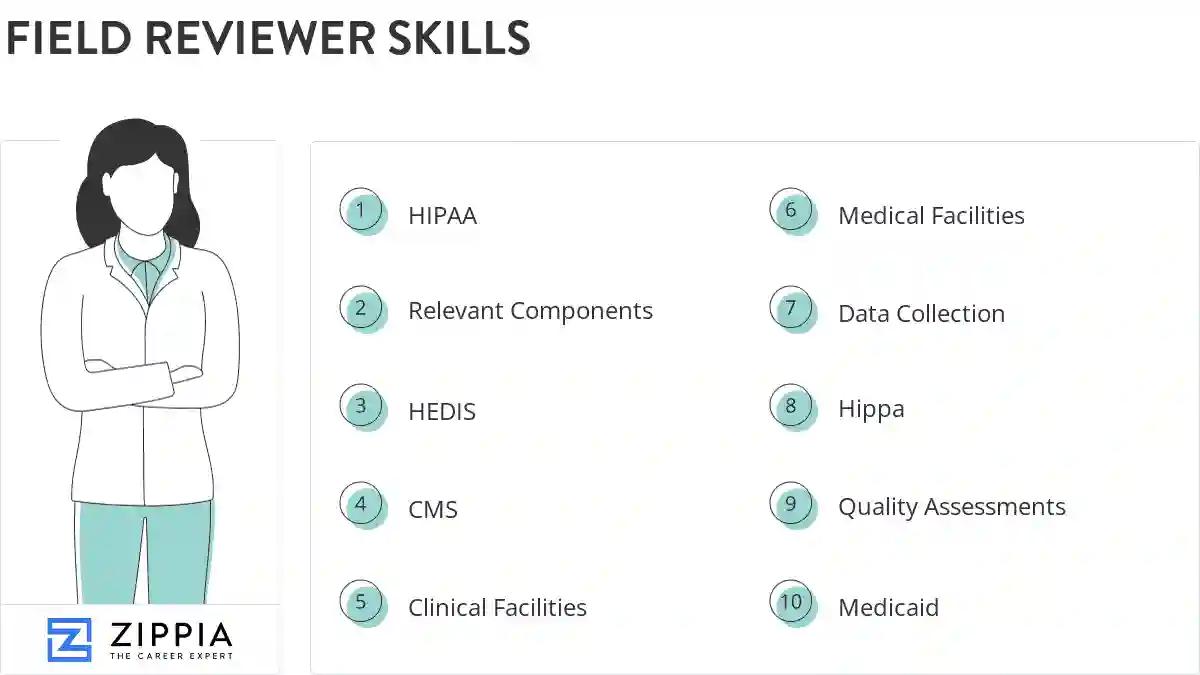
The most important skills for a field reviewer resume and required skills for a field reviewer to have include:
- HIPAA
- Relevant Components
- HEDIS
- CMS
- Clinical Facilities
- Medical Facilities
- Data Collection
- Hippa
- Quality Assessments
- Medicaid
- EHR
- HCC
- Patient Charts
- Onsite
- Health Insurance
- Communication Lines
- Patient Confidentiality
- Inter-Rater Reliability
- Medical Data
- ICD-9
- Epic
- Medical Terminology
- NCQA
- Quality Standards
- Allscripts
- Provider Sites
- Chart Audits
- PHI
- Clinical Data
- HR
- Flash Drive
Updated January 8, 2025
