
Automatically apply for jobs with Zippia
Upload your resume to get started.
Formulation chemist skills for your resume and career
15 formulation chemist skills for your resume and career
1. Scale-Up
Scale-Up refers to the act of making a product or model larger. Because all dimensions of the product must be increased, the scale of the model or rendering is increased as well. It may also refer to the act of increasing attention or force behind a certain idea or action, such as a scaled-up attempt to combat murder hornet infestations.
- Worked on formulation development and scale-up of manufacturing processes for current and future products.
- Performed process scale-up and process validation, including technology transfer to commercial production.
2. R
R is a free software environment and a language used by programmers for statistical computing. The R programming language is famously used for data analysis by data scientists.
- Used R, SSL, and SQL programming to identify and fix multiple processing and GUI problems with StarLIMS v9.
- Guide & support Energy Services R, D&E to meet and prioritize business goals.
3. Product Development
Product development is the complete procedure of creating a product from concept until release of the final product. Product development has many stages after which a product is released into the market. Identifying the need, creating the opportunity, conceptualizing a product, and providing a solution, all are different stages of product development.
- Performed and reported various laboratory tests to determine chemical and physical properties of material to support new product development efforts.
- Coordinated all phases of product development, including formulation, raw material qualification, and documentation.
4. Lab Notebook
- Maintain current records of all formula development in lab notebook.
- Develop and maintain a detailed and organized lab notebook.
5. Formulation Development
Formulation Development of a product requires knowledge of patentability, lifecycle, and stability of the product, which leads to its ultimate success. In the pharmaceutical and biotechnology industries, formulation development is an important skill to possess as it is an integral part of pharmaceutical product development. For example, in large pharmaceutical companies, formulation chemists are hired to deal with the physical drugs' characterization, conduct long-term drug stability, develop prototypes for testing, and more. All of these complicated tasks require you to have extensive knowledge in the formulation development of medical products.
- Write and maintain documentation to support process and formulation developments efforts.
- Prepared and analyzed samples for formulation development.
6. QC
Quality control is a set of instructions or procedures to ensure a manufactured product or a service is up to the highest quality standards. This set of quality control criteria are either defined by the clients or the company itself.
- Performed requisition purchases for all new materials and instrumentation, transferred finished coatings and methods to manufacturing facility and QC.
- Pass partially formulated samples to QC, and adjusting the product pool according to the sample data.
Choose from 10+ customizable formulation chemist resume templates
Build a professional formulation chemist resume in minutes. Our AI resume writing assistant will guide you through every step of the process, and you can choose from 10+ resume templates to create your formulation chemist resume.7. GMP
GMP stands for Good Manufacturing Practice. It is a system that ensures that all products like food, beverages, and medicinal drugs that are produced comply with the quality standards. It helps in minimizing the risks and hazards that cannot be eliminated after the testing of final products.
- Participated in pilot lot preparation, data recording, bulk formulations, and GMP applications.
- Assist with scale- up from development to large production with good GMP practices.
8. Analytical Methods
An analytical method is a method used to determine the chemical or physical property of a substance. It is a procedure to determine the relationship between different variables. This method can be conducted by combining scientific methods with any kind of formal process to solve a problem or prove a fact.
- Developed analytical methods for small molecule antibiotic solutions and conducted long range stability studies.
- Developed and improved formulas, processes, and analytical methods supporting paint coating products.
9. FDA
The Food and Drug Administration (FDA) is a division of the US Department of Health and Human Services that regulates the production and sale of food, pharmaceutical products, medical equipment, and other consumer goods, as well as veterinary medicine. The FDA is now in charge of overseeing the manufacture of products like vaccines, allergy treatments, and beauty products.
- Performed studies to evaluate the increase rate of chemical and physical degradation of bulk drug products in compliance with FDA regulations.
- Developed broad spectrum products with organic sunscreens, encapsulated sunscreens and inorganic particulates to meet the new FDA guidelines.
10. Stability Studies
- Conducted stability studies to monitor aging and temperature effects on the physical, chemical and microbiological characteristics of formulations.
- Perform routine stability studies for laboratory and manufacturing products.
11. Test Methods
Test methods are the steps in which thorough testing is conducted in a laboratory setting.
- Designed custom run-off mitigation test methods and designed/developed formulations with reduced run-off and efficacy equivalent to standard formulations.
- Developed standard operating procedures, test methods and wrote four patent applications.
12. Data Analysis
- Designed and validated excel workbooks containing chemical equations and statistical methodology used for formulating, product monitoring, and data analysis.
- Carried out numerical data analysis throughout chemical analysis by performing mathematical calculations such as determining concentrations and statistical information.
13. Lab Equipment
- Maintained lab equipment (balances, laminar flow hoods, etc.)
- Maintained lab equipment Provided assistance with Analytical Development
14. DSC
DSC - Differential Scanning Calorimetry is a thermo-analytical technique used to measure how much energy a sample absorbs or releases while heating or cooling. Thus, DSC measures the amount of heat required to increase the temperature of a sample as a function of temperature or time.
- Analyze drug formulations using HPLC, UV-Vis Spec., pH meter, Osmometer and DSC.
- Perform DSC purity analysis for standard certifications.
15. Technical Support
Technical support or tech support are the services provided by any hardware or software company to users. They help in solving the technical difficulties the customers face with their products or services. Moreover, the tech support employees maintain, manage, and repair the IT faults. They are also responsible for resolving the network problems, installing and configuring hardware and software.
- Served as Laboratory Six Sigma Representative and provided technical support for sales representatives.
- Provided Technical support to manufacturing unit and to address customer concerns.
5 Formulation Chemist resume examples
Build a professional formulation chemist resume in minutes. Browse through our resume examples to identify the best way to word your resume. Then choose from 5+ resume templates to create your formulation chemist resume.

What skills help Formulation Chemists find jobs?
Tell us what job you are looking for, we’ll show you what skills employers want.
What skills stand out on formulation chemist resumes?
Stephanie Hooper Marosek Ph.D.
Chair, Associate Professor, Methodist University
What soft skills should all formulation chemists possess?
Dunwei Wang Ph.D.
Margaret A & Thomas A Vanderslice Chair in Chemistry, Professor of Chemistry, Chairperson of Chemistry Department, Boston College
What hard/technical skills are most important for formulation chemists?
Dunwei Wang Ph.D.
Margaret A & Thomas A Vanderslice Chair in Chemistry, Professor of Chemistry, Chairperson of Chemistry Department, Boston College
What formulation chemist skills would you recommend for someone trying to advance their career?
Peter Rosado
Associate Professor of Chemistry, Georgia College and State University
What type of skills will young formulation chemists need?
Dr. Brian Augustine Ph.D.
Professor of Chemistry and Chair, High Point University
List of formulation chemist skills to add to your resume
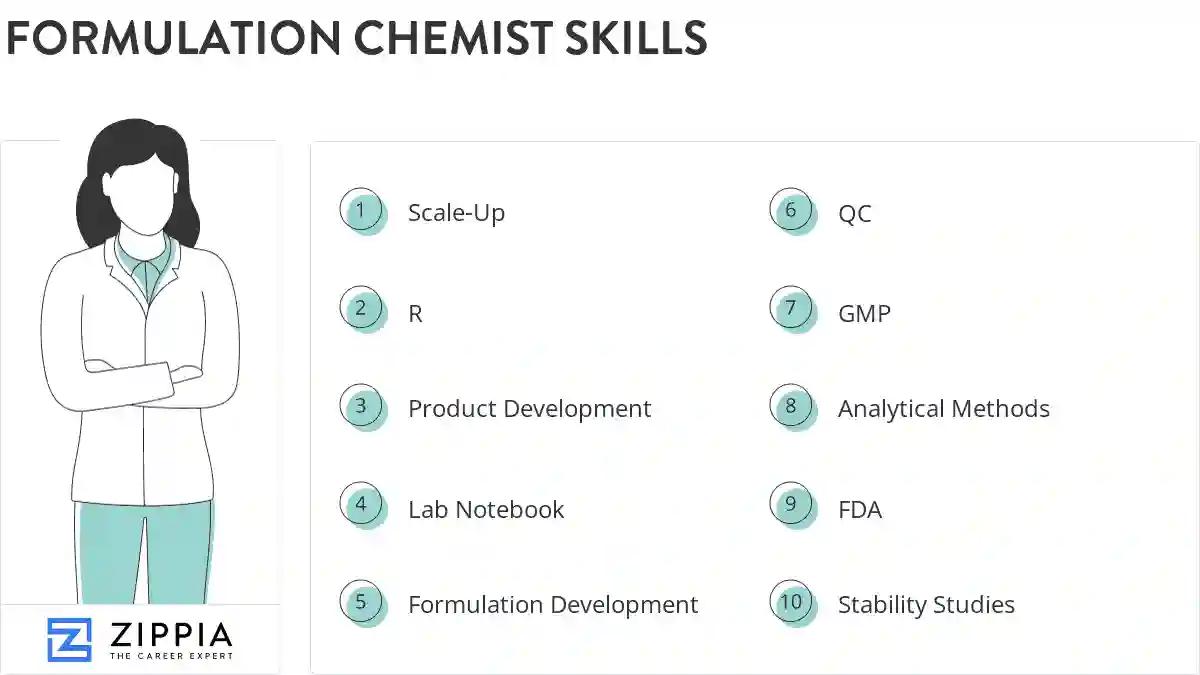
The most important skills for a formulation chemist resume and required skills for a formulation chemist to have include:
- Scale-Up
- R
- Product Development
- Lab Notebook
- Formulation Development
- QC
- GMP
- Analytical Methods
- FDA
- Stability Studies
- Test Methods
- Data Analysis
- Lab Equipment
- DSC
- Technical Support
- UV
- ISO
- Technical Reports
- HPLC
- Skin Care
- Laboratory Practices
- Field Testing
- GLP
- ASTM
- PH Meter
- EPA
- Product Quality
- Method Development
- FTIR
- Product Performance
- Pilot Plant
- GC
- Hair Care
- Creative Solutions
- Product Specifications
- Product Stability
- Development Projects
- Wet Chemistry
- Titration
- Dosage Forms
- DOE
- Competitive Products
- Immunoassay
- NMR
- Microbiology
- Physical Properties
Updated January 8, 2025
