Explore jobs
Find specific jobs
Explore careers
Explore professions
Best companies
Explore companies
Job outlook for general managers/director in the United States
General manager/director job growth summary. After extensive research, interviews, and analysis, Zippia's data science team found that:
The projected general manager/director job growth rate is 6% from 2018-2028.
About 189,200 new jobs for general managers/director are projected over the next decade.
General manager/director salaries have increased 4% for general managers/director in the last 5 years.
There are over 17,959 general managers/director currently employed in the United States.
There are 223,160 active general manager/director job openings in the US.
The average general manager/director salary is $127,274.
Are general manager/director jobs in demand?
General manager/director job and salary trends over time
General manager/director jobs over time
General manager/director job growth rate over time
| Year | # of jobs | % of population |
|---|---|---|
| 2021 | 17,959 | 0.01% |
| 2020 | 14,123 | 0.00% |
| 2019 | 14,441 | 0.00% |
| 2018 | 13,776 | 0.00% |
| 2017 | 13,310 | 0.00% |
Average general manager/director salary over time
General manager/director salary by year
| Year | Avg. salary | Hourly rate | % Change |
|---|---|---|---|
| 2026 | $127,274 | $61.19 | +2.8% |
| 2025 | $123,750 | $59.50 | --0.1% |
| 2024 | $123,934 | $59.58 | +0.5% |
| 2023 | $123,295 | $59.28 | +1.1% |
| 2022 | $121,945 | $58.63 | +1.6% |
General manager/director jobs by state
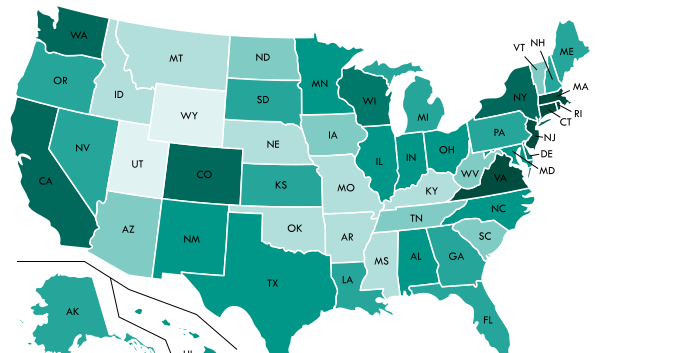
Most common states for general managers/director
| Rank | State | Population | # of jobs | Employment/ 1000ppl |
|---|---|---|---|---|
| 1 | District of Columbia | 693,972 | 523 | 75% |
| 2 | North Dakota | 755,393 | 396 | 52% |
| 3 | Alabama | 4,874,747 | 2,104 | 43% |
| 4 | South Dakota | 869,666 | 370 | 43% |
| 5 | West Virginia | 1,815,857 | 763 | 42% |
| 6 | South Carolina | 5,024,369 | 2,062 | 41% |
| 7 | Iowa | 3,145,711 | 1,303 | 41% |
| 8 | Delaware | 961,939 | 380 | 40% |
| 9 | Virginia | 8,470,020 | 2,992 | 35% |
| 10 | Massachusetts | 6,859,819 | 2,433 | 35% |
| 11 | New Hampshire | 1,342,795 | 439 | 33% |
| 12 | Wyoming | 579,315 | 190 | 33% |
| 13 | Indiana | 6,666,818 | 2,125 | 32% |
| 14 | Colorado | 5,607,154 | 1,764 | 31% |
| 15 | Minnesota | 5,576,606 | 1,751 | 31% |
| 16 | Oklahoma | 3,930,864 | 1,201 | 31% |
| 17 | Arkansas | 3,004,279 | 927 | 31% |
| 18 | Alaska | 739,795 | 226 | 31% |
| 19 | Wisconsin | 5,795,483 | 1,755 | 30% |
| 20 | Rhode Island | 1,059,639 | 315 | 30% |
Most common cities for general managers/director
| Rank | City | # of jobs | Employment/ 1000ppl | Avg. salary |
|---|---|---|---|---|
| 1 | Andover | 2 | 6% | $154,963 |
| 2 | Des Plaines | 1 | 2% | $116,225 |
| 3 | Miami | 1 | 0% | $104,994 |
| 4 | Washington | 1 | 0% | $162,688 |
General Manager/Director job outlook: Expert opinions
Our panel of general manager/director experts
Murray State University
University of Alaska Fairbanks
San Francisco State University

Dedman College of Hospitality

Pepperdine University, Seaver College

Sam Houston State University

Utah Valley University

Indiana University Bloomington

Farmingdale State College

University of Indianapolis

The City College of New York
Belmont University

Sonoma State University

Centenary College of Louisiana

University of Arkansas at Little Rock
Dr. Ben Littlepage
ProfessorMurray State University
Educational Administration And Supervision
What will help General Managers/Director increase their earning potential?
Dr. Ben Littlepage: Salary is maximized when leaders are sought after. Leaders who pursue meaningful experiences and remain 'market ready' are viewed as an asset to any organization. Leaders must carefully consider where the field is moving and respond.
What general advice would you give to a General Manager/Director?
Jaunelle Celaire: Leadership - the world needs more of these; the ability to lead, craft and grow. Digital literacy - this world is definitely turning digital and virtual is the new trend. Emotional intelligence - there is a vast number of personalities in our world today; individuals grow and it is our job to stay emotionally connected, so we can operate more effectively.
What General Manager/Director skills would you recommend for someone trying to advance their career?
Jaunelle Celaire: Never stop learning! This may consist of going back to school, earning new certifications in your field of study, attending conferences and seminars, and making sure that your time management is always at its finest level of excellence.
What will help General Managers/Director increase their earning potential?
Jaunelle Celaire: 2. Leadership - the world needs more of these; the ability to lead, craft and grow. Digital literacy - this world is definitely turning digital and virtual is the new trend. Emotional intelligence - there is a vast number of personalities in our world today; individuals grow and it is our job to stay emotionally connected, so we can operate more effectively.
Bruce Heiman Ph.D.
Professor of International BusinessSan Francisco State University
Department of International Business
What hard/technical skills are most important for General Managers/Director?
Bruce Heiman Ph.D.: -Analytical skills (ability to gather data, clean it, analyze it, write-up results and present on what the meaning of the analysis suggests for action (the last one is most important--"what does it really mean?"
-Some experience and skills with coding in any language (at the moment, Python or C++ are preferred, though Ruby on Rails is also good)
-Deep spreadsheet skills (pivot tables and macros, as examples).
-Relational database skills, including programming (e.g., MySQL)
-Data mining
-AI/Machine Learning experience
What certifications/licenses/courses can have the biggest impact for General Managers/Director?
Alishia Piotrowski Ed.D.: Certifications are always a great idea, if you are looking to stand out on the job market. With the level of competition for jobs today, it certainly can't hurt. But there is no one "best" certification. I suggest students narrow their job focus and look for certifications that focus on that specific area. For students interested in the wine industry, we recommend the Certified Specialist of Wine exam. For students interested in wedding planning, we encourage them to look into The Bridal Society. Furthering your education in a specific area, through a certification, is a great way to stand out in the job market.
What's a good job out of college for General Managers/Director?
Alishia Piotrowski Ed.D.: I think in today's market, students have to think less about the actual job, and think more about the company that they want to work for. I encourage students to look into different companies in their area of hospitality and assess how they feel they would "fit" into that company. What are the company's values? What type of culture has that company created? What are your opportunities for advancement, or for movement? These are the types of questions that a student should be asking. Unfortunately, in today's market, a great student may not get their "dream job" right out of college. But, if they target a company that they see themselves growing with, they should focus on finding any job within that company that would allow them to gain experience and to grow. If they do this, and they work hard, they will be much more likely to get that dream job once the industry has recovered and positions are available.
Will there be an enduring impact of the coronavirus pandemic on General Managers/Director?
Steven Bauer: The coronavirus has accelerated the transformation to a digital world, and this effect will continue after the pandemic is behind us. Graduates will need to be able to navigate a hybrid business environment, with in-person and virtual meetings, interactions and platforms. There will also be increased opportunities to be entrepreneurial and innovative in the digital area. In addition, graduates will have to become more skilled at navigating a global environment since greater digitization will draw countries closer to each other.
Carliss Miller Ph.D.
Assistant Professor of ManagementSam Houston State University
Department of Management & Marketing
What are the biggest trends we'll see in the General Manager/Director job market given the pandemic?
Carliss Miller Ph.D.: Flexible working arrangements were considered a perk or benefit, but given the pandemic more and more jobs will be designed with flexible work arrangements in mind. We will continue to see trends in the labor market with a push towards personal services (e.g. virtual assistants, professional organizers) and professional services. There will also continue to be a demand for knowledge work. More and more, employers are looking to hire applicants that can provide concrete evidence of being "Day 1" ready.
Employers will focus more on identifying prospects with certain "soft skills" which were a nice-to-have pre-pandemic, but are now critical for organizational survival. These skills include: critical thinking, agility, ability to adapt to change, resilience, virtual team effectiveness, crisis management, emotional intelligence, empathy, and inclusive leadership. Additionally, data analysis and interpretation is a highly sought after skill even for jobs that historically did not require analytical ability.
Meaghan McKasy Ph.D.
Assistant Professor of CommunicationUtah Valley University
Department of Communication, Public Relations Emphasis
What certifications/licenses/courses can have the biggest impact for General Managers/Director?
Meaghan McKasy Ph.D.: In our increasingly digital world, any sort of digital media or data analytics certificate or experience is incredibly valuable. Membership in professional organizations such as the Society of Professional Journalists or the Public Relations Society of America, or a research association such as the National Communication Association, can provide you with tremendous networking opportunities. If students are looking to pursue a career in public relations, then the Accreditation in Public Relations (APR) can really set you apart a crowded and competitive job market.
What's a day at work look like for a General Manager/Director?
Kerem Cakirer Ph.D.: This is a great question. The pandemic has changed the working life for good. Usually, a day at work for a graduate starts very early with commuting to the main office of the company they work. However, this is the past now. Graduates may start working from their home office and expected to be online for 8-10 hours a day, sitting in front of their computer, probably fifteen minutes after breakfast. They may not be even required to wear a suit! The living room could be the new graduate's work office too. When the day kicks off, it will definitely include lots of email correspondence, Zoom meetings and Microsoft's team collaboration works. The painted picture here may sound arbitrary; however, the whole way of doing business can create different challenges for a recent graduate. In my opinion, the most difficult challenge will be, what I call as, the no-curtain effect, which is, separating the work life from the personal life. With no hard boundaries, such as business offices or on site working projects, graduates may find very difficult to adopt the business world than ever after the pandemic. Post pandemic era, the graduates could find sustaining a balanced lifestyle more challenging because they would be expected to learn and achieve a lot in their job while they are young and novice in their career. The whole transformation of "a day at work" can even create a new demand for different line of jobs, (a life coach may be?). I am very curious to see how the evolution of "day at work" will be.
Xu Zhang Ph.D.
ChairFarmingdale State College
Department of Economics
What are the biggest trends we'll see in the General Manager/Director job market given the pandemic?
Xu Zhang Ph.D.: There are a few trends in the current job maket.
- Slow recovery. Based on the December job market reports released by the U.S. Bureau of Labor Statistics, the job market slowly recovered since April, but about 44% of the prepandemic jobs have not been gained back. Between March and April, about 22.16 million jobs were lost. The U.S. labor market started to revive in May, and since then until December the market experienced 23.32 million job gains, roughly 56% of pre-pandemic level. The unemployment rate decreased gradually from April (14.8%) to December (6.7%), but still almost twice its pre-pandemic level in February (3.5%). Additionally, although the number of unemployed persons dropped from 23.11million in April to 10.74 million in December 2020, there is still a huge gap compared to 5.72 million in February.
- Uneven impacts by industries. While overall economy was hard hit by the pandemic, the job losses disproportionally impacted industry sectors. Service industries such as educational service, elective healthcare, arts, entertainment, recreation, accommodation and food services, have been hurt the most due to social distancing. Other job losses in retail service sector were related to a boom on online shopping. In addition, teenagers experienced record high unemployment rate which is associated with lack of experiences and working in hard-hit service industries.
- More employers embracing remote work. The perception of remote work has totally changed during the pandemic. After experiencing sudden changes to remote work and managing the obstacles working at home, more and more workers and employers embrace remote work, which would expand the layouts of job hunting and talent search to larger geographic areas.
What skills stand out on General Manager/Director resumes?
Xu Zhang Ph.D.: I believe the most important attributes employers seek on a resume remain the same-problem solving skills, team work skills, analytical/quantitative skills, verbal and written communication skills. However, given the pandemic or any other unexpected shock to work environment, how to quickly and efficiently adapt to new work modes can be a very valuable attribute standing out on resume.
Dr. Gaoming Zhang
Associate Professor, Chair, Department of Leadership & Educational StudiesUniversity of Indianapolis
Department of Leadership & Educational Studies, School of Education
What skills stand out on General Manager/Director resumes?
Dr. Gaoming Zhang: -Instructional technology & tools
-Online/virtual/hybrid experiences (e.g., curriculum design, online/virtual/hybrid teaching experiences, etc.)
-Social-emotional learning. How to support students' social emotional learning in a challenging time? How to build relationships with students when you don't see them on a daily basis?
-Communication and collaboration skills. These non-cognitive skills remain important skills that employers are looking for from resumes.
What type of skills will young General Managers/Director need?
Prabal Kumar De Ph.D.: I think the necessary skills remain the same. One modification that would stay is greater virtual engagement. Therefore, newly essential skills such as acing a virtual interview, making a mark during a Zoom meeting, or managing or being a valuable part of a remote working group would be useful long after the immediate threats from the COVID-19 crisis be gone.
Will there be an enduring impact of the coronavirus pandemic on General Managers/Director?
Prabal Kumar De Ph.D.: I think there will be impacts in the short term. The most important one, obviously, is the short-term job market. Although the COVID-19 recession's effect has been less severe for college graduates so far, the new opportunities are limited and will remain so at least through 2021. For many students, learning has been affected due to remote instruction, mental stress, or the lack of peer support. Sometimes, such setback is reflected in grades, which is bad enough, but such effects may often impair career skills in the medium-term.
Nina Woodard
Senior Career Development SpecialistBelmont University
Office of Career & Professional Development
What are the biggest trends we'll see in the General Manager/Director job market given the pandemic?
Nina Woodard: The pandemic hasn't impacted all areas of the entertainment industry in the same way. Anything related to live events and touring has been placed on an extended pause, which has been very difficult for graduates hoping to work in those fields. On an encouraging note, consumers will always find a way back to live experiences, so that segment of the industry will absolutely recover; the timing is just still a bit unknown. Other areas such as record or publishing companies have held steady. And, digital marketing and content creation companies are as busy, if not busier, than they've ever been as artists seek alternative ways to stay connected to their fans. Technology has intersected with entertainment in exciting, creative ways that will continue even as some of the more traditional avenues become available again. For many companies, ideas that started as pivots are now vibrant components of their long-term strategies.
The way we work may have also permanently changed. Companies have realized that remote working is a truly viable option for most businesses. While maintaining company culture, and the social nature of an entertainment-based organization, may still require some level of in-person interaction, it seems likely that many organizations may continue with remote/hybrid office models.
What General Manager/Director skills would you recommend for someone trying to advance their career?
Nina Woodard: For entertainment, digital marketing and content creation skills are critical. Even if a role isn't specifically connected to digital marketing, social media is almost always involved in most entry-level roles. We strongly encourage students and recent graduates to learn basic graphic design platforms, video editing and audio editing. Learning how to maximize impact on social media platforms such as YouTube, Instagram or TikTok is also a worthy investment of time. There's a wide range of self-paced training resources online, many available for free or at reduced costs for students.
Craig Nathanson Ph.D.
Adjunct LecturerSonoma State University
School of Business & Economics
What type of skills will young General Managers/Director need?
Craig Nathanson Ph.D.: I see the essential human skills gaining importance to build a new post-covid work life. These include creativity, leading and working in teams, writing, speaking, being self-aware, and lowering bias and networking; career branding as critical areas for graduates to focus on now.
What experience really stands out on General Manager/Director resumes?
Craig Nathanson Ph.D.: Most important on resumes to only show accomplishments you are proud of and reflect measurable success and completion of past work. These accomplishments should be a snapshot of what we have done and can do in the future. The most important two lines of a resume are in the objectives, to list what the person is seeking. These two lines give the reader a quick view of what the person wants.
Now is a great time to start the new year to build a portable work portfolio to represent an alignment of what a person is excited about and enjoys in their work.
Dr. Barbara Davis
William J. Atkins DeanCentenary College of Louisiana
Frost School of Business
What type of skills will young General Managers/Director need?
Dr. Barbara Davis: Analysis - Graduates will need to analyze situations, identify the best choices, and seek solutions with the highest benefit to the organization.
Creativity - Graduates will need to possess critical and creative thinking skills.
Flexibility - Graduates must remain flexible to succeed in a highly changing environment.
What experience really stands out on General Manager/Director resumes?
Dr. Barbara Davis: Graduates participating in internships related to their areas of interest. Internships spanning more than one semester at the same firm stand out as well.
What are the biggest trends we'll see in the General Manager/Director job market given the pandemic?
Dr. Timothy Edwards: I think more journalists and media professionals will work remotely. The pandemic has proven that the technology is sufficient enough to facilitate this change, and this trend will help save costs for media outlets.
What skills stand out on General Manager/Director resumes?
Dr. Timothy Edwards: Writing and research skills. Analytical and critical thinking skills. Technical skills such as web design, graphic design, audio and video production skills. Employers are interested in potential employees knowledge, intelligence and skills.