Post job
zippia ai icon

Automatically apply for jobs with Zippia

Upload your resume to get started.

Hearing care practitioner skills for your resume and career

Updated January 8, 2025
1 min read
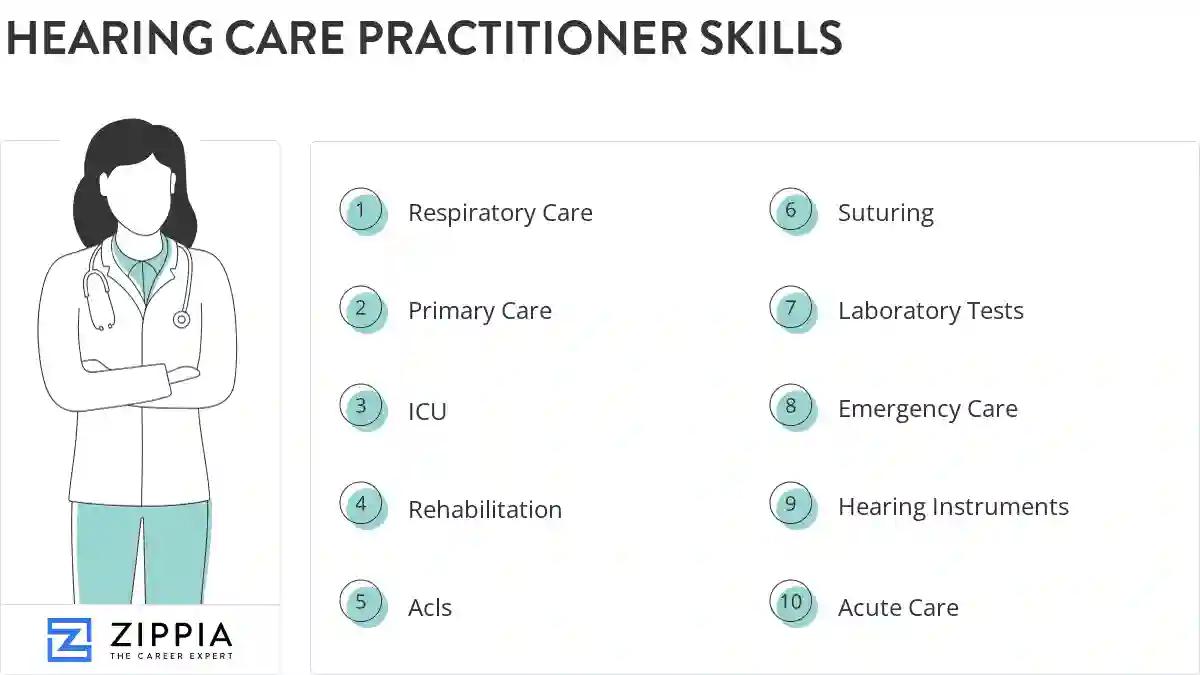
Below we've compiled a list of the most critical hearing care practitioner skills. We ranked the top skills for hearing care practitioners based on the percentage of resumes they appeared on. For example, 28.1% of hearing care practitioner resumes contained respiratory care as a skill. Continue reading to find out what skills a hearing care practitioner needs to be successful in the workplace.

12 hearing care practitioner skills for your resume and career

1. Respiratory Care

Respiratory care is the medical care discipline of having expertise in the treatment of illnesses and preventative care related to cardiopulmonary health.

Here's how hearing care practitioners use respiratory care:
  • Covered all incubations, administered all respiratory care in non-emergency and emergency care.
  • Provide respiratory care involving the application of well-defined therapeutic techniques under the supervision of a respiratory therapist and a physician.

2. Primary Care

Here's how hearing care practitioners use primary care:
  • Identify needs and opportunities to generate clinical referrals to CIPP and / or the primary care physician.
  • Coordinate continuity of care with the primary care physician and ancillary services.

3. ICU

ICU means intensive care units. It also has a name known as the critical care unit or intensive therapy unit. The ICU handles patients experiencing acute diseases or severe injuries that need specialized treatment procedures by specific professionals.

Here's how hearing care practitioners use icu:
  • Charge Respirator Care Practitioner Managed night shift workload covering various floors in ER, ICU and general admitted patients.

4. Rehabilitation

Here's how hearing care practitioners use rehabilitation:
  • Developed and implemented the Pulmonary Rehabilitation Program including a patient education handbook, power point presentations, and all related forms.
  • Created a Pulmonary Rehabilitation Program which enhanced patient outcomes improving daily living activities for a more productive life.

5. Acls

Here's how hearing care practitioners use acls:
  • Respond to all code situations and participate in ACLS.
  • Received certificates in ACLS, NRP, PALS.

6. Suturing

Here's how hearing care practitioners use suturing:
  • Trained in suturing, I&D, splinting, fracture reduction, and conscious sedation.
  • Assisted preceptor with procedures, such as suturing of incisions and cryotherapy.

Choose from 10+ customizable hearing care practitioner resume templates

Build a professional hearing care practitioner resume in minutes. Our AI resume writing assistant will guide you through every step of the process, and you can choose from 10+ resume templates to create your hearing care practitioner resume.

7. Laboratory Tests

Here's how hearing care practitioners use laboratory tests:
  • Facilitated ordering of appropriate laboratory tests and work while referring results to involved specialists, as necessary.
  • Developed differential diagnoses, treatment plan, ordered medications, laboratory tests and diagnostics.

8. Emergency Care

Here's how hearing care practitioners use emergency care:
  • Provided care to patients in medical and surgical units, as well as emergency care and trauma departments.
  • Attended high risk deliveries to provide emergency care to both mom and baby if needed.

9. Hearing Instruments

Here's how hearing care practitioners use hearing instruments:
  • Developed and insured quality control for on site manufacturing of hearing instruments.
  • Make silicon impressions of ear canals to properly fit hearing instruments.

10. Acute Care

The branch of secondary healthcare which is responsible for giving short-term care to patients recovering from severe injuries or urgent medical problems is known as acute care. Acute care comprises multiple domains like; emergency care, urgent care, short-term stabilization, pre-hospital care, critical care, and trauma care.

Here's how hearing care practitioners use acute care:
  • Assess and provide medically necessary respiratory treatments and services to patients in the neonatal/pediatric intensive care and acute care setting.
  • Facilitated complex respiratory patient transition from hospital/acute care to home setting.

11. EKG

Here's how hearing care practitioners use ekg:
  • Experienced in performing and interpretation of 12 lead EKG's, x-ray and conducting appropriate referrals protocols and treatment guidelines.
  • Perform daily EKG, CXR, and ABG interpretation.

12. Performance Evaluations

Performance evaluation is a formal and productive process to measure an employee's work and results based on their job responsibilities over a defined period of time and to properly measure an employee's contribution to the workforce and employers and achieve a high level of quality and quantity of work produced. The evaluation also helps employees provide information about deficiencies in job performance and the company's expectations for the future.

Here's how hearing care practitioners use performance evaluations:
  • Facilitated training programs and performance evaluations.
  • Assisted in conducting interviews, performance evaluations; hiring, training and evaluating new staff.
top-skills

What skills help Hearing Care Practitioners find jobs?

Tell us what job you are looking for, we’ll show you what skills employers want.

List of hearing care practitioner skills to add to your resume

Hearing care practitioner skills

The most important skills for a hearing care practitioner resume and required skills for a hearing care practitioner to have include:

  • Respiratory Care
  • Primary Care
  • ICU
  • Rehabilitation
  • Acls
  • Suturing
  • Laboratory Tests
  • Emergency Care
  • Hearing Instruments
  • Acute Care
  • EKG
  • Performance Evaluations

Updated January 8, 2025

Zippia Research Team
Zippia Team

Editorial Staff

The Zippia Research Team has spent countless hours reviewing resumes, job postings, and government data to determine what goes into getting a job in each phase of life. Professional writers and data scientists comprise the Zippia Research Team.

Browse healthcare practitioner and technical jobs