What does an implementation manager do?

An implementation manager specializes in introducing new systems, networks, and processes to the entire company workforce. Typically, their responsibilities revolve around overseeing the implementation team to ensure that everything is running smoothly, devising action and work plans, coordinating with different departments, monitoring requisitions and information materials, and verifying their accuracy. An implementation manager may also address issues and concerns, providing technical support when necessary. Furthermore, it is essential to lead and encourage the team, all while adhering to the company's policies and regulations.
Implementation manager responsibilities
Here are examples of responsibilities from real implementation manager resumes:
- Lead the strategic project planning efforts and the technology architecture design initiatives.
- Document each client's processes for artifacts and manage through project closure via SharePoint.
- Create and manage detailed project plans for all phases of SDLC to ensure successful deployments.
- Lead a group of 10 Java engineers and 12 web developers in creating web-base online banking applications.
- Manage one internal ERP specialist, who maintains and modifies the ERP system and provides specialist technical support.
- Manage state-by-state projects from planning/scheduling, architecture, development, Nessus scan vulnerabilities, QA, UAT, to deployment.
- Provide telephone and remote PC support for employees post implementation.
- Update HTML code as needed for the lab screens.
- Provide remote support to customers during go-live.
- Modify HTML and ASPX to customize web applications.
- Direct client's EDI implementation and B2B backend integration.
- Obtain client approvals for requirement documents, testing, and go-live.
- Resolve issues via troubleshooting HL7 messages and ensure proper formatting on reports.
- Submit applications to proper agencies work very closely with Medicaid state workers.
- Demonstrate knowledge of HL7 v2.3.1 standard through implementation for each and every project.
Implementation manager skills and personality traits
We calculated that 15% of Implementation Managers are proficient in Project Management, Account Management, and Client Relationships. They’re also known for soft skills such as Business skills, Leadership skills, and Organizational skills.
We break down the percentage of Implementation Managers that have these skills listed on their resume here:
- Project Management, 15%
Completed Project Management Professional Certification.
- Account Management, 7%
Established requirements and procedures for turnover Help Desk, Network Operations and customer account management and developed project templates.
- Client Relationships, 6%
Introduced After-Market Services to extend client relationships, satisfaction and to generate additional services revenue by uncovering new opportunities.
- Client Expectations, 6%
Collaborated with business partners on client expectations and maintain open line of communication throughout each implementation until successful conclusion.
- Client Facing, 5%
Promoted to Resource Manager for Client Services to support all client facing departments and provide direct support to the President.
- Customer Service, 5%
Managed project team of representatives from accounting, manufacturing, procurement and customer service to implement software upgrades and enhancements.
"project management," "account management," and "client relationships" are among the most common skills that implementation managers use at work. You can find even more implementation manager responsibilities below, including:
Business skills. To carry out their duties, the most important skill for an implementation manager to have is business skills. Their role and responsibilities require that "it managers must develop and implement strategic plans to reach the goals of their organizations." Implementation managers often use business skills in their day-to-day job, as shown by this real resume: "enabled the company to easily handle influx of more business via the new erp system. "
Leadership skills. Another essential skill to perform implementation manager duties is leadership skills. Implementation managers responsibilities require that "it managers must lead and motivate it teams or departments so that workers are efficient and effective." Implementation managers also use leadership skills in their role according to a real resume snippet: "recognized for leadership of basic development and process design on $2m erp data implementation project. "
Organizational skills. This is an important skill for implementation managers to perform their duties. For an example of how implementation manager responsibilities depend on this skill, consider that "some it managers must coordinate the work of several different it departments to make the organization run efficiently." This excerpt from a resume also shows how vital it is to everyday roles and responsibilities of an implementation manager: "develop, implement, and manage internal business process re-engineering efforts improving organizational efficiency. ".
Analytical skills. implementation manager responsibilities often require "analytical skills." The duties that rely on this skill are shown by the fact that "it managers must analyze problems and consider and select the best ways to solve them." This resume example shows what implementation managers do with analytical skills on a typical day: "manage data validation for seamless integration with erp, cms, crm, and back-end business functions. "
Communication skills. Another common skill required for implementation manager responsibilities is "communication skills." This skill comes up in the duties of implementation managers all the time, as "it managers must explain their work to top executives and give clear instructions to their subordinates." An excerpt from a real implementation manager resume shows how this skill is central to what an implementation manager does: "facilitate coordination and communication between support functions such as support services, it, hr, account and finance services. "
The three companies that hire the most implementation managers are:
- Deloitte400 implementation managers jobs
- Pwc236 implementation managers jobs
- General Dynamics223 implementation managers jobs
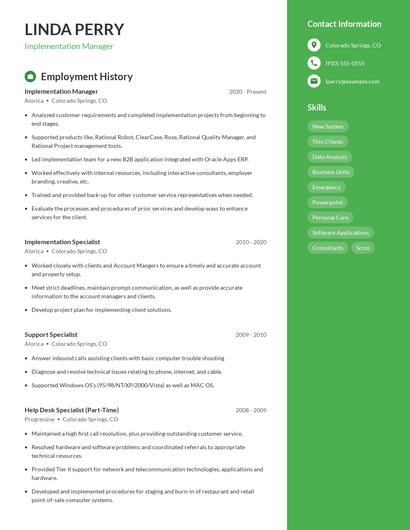
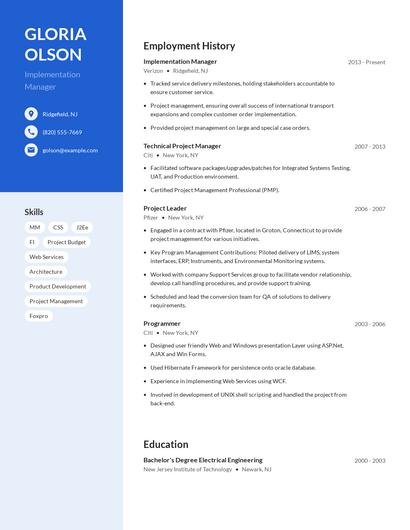
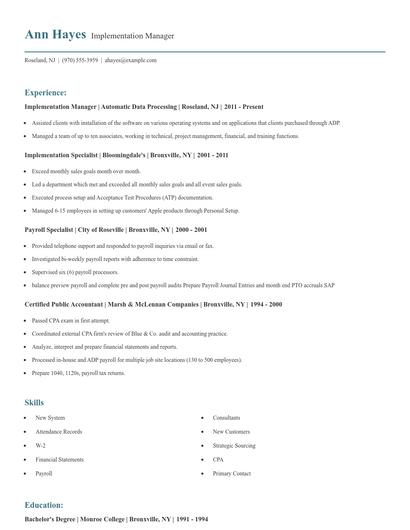
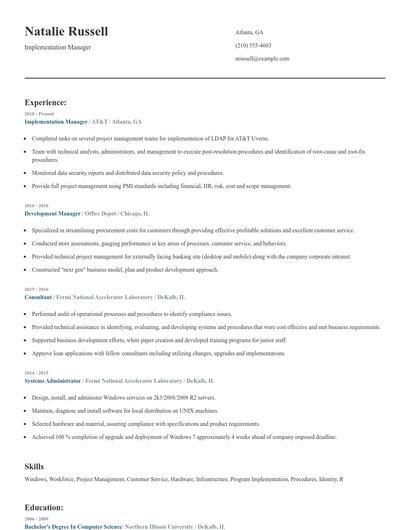
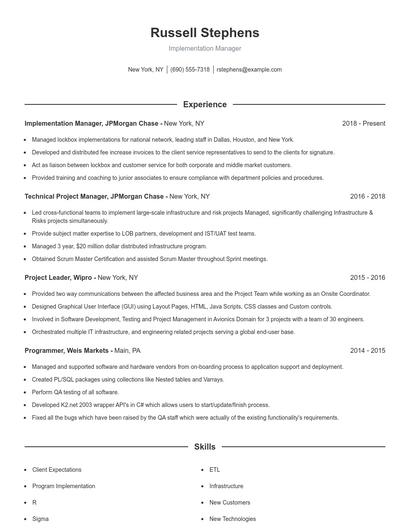
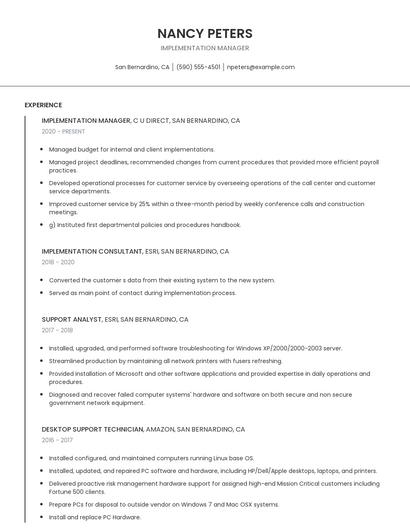
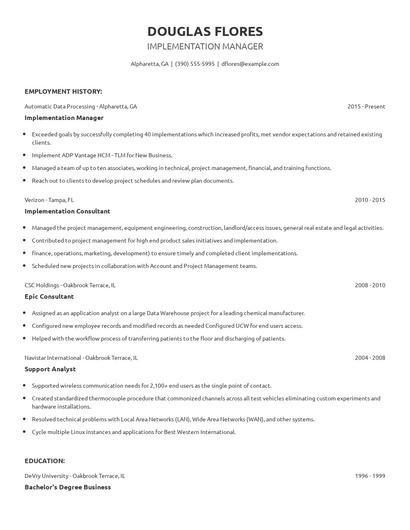
Choose from 10+ customizable implementation manager resume templates
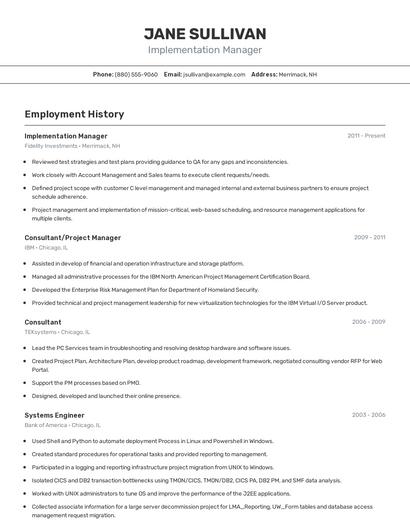
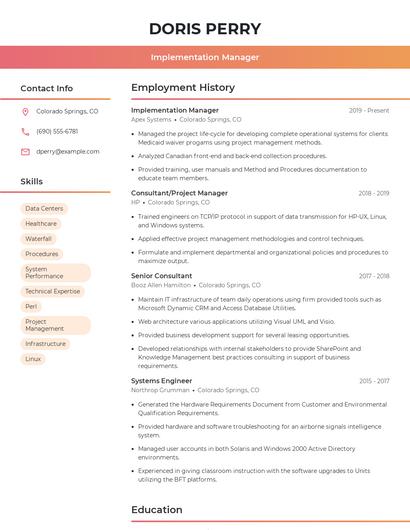
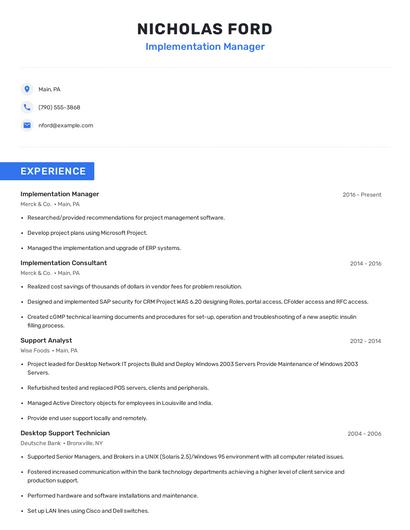
Build a professional implementation manager resume in minutes. Our AI resume writing assistant will guide you through every step of the process, and you can choose from 10+ resume templates to create your implementation manager resume.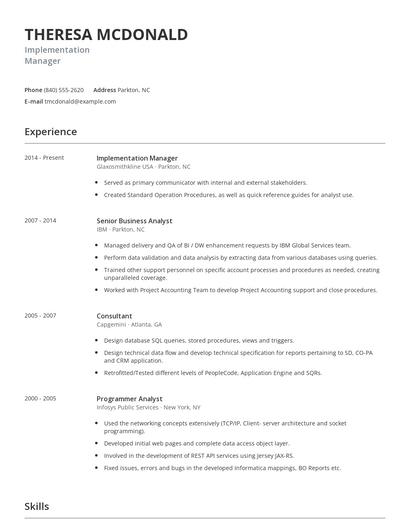

Compare different implementation managers
Implementation manager vs. Manager, program management
A program management manager is an individual who guides project managers and oversees and coordinates an organization's projects, products, and other strategic initiatives. The day-to-day responsibilities of a program manager include planning the overall program, managing the program's budget and the main program documents, and defining the program governance. The requirements to qualify for the program manager position including possessing a good managerial, business, and problem-solving skills and possessing a bachelor's or master's degree in business, management, or a related field.
These skill sets are where the common ground ends though. The responsibilities of an implementation manager are more likely to require skills like "account management," "client relationships," "client expectations," and "enterprise resource planning." On the other hand, a job as a manager, program management requires skills like "risk management," "oversight," "infrastructure," and "continuous improvement." As you can see, what employees do in each career varies considerably.
Managers, program management tend to reach similar levels of education than implementation managers. In fact, managers, program management are 4.4% more likely to graduate with a Master's Degree and 1.3% more likely to have a Doctoral Degree.Implementation manager vs. Information technology director
An information technology (IT) Director is an individual responsible for the management, strategy, and execution of an organization's IT infrastructure. He/She supervises a team of workers while working with the organization's management and external vendors and advisors. Aside from managing workers, an IT director should possess problem-solving skills and an aptitude for organizational thinking. An IT director must also identify new market opportunities and should lead an effort to improve the organization's IT process.
While some skills are similar in these professions, other skills aren't so similar. For example, resumes show us that implementation manager responsibilities requires skills like "account management," "client relationships," "client expectations," and "client facing." But an information technology director might use other skills in their typical duties, such as, "cloud," "network infrastructure," "disaster recovery," and "windows server."
Information technology directors earn similar levels of education than implementation managers in general. They're 0.7% more likely to graduate with a Master's Degree and 1.3% more likely to earn a Doctoral Degree.Implementation manager vs. Technical services manager
A technical services manager is an individual who supervises and collaborates with staff members and clients to implement maintenance and repairs to the information technology (IT) system. Technical services managers must assist the technical operations performed by programmers and IT support experts to ensure that clients' targets are achievable. They must develop policies and strategies that are effective in fixing critical technical and procedural issues. Technical services managers must also ensure that software and hardware components are up-to-date.
The required skills of the two careers differ considerably. For example, implementation managers are more likely to have skills like "account management," "client relationships," "client expectations," and "enterprise resource planning." But a technical services manager is more likely to have skills like "linux," "email marketing," "customer issues," and "continuous improvement."
Most technical services managers achieve a lower degree level compared to implementation managers. For example, they're 5.8% less likely to graduate with a Master's Degree, and 0.7% less likely to earn a Doctoral Degree.Implementation manager vs. Technical manager
A technical manager is responsible for maintaining the company's information systems database and analyzing technology system matters to ensure its efficiency and accuracy in supporting business operations. Technical managers perform network checks regularly to assess any possible malfunctions that might compromise the company's cybersecurity. They carefully analyze business and clients' specifications on working with systems integration, responding to end-users' concerns and inquiries. A technical manager must have excellent knowledge of the information technology systems industry, as well as a strong command on network codes to conduct adjustments and manage network infrastructure.
Even though a few skill sets overlap between implementation managers and technical managers, there are some differences that are important to note. For one, an implementation manager might have more use for skills like "account management," "client relationships," "client expectations," and "enterprise resource planning." Meanwhile, some responsibilities of technical managers require skills like "infrastructure," "architecture," "digital transformation," and "c++. "
The average resume of technical managers showed that they earn similar levels of education compared to implementation managers. So much so that theyacirc;euro;trade;re 1.0% more likely to earn a Master's Degree and more likely to earn a Doctoral Degree by 1.7%.Types of implementation manager
Updated January 8, 2025
