
Automatically apply for jobs with Zippia
Upload your resume to get started.
Information systems administrator skills for your resume and career
15 information systems administrator skills for your resume and career
1. Linux
Linux is a Unix-like operating system. Just like Windows, Mac OS, and IOS, Linux is an operating system used by millions across the globe. Android itself is powered by the Linux operating system. Linux manages all the hardware resources that are associated with your computer. The software is famous because of the protection it grants from viruses, malware, and crashes. The Linux operating system is entirely free and is an open-source software meaning it can be altered by those equipped with the knowledge to code.
- Developed a deep technical and organization understanding of Windows and Linux Administration, LAN/WAN/VPN Administration.
- Develop and provide configuration management of RedHat Enterprise Linux operating systems for all CV-TSC systems.
2. Troubleshoot
Troubleshooting is the process of analyzing and fixing any kind of problem in a system or a machine. Troubleshooting is the detailed yet quick search in the system for the main source of an issue and solving it.
- Administer and troubleshoot data warehouse Servers.
- Install, configure, maintain, upgrade, and troubleshoot file, email, Internet access and other networked services.
3. OS
In technical terms, OS stands for "Operating System". It is a software that is used to run programs on the computer. An operating system acts as a link between the user and the hardware components. Windows, macOS, iOS, Linux are examples of an operating system.
- Organized patch management for Windows and Mac OS computing environments
- Conducted training sessions for Web Developers on beta testing procedures so they could identify issues with OS compatibility and design layout.
4. Unix
UNIX is a computer operating system that was first created in the 1960s and has been constantly updated since then. The operating system refers to the set of programs that enable a machine to function. It is a multi-user, multi-tasking device that works on computers, laptops, and servers. UNIX systems also have a graphical user interface (GUI), similar to Microsoft Windows, that makes it simple to use.
- Migrated accounting system from an IBM System 36 operating system to Professional Data Solutions, using a UNIX operating system.
- Upgraded the company from a UNIX / AS400 system to a PC environment to enhance communication between web-based manufacturers.
5. Virtualization
- Provided continuing support and administration for server migrations projects, to include VMWare virtualization.
- Implemented VMware virtualization for development and test server environment.
6. Java
Java is a widely-known programming language that was invented in 1995 and is owned by Oracle. It is a server-side language that was created to let app developers "write once, run anywhere". It is easy and simple to learn and use and is powerful, fast, and secure. This object-oriented programming language lets the code be reused that automatically lowers the development cost. Java is specially used for android apps, web and application servers, games, database connections, etc. This programming language is closely related to C++ making it easier for the users to switch between the two.
- Enhanced the system by installing system patches with modified plug in tools (e.g.- Java JRE).
- Converted a batch program to update graduate student records using Java and SQL.
Choose from 10+ customizable information systems administrator resume templates
Build a professional information systems administrator resume in minutes. Our AI resume writing assistant will guide you through every step of the process, and you can choose from 10+ resume templates to create your information systems administrator resume.7. Provisioning
- Credited with provisioning new hire accounts, entitlements, authorizations, access rights, and modifications.
- Managed Active Directory, Provisioning / Profile management per user or group roaming profiles.
8. Ruby
Ruby is a high-level programming language, versatile in its uses and tools. It might be used to design either programs and software which can be applied and used on a number of devices, other programs, and platforms. The fact that it is a high-level programming language means that it is easier to use than low-level languages, in that it automises parts of the program building process and uses natural language for some of its elements.
- Converted PHP website to Ruby MVC for increased performance and better object oriented design.
- Reduced email management by 80% and domain user management by 50% via ruby shell scripting.
9. Tcp Ip
- Managed networks through TCP IP configurations with routers and security features.
- Network administrator (installation and configuration of TCP IP LANs, switches, Cisco routers, internet servers.
10. TCP/IP
- Engaged in troubleshooting and refining network connectivity across a WAN link using TCP/IP and IPX.
- Installed, configured and administered TCP/IP, IPX/SPX, NETBIOS and NFS software.
11. Customer Service
Customer service is the process of offering assistance to all the current and potential customers -- answering questions, fixing problems, and providing excellent service. The main goal of customer service is to build a strong relationship with the customers so that they keep coming back for more business.
- Improved internal operations' efficiency by automating back-end process and enhanced customer service delivery by creating an Intranet.
- Experienced in system-operations and software training, computer networking, and excellent experience in customer service.
12. Customer Support
- Provide high-level technical support on all IT related items within the company as well as customer support for industry proprietary software.
- Provided IT security expertise, customer support and desktop troubleshooting support for 50 personnel.
13. VMware
- Upgraded and consolidated numerous separate systems to fault tolerant VMware virtual environment.
- Provided system administration for VMware environments.
14. Windows Server
- Install / configure / upgrade essential Vendor purchased enterprise software within a Windows enterprise environment (Windows Server operating system).
- Direct work with Windows Servers, Active Directory, Microsoft Exchange, Windows XP, Windows 7 and some Windows Vista.
15. SQL Server
- Installed and Support Corporate Financial Applications, PeopleSoft Financial Application, Maintain the MS-SQL Server Database that house the PeopleSoft data.
- Manage multiple SQL server databases, including user accounts and permissions, transferring databases to other servers.
5 Information Systems Administrator resume examples
Build a professional information systems administrator resume in minutes. Browse through our resume examples to identify the best way to word your resume. Then choose from 5+ resume templates to create your information systems administrator resume.

What skills help Information Systems Administrators find jobs?
Tell us what job you are looking for, we’ll show you what skills employers want.
What skills stand out on information systems administrator resumes?
Jennifer Richardson Ph.D.
Professor, Purdue University
What soft skills should all information systems administrators possess?
David Garaventa
Director, Computer Information Systems and Cybersecurity Programs, Assistant Professor, CIS, Albertus Magnus College
This is not to say that technical skills don't matter, because they do, especially in the IT field. But suppose an employee brings a strong set of soft skills to an IT team (e.g., collaboration, communication, critical thinking, etc.). In that case, they probably also can learn more technical skills as part of their job function. I once had a colleague say to me that when she is hiring, she has found that technical skill is all over the place...but it's the soft skills that are harder to find. Lastly, having the ability - and a desire - to be continually learning is essential. Technology is not static, and businesses are not static, so thinking critically in different settings across various technology platforms is very important. The tools your department uses today may not be the tools they are using tomorrow, so being fluid, adaptable, and constantly learning is the name of the game.
What hard/technical skills are most important for information systems administrators?
David Garaventa
Director, Computer Information Systems and Cybersecurity Programs, Assistant Professor, CIS, Albertus Magnus College
Going deeper into the subject, technical skills around project management, cloud infrastructure, security, and end-user support bridge across all industries. Having knowledge and skills in these areas will serve IT professionals well, no matter what field or industry they end up in. Again, it is challenging to recommend specific technical skills because the field of IT is so broad.
What information systems administrator skills would you recommend for someone trying to advance their career?
Ranganathan Chandrasekaran
Professor and Director of Graduate Studies, University of Illinois
What type of skills will young information systems administrators need?
Peter Dordal Ph.D.
Director for Information Technology, Loyola University Chicago
IT students entering the business world will need to know how to get the maximum leverage out of business systems. In many cases, this will mean writing their own specialized queries to extract the precise business intelligence needed; general-purpose "canned" queries just won't cut it. They will need a broad understanding of what software can accomplish for the enterprise and how to deploy new software effectively; this applies to software used in the office as well as to software used in manufacturing and shipping. And they will need to understand how to lease storage and computing resources from the cloud to meet not only predictable, long-term demands but also sudden short-term business projects.
Students working in database administration and management will need to be able to manage much larger volumes of data than a few years ago. They will need to be familiar with the great variety of new databases in order to pick the best tool for the job.
Students working in network management will need to be able to ensure that everyone has the bandwidth and server access they need, as those demands expand to include extensive video, low-latency real-time connectivity, and the regular transfer of huge amounts of data.
Students in cybersecurity will need to be fully acquainted with all the recommended best practices. However, they will also have to be able to anticipate and guard against potential new vulnerabilities. "By the book" protection is no longer sufficient.
List of information systems administrator skills to add to your resume
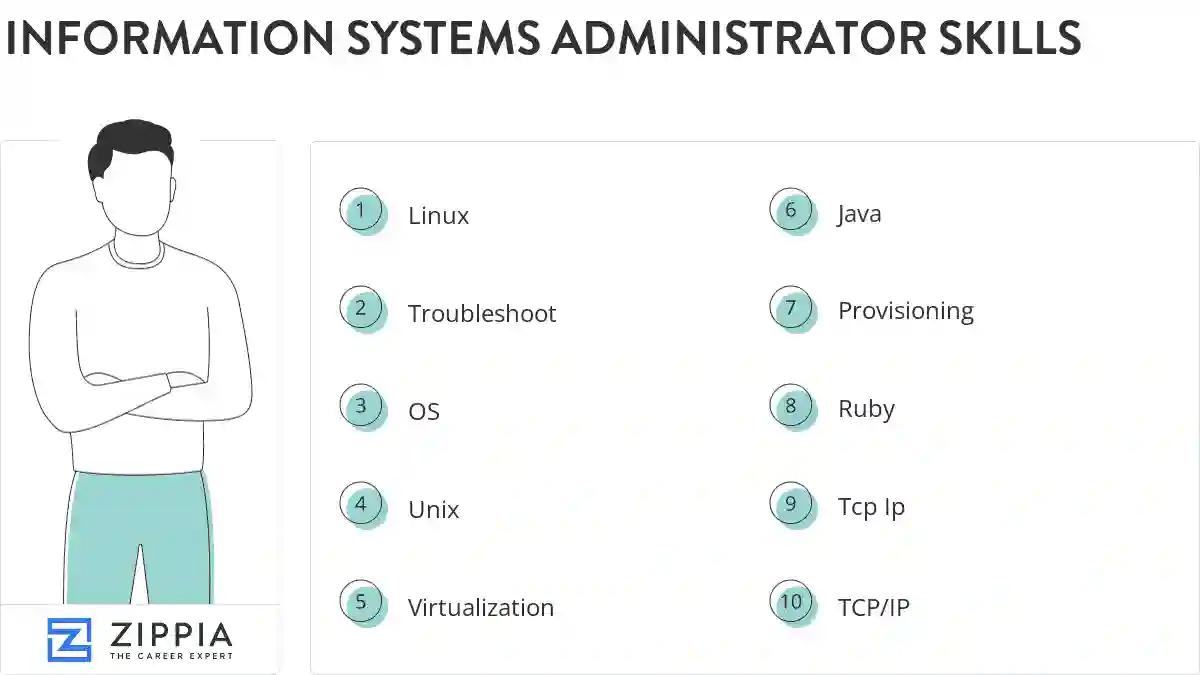
The most important skills for an information systems administrator resume and required skills for an information systems administrator to have include:
- Linux
- Troubleshoot
- OS
- Unix
- Virtualization
- Java
- Provisioning
- Ruby
- Tcp Ip
- TCP/IP
- Customer Service
- Customer Support
- VMware
- Windows Server
- SQL Server
- Solaris
- Technical Support
- DNS
- Data Entry
- DHCP
- SAN
- Switches
- DOD
- Azure
- HR
- Computer System
- PC
- Disaster Recovery
- System Upgrades
- Network Security
- SharePoint
- Network Connectivity
- Software Applications
- User Support
- User Accounts
- Lan
- IIS
- Microsoft Windows
- VPN
- Network Administration
- HRIS
- Workstations
- VoIP
- Citrix
- Network Infrastructure
- Mac
Updated January 8, 2025
