Explore jobs
Find specific jobs
Explore careers
Explore professions
Best companies
Explore companies
Job outlook for internal account executives in the United States
Are internal account executive jobs in demand?
Internal account executive job and salary trends over time
Internal account executive jobs over time
Internal account executive job growth rate over time
| Year | # of jobs | % of population |
|---|---|---|
| 2021 | 617 | 0.00% |
| 2020 | 596 | 0.00% |
| 2019 | 599 | 0.00% |
| 2018 | 589 | 0.00% |
| 2017 | 580 | 0.00% |
Average internal account executive salary over time
Internal account executive salary by year
| Year | Avg. salary | Hourly rate | % Change |
|---|---|---|---|
| 2026 | $52,836 | $25.40 | +2.8% |
| 2025 | $51,393 | $24.71 | +1.5% |
| 2024 | $50,638 | $24.35 | +1.7% |
| 2023 | $49,812 | $23.95 | +1.8% |
| 2022 | $48,950 | $23.53 | +1.4% |
Internal account executive jobs by state
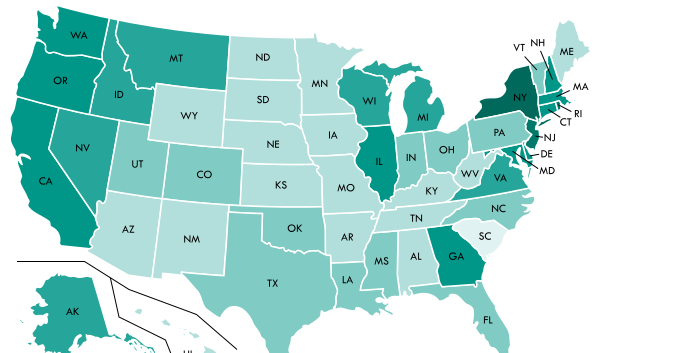
Most common states for internal account executives
| Rank | State | Population | # of jobs | Employment/ 1000ppl |
|---|---|---|---|---|
| 1 | District of Columbia | 693,972 | 260 | 37% |
| 2 | Delaware | 961,939 | 253 | 26% |
| 3 | Vermont | 623,657 | 154 | 25% |
| 4 | North Dakota | 755,393 | 182 | 24% |
| 5 | Washington | 7,405,743 | 1,615 | 22% |
| 6 | Minnesota | 5,576,606 | 1,224 | 22% |
| 7 | Utah | 3,101,833 | 695 | 22% |
| 8 | Virginia | 8,470,020 | 1,773 | 21% |
| 9 | Connecticut | 3,588,184 | 744 | 21% |
| 10 | New Hampshire | 1,342,795 | 277 | 21% |
| 11 | Massachusetts | 6,859,819 | 1,397 | 20% |
| 12 | Montana | 1,050,493 | 215 | 20% |
| 13 | Rhode Island | 1,059,639 | 214 | 20% |
| 14 | Wyoming | 579,315 | 116 | 20% |
| 15 | Georgia | 10,429,379 | 2,023 | 19% |
| 16 | Arizona | 7,016,270 | 1,339 | 19% |
| 17 | Colorado | 5,607,154 | 1,067 | 19% |
| 18 | Maryland | 6,052,177 | 1,087 | 18% |
| 19 | Iowa | 3,145,711 | 555 | 18% |
| 20 | Nebraska | 1,920,076 | 348 | 18% |
Internal Account Executive job outlook: Expert opinions
Our panel of internal account executive experts
SUNY College at Old Westbury
Methodist University
University of Missouri - St Louis

Misericordia University
University of Maine Orono

Case Western Reserve University

The University of Findlay

Fordham University Gabelli School of Business
University of Nebraska at Omaha

Fairfield University
Virginia Polytechnic Institute and State University
University of Dallas
Eastern Kentucky University

Central Connecticut State University

University of Wisconsin - Green Bay

New Jersey City University
What general advice would you give to an Internal Account Executive?
Mollie Sweet Ph.D., CPA, CMA, SHRM-SCP: Likes: Having a set schedule, upward mobility and career growth, opportunity to continuously learn and exposure to many areas, close relationship to clients and understanding of their business, solving problems, participate in strategic decision making and make strategic recommendations, collaborating with different departments, analyze data to guide decision making, leading process improvements. Dislikes: The work entails high responsibility and is at the same time prone to human error, can put in long hours (especially at the end of a close period or during tax season), can be frustrating when things don't balance, can be a challenge finding missing pieces, repetitive work.
What Internal Account Executive skills would you recommend for someone trying to advance their career?
Patrick O'Brien: There are a variety of fields in the accounting profession. Most accounting majors in college usually end up in public accounting working in either audit or tax. An audit professional will usually work for a public accounting firm, such as PwC or Deloitte, and will be assigned to various clients to perform audits of their client’s financial information. This could include tasks like reviewing the financial statements of the client he or she is working for, meeting with the client to discuss information and documentation needs, validating various transactions the company has recorded to ensure they are in compliance with Generally Accepted Accounting Principles (GAAP), etc. A tax professional working at a public accounting firm will usually be working with his or her client to prepare income tax returns for the corporation, partnership, etc., as well as determining tax withholdings and liabilities. Some large public accounting firms will even work with high net worth individuals to assist them with their taxes given the complexity. Medium-sized and smaller accounting firms would work with individuals to have their taxes done and filed annually. There are other fields of accounting, such as forensic accounting, which becomes necessary when there is potential financial fraud occurring within a business. Additionally, there are always needs for accountants within the government on the local, state, and federal levels. These accountants would be responsible for providing financial information to the taxpayers and the general public. There are also accountants that work within companies and other organizations that are responsible for gathering, recording, analyzing, and summarizing financial data both inside and outside of the organization.
What will help Internal Account Executives increase their earning potential?
Patrick O'Brien: No matter the field of accounting that one goes into, each one has its own type of “busy season”. These busy seasons generally require an accountant to work more hours than a typical 40-hour work week for a set period of time. While the hours can be intense, they are usually predictable, so the accountant can plan accordingly. In terms of what people usually like about being an accountant, there are a number of factors. The main one is that it is a career (rather than a job) with a clear path for advancement and promotion (generally, speaking). With this, there comes a level of career stability that many other professions and jobs cannot provide. Additionally, it has often been said that the accounting profession is “recession proof”. During poor economic periods, accountants tend to experience less career disturbances than other professions. Lastly, every business needs an accountant! This allows accountants the opportunity to break into any industry or company that they desire. Many professionals begin as accountants within an organization and have incredible upward mobility (whether as accountants or not). Accountants see most aspects and operations of an organization, so this knowledge and understanding makes them excellent top-level executives.
What general advice would you give to an Internal Account Executive?
Dr. Mfon Akpan CGMA: An accountant day-to-day can vary depending on the role, and accounting is a very broad field. So the way that I would answer this question is when you're thinking of getting into the accounting field, think about if you're the type of person that likes to sit at your desk, you don't like to interact with a lot of people or move around or have to travel, or if you're the person that likes to move around, you don't want to be sitting at your desk for a long period of time doing work at a computer. Also, so that could mean if you're the type of person that will be a tax associate. So if you're a tax associate during busy season, you may be in the office, you may be at your desk, you may be working 60 hours a week. If you work in internal audit, for example, you may be moving all around, speaking with people, performing your risk assessment, doing tests. So you may move around quite a bit and you may not be in your office as much. So I think one thing to consider is that accounting is a very broad field and you can work in various aspects of the field and in different industries, which can have drastically different day-to-days. The other thing to think about is as an accountant or entering the field, we're just talking about the field of accounting, which is very broad. You also have to think about adjacent fields. So if you work in finance, if you work as a financial advisor in the financial services field, you can work in banking, investment bank. So you can move into many of these adjacent fields as well. So that's also something to think of when entering the field of accounting or entering the profession. Very broad, very dynamic, very interesting, very flexible. Additionally, your role might mean being a tax associate. During the busy season, you could find yourself in the office, at your desk, working sixty hours a week. Conversely, if you work in internal audit, you might be moving around a lot, speaking with people, performing risk assessments, and conducting tests, which means you might not be in your office as much. It's important to recognize that accounting is a very broad field, offering various roles across different industries, each with drastically different day-to-days. When considering a career in accounting, also consider adjacent fields like finance. As a financial advisor or working in financial services, opportunities extend to banking and investment banking. This flexibility makes the field dynamic, interesting, and very broad, suitable for those looking for diverse career paths.
What will help Internal Account Executives increase their earning potential?
James Lawson: The ability to leverage AI (artificial intelligence). There is a lot of discussion regarding the impact of AI on society, but AI is another tool that accountants can use to complete their tasks and add value to their client relationships.
What Internal Account Executive skills would you recommend for someone trying to advance their career?
Amy Kass CPA, MBA: The three skills I think that will become more important and prevalent in the next three to five years in the accounting industry will include: technical skills, regulatory knowledge, and written and oral communication skills. The technical skills and the regulatory knowledge skills areas are constantly changing, so there's always something new to learn that will benefit your role in the industry.
What will help Internal Account Executives increase their earning potential?
Abbie Daly PhD, CPA: Accounting has long been an excellent field to enter for those interested in any aspect of business - understanding a business requires speaking the language. However, now is an especially excellent time to enter the profession, as opportunities are plentiful with more accounting positions available than there are accountants. Further, rapid technological development is affecting the role of the accountant, with routine accounting tasks being automated as platforms such as artificial intelligence and blockchain become more widespread. This will increase accountants' efficiency so that accountants can spend their time on more value-added advisory and analytical tasks. Those entering the accounting profession with these skills will have boundless opportunities available to them. At UW-Whitewater, students acquire these skills by taking classes on accounting analytics, artificial intelligence, and blockchain.
Thomas Kozloski PhD, CPA, CGMA
Chair - Department of AccountingUniversity of Missouri - St Louis
Accounting And Related Services
What Internal Account Executive skills would you recommend for someone trying to advance their career?
Thomas Kozloski PhD, CPA, CGMA: Accountants use their business and accounting knowledge and skills to assemble and analyze financial and operational data and communicate that information to various internal and external stakeholders of the entity they work for. This includes preparing financial reports including financial statements. Accountants may also work in the tax profession preparing tax reports and returns, and the auditing profession where they conduct procedures and tests to provide assurance that financial information is fairly stated.
Charles Makar
Instructor of BusinessMisericordia University
Business Department
What soft skills should all Internal Account Executives possess?
Charles Makar: Communications skills (oral and written).
Dr. Henri Akono Ph.D.
Associate Professor of AccountingUniversity of Maine Orono
Maine Business School
What hard/technical skills are most important for Internal Account Executives?
Dr. Henri Akono Ph.D.: -In today's environment, with greater usage of data big and small by companies, accountants are expected to have a better understanding of accounting analytics and a greater ability to analyze and identify patterns in data. Therefore, accounting analytics is a very important skill for accountants today.
-Just knowing excel is not enough. Being able to use software like excel QuickBooks for accounting/controllership/audit/tax-related decisions is a plus.
-In addition, being able to use visualization software like Tableau or Power BI is also a plus.
-Some type of analytics certification (Excel, general analytics, etc.) is a plus.
-However, this does not substitute for accounting-related knowledge and understanding.
Thomas King
Department Chair, Director, Master of Accountancy Program, Professor, AccountancyCase Western Reserve University
Accountancy Department
What general advice would you give to an Internal Account Executive?
Thomas King: Be dependable. Reputations form quickly after people join organizations. A newly hired professional who demonstrates the ability to get things done rapidly and accurately will soon become a "go-to" person when new opportunities arise. Such exposure early in a career is invaluable.
Are there any particularly good places in the United States for Internal Account Executives to find work opportunities?
Christopher Sippel Ed.D.: A silver lining to the pandemic may be that the location of an individual in many industries no longer dictates which company or organization someone can work for. When travel restrictions begin to ease, successful candidates will be willing to go wherever they are asked to go. In these challenging times, organizations will need people that are open to working where they are needed.
What experience really stands out on Internal Account Executive resumes?
Anthony DeFrancesco: Knowledge and experience with sales technology tools and effectively navigating Omnichannel hybrid sales environments. Social selling and analytical skills are also highly important. Product and industry knowledge for the targeted verticals also stands out. Experience with specific industry vertical prospecting tools can be a major differentiator. Finally, important to complement the aforementioned ATS keywords are leadership and team collaboration.
Will there be an enduring impact of the coronavirus pandemic on Internal Account Executives?
Anthony DeFrancesco: Yes, there will. Many businesses are changing their headquarters, operational infrastructure and buying communications protocols. Effective vertical prospecting, networking and selling skills will still be as important as ever as sales engagements will continue to become more complex. According to McKinsey sales engagements of course have moved mostly to digital and remote which is a trend that started before the pandemic. A McKinsey survey of B2B companies finds that, "Almost 90 percent of sales have moved to a videoconferencing(VC)/phone/web sales model, and while some skepticism remains, more than half believe this is equally or more effective than sales models used before COVID-19." (The B2B digital inflection point: How sales have changed during COVID-19) April 30, 2020 McKinsey Article)
What experience really stands out on Internal Account Executive resumes?
Anthony DeFrancesco: Knowledge and experience with sales technology tools and effectively navigating Omnichannel hybrid sales environments. Social selling and analytical skills are also highly important. Product and industry knowledge for the targeted verticals also stands out. Experience with specific industry vertical prospecting tools can be a major differentiator. Finally, important to complement the aforementioned ATS keywords are leadership and team collaboration.
What Internal Account Executive skills would you recommend for someone trying to advance their career?
Laura Sansoni: I think taking a year between high school and college or between a bachelor's and master's degree can be incredibly beneficial if the individual approaches this time with intentional purpose. If they want to gain work experience and/or save up money for school, seeking a position with ties to a career that interests them is going to help them narrow down their academic path once they begin their higher education.
If they want to use this time to travel, they should consider documenting their experiences to reflect on their personal growth and any new skills they gain such as learning a new language. If they simply wish to take a break from their studies, take the year to explore their personal interests and hobbies by trying new things and meeting with people doing work that interests them. Lifelong, fulfilling careers stem from your passions and interests. Discovering both early will help guide them in educational pursuits as well as fulfilling work throughout their life.
What general advice would you give to an Internal Account Executive?
Laura Sansoni: Whenever I work with a new graduate, I see them experiencing many emotions ranging from excitement from completing their education to anxiety about starting their careers.
For the graduates that have a job, I highly encourage them to take advantage of any opportunity presented to them. Participate in workplace events, take advantage of professional development opportunities like attending conferences or trainings, and volunteer to work on projects when asked to. Taking advantage of these opportunities in your workplace will increase your skills and experiences while deepening your connections to your colleagues and growing your personal network.
For graduates that are still looking for jobs, I remind them that the worst things that can happen in the job search are an employer saying "no", "we went with another candidate", or not responding to your application at all. While that can be scary and defeating at times, think about the positives of the situation. You didn't get the interview or the job, but you didn't lose anything either. Instead, you gained more experience in the job search process that you can improve upon for the next time. I also remind new grads to let the employers decide if they are the right fit for the job instead of counting yourself out too early. If you meet 75 percent of the qualifications in the job description, apply for the job and let the recruiter decide whether to set up an interview. Don't be so afraid of the next "no" that it prevents you from finding the next possible "yes".
What are the biggest trends we'll see in the Internal Account Executive job market given the pandemic?
Kathi Mettler: The trend that we are seeing at Fairfield is that more people are pursuing graduate degrees (either going back to school or continuing after undergrad). The trend that I am seeing from the public accounting firms is that they are right-sizing and pushing out start dates into 2021 or early 2022. The accounting profession requires continuing professional education (CPE), so the pandemic has forced those CPE and other conferences and seminars to be online and virtual. I do believe folks will gravitate back to in-person learning and meetings once it is safe to do so, but some of these will remain online. Travel to visit clients has also stopped, so I believe that the amount of travel will be reduced going forward.
Jonathan Byers
Assistant DirectorVirginia Polytechnic Institute and State University
Career and Professional Development
What skills stand out on Internal Account Executive resumes?
Jonathan Byers:
- Professional skills related to career development competencies such as strong oral & written communication, teamwork & collaboration, leadership, problem-solving ability & creativity, and professional integrity, but we recommend that applicants do not just list these skills. They should provide evidence of how they have used them in their work experience, volunteer experience, academic experience, etc.
-The ability to use technology effectively to solve problems or improve collaboration; this could relate to social media management, computer hardware or software skills, proficiency with general programs like Microsoft Office Suite (also being able to demonstrate the use of these skills in various experiences).
-With diversity, equity, and inclusion becoming more important in 2020, the ability to appreciate different points of view, accept and appreciate different cultural backgrounds & types of identities, and increased awareness of one's own cultural biases and assumptions can also be important to market on a resume.
Are there any particularly good places in the United States for Internal Account Executives to find work opportunities?
Jonathan Byers: Like most Liberal Arts graduates, people with History degrees will most likely develop a number of the professional skills mentioned above that can be applicable in many different industry areas. In today's job market, college graduates are not bound to one type of job opportunity. History majors from Virginia Tech have found employment in Higher Education, Law, Politics, Public Policy, Business, Marketing, Information Technology, Information Management, International Affairs, Local & State Government, and the Federal Government. They have found opportunities in many different locations across the United Students. A person who finds a job depends on how much they are willing to network with other professionals and be strategic and intentional with their job search strategies.
Dr. Tammy Leonard
Chair & Associate Professor, Co-Director Community Assistance ResearchUniversity of Dallas
Economics Department
What experience really stands out on Internal Account Executive resumes?
Dr. Tammy Leonard: I always tell my students that the experience that stands out is the one they own. It's been tough for students to get the same "traditional" internship experience during the pandemic. However, there are still plenty of opportunities to contribute to those willing to own those responsibilities. At UD, my Community Assistance Research (CARE) group leads an academic-community partnership with local nonprofits. We have had students creating internships out of volunteer opportunities with these organizations serving the many households adversely affected by the pandemic. Even if it's a tiny part of a project or an unpaid role, students who take ownership of something ultimately exemplify leadership, responsibility, and impact. When students go off for internships, I often encourage them to check in a month or so into the engagement, and we talk about what they can own and what they are going to do with it.
Will there be an enduring impact of the coronavirus pandemic on Internal Account Executives?
Dr. Tammy Leonard: "Some students have flourished in the online learning environment, and others have not. I fear employers may interpret these differences as indicators of something more than they are. Indeed, some students are more capable of managing their time than others, which is one factor that employers care about. Still, students also really learn in many different ways -and the sudden change in learning formats affected some learners more than others.
Also, Covid impacted the external situation of some students much more than others. The pandemic could further amplify disparities between different types of learners and students from diverse socio-economic backgrounds. One way to remedy this is for employers to be very forthright in asking students how they adjusted to the changing learning environment. It's unlikely the learning environment will ever go 100% back to what it used to be, so this change (and asking about this change) is here for the next several years. Employers need to be aware of the vast heterogeneity in pandemic impacts; those differences are large and likely will endure for some time.
Employers that care about equal opportunity and diversity need to be even more aware that the landscape has changed and disparities are potentially more extensive than ever before. For example, I have one student who has moved from a solid A student to an A/B student during the pandemic. That same student is managing more than one job and relying on an old computer. Another student has moved from an A/B student to more of an A student. That student is still good, but they benefit from the fact that many exams are an open book because of the online format, and there are fewer social distractions. Employers need to seek out this information when making comparisons-now more than ever."
What type of skills will young Internal Account Executives need?
Dr. Tammy Leonard: The acceleration of remote working has amplified the need for strong technical communication skills. Face-to-face communication is a rarer commodity than it was before the pandemic, and I believe some of that will endure. Graduates need to understand that communication is not one step of the process but is incorporated into everything they do. The way an Excel workbook is structured, how they organize their boss's requests, and the way they phrase questions-these are all necessary forms of technical communication that occur before the point at which most graduates think that the "communication part" of a project begins. Students are getting a chance to understand this if they critically examine how course content is being taught throughout the pandemic. What styles work well? When something doesn't work...where did it start going off track?
What Internal Account Executive skills would you recommend for someone trying to advance their career?
Dr. LIsa Gardner Ph.D.: Interviewing skills - if you don't interview well, it's hard to find a job. Coaching about these skills can be gained through university career placement offices, friends who work in HR, and role-playing with someone who will give you feedback. Be clear about your strengths and how they relate to any position you may apply for. Self-knowledge, input from those who know you best, and a tool like Clifton Strengthfinders can be helpful here. Expand your network of contacts by reaching out to friends and family members, as well as classmates. Use LinkedIn. Attend virtual job fairs and professional conferences, if possible, and network there. Ask people for their perspectives about job skills and how your match-up. Let people know that you are looking for work.
If it suits your interests, developing additional computer programming skills in Python, SQL, and R will help you open opportunities.
What Internal Account Executive skills would you recommend for someone trying to advance their career?
Kaustav Misra Ph.D.: This pandemic taught us many things and one important thing that we have an efficiency gap.
The way of doing business will be much more technology orientated. Hence graduates should be ready to unskill and upskill their credentials. This time it is necessary to forget the old way of doing business and learn new skills to get a job or stay in a current job. Soft skills have become much more important than before, but a different soft skill set would be essential to interact with future market participants. Thus, a gap year should be utilized to unskill-upskill and enhance relevant credentials by getting into short-long term programs, training, and workshops would be highly recommended.
Dr. Vallari Chandna
Chair and Associate ProfessorUniversity of Wisconsin - Green Bay
Marketing and Management Department
What type of skills will young Internal Account Executives need?
Dr. Vallari Chandna: Critically, for all graduates, expertise or interests, in sustainability will be important. The reason behind this is the shift in looking at sustainability holistically and not just as something one-person does. This would also give an edge to those with degrees, specifically in sustainability. Graduates with degrees related to sustainability will often be asked to oversee or manage these across-the-board sustainability endeavors. Also, soft skills are highly desired. The ability to be better at time management, work in teams, and have a strong work ethic, will be more desirable. These are all interconnected with remote work as well. Employees who "thrived" in the pandemic were those able to manage their work-life balance, work remotely in teams, all the while performing well. The skills are thus "transferable" to both modalities of work in this way.
Are there any particularly good places in the United States for Internal Account Executives to find work opportunities?
Nava Cohen Ph.D.: Accounting jobs are actually in demand throughout the country. Experts predict the industry will grow significantly over the next five years, due in part to a widespread talent shortage. Accounting firms are excellent employers. The 'Big Four' accounting firms - Ernst & Young, PricewaterhouseCoopers, Deloitte, and KPMG - are always listed among the top 100 companies to work for in America and offer benefits such as high salary and opportunities for growth.
Although the accountant industry is concentrated in major cities (California, New York, and Texas) where the salaries are the highest, there are job opportunities in less populous parts.
In the past few years, there was an urban vs. rural employment gap in the accounting industry. The job market in rural areas appeared less attractive than in urban areas, mostly because many positions disappeared during the recession. The good news is that remote work, encouraged by companies during the pandemic, now has the potential to change this paradigm. Remote work helps bring in new employment opportunities to recent locations. Accounting professionals in rural areas can be employed in a small job, even if they are headquartered in a different state.