Explore jobs
Find specific jobs
Explore careers
Explore professions
Best companies
Explore companies
Job outlook for international sales coordinators in the United States
Are international sales coordinator jobs in demand?
International sales coordinator job and salary trends over time
International sales coordinator jobs over time
International sales coordinator job growth rate over time
| Year | # of jobs | % of population |
|---|---|---|
| 2021 | 2,119 | 0.00% |
| 2020 | 1,832 | 0.00% |
| 2019 | 1,885 | 0.00% |
| 2018 | 1,772 | 0.00% |
| 2017 | 1,731 | 0.00% |
Average international sales coordinator salary over time
International sales coordinator salary by year
| Year | Avg. salary | Hourly rate | % Change |
|---|---|---|---|
| 2026 | $58,431 | $28.09 | +4.5% |
| 2025 | $55,935 | $26.89 | +1.9% |
| 2024 | $54,866 | $26.38 | +2.6% |
| 2023 | $53,470 | $25.71 | +2.6% |
| 2022 | $52,101 | $25.05 | +3.6% |
International sales coordinator jobs by state
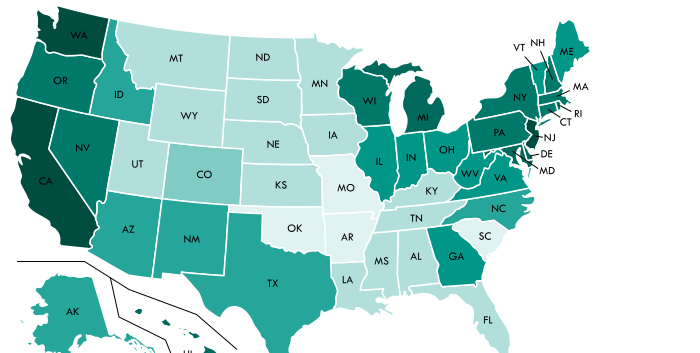
Most common states for international sales coordinators
| Rank | State | Population | # of jobs | Employment/ 1000ppl |
|---|---|---|---|---|
| 1 | Vermont | 623,657 | 178 | 29% |
| 2 | Delaware | 961,939 | 237 | 25% |
| 3 | Rhode Island | 1,059,639 | 244 | 23% |
| 4 | Wyoming | 579,315 | 132 | 23% |
| 5 | District of Columbia | 693,972 | 155 | 22% |
| 6 | North Dakota | 755,393 | 153 | 20% |
| 7 | Maine | 1,335,907 | 241 | 18% |
| 8 | New Mexico | 2,088,070 | 347 | 17% |
| 9 | Alabama | 4,874,747 | 804 | 16% |
| 10 | West Virginia | 1,815,857 | 292 | 16% |
| 11 | Idaho | 1,716,943 | 272 | 16% |
| 12 | South Dakota | 869,666 | 131 | 15% |
| 13 | Oklahoma | 3,930,864 | 522 | 13% |
| 14 | Hawaii | 1,427,538 | 174 | 12% |
| 15 | Utah | 3,101,833 | 270 | 9% |
| 16 | Massachusetts | 6,859,819 | 537 | 8% |
| 17 | California | 39,536,653 | 2,645 | 7% |
| 18 | Illinois | 12,802,023 | 834 | 7% |
| 19 | Oregon | 4,142,776 | 310 | 7% |
| 20 | Connecticut | 3,588,184 | 263 | 7% |
Most common cities for international sales coordinators
| Rank | City | # of jobs | Employment/ 1000ppl | Avg. salary |
|---|---|---|---|---|
| 1 | Fremont | 1 | 4% | $48,004 |
| 2 | Chattanooga | 1 | 1% | $51,138 |
| 3 | Davie | 1 | 1% | $51,136 |
| 4 | Greeley | 1 | 1% | $52,682 |
| 5 | Tampa | 1 | 0% | $50,872 |
International Sales Coordinator job outlook: Expert opinions
Our panel of international sales coordinator experts
Georgia State University
Drexel University
Utah State University
Texas Christian University

Wayne State University

Baylor University
Christopher Newport University

Valdosta State University

Penn State Behrend

William Paterson University

Minnesota State University Moorhead

University of Minnesota
Buffalo State College

Longwood University
Aquinas College

Montana State University

Michigan State University

Upper Iowa University
Fordham University
What general advice would you give to an International Sales Coordinator?
Andrew Spicer: Resiliency is a particularly important skill for international business and career progression. Resiliency – the ability to recover quickly in the face of obstacles and failures – has always been a critical part of successful international assignments. The only constant of working abroad is that there will be miscommunication and mistakes. Successful international business careers depend on the ability to learn from these inevitable setbacks to improve over time. The constant change in the global business environment also leads to the demand for resiliency among international business specialists. An important role for those with a global mindset is to help companies adapt to the massive disruption to the global business environment for international trade and investment presently taking place across the world.
What will help International Sales Coordinators increase their earning potential?
Salomao De Farias: Likes: IB analysts often see a direct impact of their work on company decisions and strategy, which can be highly satisfying. IB roles offer varied problems to solve, which can make every day interesting and intellectually stimulating. Working with international markets offers exposure to different cultures and business practices, enhancing personal and professional growth. Travelling internationally, getting to know different countries, cities and cultures around the globe. Dislikes: I wouldn’t call dislikes, rather challenges. I will start pointing that the stakes are high, as incorrect analysis could lead to poor strategic decisions. This pressure can be stressful. Also, navigating various international regulations, economic conditions, and cultural nuances can be daunting and complex. Depending on the markets covered, working hours might be irregular to overlap with different time zones.
Parfait Kouassi PhD.
Associate Teaching ProfessorDrexel University
Bilingual, Multilingual, And Multicultural Education
What International Sales Coordinator skills would you recommend for someone trying to advance their career?
Parfait Kouassi PhD.: Maximizing your salary potential when starting your career with multilingual and multicultural skills requires a strategic approach. While some companies offer language incentives, the true value of these skills extends far beyond financial compensation. Multilingual and multicultural individuals enjoy a wealth of social fulfillment by fostering connections, building bridges, and gaining deeper insights into diverse perspectives and ways of life. If you want to maximize your financial gain and your chosen field does not directly reward language proficiency, you should be aware that numerous opportunities exist across various industries that actively seek out and compensate individuals with your unique skill set. Fields such as international business, diplomacy, education, healthcare, and tourism highly value bilingual and multicultural individuals for their ability to facilitate communication, build bridges, and drive innovation in diverse contexts.
Brent Allred
Professor of International Business and Strategic ManagementUtah State University
Marketing
What will help International Sales Coordinators increase their earning potential?
Brent Allred: As stated above, I feel that students should focus first on establishing a solid job/career within a company, typically an American company for US students. International assignments and experience within a company will only enhance your value. Pursuing international jobs directly in countries that pay as locals is not a recommended path for maximizing salary. It could be a good path for gaining experience, but many countries do not pay as well as the US and the cost of living may be high. I led a student experience to London this past March and while the students came away with a sense that they could pursue jobs there, they also learned that they would not be paid as well in a very expensive city. A colleague of mine taught at the London Business School and told me that his salary paid for rent and his consulting paid for food. It is wonderful to live and work in places like London for a couple of years, but that may not help you get ahead financially. On the other hand, the experience may prove invaluable for a career and future opportunities. It should also help make you a better global citizen, which may be the most important thing to be.
Ken Corbit Ph.D.
Assistant Professor of Professional Practice in MarketingTexas Christian University
Specialized Sales, Merchandising And Marketing Operations
What general advice would you give to an International Sales Coordinator?
Ken Corbit Ph.D.: Strategic
Company Selection:
Focus on joining companies with robust sales training programs, emphasizing consultative selling. Look for organizations that invest in your development, providing live calling experiences, quota-driven sales processes, and exposure to tools like Salesforce.
Tech
Proficiency and Sales Tools Mastery:
Familiarize yourself with cutting-edge sales technologies, including CRM tools like Salesforce. Your proficiency in these tools will not only streamline your sales processes but also position you as a tech-savvy professional in the competitive sales landscape.
Hands-On
Experience:
Actively engage in live calling, take ownership of sales funnels, and work with senior hiring authorities during your training. This hands-on experience will not only build your confidence but also prepare you for the challenges of consultative selling.
Research
and Decision-Making Skills:
Develop strong research skills to evaluate companies based on fit, growth opportunities, compensation structures, and overall potential. This informed decision-making approach will set you apart and empower you to navigate the sales landscape strategically.
Mentorship
and Networking:
Seek mentorship both within and outside your organization. Building relationships with mentors who invest in your sales skills and knowledge will provide valuable insights. Additionally, actively participate in online forums to connect with practical sales
knowledge and best practices.
What International Sales Coordinator skills would you recommend for someone trying to advance their career?
Ken Corbit Ph.D.: AI-Integrated Consultative Selling: Recognize the evolving role of AI in sales. Embrace AI tools that enhance your pre-call preparation, role-playing, agenda setting, and call talk track development. Stay ahead by incorporating AI into your sales strategies to deliver personalized and efficient client engagements.
What will help International Sales Coordinators increase their earning potential?
Ken Corbit Ph.D.: Holistic
Knowledge Mastery:
Become an expert in your industry, staying abreast of market trends, and thoroughly understanding the products/services you sell. This comprehensive knowledge will empower you to provide exceptional value, resulting in higher sales success and increased client
retention.
Strategic
Question-Based Selling:
Master the art of question-based selling. Use insightful questions to uncover client needs, address pain points, and tailor your approach. This strategic skill will not only boost initial sales but also contribute to secondary sales and long-term client satisfaction.
Compensation
Structure Expertise:
Understand your organization's compensation structure thoroughly. This includes baseline compensation, commission and bonus plans, and additional benefits. This knowledge allows you to set realistic targets, maximize your earnings, and take full advantage
of uncapped commission structures.
Consistent
Target Achievement:
Consistently meet or exceed targets and quotas to demonstrate your value. This not only enhances your immediate success but also positions you for continuous earning potential, especially in roles with uncapped commissions.
Negotiation
and Value Recognition:
Develop negotiation skills to ensure you are compensated appropriately. Recognize your worth and, when appropriate, discuss compensation adjustments or additional benefits with your employer. A proactive approach to recognizing and articulating your value
contributes to your overall salary potential.
In a rapidly evolving sales landscape, continuous learning, tech adaptability, and proactive career management are fundamental for achieving sustained success in consultative sales.
Attila Yaprak Ph.D.
Professor of Marketing and International Business, Director, Doctoral ProgramsWayne State University
Mike Ilitch School of Business
What skills will help International Sales Coordinators earn the most?
Attila Yaprak Ph.D.: Portfolio of the above three with different weights depending on context.
Andrea Dixon Ph.D.
Executive Director, Center for Professional Selling, Frank and Floy Smith Holloway Endowed Professorship in Marketing, President, University Sales Center Alliance 2019-2021Baylor University
Hankamer School of Business
What skills stand out on International Sales Coordinator resumes?
Andrea Dixon Ph.D.: Like salespeople, sales managers must focus their resumes on tangible, objective performance results that are achieved by their teams.
Growth in revenue or quota attainment for the overall team are examples of the types of objective performance results that matter.
High-performing sales managers also highlight long-term performance indicators, which includes both long-term revenue growth by the unit
AND investment metrics that signal the sales manager is building company results for the long run. For example, a high-performance sales manager focuses on building and maintaining a high-performing unit. Such a manager looks to move low performers to other roles where they can be successful.
Another investment metric that a sales manager can signal is the percent of their unit promoted to managerial roles in the organization.
What soft skills should all International Sales Coordinators possess?
Andrea Dixon Ph.D.: Since sales professionals have a lot of information available to them today via customer relationship management (CRM) systems, the sales manager's "supervisory" role is less important (especially for experienced sellers). Consequently, the sales manager needs to be more of a coach and enabler of high performance. Having confidence balanced with humility allows the sales manager to engage more effectively with their salespeople.
One of the critical soft skills for sales managers going forward will be the ability to connect members of the sales team to others in the organization - in other words, the sales manager of the future needs to have strong skills in network building for others. Sellers have access to data which helps them build success.
They also need access to the right people to turn to when they need specific expertise or assistance.
What hard/technical skills are most important for International Sales Coordinators?
Andrea Dixon Ph.D.: One of the growing technical skill requirements for sales managers is in the area of data analytics. Our performance and customer systems provide a myriad of data, and the role of the sales manager is to be a sense-maker of that mound of data. What are the implications for changes in strategy or behavior evident in last quarter's activity? How can the sales manager help a specific seller "see" where the data suggest new approaches?
What skills will help International Sales Coordinators earn the most?
Andrea Dixon Ph.D.: People who can recognize patterns (in data, in people), build connections with and across others, create a focus on high-performance behaviors, and lead with a confident humility are those who will win today and in the future business environment.
Todd Lee Goen
Instructor & Internship DirectorChristopher Newport University
Department of Communication
What are the biggest trends we'll see in the International Sales Coordinator job market given the pandemic?
Todd Lee Goen: The pandemic is demonstrating that employees can be productive working remotely and with flexible schedules, so we're likely to see more flexible and remote positions emerge in the job market. This will be industry/company/position specific, but these options give employers access to a larger applicant pool (which means a more talented workforce) and allows them to reduce overhead costs of maintaining physical office space.
Relatedly, hiring processes will become more technology-driven. In-person interviews (especially if there are multiple rounds) will be significantly less likely and more organizations will opt for pre-recorded interviews. This started pre-pandemic, but the pandemic will accelerate it. The good news is that as the technology improves the application process should become more efficient and streamlined (e.g., applying with LinkedIn profiles has the potential to become more of a norm).
The job market in recession-proof industries will remain strong, but wages will likely stagnate and may even decrease. Many recession-proof jobs are connected to state and local governments. The pandemic and its associated recession brought decreased tax revenues and increased demands for public expenditures, and state and local governments won't have the funds to support wage growth for the next few years. The job market in recession-intolerant industries will fluctuate for several years and will only stabilize once the economy begins to recover.
One of the key take-aways from the pandemic is that public health systems are inadequate. One possible outcome is that in the next few years there will be a greater number of jobs in the public health sector. Whether or not this happens will largely depend on the length and severity of the current recession as well as funding allocations of governments post-pandemic. Given the US federal government ceded much of the responsibility for responding to the pandemic, expect many of these positions to be with state and local governments. Also, expect many of these will be community/public engagement type positions that focus on communication and relationship building.
What's a good job out of college for International Sales Coordinators?
Todd Lee Goen: Pandemic or no pandemic, the best job out of college is one that sets you on the path to achieve your ultimate career goal(s). Reflect on where you want to be in five or ten years or even twenty-five years. Then consider positions that will set you on the path to achieve that goal. Very few people land their dream job upon graduation - dream jobs are typically those we're not qualified to do without some additional work experience and training. A good job is one that will help you achieve your goal(s) - just don't frame it that way in the interview.
Good jobs pay a livable salary for the location, offer benefits (health insurance and retirement at minimum), and provide professional development opportunities (these can take a variety of forms). Too often, college grads overlook professional development. If an employer isn't willing to invest in you, there's no guarantee you will succeed in the job. Good employers understand they need qualified employees who continually develop their skills and abilities, and good employers will make sure employees have the resources they need to succeed.
Herbert Fiester Ph.D.
Associate Professor, Program Coordinator, Curriculum and Instruction Doctoral ProgramValdosta State University
Department of Curriculum, Leadership, and Technology
Are there any particularly good places in the United States for International Sales Coordinators to find work opportunities?
Herbert Fiester Ph.D.: I used to think of "place" as a geographic location, but with the technological changes that have occurred within the past several years, and especially this past year, many doors have opened to allow flexible working conditions. Telecommuting, remote work, working from home, and telework, which were once frowned upon by many employers, have now been embraced. With this new acceptance, "place" becomes much less about geographic location and much more about industry type. I have not observed a lot of activity in higher education and P-12 domains lately due to the pandemic and tight budgets, and industry probably holds the most opportunity. Applicants who are willing to work in flexible work models will have access to many more job opportunities.
What are the biggest trends we'll see in the International Sales Coordinator job market given the pandemic?
Dr. Mark Owens Ph.D.: It is hard to know for sure, but it seems like there will be a trend toward doing more job related tasks remotely. The pandemic forced many employers to adjust to life without in-person contact and many of these changes are going to persist in some form.
What skills stand out on International Sales Coordinator resumes?
Dr. Mark Owens Ph.D.: In international business it helps to be bilingual and to have study abroad and/or an international internship on your resume.
Are there any particularly good places in the United States for International Sales Coordinators to find work opportunities?
Giuliana Andreopoulos: The job opportunities for business students mainly depend on their personal skills, GPA, field of specialization, practical experience, and networking. Based on my ten-year experience as the Director of Experiential Learning at WPU, global business students need some sort of specialization, otherwise it is not easy to get a job because companies still require specific skills. Thus, a global business degree is most useful when it is taken in conjunction with another more specialized program or degree, like finance, marketing, management, or law and politics. This becomes evident if we look at possible careers such as Marketing Manager, Human Resources Manager, Financial Analyst, and Policy Analyst. The US offers many job opportunities for graduates in international business, especially in cities like NYC, Chicago, Washington, and San Francisco. However, outside the Unites States countries like Singapore, Canada, Switzerland should also be very appealing to international business graduates.
Wooyang Kim Ph.D.
Associate ProfessorMinnesota State University Moorhead
Paseka School of Business
What International Sales Coordinator skills would you recommend for someone trying to advance their career?
Wooyang Kim Ph.D.: I believe diverse recommendations exist dependent upon the job positions in the different industry sectors. Generally speaking, even marketing-related jobs encompass numerous functional areas in many business organizations, such as advertising and PR, branding, customer experience and service, digital marketing, new product development, product management, sales and promotions, social media marketing, and more.
Regardless of the diversity above, I commonly recommend two skills to enhance marketing-related competence: 1) communication skills as a soft skill and 2) analytical skills as a hard skill responding to the concurrent marketing environment. These two skills would be fundamental skills to be marketers since marketing job activities always interplay with people (colleagues, consumers, partners, etc.) and products/services, and therefore, job seekers should understand human behavior and are capable of comprehending the marketability of products/services.
To obtain these two skills, I suggest that students need repetitive practices by conducting continuous observations and interacting with others in the college and workplace. In this process, I urge them to keep asking three essential questions - what (it is), why (it occurs), and how (to act) questions, according to the principle of 5W and 1H, when facing the situation needed to react or solve. In my opinion, this continuous training would help to develop the recommended skills: communication and analytical skillsets.
What are the biggest trends we'll see in the International Sales Coordinator job market given the pandemic?
Geoff Kaufmann: Working remotely and integration of personal and professional lives and in many cases increased productivity of those workers.
What are the biggest trends we'll see in the International Sales Coordinator job market given the pandemic?
Annemarie Franczyk: Workplaces will be shifting to remote formats as businesses discover how much money is to be saved by not having to pay rent, a mortgage, WiFi, utilities and other expenses of a brick-and-mortar location. Workers will need to continue to prove to bosses that they can work independently and be productive and responsive from their home offices. Today's students and tomorrow's workers will have had that experience in spades for more than a year as the majority of courses and many activities moved online. Therefore, they and will be poised to do quite well the new and evolving remote employment environment.
What International Sales Coordinator skills would you recommend for someone trying to advance their career?
Annemarie Franczyk: Every industry is looking for professionals who can write and communicate visually, so any activity, extra course or private tutor who can help graduates keep up or build these skills will be to their advantage professionally. Additionally, data analysis has application across all disciplines, so a course or two in that area will be of value. And if the graduate can put these two areas of study together and communicate data effectively, he or she will be in demand.
Are there any particularly good places in the United States for International Sales Coordinators to find work opportunities?
Dr. David Lehr: Most job growth will continue to be in urban centers and the surrounding suburbs. Rural areas will continue to struggle (remote work notwithstanding).
What are the biggest trends we'll see in the International Sales Coordinator job market given the pandemic?
Dr. David Lehr: A premium on flexibility and having a variety of skillsets. Continued weakness across the board in labor markets.
What skills stand out on International Sales Coordinator resumes?
Dr. David Lehr: Information flow skills, particularly surrounding data analytics.
Kerri Orders
Assistant Professor of BusinessAquinas College
Business Administration Department
What International Sales Coordinator skills would you recommend for someone trying to advance their career?
Kerri Orders: In terms of a gap year, I recommend that international business students acquire tangible skills, relevant experience and/or certifications which will enhance their success in their desired area of interest. For example, a gap year could consist of gaining technical or digital training overseas, which would also further the students' cultural intelligence and language proficiency. These types of enriching gap year experiences will assist students to distinguish themselves in a highly competitive market. Furthermore, students should focus on broadening and maintaining their global network during a gap year in order to be ready for the job market once the gap year is concluded.
What general advice would you give to an International Sales Coordinator?
Kerri Orders: There is more than one path to any given career, therefore students will benefit from being curious, creative, and collaborative as they embark upon their international business careers. More than ever, employers will be looking for students who are adaptable, flexible, and proactive. In this tighter job market, students should be more open-minded about opportunities and willing to work in a range of sectors and different sizes of companies. The pandemic has impacted businesses around the world, so this advice will apply to graduates from all regions of the world.
What are the biggest trends we'll see in the International Sales Coordinator job market given the pandemic?
Kerri Orders: In 2020, companies of all sizes rapidly changed the way they were organized and conducted business daily, both internally and externally, with customers and suppliers. COVID has accelerated the potential and opportunity for remote work, both domestically and within the international business environment. Consequently, the future trends for international business will be a decrease in business travel and an increase in collaboration and communication via remote modalities. Many companies have now realized the ability for employees to conduct international business via remote networks, which are both effective and economically efficient. Increasingly, employers are looking for candidates with a global mindset, a culturally diverse range of experiences, and a broad skill set. In addition, employers will expect candidates to have a high level of technical and communication skills in order to thrive and have a shorter learning curve at the entry level. It is important for students entering the job market to highlight and promote their specific skills and value added to a potential employer.
What are the biggest trends we'll see in the International Sales Coordinator job market given the pandemic?
Dr. Angela Woodland Ph.D.: There is still work that needs to be done. Those jobs that are necessary for the economy to continue and for the protection and service of the public will continue to need willing and able employees. The field I know most about is accounting. Publicly-traded companies are required to have audits of their financial statements. This is for the protection of all who use financial statements to make investing decisions. Think about your retirement savings plans, 401(k) plans, etc. So, every year there is a need to hire students who are ready to take the CPA exam and ready to become auditors. The same goes for students who are trained and ready to prepare income tax returns for corporations and individuals. Pandemic or no pandemic, we still need accountants. In fact, we now need accountants who are prepared to make certain that loans and grants related to pandemic relief have been used for their intended purposes and have been distributed appropriately.
What skills stand out on International Sales Coordinator resumes?
Dr. Angela Woodland Ph.D.: Skills that are immediately useful stand out on resumes. Right now, data analytics skills are in hot demand. A desirable job candidate should be able to import large data sets in various formats, clean data, manipulate data, interrogate data, and draw conclusions from the data. Additionally, the job candidate should be able to prepare informative and easy-to-follow data visualizations of the results. This skill set allows a job candidate to be immediately useful in an organization. It is the new way of analyzing and communicating.
Are there any particularly good places in the United States for International Sales Coordinators to find work opportunities?
Dr. Angela Woodland Ph.D.: There are pockets of opportunity in most communities. The savvy student will meet and make connections with local businesses through internships, student clubs, guest lectures, and other college events. With a little effort, students can learn to speak the vernacular of local industries and tailor their resumes and skill sets accordingly.
Wyatt Schrock Ph.D.
Assistant Professor of MarketingMichigan State University
Broad College of Business
What type of skills will young International Sales Coordinators need?
Wyatt Schrock Ph.D.: For graduates entering careers in sales, two skills that come to my mind are (1) listening skills and (2) analytical skills. First, I think listening is indeed a skill that can be developed with techniques and practice. Importantly, and for several reasons (e.g., building rapport, overcoming objections), I do not think you can be a good salesperson and be a bad listener. Second, I think analytical skills may be overlooked in terms of importance for salespeople. Certainly, selling is about relationship-building. However, and simultaneously, selling is also about delivering quantifiable value. It may be increasingly important for salespeople to have the ability to demonstrate exactly how or where they intend to help their customers grow revenue or reduce expenses.
What experience really stands out on International Sales Coordinator resumes?
Wyatt Schrock Ph.D.: Based on my experience and discussions with recruiters, at least two things stand out for applicants looking for sales jobs. First, I think transferrable skills are important to signal on a resume. For example, working as a hostess or waiter at a restaurant could signal to recruiters certain interpersonal skills that are important in sales. Second, I think any experience that allows the applicant to quantify their success will help applicants to stand out. If a person did well at work, I think it is worth spending some time thinking about how to tell that story with numbers. I think numbers can be just as important as words on a resume, especially when applying for a sales position.
Will there be an enduring impact of the coronavirus pandemic on International Sales Coordinators?
Wyatt Schrock Ph.D.: For graduates entering careers in sales, I expect the coronavirus pandemic to have at least one enduring impact. That is, I think the pandemic has changed the way that people think about the nature of buyer-seller interactions. In particular, I think we now know that a lot of relationship-building, problem-solving, etc., can be accomplished remotely with video meeting applications. This development might, for example, ultimately lead to lower levels of business travel for salespeople.
Dr. Karla Gavin
Director of the Master of Sport Administration Program, Associate Professor of Sport Administration (2010)Upper Iowa University
School of Business and Professional Studies
What are the biggest trends we'll see in the International Sales Coordinator job market given the pandemic?
Dr. Karla Gavin: At this time, it appears that individuals will continue to be interviewed and hired virtually without meeting their employer face-to-face. To retain these new hires, employers need to have stellar orientation programs to be completed remotely and onboarding that engages them before Day 1 of employment. Constant communication is critical, especially in the hiring process.
Work is very likely to be conducted in a virtual format for many employees in at least the first six months of 2021. Candidates with experience working with multiple virtual communication platforms will stand out during this time frame.
Employers may require employees to be vaccinated for COVID-19 before returning to face-to-face work with colleagues and clients. Depending on what happens as this vaccine is more widely administered, it could impact employee and new hire decisions to stay or to leave.
What skills stand out on International Sales Coordinator resumes?
Dr. Karla Gavin: College students who graduate and move into the workforce need to think of themselves as independent contractors. They need to articulate their abilities to be flexible and adaptable, and to communicate very clearly in written and verbal communication. Job candidates will benefit from viewing issues as challenges instead of problems and using out-of-the-box thinking to resolve those issues.
They need to share their ability to work with diverse groups of people in team settings. Their willingness to be lifelong learners is important and they should reflect their desire to attend professional development activities and to pursue advanced degrees or certifications. Examples of leadership positions and opportunities need to be indicated on the resume.
Each of the areas mentioned above requires related examples to be stated concisely to reiterate their accomplishments and future goals.
Are there any particularly good places in the United States for International Sales Coordinators to find work opportunities?
Dr. Karla Gavin: The world of work is in great flux right now. Willingness to relocate and to learn the field from the bottom up is very important, wherever that might be. Too many students have unrealistic expectations for salary and job title upon graduation.
They also need to know themselves well enough to understand how their personal purpose and passion match that of their chosen field and of their specific employer.
What type of skills will young International Sales Coordinators need?
Peter Johnson DPS: There are three things that employers are looking for:
1. Demonstrated ability to solve problems
2. Ability to analyze and make decisions based on data
3. Communication skills with management, teams, and clients
Will there be an enduring impact of the coronavirus pandemic on International Sales Coordinators?
Peter Johnson DPS: From an academic standpoint, I believe there will be a minimal long-lasting impact on our graduates. All students will be required to complete the necessary credits and be assessed for their performance. Many of their courses will be online, but there is currently no research body that clearly indicates that online teaching is significantly less effective than in class. Several studies of work from home (WFH) indicate comparable or increase productivity.
What experience really stands out on International Sales Coordinator resumes?
Peter Johnson DPS: For entry-level positions, resumes need to include the basic "table stakes" type of skills: career-related coursework, leadership experience, and technical competencies: PowerPoint, Excel, CRM, and something like Python, if analytics are required. To stand out and for mid-level positions: published articles or white paper; original research, for demonstrated expertise in a product or service category.