
Automatically apply for jobs with Zippia
Upload your resume to get started.
Junior research assistant skills for your resume and career
15 junior research assistant skills for your resume and career
1. Patient Care
Patient care entails the diagnosis, recovery, and control of sickness as well as the maintenance of physical and emotional well-being through the use of healthcare providers' services. Patient care is described as services provided to patients by health practitioners or non-professionals under guidance.
- Aided dentist in day-to-day operations involving patient care including sanitizing medical equipment
- Provided strong patient care, performed all duties of a Dental Assistant; operated x-ray equipment.
2. Data Analysis
- Performed data analysis, quality assurance, data checking and editing and data entry.
- Developed skills in data analysis, critical thinking, and public speaking.
3. Cell Culture
- Performed cell culture utilizing sterile technique and managed laboratory safety/chemical inventory/equipment.
- Supported Cell Culture process optimization by exploring new filtration techniques and assays to provide characterization feedback of Cell Broth.
4. Behavioral Data
- Collected, concatenated, and analyzed electroencephalogram (EEG), magnetic resonance imaging (MRI) and behavioral data.
5. Vital Signs
Vital signs are a set of values indicating different body systems' performance. They are measurements of the body's most basic functions. The four major vital signs used in medicine to assess a patient are body temperature, pulse rate, respiration rate, and blood pressure.
- Monitored patients for vital signs, clear airways, bleeding, circulation and pain control.
- Measure and recording vital signs, obtaining chief complaint, and interview history.
6. RNA
A Ribonucleic acid (RNA) has a vital role in determining the biological macromolecule commonly found in all bodily cells. It is the synthesis of protein, carriers message instruction from the Deoxyribonucleic acid or DNA. RNA is a kind of single-stranded cell that has different forms. It allows the molecule to go back and forth to its original condition.
- Implemented a working protocol for isolating RNA from metastatic cell lines for investigating gene expression using differential display analysis.
- Established mammalian cell based target validation by optimizing an endogenous expression cassette system for short hairpin RNA.
Choose from 10+ customizable junior research assistant resume templates
Build a professional junior research assistant resume in minutes. Our AI resume writing assistant will guide you through every step of the process, and you can choose from 10+ resume templates to create your junior research assistant resume.7. Research Study
Resaerch studies are conducted to learn something new about a subject or confirm an hypothesis one believe to be correct. They occur in both business and academia and normally involve some kind of survey of data, or observation of someone or something.
- Assist in a research study that is being conducted in the community.
- Planned and completed a research study examining the racial/ethnic differences in stigma-related strain of caregivers to adolescence with serious emotional disturbances.
8. PCR
PCR stands for Polymerase Chain Reaction, a tool to make millions of copies of a target part of DNA. Polymerase chain reaction involves the process of heating and cooling. The process takes place using a machine, which helps in heating and cooling off the substances. The purpose of heating exists to separate the DNA into two single strands.
- Learned PCR and electron microscopic observation.
- Leaned basic laboratory techniques such as PCR transformations, mini-prep analysis, SDS-PAGE gels, restriction enzyme digest, and Western Blots
9. DNA
Deoxyribonucleic acid, or only DNA, which is considered the king of molecules, is a macromolecule that contains the main component of chromosomes. Shaped like a double helix, DNA is usually found in the nucleus of a cell. It is a type of material that transports characteristics in many forms, developed in nucleotides around one another.
- Trained staff in DNA techniques and taught graduate level laboratory classes.
- conducted research in mulberry DNA polymorphism markers of pest resistant varieties.
10. PowerPoint
- Transcribed Audio Files into written documents and drafted, edited and translated PowerPoint Presentations and important documents.
- Produced weekly industry updates and helped to prepare initiation of coverage on new companies and created PowerPoint presentations for analyst marketing.
11. Physical Examinations
- Performed patient evaluation with history and physical examination.
12. Front Desk
- Practiced proper sterilization and kept inventory and ordered supplies as needed; did front desk duties when necessary.
- Provided front desk duties and back up on a daily basis.
13. Blot
- Quantified Western Blot results to focus research on appropriate tagged proteins.
- Observed and analyzed Western Blot procedures and protocol.
14. Python
Python is a widely-known programming language. It is an object-oriented and all-purpose, coding language that can be used for software development as well as web development.
- Created WikiPapers, a Python bibliography manager with a Semantic MediaWiki backend that gets pdfs.
- Developed applications using Python for statistical analysis in UNIX for intellectual property protections for corn and soy.
15. Statistical Analysis
- Conducted library research and performed statistical analysis of Pennsylvania state hospital data.
- Performed descriptive and comparative statistical analysis
5 Junior Research Assistant resume examples
Build a professional junior research assistant resume in minutes. Browse through our resume examples to identify the best way to word your resume. Then choose from 5+ resume templates to create your junior research assistant resume.

What skills help Junior Research Assistants find jobs?
Tell us what job you are looking for, we’ll show you what skills employers want.
What skills stand out on junior research assistant resumes?
Verónica Gutiérrez Ph.D.
Director of Undergraduate Research, Director of Bridge and Launch Programs, Associate Professor of Latin American History, Azusa Pacific University
What junior research assistant skills would you recommend for someone trying to advance their career?
Slavko Komarnytsky
Associate Professor, North Carolina State University
Instead, take initiative, and show your value. Look up and reach out to professors in your department who work in your area of interest with a single question, "Would it be possible for me to develop a review manuscript on (topic) with you as my mentor?" If accepted, you immediately gain access to your professor's professional network, in-depth knowledge in your area of research, writing skills, teamwork, and visibility once the manuscript is submitted and published. Hey, email me, and I will work with you to make it happen. Also, pay attention to local clubs and student organizations that are active in the areas of your interest - by participating in their activities, you gain access to the group of the brightest and most active students in your program. You will be surprised how much you can accomplish with Zoom meetings, proper distancing, and masks. Check NCSU Student Food Science Club led by David Mohebpour or UNC Chapel Hill Student Alternative Proteins Project led by Sophia Retchin as examples.
What type of skills will young junior research assistants need?
Bart Elmore
Associate Professor of Environmental History, Ohio State University
What technical skills for a junior research assistant stand out to employers?
Sya Kedzior Ph.D.
Associate Professor, Towson University
What soft skills should all junior research assistants possess?
Shiri Noy Ph.D.
Assistant Professor, Denison University
What hard/technical skills are most important for junior research assistants?
Harriet Phinney Ph.D.
Associate Professor, Seattle University
List of junior research assistant skills to add to your resume
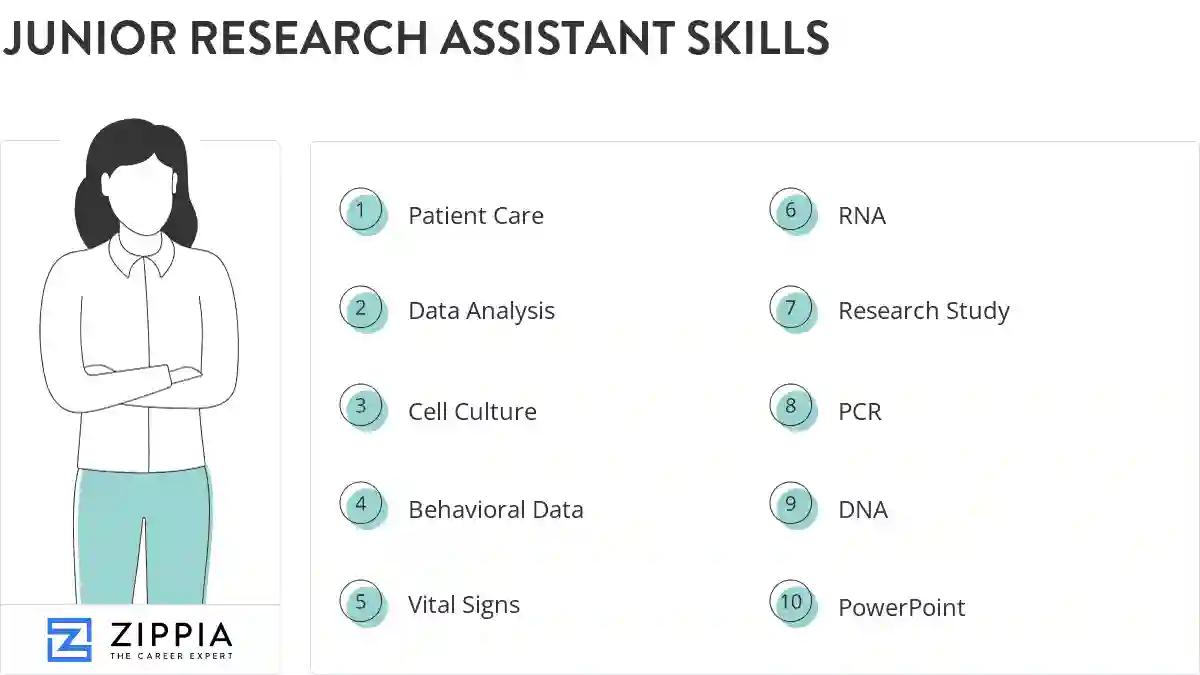
The most important skills for a junior research assistant resume and required skills for a junior research assistant to have include:
- Patient Care
- Data Analysis
- Cell Culture
- Behavioral Data
- Vital Signs
- RNA
- Research Study
- PCR
- DNA
- PowerPoint
- Physical Examinations
- Front Desk
- Blot
- Python
- Statistical Analysis
- Proofread
- MATLAB
Updated January 8, 2025
