What does a laboratory analyst do?
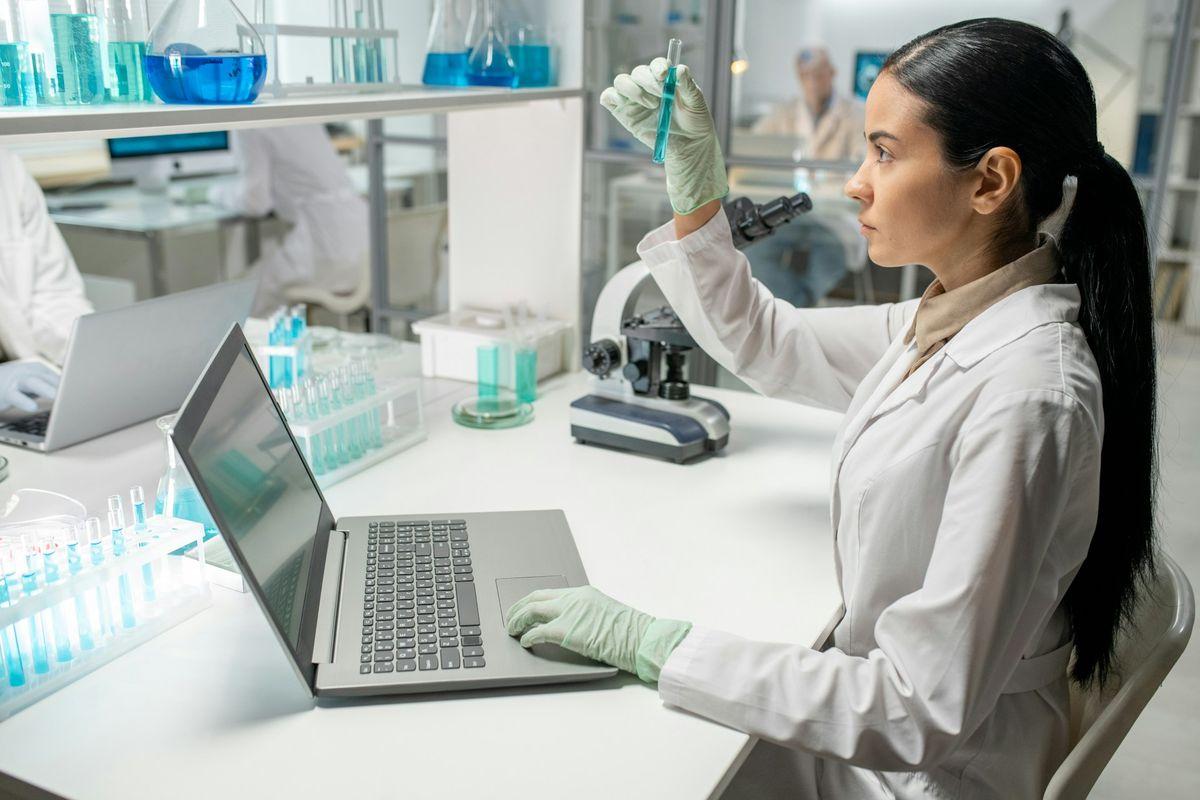
A Laboratory Analyst helps conduct experiments, run laboratory tests, and analyze results. They compile and record data for the documentation needed for testing and report preparation.
Laboratory analyst responsibilities
Here are examples of responsibilities from real laboratory analyst resumes:
- Use sophisticate laboratory instrumentation (HPLC, FTIR, UV, GC) and computer systems to collect and record data.
- Analyze organic compounds using gravimetric, titration, distillation and spectrophotometry methods.
- Prepare for and represent the laboratory during FDA, customer, and ISO audits.
- Complete preparation of organic samples for GC, HPLC, IR and GCMS analysis.
- Prepare solid and aqueous samples for analysis on diagnostic instruments including GC, GCMS and IC.
- Utilize internal LIMS computer database for data entry and communication.
- Interpret and report data to various agencies through LIS systems.
- Handle data entry, reports, sops, quality control, etc.
- Perform maintenance, troubleshooting, repair and improvement of FTIR instrumentation on mobile platforms.
- Experience in HPLC-MS method validation and protocol execution in support of GLP animal vaccination studies.
- Organize the microbiology department by implementing a new format of restocking supplies and efficiency in media usage.
- Work closely with the PADEP to comply with their NPDES permit program through sampling and testing wastewater.
- Provide trouble shooting and maintenance of LC/MS/MS, GC/MS and ICP/MS.
- Enter laboratory specifications into LIMS database.
- Supervise training of laboratory personal on HPLC.
Laboratory analyst skills and personality traits
We calculated that 8% of Laboratory Analysts are proficient in Test Methods, Lab Equipment, and Lims. They’re also known for soft skills such as Analytical skills, Communication skills, and Ability to use technology.
We break down the percentage of Laboratory Analysts that have these skills listed on their resume here:
- Test Methods, 8%
Completed and prepared required documentation, handled samples and performed analyses according to procedures and test methods.
- Lab Equipment, 7%
Maintained lab equipment in proper operating condition, and assisted in calibration as required.
- Lims, 5%
Entered laboratory specifications into LIMS database.
- Laboratory Procedures, 5%
Ensured that all safety procedures and PPE are properly exercised during laboratory procedures.
- Sample Preparation, 5%
Sample preparation for soil and aqueous Batched samples for metals and organics departments Mercury preparation and analysis
- Analytical Methods, 4%
Participate in Analytical method transfers, investigations of non-conforming results to comply with Pfizer metrics.
"test methods," "lab equipment," and "lims" are among the most common skills that laboratory analysts use at work. You can find even more laboratory analyst responsibilities below, including:
Analytical skills. The most essential soft skill for a laboratory analyst to carry out their responsibilities is analytical skills. This skill is important for the role because "environmental science and protection technicians must carry out a wide range of laboratory and field tests, and their results must be accurate and precise." Additionally, a laboratory analyst resume shows how their duties depend on analytical skills: "adhered to fda regulated pharmaceutical product manufacturing and analysis. "
Communication skills. Another soft skill that's essential for fulfilling laboratory analyst duties is communication skills. The role rewards competence in this skill because "environmental science and protection technicians must have good listening and writing skills, because they must follow precise directions for sample collection and communicate their results effectively in written reports." According to a laboratory analyst resume, here's how laboratory analysts can utilize communication skills in their job responsibilities: "wet chemistry product testing assisting with tests following lab procedures lab safety communication independent work ethics"
The three companies that hire the most laboratory analysts are:
- SGS34 laboratory analysts jobs
- Eurofins14 laboratory analysts jobs
- Kelly Services10 laboratory analysts jobs
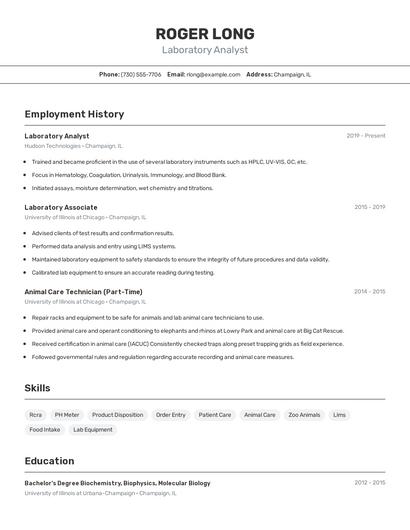
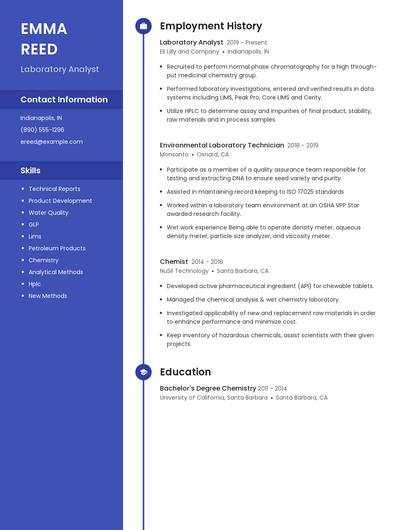
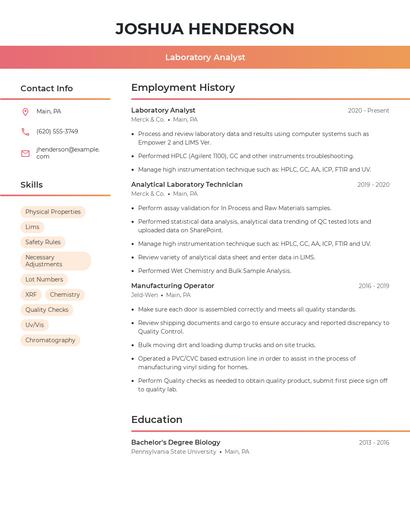
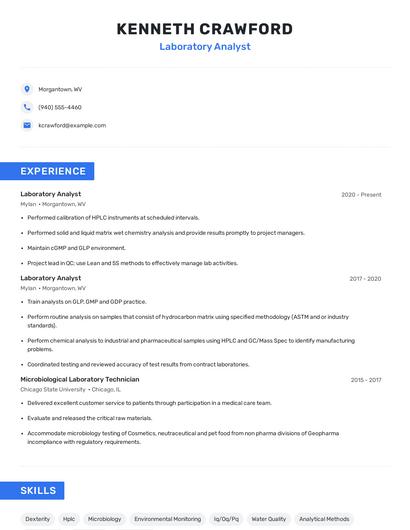
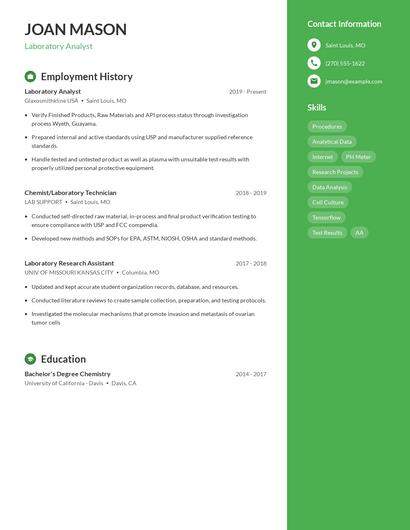
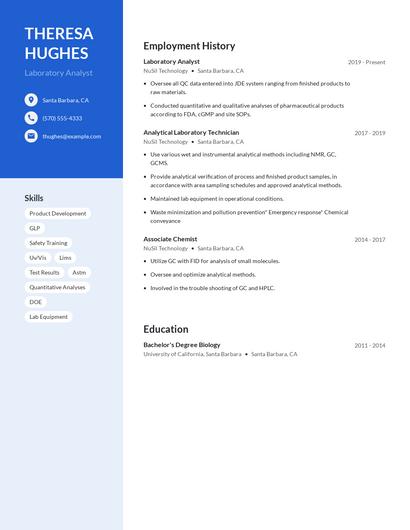
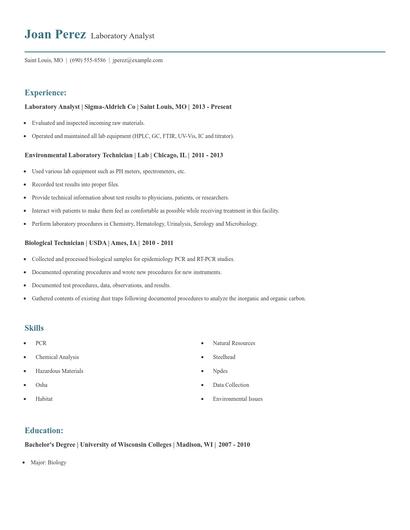
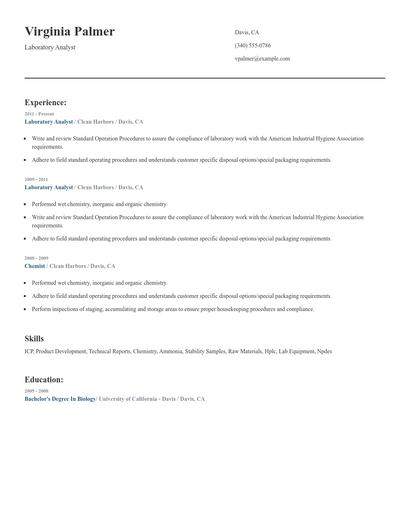
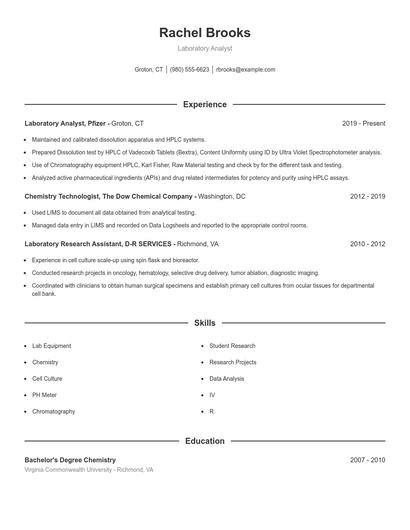
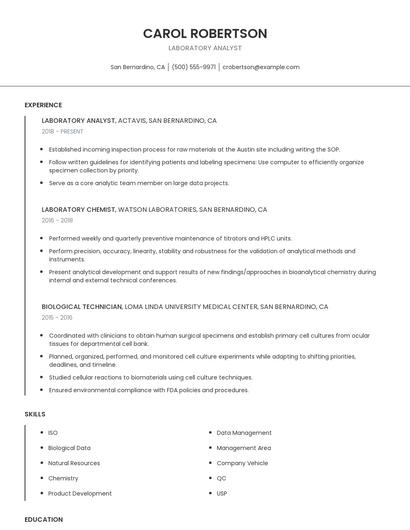
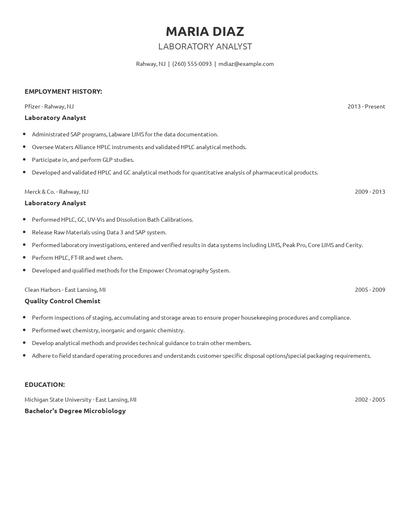
Choose from 10+ customizable laboratory analyst resume templates
Build a professional laboratory analyst resume in minutes. Our AI resume writing assistant will guide you through every step of the process, and you can choose from 10+ resume templates to create your laboratory analyst resume.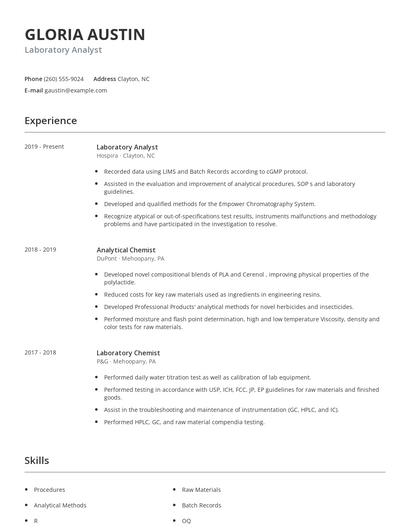
Compare different laboratory analysts
Laboratory analyst vs. Chemical technician
A chemical technician is responsible for supporting chemists and laboratory technicians in performing laboratory investigations and examining chemical components and structures. Chemical technicians ensure the stability of laboratory tools and equipment, performing proper sterilization and segregation of disposable materials, and maintaining the adequacy of inventory. They also record the research progress, including scientific methods, and write observation reports for reference. A chemical technician manages the cleanliness and orderliness of the facility to avoid potential hazards and complications during chemical operations.
These skill sets are where the common ground ends though. The responsibilities of a laboratory analyst are more likely to require skills like "test methods," "laboratory procedures," "sample preparation," and "analytical methods." On the other hand, a job as a chemical technician requires skills like "safety procedures," "hazardous materials," "osha," and "troubleshoot." As you can see, what employees do in each career varies considerably.
Chemical technicians earn the highest salaries when working in the pharmaceutical industry, with an average yearly salary of $66,439. On the other hand, laboratory analysts are paid more in the pharmaceutical industry with an average salary of $47,806.On average, chemical technicians reach similar levels of education than laboratory analysts. Chemical technicians are 3.8% less likely to earn a Master's Degree and 0.4% less likely to graduate with a Doctoral Degree.Laboratory analyst vs. Assistant research scientist
An Assistant Research Scientist assists in planning, conducting, and analyzing various research projects. They also order and manage lab inventory, materials, and equipment.
In addition to the difference in salary, there are some other key differences worth noting. For example, laboratory analyst responsibilities are more likely to require skills like "test methods," "lims," "laboratory procedures," and "test results." Meanwhile, an assistant research scientist has duties that require skills in areas such as "research projects," "data collection," "cell culture," and "chemistry." These differences highlight just how different the day-to-day in each role looks.
On average, assistant research scientists earn a higher salary than laboratory analysts. Some industries support higher salaries in each profession. Interestingly enough, assistant research scientists earn the most pay in the education industry with an average salary of $71,080. Whereas laboratory analysts have higher pay in the pharmaceutical industry, with an average salary of $47,806.Average education levels between the two professions vary. Assistant research scientists tend to reach higher levels of education than laboratory analysts. In fact, they're 9.2% more likely to graduate with a Master's Degree and 0.4% more likely to earn a Doctoral Degree.What technology do you think will become more important and prevalent for laboratory analysts in the next 3-5 years?
Dr. Betsy Smith
Assistant Professor of Chemistry, Elmira College
Laboratory analyst vs. Chemist
Chemists are generally responsible for observing and investigating chemical substances to create new and safe compounds essential for practical applications. They are often grouped depending on a particular area of specialization to focus and understand the complexities of the matter. A chemist usually takes time performing research and conducting experiments to test and further improve the quality and usage of a specific chemical substance. Chemists are expected to write on their observations and findings to establish scientific results.
There are many key differences between these two careers, including some of the skills required to perform responsibilities within each role. For example, a laboratory analyst is likely to be skilled in "laboratory procedures," "math," "microbiological," and "data entry," while a typical chemist is skilled in "chemistry," "product development," "analytical techniques," and "troubleshoot."
Chemists earn the best pay in the manufacturing industry, where they command an average salary of $75,495. Laboratory analysts earn the highest pay from the pharmaceutical industry, with an average salary of $47,806.Most chemists achieve a similar degree level compared to laboratory analysts. For example, they're 3.9% more likely to graduate with a Master's Degree, and 2.1% more likely to earn a Doctoral Degree.Laboratory analyst vs. Research technician
A research technician is responsible for assisting in research studies and laboratory experiments. Research technicians operate laboratory tools and equipment, process data for experiments, collect samples for study, analyze existing research materials, analyze experiment results, manage inventories and stock supplies, record observations, and create reports for further examination. A research technician must have strong analytical and scientific knowledge, as well as a passion for research writing and investigations crucial for this kind of industry.
Types of laboratory analyst
Updated January 8, 2025
