What does a laboratory supervisor do?

The primary job of laboratory supervisors is to oversee the daily operations of laboratories. They are responsible for facilitating the collection, analysis, and interpretation of laboratory results. Other responsibilities include supervising personnel, managing the operating budget of the laboratory, and hiring employees. Laboratory supervisors are responsible for overseeing quality assurance and enforcing practices to ensure quality control within the laboratory. Aside from these tasks, they also manage the acquisition of laboratory equipment and supplies and resolve any technical or administrative issues within the laboratory.
Laboratory supervisor responsibilities
Here are examples of responsibilities from real laboratory supervisor resumes:
- Manage personnel within the team, and provide guidance relating to laboratory EMR to performance improvement projects
- Handle administrative and IRB tasks, manage fiscal matters, maintain record system of participant data.
- Manage all static data, generate reports, run queries and support laboratories with technical knowledge and advice.
- Manage pneumatic resistance rehabilitation lab.
- Manage and maintain various automate laboratory equipment though GMP safe practices.
- Assist with implementation of new procedures as laboratory works to achieving ISO certification.
- Supervise machine maintenance and proficiency testing for hematology and chemistry departments as well as several microbiology procedures conduct during the night.
- Perform centrifugation, gel electrophoresis, PCR, sterile techniques and autoclave.
- Execute and analyze tests in areas including chemistry, hematology, coagulation, urinalysis, serology, and immunology.
- Blood draw, ekg, inj, vital signs, clia waive testing
- Isolate DNA & RNA from incoming blood, bone marrow, tissue and paraffin blocks.
- Coordinate and follow-up proficiency testing for CLIA compliance in a high complexity laboratory.
- Analyze blood work, urinalysis and fecal matter.
- Perform daily maintenance to ensure all AU400 equipment run efficiently.
- Run samples, perform QC and calibrations in all departments.
Laboratory supervisor skills and personality traits
We calculated that 11% of Laboratory Supervisors are proficient in Clinical Laboratory, Patients, and Chemistry. They’re also known for soft skills such as Problem-solving skills, Time-management skills, and Leadership skills.
We break down the percentage of Laboratory Supervisors that have these skills listed on their resume here:
- Clinical Laboratory, 11%
Interact with California Department of Public Health examiners/inspectors to ensure that lab is current with clinical laboratory - regulatory requirements.
- Patients, 10%
Provided guidance and direction resulting in successful, timely finalized toxicology results for over 5,000 patients.
- Chemistry, 6%
Created and updated operational procedures to assure proper performance of tests in Chemistry, Hematology, Serology, Urinalysis and Microbiology.
- Patient Care, 5%
Identified opportunities for enhancing delivery of laboratory services, quality-of-work life and patient care issues.
- Lab Equipment, 5%
Maintained lab equipment and performed calibrations, correlations, proficiency study specimens and specimens for CAP inspections.
- Test Results, 5%
Demonstrated the ability to communicate test results effectively with physicians, pathologists and nursing staff as a member of interdisciplinary team.
"clinical laboratory," "patients," and "chemistry" are among the most common skills that laboratory supervisors use at work. You can find even more laboratory supervisor responsibilities below, including:
Problem-solving skills. The most essential soft skill for a laboratory supervisor to carry out their responsibilities is problem-solving skills. This skill is important for the role because "production managers must identify and address problems that arise." Additionally, a laboratory supervisor resume shows how their duties depend on problem-solving skills: "experience with 8 d, pfema, problem solutions (ishikawa diagrams), 5 s. experience with iso 9001. "
Leadership skills. Another skill that relates to the job responsibilities of laboratory supervisors is leadership skills. This skill is critical to many everyday laboratory supervisor duties, as "to keep the production process running smoothly, industrial production managers must motivate and direct employees." This example from a resume shows how this skill is used: "provide leadership to a growing number of clinic staff through hiring, conducting training and performance evaluations. "
Interpersonal skills. A big part of what laboratory supervisors do relies on "interpersonal skills." You can see how essential it is to laboratory supervisor responsibilities because "industrial production managers must have excellent communication skills to work well other managers and with staff." Here's an example of how this skill is used from a resume that represents typical laboratory supervisor tasks: "provided excellent interpersonal and communication skills. "
The three companies that hire the most laboratory supervisors are:
- Laboratory Corporation of America Holdings61 laboratory supervisors jobs
- Danaher38 laboratory supervisors jobs
- Tenet Healthcare27 laboratory supervisors jobs
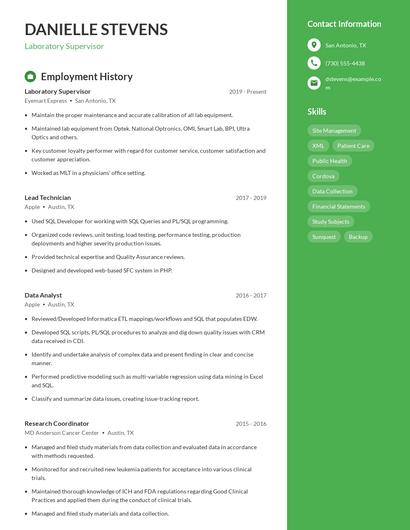
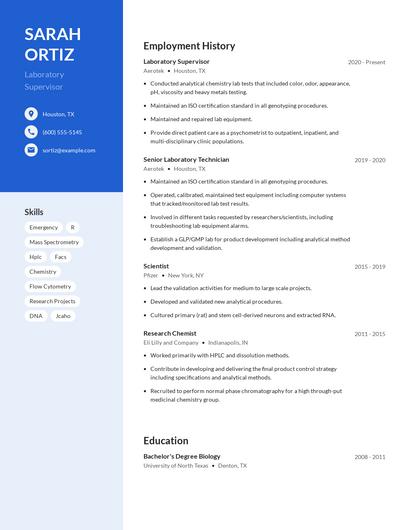
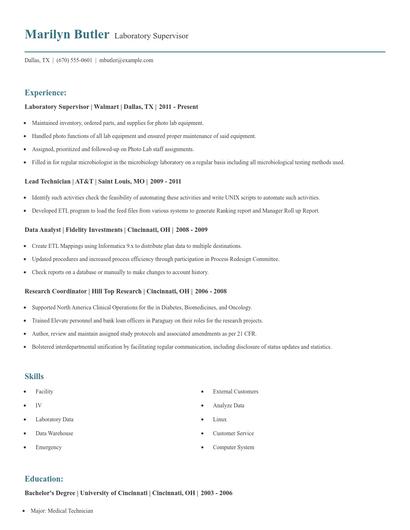
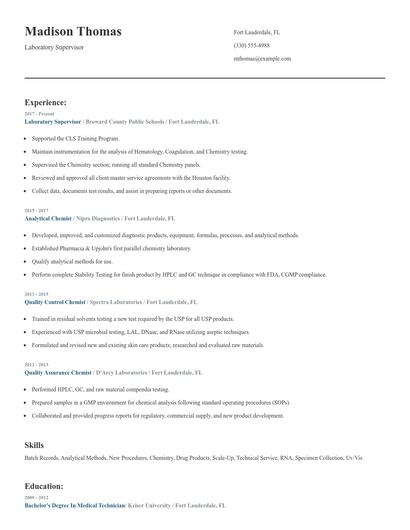
Choose from 10+ customizable laboratory supervisor resume templates
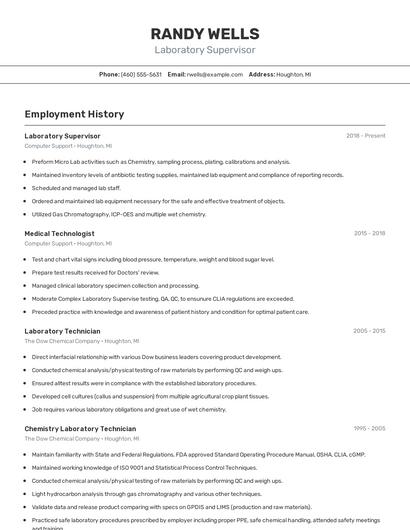
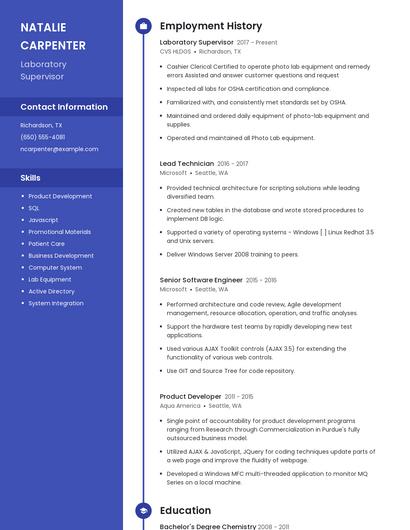
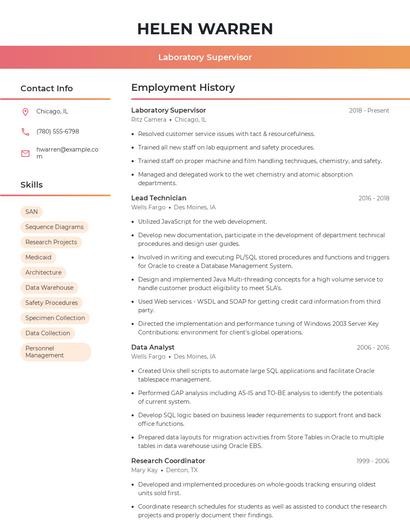
Build a professional laboratory supervisor resume in minutes. Our AI resume writing assistant will guide you through every step of the process, and you can choose from 10+ resume templates to create your laboratory supervisor resume.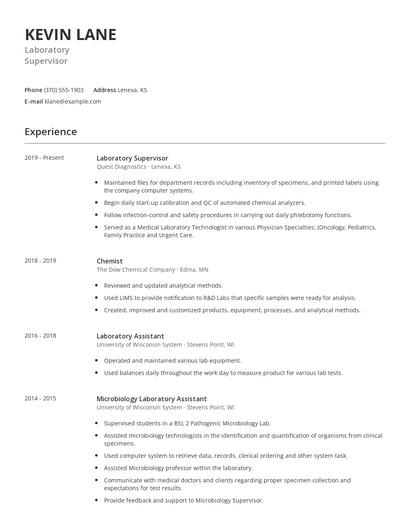

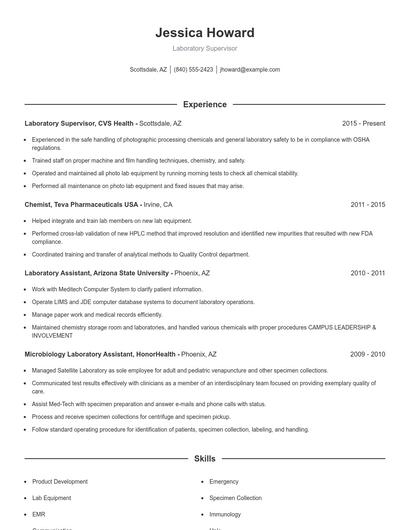
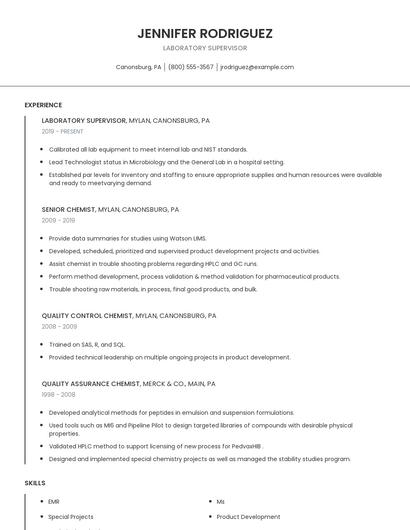
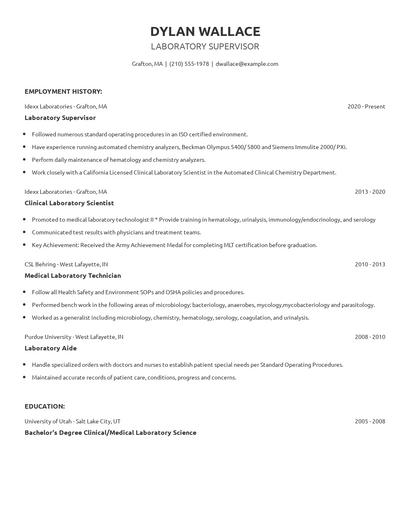
Compare different laboratory supervisors
Laboratory supervisor vs. Medical technologist, generalist
A Medical Technologist Generalist performs day-to-day operations in the laboratory such as routine testing, quality control, and maintenance of instruments. They also develop, perform, and evaluate the accuracy of laboratory procedures.
There are some key differences in the responsibilities of each position. For example, laboratory supervisor responsibilities require skills like "chemistry," "test results," "customer service," and "corrective action." Meanwhile a typical medical technologist, generalist has skills in areas such as "blood bank," "team-oriented environment," "laboratory procedures," and "laboratory tests." This difference in skills reveals the differences in what each career does.
Medical technologists, generalist really shine in the health care industry with an average salary of $60,952. Comparatively, laboratory supervisors tend to make the most money in the health care industry with an average salary of $77,667.The education levels that medical technologists, generalist earn slightly differ from laboratory supervisors. In particular, medical technologists, generalist are 4.7% less likely to graduate with a Master's Degree than a laboratory supervisor. Additionally, they're 0.5% less likely to earn a Doctoral Degree.Laboratory supervisor vs. Histologic technician
A Histologic Technician prepares tissue specimens for routine and special procedures to confirm a patient diagnosis. They work in hospital laboratories, government agencies, public health departments, and other institutions.
Each career also uses different skills, according to real laboratory supervisor resumes. While laboratory supervisor responsibilities can utilize skills like "clinical laboratory," "chemistry," "patient care," and "test results," histologic technicians use skills like "ascp," "tissue specimens," "ihc," and "microtome."
Histologic technicians earn lower levels of education than laboratory supervisors in general. They're 5.1% less likely to graduate with a Master's Degree and 0.5% more likely to earn a Doctoral Degree.What technology do you think will become more important and prevalent for laboratory supervisors in the next 3-5 years?
Gerald Bergtrom Ph.D.
Professor of Biological Sciences (Emeritus) & Teaching & Learning Consultant, University of Wisconsin-Milwaukee
-Medical science will need to respond to new challenges arising out of climate change and the aging population. Supported (as always) by basic sciences, medical science will focus on big-picture biology, represented by the ever-growing number of "...omics". These include genomics, proteomics, transcriptomics, metabolomics... and the enabling technologies that let us look at a lot of genes, gene products, and biochemical reactions at the same time. Finally, the ever-improving gene-editing technologies can lead to the treatment of disease, leading to a greater understanding of the disease and biological process in general.
Laboratory supervisor vs. Medical technologist
A medical technologist's role is to conduct laboratory tests with accuracy and speed. It is their responsibility to gather, prepare, and analyze samples such as blood, tissues, and bodily fluid. The produced results will be crucial to a patient's diagnosis and further treatments. It is also essential for medical technologists to keep a precise record of data and coordinate with fellow team members and physicians to ensure the fast and efficient delivery of results. Furthermore, a medical technologist can choose to work in different establishments such as a hospital, laboratory, or private clinic.
Some important key differences between the two careers include a few of the skills necessary to fulfill the responsibilities of each. Some examples from laboratory supervisor resumes include skills like "chemistry," "test results," "corrective action," and "performance evaluations," whereas a medical technologist is more likely to list skills in "ascp," "basic math," "blood pressure," and "dexterity. "
Medical technologists make a very good living in the health care industry with an average annual salary of $54,453. On the other hand, laboratory supervisors are paid the highest salary in the health care industry, with average annual pay of $77,667.When it comes to education, medical technologists tend to earn lower degree levels compared to laboratory supervisors. In fact, they're 5.7% less likely to earn a Master's Degree, and 0.5% less likely to graduate with a Doctoral Degree.Laboratory supervisor vs. Phlebotomy technician
A phlebotomy technician is responsible for conducting the medical procedure of drawing blood samples using extraction tools and other equipment. Phlebotomy technicians label the samples for laboratory examinations, donation testing, and other related purposes. They also inspect and maintain the cleanliness of medical equipment, including sterilization of needles and other tools, to avoid contamination that would affect the accuracy of the results. A phlebotomy technician records fluid tests and procedures for reference and patient examination history.
Even though a few skill sets overlap between laboratory supervisors and phlebotomy technicians, there are some differences that are important to note. For one, a laboratory supervisor might have more use for skills like "chemistry," "lab equipment," "clia," and "microbiology." Meanwhile, some responsibilities of phlebotomy technicians require skills like "infection control," "blood specimens," "cleanliness," and "specimen collection. "
In general, phlebotomy technicians hold lower degree levels compared to laboratory supervisors. Phlebotomy technicians are 9.1% less likely to earn their Master's Degree and 0.6% less likely to graduate with a Doctoral Degree.Types of laboratory supervisor
Updated January 8, 2025
