
Automatically apply for jobs with Zippia
Upload your resume to get started.
Loan review analyst skills for your resume and career
15 loan review analyst skills for your resume and career
1. Financial Statements
A financial statement is a report of an individual or a company that includes all the information about the declared assets, the use of money, income, and also the contribution of shareholders over a certain period.
- Reviewed financial statements of commercial loan customers, prepared reports summarizing findings, and communicated with lenders.
- Analyze and interpret financial statements to determine the operating performances of affordable housing properties and small businesses.
2. Loan Documentation
- Examine residential loan documentation for accuracy, completeness, and compliance with appropriate company and secondary market investor standards.
- Reviewed individual commercial loans and commercial portfolios to determine asset quality and loan documentation on 30 reviews.
3. Real Estate
Real estate is land that has buildings on it. This kind of property consists of permanent improvements either natural or man-made, which include, houses, fences, bridges, water trees, and minerals. There are 4 types of real estate namely; residential real estate, commercial real estate, industrial real estate, and vacant land.
- Reviewed real estate collateral requirements and appraisals which encompassed consumer and residential loan portfolio underwriting.
- Compiled all necessary collateral documents and real estate appraisals.
4. Loan Portfolio
- Performed review of commercial loan portfolio for credit quality, accuracy of documentation and regulation compliance.
- Examine, audit, and analyze eleven separately chartered financial institutions and their loan portfolios.
5. Investor Guidelines
An investor guideline refers to general standards, strategies, and parameters relating to investments; the set guidelines get altered from time-to-time.
- Review performing and non-performing mortgage notes to determine origination and servicing compliance with investor guidelines throughout the servicing period.
- Reviewed loans delivered by correspondent lenders to insure investor guidelines were met.
6. Audit Findings
- Research data as required and report audit findings and recommendations to underwriting.
- Communicated audit findings to Underwriting team and made suggestions on how to improve quality.
Choose from 10+ customizable loan review analyst resume templates
Build a professional loan review analyst resume in minutes. Our AI resume writing assistant will guide you through every step of the process, and you can choose from 10+ resume templates to create your loan review analyst resume.7. Loan Review
- Provided Senior management with detailed loan review reports on loans evaluated.
- Developed work-flow procedures and file organization systems for Loan Reviewers.
8. IRB
An institutional review board (IRB), is a form of committee that applies research ethics by vetting research procedures to ensure they are ethical. In order to decide whether or not research can be undertaken, they often perform a kind of risk-benefit analysis. The IRB's function is to ensure that adequate safeguards are in place to protect the interests and health of humans who are participants of a research sample.
- Assisted with protocol and regulatory document submissions into IRB electronic database.
- Facilitated, coordinated, and attended IRB meetings, including detailing of minutes, correspondence, and committee proposals and decisions.
9. Credit Quality
- Provide management with accurate and timely information related to credit quality.
- Audit loans within the In-line scope to ensure loans are aligned with Credit Quality Control (CQC) measures.
10. Medicaid
- Interacted closely with the surveillance utilization and review team to audit medical record documentation in accordance with Medicaid regulations and guidelines.
- Adjudicated inpatient Medicaid claims, ensured Medicaid provider compliance through on site audits, and participated in administrative appeals process.
11. Credit Analysis
Credit analysis is the process of evaluating a person's or company's ability to repay their debts.
- Evaluated new loan applications to ensure proper completion and submission of required financial information to facilitate financial credit analysis.
- Managed risk rating integrity, administrative monitoring, policy compliance, underwriting and credit analysis.
12. Credit Risk
Credit risk entails the risk experienced by a lender from the possibility of losing money due to a borrower failing to repay or meet their obligations set out in a loan contract. Credit risk manifests in many forms including loans (the most popular), letters of credit, foreign exchange and lines of credit.
- Provide credit risk analysis and recommendation for repurchase.
- Assessed the credit risk of each commercial loan relationship utilizing CBI risk-rating criteria, public credit rating and industry comparative data.
13. Federal Regulations
Federal regulations refer to the set of rules, both general and permanent that are published in the Federal Register by the agencies of the federal government and the executive departments. Federal regulations are the large body of rules that govern federal practice. Examples of these laws include taxes and financial regulation, discrimination law, wages law, and so on.
- Review residential mortgage loan documents to ensure data accuracy and compliance with all Federal regulations and company policies.
- Apply all internal underwriting guidelines, secondary market requirements, and federal regulations to the decision process to ensure loan quality.
14. Due Diligence
Due diligence refers to the process of auditing, investigating, or reviewing done to confirm the authenticity of relevant facts. In addition to this, it also refers to the evaluation of a party's financial records to determine whether one should enter into a transaction with the said party or not.
- Perform due diligence and secondary market underwriting.
- Conduct Due Diligence, Pre-Funding and Post-Closing Quality Control Reviews on mortgage files with emphasis on accuracy and adherence to guidelines.
15. Commercial Loans
- Provide coaching and training to employees as needed to help them understand bank policy and regulatory requirements for commercial loans.
- Funded and boarded commercial loans on all products as Loan Support Specialist, adhering to bank policies and procedures.
5 Loan Review Analyst resume examples
Build a professional loan review analyst resume in minutes. Browse through our resume examples to identify the best way to word your resume. Then choose from 5+ resume templates to create your loan review analyst resume.

What skills help Loan Review Analysts find jobs?
Tell us what job you are looking for, we’ll show you what skills employers want.
What type of skills will young loan review analysts need?
Janet Ruiz
Director – Strategic Communication, Insurance Information Institute
List of loan review analyst skills to add to your resume
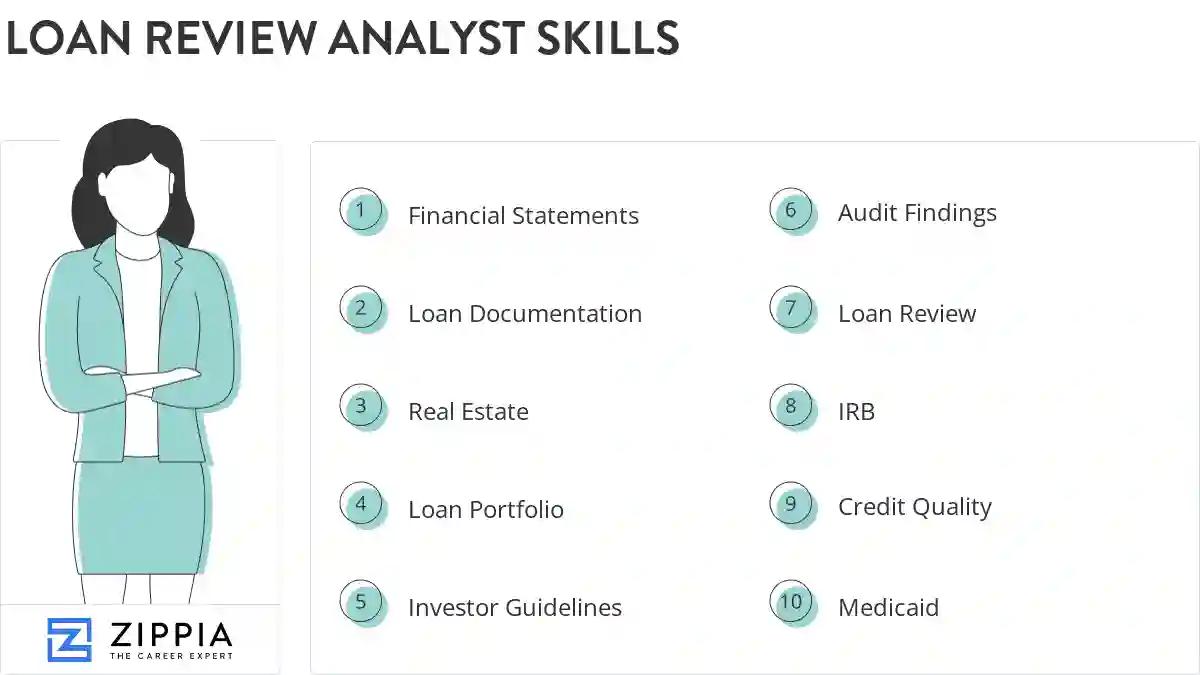
The most important skills for a loan review analyst resume and required skills for a loan review analyst to have include:
- Financial Statements
- Loan Documentation
- Real Estate
- Loan Portfolio
- Investor Guidelines
- Audit Findings
- Loan Review
- IRB
- Credit Quality
- Medicaid
- Credit Analysis
- Credit Risk
- Federal Regulations
- Due Diligence
- Commercial Loans
- Federal Laws
- Cash Flow
- Business Administration
- Bank Policies
- Return Analysis
- Tax Returns
- Appraisal Reports
- Foreclosure
- FHA
- Credit Reports
- CPT
- HUD-1
- Automated Underwriting
- Fannie MAE
- Medical Claims
- USPAP
- GSE
- FNMA
- Red Flags
- Cash Flow Analysis
- Title Commitments
- Freddie Mac
- FHLMC
- Underwriting Guidelines
- CMS
- Employment Documentation
- Annuities
- In-Depth Research
- RESPA
- Loan Packages
- QA
- PLS
- OCC
- SME
- ICD-9
Updated January 8, 2025
