What does a logistics operator do?
A logistics operator is primarily in charge of spearheading and supervising the transportation and distribution of supplies, ensuring efficient supply chain operations. It is their duty to verify purchase orders and deliveries, review documentation, oversee the packaging processes, liaise with internal and external parties, and address issues and concerns, resolving them promptly and efficiently. Furthermore, a logistics operator must maintain an active communication line with different teams, coordinating them while implementing the company's policies and regulations.
Logistics operator responsibilities
Here are examples of responsibilities from real logistics operator resumes:
- Participate in warehouse operations including product selection, labeling, moving and securing pallets, wrapping and staging for proper shipment.
- Comply with all safety, HAZMAT regulations and company policies.
- Exercise a FIFO base inventory system for project raw materials.
- Participate on the ISO 9001 team to prepare for ISO certification.
- Operate PC, RF and other computer accessories require for material handling and transfer.
- Use RF scanner to obtain bi-weekly inventory counts, and recounts to maintain systematic and physical warehouse inventory.
- Operate heavy equipment (load, pan, and backhoe) effectively reducing injury, property damage or loss.
- Used a bobcat to push magnesium scrap into a trailer to be ship off to be melt back down into bars.
- Attend CPR classes and obtain certification
- Operate heavy machinery such as bobcat equipment and also operate and pave asphalt perform demolition work.
- Perform specialized production line and quality control duties in a professional production environment specializing in plastic extrusion.
- Perform many functions on the quality data base and ERP software as well.
- Blend, lift raw materials, finish products, and pack items, manually or used hoists.
- Verify tank farm line ups.
- Assist in machine start ups and shutdowns.
Logistics operator skills and personality traits
We calculated that 13% of Logistics Operators are proficient in Pallets, Basic Math, and Pallet Jack. They’re also known for soft skills such as Alertness, Communication skills, and Coordination.
We break down the percentage of Logistics Operators that have these skills listed on their resume here:
- Pallets, 13%
Place product on pallets and make sure they have the right Coke products that the stores need to fill their orders.
- Basic Math, 10%
Apply basic mathematical concepts such as adding, subtracting, multiplying, dividing and knowledge of weights and measures.
- Pallet Jack, 10%
Experienced in diverse machining operations as well as hand cart, pallet jack, forklift use.
- Warehouse Operations, 7%
Warehouse operations included assembling, packing, storing, issuing, receiving, checking, delivery, and staging of materials.
- Dynamic Environment, 7%
Perform miscellaneous activities as directed to support the efficient operation of a warehouse in a dynamic environment.
- Customer Orders, 6%
Assemble materials for customer orders, receiving new and returned product, and maintaining safety and quality standards within the warehouse.
Common skills that a logistics operator uses to do their job include "pallets," "basic math," and "pallet jack." You can find details on the most important logistics operator responsibilities below.
Communication skills. Another essential skill to perform logistics operator duties is communication skills. Logistics operators responsibilities require that "material moving machine operators signal and direct workers to load and unload material." Logistics operators also use communication skills in their role according to a real resume snippet: "excel in communication with foreign and domestic customers, data entry, and fast paced work environment. "
Coordination. logistics operators are also known for coordination, which are critical to their duties. You can see how this skill relates to logistics operator responsibilities, because "material moving machine operators must have steady hands and feet to guide and control heavy machinery precisely." A logistics operator resume example shows how coordination is used in the workplace: "meet productivity goals & quality standards- communicate in english, both verbal and written- good hand-eye coordination- attention to detail"
Mechanical skills. A big part of what logistics operators do relies on "mechanical skills." You can see how essential it is to logistics operator responsibilities because "material moving machine operators make minor adjustments to their machines and perform basic maintenance on them." Here's an example of how this skill is used from a resume that represents typical logistics operator tasks: "operate forklift loading and unloading trucks and kilns* feed dried lumber to grading crew* light mechanical and preventive maintenance"
Visual ability. Another crucial skill for a logistics operator to carry out their responsibilities is "visual ability." A big part of what logistics operators relies on this skill, since "material moving machine operators must be able to see clearly where they are driving or what they are moving." How this skill relates to logistics operator duties can be seen in an example from a logistics operator resume snippet: "conduct visual product quality inspections. "
The three companies that hire the most logistics operators are:
- SAMSUNG SDS15 logistics operators jobs
- Applied Materials9 logistics operators jobs
- Lockheed Martin8 logistics operators jobs
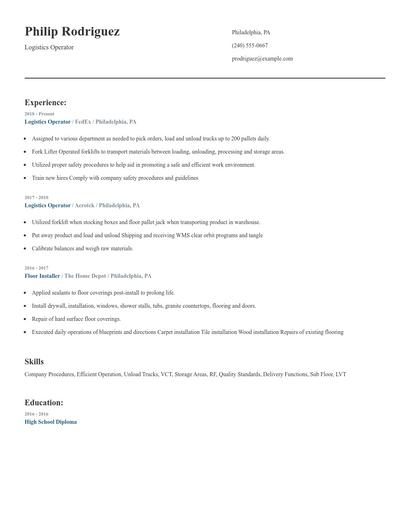
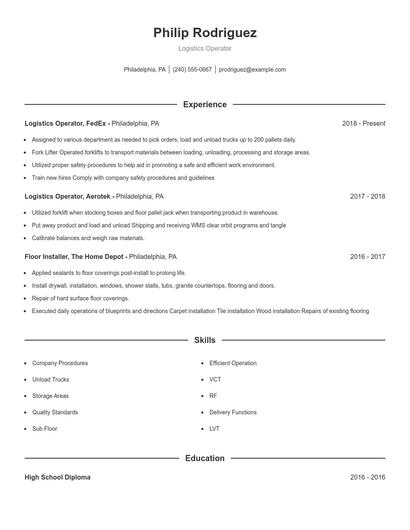
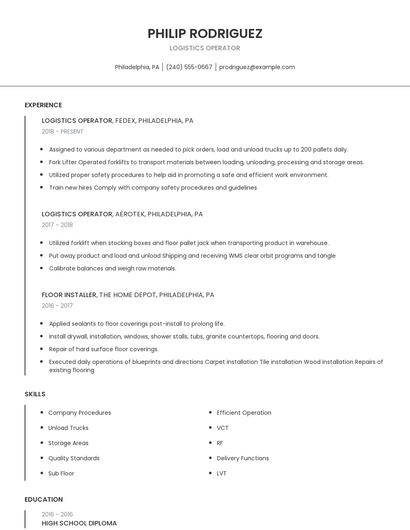
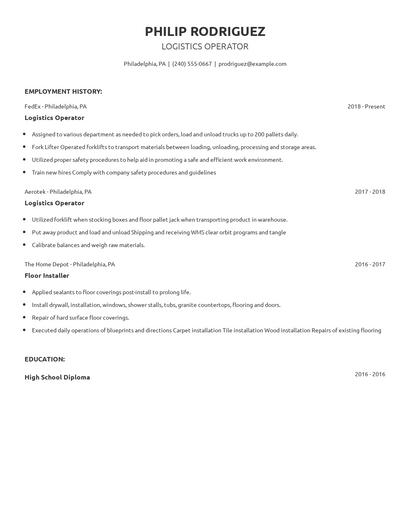
Choose from 10+ customizable logistics operator resume templates
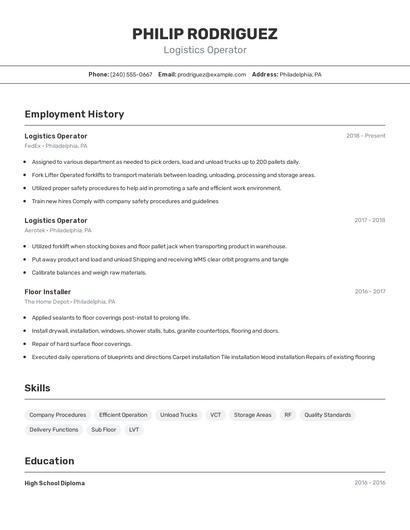
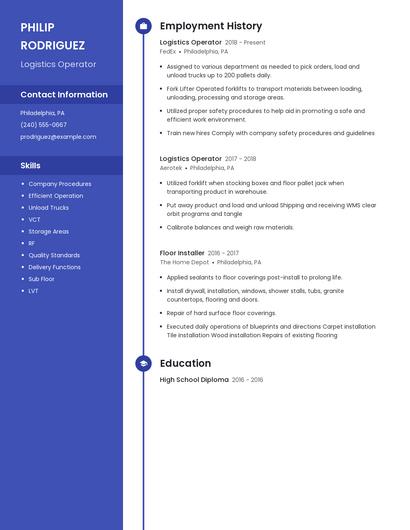
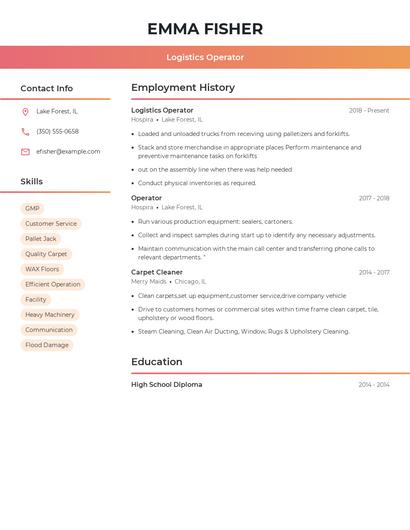
Build a professional logistics operator resume in minutes. Our AI resume writing assistant will guide you through every step of the process, and you can choose from 10+ resume templates to create your logistics operator resume.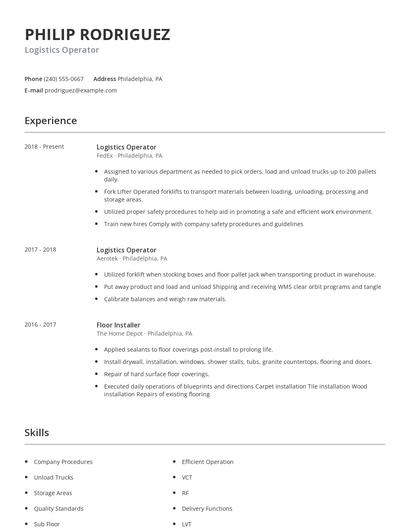
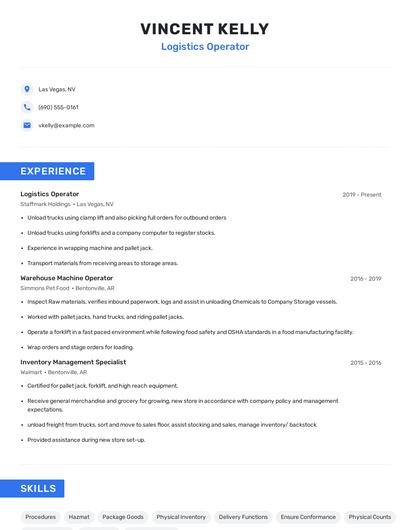
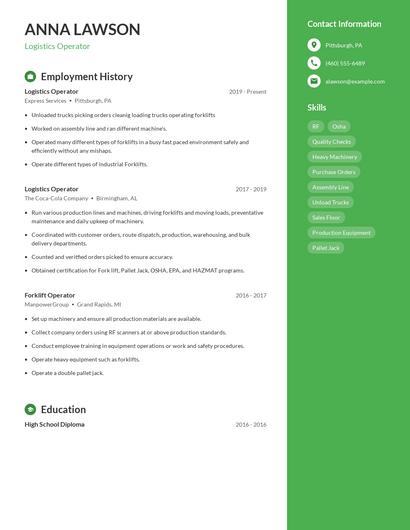
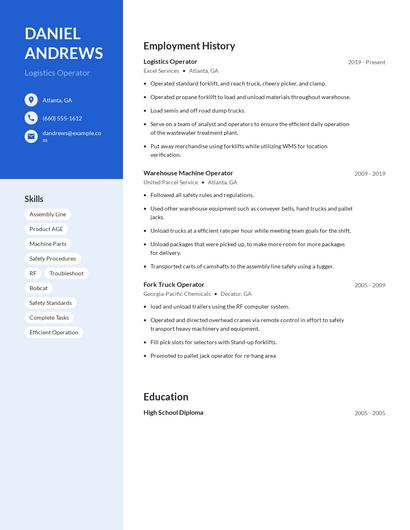
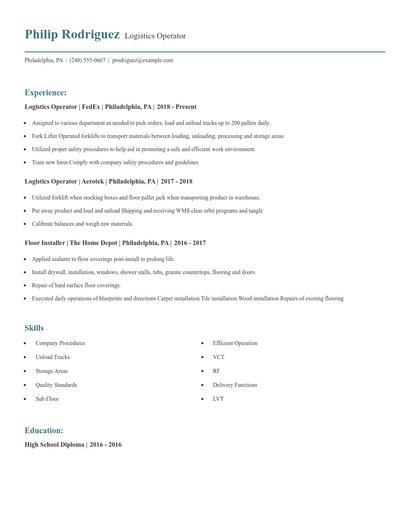
Compare different logistics operators
Logistics operator vs. Machine operator/forklift operator
A machine operator/forklift operator is responsible for operating industrial trucks to move merchandise around the warehouse facilities and other assigned areas. Machine operators/forklift operators also assist with inventory tasks by scanning orders and ensuring the correct merchandise for shipment. They manage the stability of the vehicles, ensuring its efficiency and optimization during operations, performing engine repairs for any inconsistencies to avoid delays on deliveries. A machine operator/forklift operator should strictly follow the safety protocols of the business, as well as have knowledge of the mechanical industry.
While similarities exist, there are also some differences between logistics operators and machine operator/forklift operator. For instance, logistics operator responsibilities require skills such as "pallets," "basic math," "pallet jack," and "warehouse operations." Whereas a machine operator/forklift operator is skilled in "drive forklift," "machine operation," "cnc," and "electric pallet jack." This is part of what separates the two careers.
Machine operator/forklift operators earn the highest salaries when working in the automotive industry, with an average yearly salary of $36,711. On the other hand, logistics operators are paid more in the manufacturing industry with an average salary of $39,534.On average, machine operator/forklift operators reach similar levels of education than logistics operators. Machine operator/forklift operators are 3.9% less likely to earn a Master's Degree and 0.1% more likely to graduate with a Doctoral Degree.Logistics operator vs. Transportation coordinator
A transportation coordinator is responsible for monitoring the timely deliveries of goods and services based on the shipment agreement. Transportation coordinators track the delivery logistics, assigning fast routes to drivers to avoid possible delays, and adhere to the deadline. They assist in loading and unloading merchandise from the distribution trucks, inspecting the items for defects and inconsistencies, and move the products in safe storage areas. A transportation coordinator may also operate warehouse tools and equipment, as well as perform data processing to update stock information on the software system and investigate delivery issues.
In addition to the difference in salary, there are some other key differences worth noting. For example, logistics operator responsibilities are more likely to require skills like "pallets," "basic math," "pallet jack," and "warehouse operations." Meanwhile, a transportation coordinator has duties that require skills in areas such as "customer service," "patients," "safety rules," and "medical appointments." These differences highlight just how different the day-to-day in each role looks.
Transportation coordinators may earn a lower salary than logistics operators, but transportation coordinators earn the most pay in the government industry with an average salary of $46,415. On the other hand, logistics operators receive higher pay in the manufacturing industry, where they earn an average salary of $39,534.In general, transportation coordinators achieve similar levels of education than logistics operators. They're 1.1% more likely to obtain a Master's Degree while being 0.1% more likely to earn a Doctoral Degree.Logistics operator vs. Material handler/forklift operator
A material handler and forklift operator is responsible for transporting and storing various kinds of goods, even including fragile or hazardous shipments. The duties and location will vary depending on the line of work or industry involved. However, most of the tasks will require efficiency in operating machinery, communication skills, and great attention to detail. Furthermore, a material handler and forklift operator must monitor products and keep an accurate record of overall activities, transport materials within allotted time and schedule, and maintain communication and coordination with co-workers and supervisors.
There are many key differences between these two careers, including some of the skills required to perform responsibilities within each role. For example, a logistics operator is likely to be skilled in "basic math," "pallet jack," "warehouse operations," and "dynamic environment," while a typical material handler/forklift operator is skilled in "safety procedures," "electric pallet jack," "forklift operation," and "rf scanner."
Material handler/forklift operators earn the highest salary when working in the automotive industry, where they receive an average salary of $37,909. Comparatively, logistics operators have the highest earning potential in the manufacturing industry, with an average salary of $39,534.material handler/forklift operators typically earn similar educational levels compared to logistics operators. Specifically, they're 3.9% less likely to graduate with a Master's Degree, and 0.1% less likely to earn a Doctoral Degree.Logistics operator vs. Mechanical spreader operator
A mechanical spreader operators manage and operate all equipment in various industries where they perform their jobs. The operators work as general mechanics in building HVAC, general building maintenance, and pump station operations. They test electro-mechanical subsystems for operational reliability and circuit integrity. Their job includes promoting quality assurance and performance improvement programs within the organization. Also, they perform an energy audit to improve the efficiency of HVAC energy.
Types of logistics operator
Updated January 8, 2025
