
Automatically apply for jobs with Zippia
Upload your resume to get started.
Market research manager skills for your resume and career
15 market research manager skills for your resume and career
1. PowerPoint
- Analyzed nuclear and diagnostic imaging secondary data and published written and PowerPoint reports.
- Designed PowerPoint dashboards/report templates for data entry.
2. SPSS
- Assisted in analyzing and interpreting quantitative and qualitative data using SPSS.
- Maintained, updated and scrutinized all databases developed in surveys, including MS Access, SPSS and Excel.
3. Data Analysis
- Utilized data analysis proprietary databases to quantify, and define consumer behavior to determine advertising strategies.
- Derived response curve of search marketplace revenue and advertisers budget based on data analysis and simulation.
4. Data Collection
Data collection means to analyze and collect all the necessary information. It helps in carrying out research and in storing important and necessary information. The most important goal of data collection is to gather the information that is rich and accurate for statistical analysis.
- Introduced online data collection for custom research and conducted online survey programming and data collection services for small-scale internal projects.
- Engaged in primary research, including survey design and execution, data collection and statistical analysis.
5. Healthcare
Healthcare is the maintenance or improvement of a person's health by the diagnosis and treatment of a person's injury, illness, or any other disease. Healthcare is a basic necessity of human life and is the responsibility of the country's government to ensure that each person gets healthcare. Providing healthcare is the job of certified health professionals that includes doctors, surgeons, nurses, and other physicians. Pharmaceutical companies, hospitals, dentistry, therapy, and health training all come under healthcare. Healthcare plays a vital role in the country's economy and its development.
- Conducted interviews with technology leaders, financial heads and other managers of major healthcare organizations regarding administrative and information technology issues.
- Worked closely with various healthcare organizations to develop marketing and strategic business plans.
6. Research Design
Research design is the process of tackling research-based questions through relevant strategies and data analytics. A full-fledged plan is created to carry out the research in any field, including business, law, medical, marketing, etc. The researcher will use his/her own methodology and tactics to approach the research and interpret the data associated with it.
- Developed research design, managed tactical execution and reconciled budget trade-offs within and across research projects.
- Consulted with business owners to understand research needs and recommend research design and methodology.
Choose from 10+ customizable market research manager resume templates
Build a professional market research manager resume in minutes. Our AI resume writing assistant will guide you through every step of the process, and you can choose from 10+ resume templates to create your market research manager resume.7. Market Research
Market research is a collective effort to collect information related to a consumer's needs and wants. It is a systematic approach that involves recording and analysis of both qualitative and quantitative data. Market research helps a business to identify a target market correctly and identify the gaps in potential consumer's expectations.
- Lead all primary and secondary market research activities to support a $3B global cellular phone business featuring proprietary push-to-talk technology.
- Managed all financial products market research providing value added analysis and interpretations for concept tests, customer satisfaction and loyalty measurement.
8. Project Management
- Provided full project management to address market research issues, including study design, implementation, analysis and presentation of results/recommendations.
- Project Management: Spearheaded the requirements gathering, installation, integration, and customization of the opportunity pipeline management tool.
9. Qualitative Research
- Conducted qualitative research to understand priorities from C-Level executives on Media Delivery and Digital Advertising.
- Moderated and facilitated qualitative research projects.
10. Visualization
- Conceived and implemented data visualization.
- Developed some of the first data visualization reports at the College using Tableau.
11. Research Findings
- Synthesized and present primary and secondary research findings to educate various teams throughout the organization on relevant industry and consumer trends.
- Developed sales and marketing materials from research findings and competitive analysis.
12. Consumer Insights
- Developed, planned and executed qualitative and quantitative research projects, delivering crucial consumer insights, competitive intelligence and performance indicators.
- Utilized proprietary database systems that provided consumer insights for brand and category management.
13. Customer Satisfaction
- Participated in internal/ external customer satisfaction monitoring process, including survey design, administration, report preparation and presentation of results.
- Directed CRM strategy project, dramatically increasing customer satisfaction, and developing better communication channels.
14. Research Vendors
- Managed relationships with outside research vendors, attended quarterly market briefings, and advised the executive board on market.
- Managed relationships with research vendors regarding prices and logistics of custom projects as well as selecting new vendors.
15. Business Development
Business development is the ideas or initiatives that work to make business work better. Selling, advertising, product development, supply chain management, and vendor management are only a few of the divisions involved with it. There is still a lot of networking, negotiating, forming alliances, and trying to save money. The goals set for business development guide and coordinate with all of these various operations and sectors.
- Apprised product and business development of industry forecasts and trending data along with aggregated reports on competitors' financial performance.
- Managed & provided market research, business & competitive intelligence to the Business Development Division.
5 Market Research Manager resume examples
Build a professional market research manager resume in minutes. Browse through our resume examples to identify the best way to word your resume. Then choose from 5+ resume templates to create your market research manager resume.

What skills help Market Research Managers find jobs?
Tell us what job you are looking for, we’ll show you what skills employers want.
What skills stand out on market research manager resumes?
Dr. Charlotte Kunkel
Professor of Sociology, Luther College
What market research manager skills would you recommend for someone trying to advance their career?
Cheryl Dorsey
Lecturer, Benjamin Franklin Institute of Technology
What type of skills will young market research managers need?
Matthew Fisher SFSU, Hult, SMC
Business Instructor, San Francisco State University
What soft skills should all market research managers possess?
Dr. Anne Paulet Ph.D.
Professor, History Department, Humboldt State University
List of market research manager skills to add to your resume
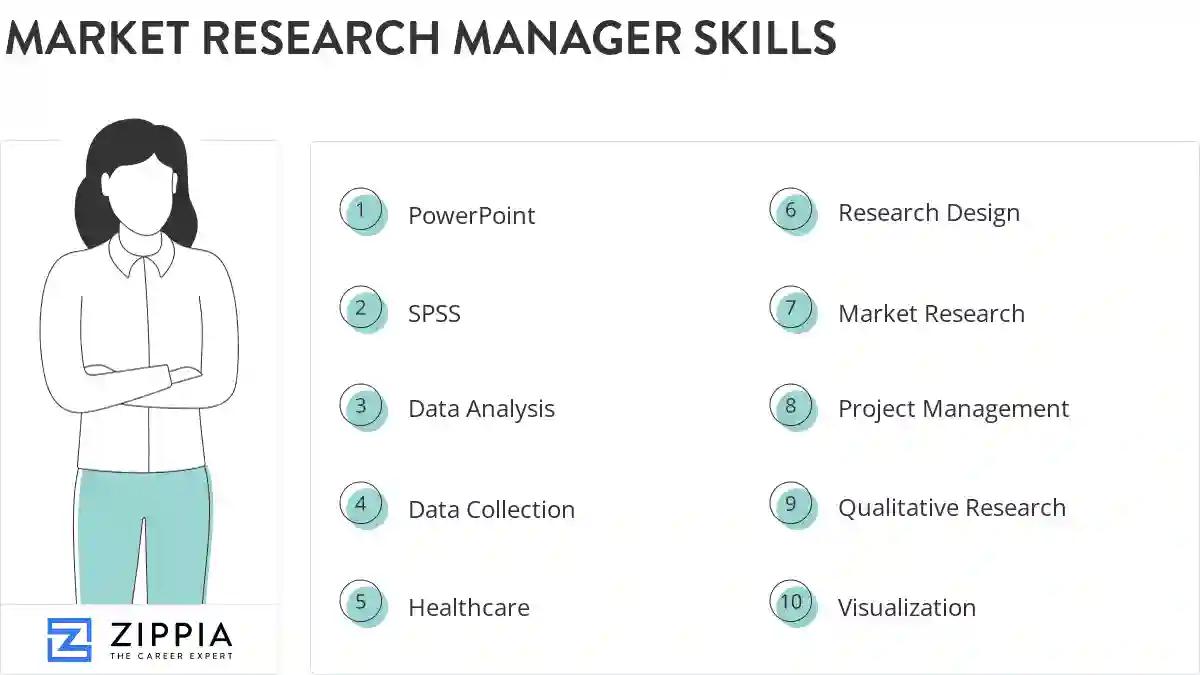
The most important skills for a market research manager resume and required skills for a market research manager to have include:
- PowerPoint
- SPSS
- Data Analysis
- Data Collection
- Healthcare
- Research Design
- Market Research
- Project Management
- Qualitative Research
- Visualization
- Research Findings
- Consumer Insights
- Customer Satisfaction
- Research Vendors
- Business Development
- Competitive Intelligence
- Research Data
- Statistical Analysis
- Product Development
- Research Results
- Digital Marketing
- Strategic Direction
- Client Facing
- Market Research Studies
- Research Methodology
- Market Trends
- Internal Clients
- Primary Market Research
- Pharmaceutical Industry
- Market Intelligence
- Nielsen
- Strategic Recommendations
- Client Satisfaction
- CRM
- Regression
- Competitive Analysis
- Macro
- R
- Consumer Research
- External Clients
- Market Data
- Survey Design
- ROI
- Market Analysis
- Research Plans
- Research Objectives
- Research Budget
- Develop Insights
Updated January 8, 2025
