What does a master data analyst do?
A master data analyst is responsible for maintaining the safety and security of the organization's network database, ensuring the correct data integration and processing, and monitoring the feasibility of data requirements. Master data analysts work closely with the technology department to perform data quality control procedures, resolve data management issues, and upgrade system features to prevent unauthorized access and malicious activities. A master data analyst must have excellent knowledge of the technology industry, as well as a strong command on the programming languages and system codes to manage data management complexities and improve business operational functions.
Master data analyst responsibilities
Here are examples of responsibilities from real master data analyst resumes:
- Manage SharePoint document repository for project implementation.
- Manage customer relationship by providing internal support; communicate ERP standards and infrastructure by answering questions; resolving concerns and issues.
- Document all issues within the Microsoft CRM and Salesforce management systems.
- Ensure data accuracy and standardization when researching and loading product and order information into Lawson ERP materials management system.
- Train in SAS reporting using the GUI and CMD interfaces.
- Involve in migrating the back-end services written in Java to SOA services.
- Create and customize UNIX shell scripts for automating regular maintenance and batch jobs.
- Review CDM for delete CPT codes and make the appropriate updates for proper billing.
- Utilize CRM for tracking customer status from date of initial information to activation of account.
- Experience in Unix shell scripting as part of file manipulation, scheduling and text processing.
- Used SAS to join, convert and reformat complex data files and generate statistical reports.
- Act as primary writer of Winshuttle scripts for BOM creation/maintenance, mass changes/uploads and other requirements.
- Perform requirements gathering, analysis, implementation, testing and deployment of ETL processes and scripts.
- Support multiple real time data feeds and troubleshoot issues as they arise using ETL with VB.net.
- Develop Java application to calculate cost per flight hour of a few operators for testing purposes.
Master data analyst skills and personality traits
We calculated that 11% of Master Data Analysts are proficient in Data Quality, Customer Service, and Data Governance. They’re also known for soft skills such as Creativity, Analytical skills, and Communication skills.
We break down the percentage of Master Data Analysts that have these skills listed on their resume here:
- Data Quality, 11%
Resolve data quality issues including inaccurate, incomplete, missing or invalid data, outdated information and inconsistent data across systems.
- Customer Service, 9%
Ensured all data-entry was accurate and provided customer service.
- Data Governance, 8%
Created job descriptions, organizational structure, policies and procedures in conjunction with Corporate Master Data Governance and audit regulations.
- Data Analysis, 7%
Business-oriented data analyst offering professional expertise in providing solutions for data analysis, coding, and variable information controls.
- Data Integrity, 5%
Provided technical support for order administration and finance by identifying and resolving data integrity, business process issues.
- ERP, 5%
Managed customer relationship by providing internal support; communicated ERP standards and infrastructure by answering questions; resolving concerns and issues.
"data quality," "customer service," and "data governance" are among the most common skills that master data analysts use at work. You can find even more master data analyst responsibilities below, including:
Creativity. One of the key soft skills for a master data analyst to have is creativity. You can see how this relates to what master data analysts do because "because analysts are tasked with finding innovative solutions to computer problems, an ability to “think outside the box” is important." Additionally, a master data analyst resume shows how master data analysts use creativity: "maintain integrity of corporate master inventory files and convert legacy inventory data for new erp system as needed. "
Analytical skills. Another essential skill to perform master data analyst duties is analytical skills. Master data analysts responsibilities require that "analysts must interpret complex information from various sources and decide the best way to move forward on a project." Master data analysts also use analytical skills in their role according to a real resume snippet: "ensured data accuracy and standardization when researching and loading product and order information into lawson erp materials management system. "
Communication skills. This is an important skill for master data analysts to perform their duties. For an example of how master data analyst responsibilities depend on this skill, consider that "analysts work as a go-between with management and the it department and must explain complex issues in a way that both will understand." This excerpt from a resume also shows how vital it is to everyday roles and responsibilities of a master data analyst: "transitioned the department internal web site and users to a new sharepoint 2007 site for enhanced communication and collaboration. ".
The three companies that hire the most master data analysts are:
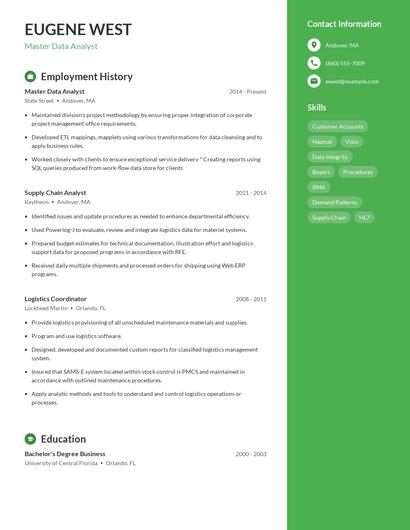
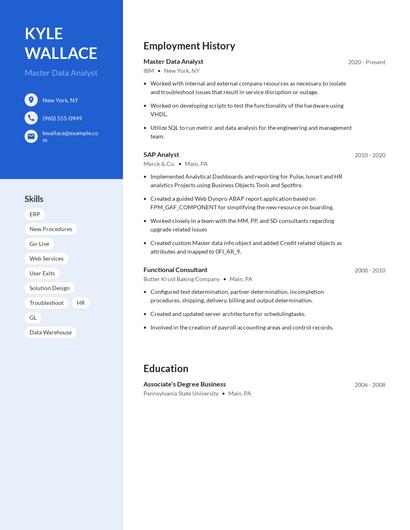
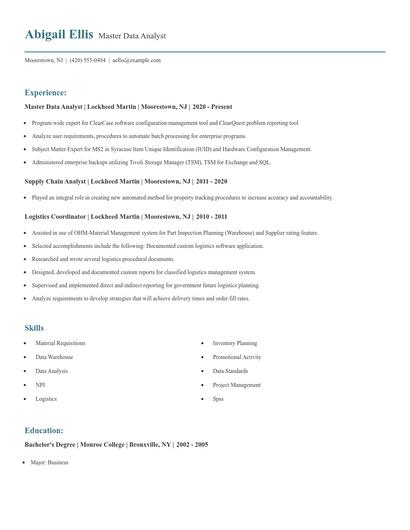
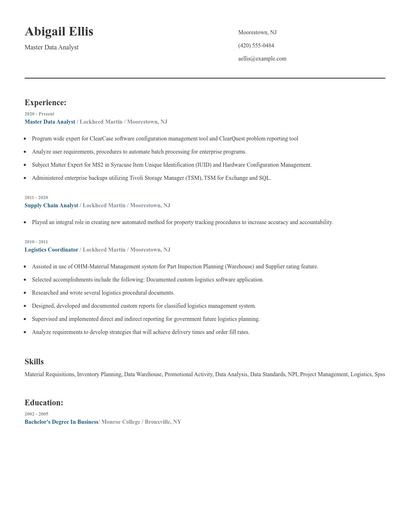
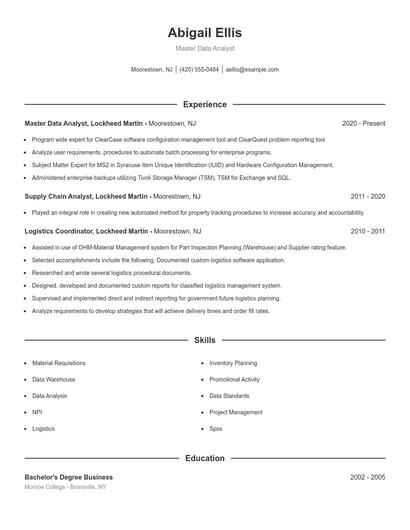
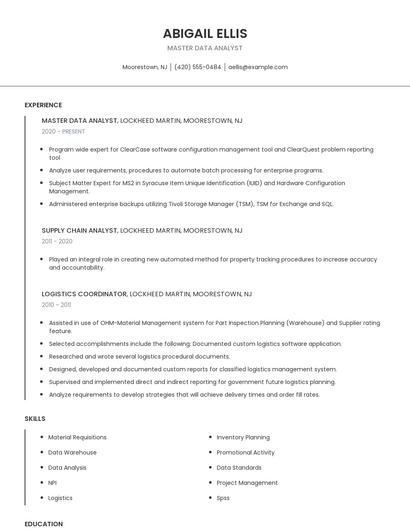
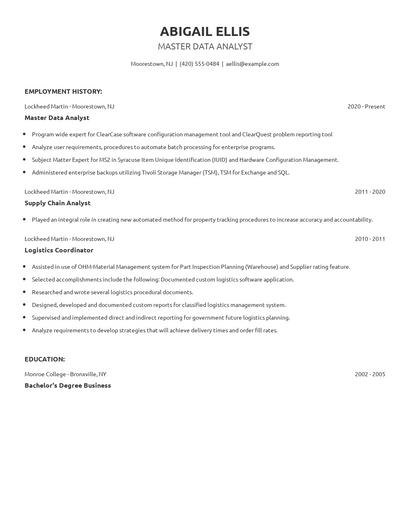
Choose from 10+ customizable master data analyst resume templates
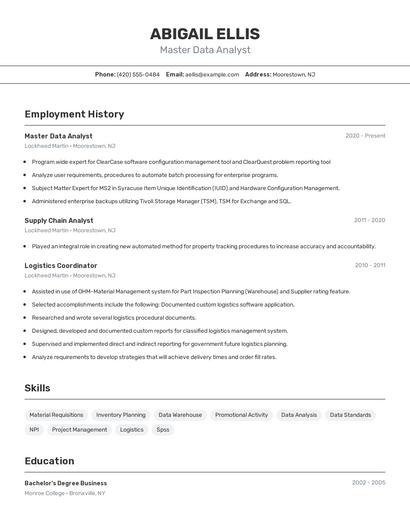
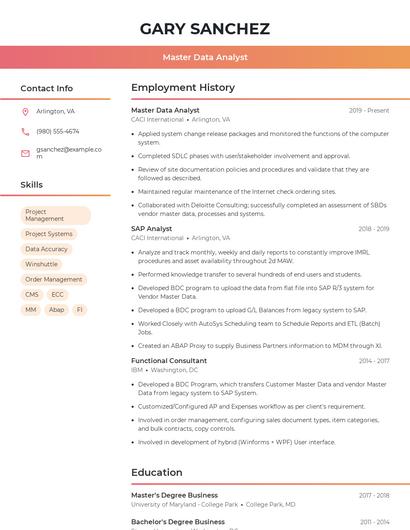
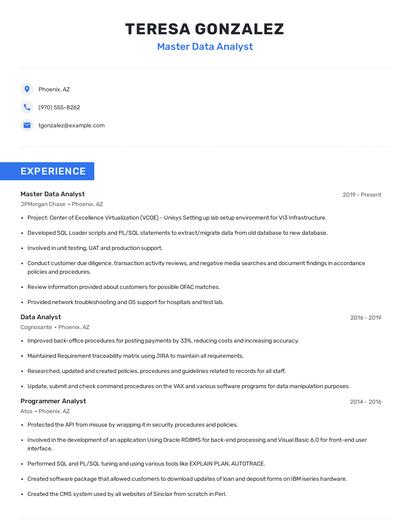
Build a professional master data analyst resume in minutes. Our AI resume writing assistant will guide you through every step of the process, and you can choose from 10+ resume templates to create your master data analyst resume.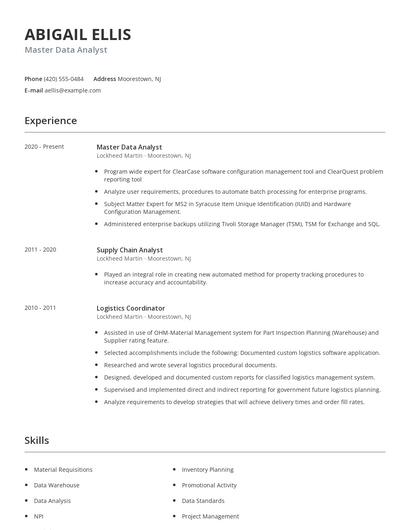

Compare different master data analysts
Master data analyst vs. Analyst lead
The duties of an analyst lead depend on one's line of work or industry of employment. Typically, their responsibilities revolve around performing research and analysis, coordinating with different departments to gather leads and data, reviewing findings, and producing reports and presentations for the stakeholders and other higher-ranking officials. Through the results, an analyst lead can provide advice, devise strategies for business optimization, spearhead the development of processes, identify strengths and weaknesses, and offer recommendations on areas in need of improvement. All of this is done while in adherence to the company's vision and mission.
There are some key differences in the responsibilities of each position. For example, master data analyst responsibilities require skills like "data quality," "data governance," "data integrity," and "erp." Meanwhile a typical analyst lead has skills in areas such as "analytics," "project management," "excellent interpersonal," and "java." This difference in skills reveals the differences in what each career does.
Analyst leads really shine in the finance industry with an average salary of $110,488. Comparatively, master data analysts tend to make the most money in the technology industry with an average salary of $91,962.The education levels that analyst leads earn slightly differ from master data analysts. In particular, analyst leads are 4.3% more likely to graduate with a Master's Degree than a master data analyst. Additionally, they're 1.1% more likely to earn a Doctoral Degree.Master data analyst vs. Programmer/analyst lead
A document analyst is responsible for sorting and storing company documents safely and securely. Document analysts work closely with the marketing and public relations team to manage promotional materials and advertisements for editing and proofreading before publishing on various market platforms. They also review company requirements and regulations and ensure that all documents adhere to the guidelines and conditions for public use. A document analyst must have excellent organizational and communication skills, especially on data management processes, such as updating documents, creating backups, and disposing of files accordingly.
While some skills are similar in these professions, other skills aren't so similar. For example, resumes show us that master data analyst responsibilities requires skills like "data quality," "customer service," "data governance," and "data integrity." But a programmer/analyst lead might use other skills in their typical duties, such as, "c++," "c #," "java," and "project management."
Programmer/analyst leads may earn a higher salary than master data analysts, but programmer/analyst leads earn the most pay in the retail industry with an average salary of $110,090. On the other hand, master data analysts receive higher pay in the technology industry, where they earn an average salary of $91,962.programmer/analyst leads earn similar levels of education than master data analysts in general. They're 1.1% less likely to graduate with a Master's Degree and 1.1% more likely to earn a Doctoral Degree.What technology do you think will become more important and prevalent for master data analysts in the next 3-5 years?
Pavel Chernyavskiy Ph.D.
Assistant Professor of Statistics, University of Wyoming
Master data analyst vs. Document analyst
A clinical analyst is responsible for monitoring the efficiency of the hospital's computer systems, resolving network issues, and conducting configuration to improve infrastructure. Clinical analysts manage data management procedures, ensuring the safety and security of the systems across the institution to protect the network from unauthorized access and confidentiality risks. They also evaluate clinical data, facilitate the staff on systems navigation, and identify computer systems that require upgrades. A clinical analyst must have excellent communication and technical skills, recommending process improvement workflows and maximizing smooth navigation of data technologies.
There are many key differences between these two careers, including some of the skills required to perform responsibilities within each role. For example, a master data analyst is likely to be skilled in "data quality," "data governance," "data integrity," and "erp," while a typical document analyst is skilled in "powerpoint," "windows," "technical documentation," and "real estate."
Document analysts make a very good living in the finance industry with an average annual salary of $48,019. On the other hand, master data analysts are paid the highest salary in the technology industry, with average annual pay of $91,962.Most document analysts achieve a lower degree level compared to master data analysts. For example, they're 6.5% less likely to graduate with a Master's Degree, and 4.6% less likely to earn a Doctoral Degree.Master data analyst vs. Clinical analyst
Even though a few skill sets overlap between master data analysts and clinical analysts, there are some differences that are important to note. For one, a master data analyst might have more use for skills like "data quality," "customer service," "data governance," and "data integrity." Meanwhile, some responsibilities of clinical analysts require skills like "healthcare," "patient care," "patients," and "ehr. "
In general, clinical analysts earn the most working in the health care industry, with an average salary of $80,200. The highest-paying industry for a master data analyst is the technology industry.The average resume of clinical analysts showed that they earn similar levels of education compared to master data analysts. So much so that theyacirc;euro;trade;re 1.2% more likely to earn a Master's Degree and more likely to earn a Doctoral Degree by 2.5%.Types of master data analyst
Updated January 8, 2025
