
Automatically apply for jobs with Zippia
Upload your resume to get started.
Medical technologist-microbiology skills for your resume and career
15 medical technologist-microbiology skills for your resume and career
1. ASCP
- Utilized online continuing educational programs provided by ASCP and CAP
- Experienced and ASCP certified Medical Technologist with a specialization in Molecular Diagnostics and a thorough working knowledge of CLIA Laboratory practices.
2. Clinical Laboratory
- Perform routine clinical laboratory tests in Microbiology Prepare Microbiological growth media and other laboratory solutions to support microbiology laboratory testing.
- Educated, managed, and evaluated Clinical Laboratory Science students in their Microbiology rotation.
3. Test Results
- Communicated test results and other pertinent information to authorized personnel.
- Identified and addressed problems adversely affecting test results.
4. Medical Technology
Medical technology refers to the advancements made in the medical world. These include developing new, improved medical equipment, valuable findings in a disease's research, production of drugs to deal with conditions, formulating solutions for health problems, and more. Advances in medical research and technology can have the following long-term benefits: healthcare becomes more accessible, successful cures to previously incurable diseases, new medical equipment is available, and more straightforward solutions than complicated operations. The medical technology in a hospital determines how well it tackles any health issue and the quality of service it provides.
- Assisted instruction of medical students, medical technology students and residents.
- Trained Medical Technology students, interns, pathology residents and technicians.
5. Specimen Handling
- Acted in compliance with laboratory procedures for specimen handling and processing.
- Conducted specimen handling, processing, and test analysis.
6. Chemistry
Chemistry is the branch of science that tells us about the composition, properties, and structure of elements and compounds. The processes these elements undergo and how they undergo change all come under the branch of chemistry.
- Cross trained and qualified to work in chemistry, hematology and urinalysis laboratories.
- Perform patient testing and troubleshooting on Chemistry analyzers.
Choose from 10+ customizable medical technologist-microbiology resume templates
Build a professional medical technologist-microbiology resume in minutes. Our AI resume writing assistant will guide you through every step of the process, and you can choose from 10+ resume templates to create your medical technologist-microbiology resume.7. CLIA
- Followed CLIA, HIPPA, OSHA, and safety protocols as described in their respective guidelines.
- Delivered completed CAP surveys with 100% efficiency; participated in JHACO and CLIA inspections.
8. Laboratory Tests
- Perform complex laboratory tests written below and procedure according to laboratory policies.
- Answered phone inquiries related to tests, samples, and laboratory tests.
9. Proficiency Testing
- Participated in proficiency testing and trained local college students in microbiology.
- Conduct successful proficiency testing on external/internal specimens.
10. Laboratory Procedures
- Participated in the College of American Pathologists surveys to ensure proficiency of laboratory procedures.
- Instructed medical laboratory students and other medical personnel in laboratory procedures.
11. Hematology
Hematology is the name of that branch of medicine that deals with all the matters pertaining to blood. The branch also deals with the treatment of blood-related diseases, predicting the outcome of developing diseases, the prevention of all such diseases, and their treatment.
- Weekend Generalist Technologist in Chemistry and Hematology/Coagulation/Urinalysis Departments of the Laboratory.
- Managed Hematology Laboratory Department Inventory.
12. Customer Service
Customer service is the process of offering assistance to all the current and potential customers -- answering questions, fixing problems, and providing excellent service. The main goal of customer service is to build a strong relationship with the customers so that they keep coming back for more business.
- Perform basic internal and external customer service duties by answering questions regarding various testing procedures and policies.
- Accepted supervisory responsibility which included decision making and maintaining open lines of communication with doctors, nurses, and customer service.
13. QC
Quality control is a set of instructions or procedures to ensure a manufactured product or a service is up to the highest quality standards. This set of quality control criteria are either defined by the clients or the company itself.
- Perform ID and Susceptibility testing on cultures Perform QC and maintenance as needed.
- Performed and documented daily, weekly, and monthly QC.
14. Microbiology Lab
- Lead technologist in the selection and implementation of new identification and susceptibility system for Microbiology laboratory, the BD Phoenix system.
- Performed routine clinical lab bench work in all areas of Microbiology laboratory, including Virology, Mycology and Microbial Immunology.
15. Test Performance
- Identified problems that may adversely affect test performance or reporting.
5 Medical Technologist-Microbiology resume examples
Build a professional medical technologist-microbiology resume in minutes. Browse through our resume examples to identify the best way to word your resume. Then choose from 5+ resume templates to create your medical technologist-microbiology resume.

What skills help Medical Technologist-Microbiologies find jobs?
Tell us what job you are looking for, we’ll show you what skills employers want.
What skills stand out on medical technologist-microbiology resumes?
Jennifer Larimore Ph.D.
Associate Professor, Agnes Scott College
What soft skills should all medical technologist-microbiologys possess?
Jennifer Larimore Ph.D.
Associate Professor, Agnes Scott College
What hard/technical skills are most important for medical technologist-microbiologys?
Jennifer Larimore Ph.D.
Associate Professor, Agnes Scott College
What medical technologist-microbiology skills would you recommend for someone trying to advance their career?
Ethan Kentzel MS, MLS ASCPcm
Program Director, Medical Laboratory Science and Phlebotomy Programs, Bloomsburg University of Pennsylvania
What type of skills will young medical technologist-microbiologys need?
Chery Whipple Ph.D.
Assistant Professor of Biology, Colby-Sawyer College
List of medical technologist-microbiology skills to add to your resume
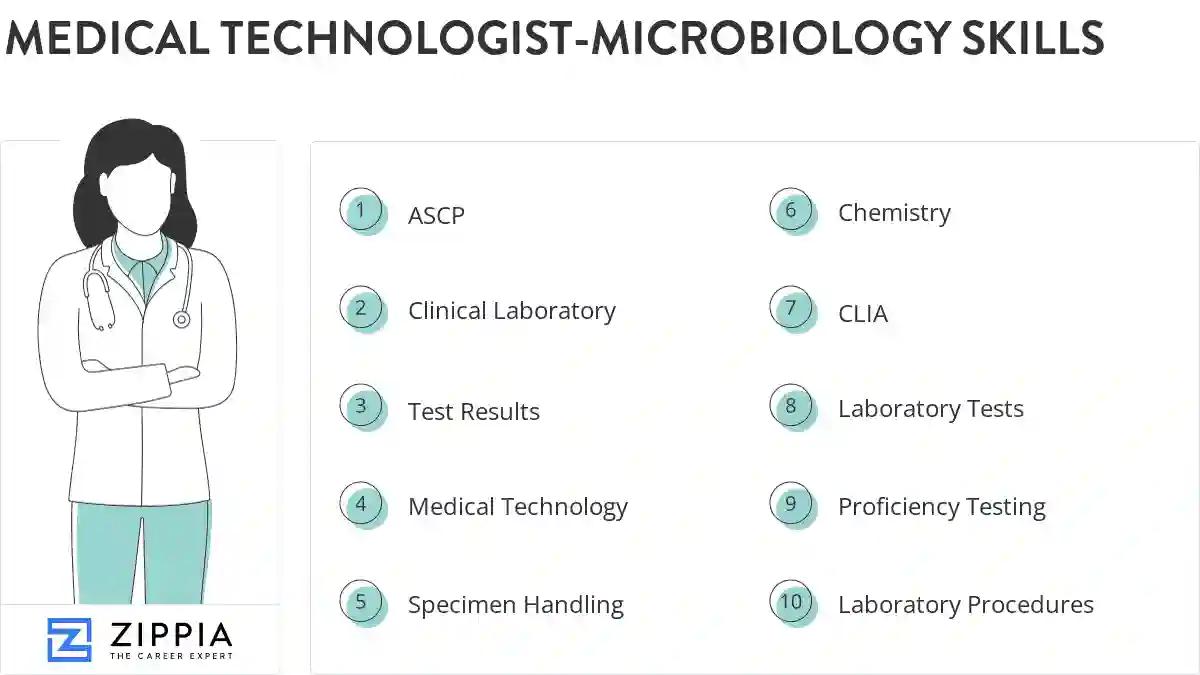
The most important skills for a medical technologist-microbiology resume and required skills for a medical technologist-microbiology to have include:
- ASCP
- Clinical Laboratory
- Test Results
- Medical Technology
- Specimen Handling
- Chemistry
- CLIA
- Laboratory Tests
- Proficiency Testing
- Laboratory Procedures
- Hematology
- Customer Service
- QC
- Microbiology Lab
- Test Performance
- Patient Specimens
- Infection Control
- Immunology
- OSHA
- Body Fluids
- Equipment Maintenance
- Stat
- Patient Samples
- Gram Stains
- Serology
- Bacteriology
- Clinical Microbiology
- Virology
- Mycology
- Critical Values
- QA
- Laboratory Policies
- Patient Results
- PCR
- Maldi-Tof
- Quality Control Procedures
- MALDI
- Parasitology
- Vitek
- Critical Results
- Pathogens
- HIPAA
- Microorganisms
- Blood Cultures
- Clinical Specimens
- Sops
- Standard Operating Procedure
Updated January 8, 2025
